Chapterبەش 6 · Lectureوانە 6.4
The Symbol Dictionaryفەرهەنگی هێماکان
Every symbol of the course in one place: nineteen families, from letters and Greek to computing, each with the symbol, how to say it in English and Kurdish, its meaning, its LaTeX and the section that teaches it; the symbols with several meanings; how to look up a symbol you do not know; practice; and the end of the course.
هەموو خوولەکە لە یەک شوێندا: نۆزدە خێزان، لە پیت و یۆنانییەوە تا ، هەریەکەیان لەگەڵ ، خوێندنەوەی بە ئینگلیزی و کوردی، واتاکەی، و ئەو بەشەی فێری دەکات؛ ئەو چەند واتایان هەیە؛ چۆن بدۆزیتەوە کە نایناسیت؛ ڕاهێنان؛ و کۆتایی خوولەکە.
What you will learnچی فێر دەبیت
- Find any symbol of the course by its family or its shape, and read its row: reading, meaning, LaTeX and lesson.
- Say the common symbols aloud in English and in Kurdish.
- Recognise symbols with several meanings and choose the meaning from the subject.
- Look up an unknown symbol by context, book, shape, Unicode name or topic.
- هەر خوولەکە بە خێزانەکەی یان بە شێوەکەی بدۆزیتەوە و ڕیزەکەی بخوێنیتەوە: خوێندنەوە، واتا، و وانە.
- باوەکان بە ئینگلیزی و بە کوردی بە دەنگی بەرز بڵێیت.
- ئەو چەند واتایان هەیە بناسیتەوە و واتاکە لە بابەتەکەوە هەڵبژێریت.
- نەناسراو بە دەوروبەر، کتێب، شێوە، ناوی یان بابەت بدۆزیتەوە.
How to use this dictionaryچۆن ئەم فەرهەنگە بەکار بهێنیت
This last lesson collects every symbol of the course, one family per screen, in the order of the course. Each row gives the symbol, how to say it (in Kurdish mode the Kurdish reading comes first, with the English one in brackets), what it means, how to type it in LaTeX, and the section that teaches it, sometimes with the topic lesson that uses it. The poster shows all nineteen families at once, so you can find a symbol by its shape.
ئەم دوایین وانەیە هەموو خوولەکە کۆ دەکاتەوە، هەر خێزانێک لە شاشەیەکدا، بە ڕیزبەندیی خوولەکە. هەر ڕیزێک ، چۆنیەتیی خوێندنەوەی (خوێندنەوەی کوردی یەکەم دێت و ئینگلیزییەکە لە ناو کەوانەدا)، واتاکەی، نووسینی بە و ئەو بەشەی فێری دەکات دەدات، هەندێک جار لەگەڵ ئەو وانەیەی بابەتەکە کە بەکاری دەهێنێت. پۆستەرەکە هەر نۆزدە خێزانەکە پێکەوە پیشان دەدات، بۆیە دەتوانیت بە شێوەکەی بدۆزیتەوە.
The Kurdish readings are the ones the lessons use. Kurdish classrooms do not all read symbols the same way yet, so where another reading is common it follows هەروەها. Readings matter less than meanings: if your teacher says it another way, the symbol still means the same.
خوێندنەوە کوردییەکان ئەوانەن کە وانەکان بەکاریان دەهێنن. هێشتا هەموو پۆلە کوردییەکان بە یەک شێوە ناخوێننەوە، بۆیە لە شوێنێک خوێندنەوەیەکی تریش باو بێت، لە دوای «هەروەها» دێت. خوێندنەوە لە واتا کەمتر گرنگە: ئەگەر مامۆستای پۆلەکەت بە شێوەیەکی تر بیڵێت، هەر هەمان واتای هەیە.
1. Letters, marks and small words1. پیت، نیشانە و وشە بچووکەکان
The symbols of Letters and Greek. Find the shape in the tile, then read its row in the table; orange shapes have more than one meaning.
وانەی پیت و ئەلفوبێی یۆنانی. شێوەکە لە وێنەکەدا بدۆزەوە، پاشان ڕیزەکەی لە خشتەکەدا بخوێنەوە؛ شێوە پرتەقاڵییەکان زیاتر لە یەک واتایان هەیە.
| Symbol | Say itخوێندنەوە (کوردی) | Meaningواتا | Type it (LaTeX)نووسین (LaTeX) | Learn it inفێری ببە لە |
|---|---|---|---|---|
| x sub one; x one«x ژێر 1» (x sub one; x one)؛ هەروەها: «x یەک» | a subscript: which one; a label, not a power: کامیان؛ ناونیشانە، نەک | x_1 | Letters and Greekپیت و ئەلفوبێی یۆنانی | |
| X sub i«X ژێر i» (X sub i) | any one of the values هەر یەکێک لە نرخەکانی | X_i | Letters and Greek · statisticsپیت و ئەلفوبێی یۆنانی · ئامار | |
| x super i, in brackets«x، i لە ناو کەوانەدا» (x super i, in brackets) | a raised label, not a power: the i-th example وەک ناونیشان، نەک : نموونەی iـەم | x^{(i)} | Letters and Greekپیت و ئەلفوبێی یۆنانی | |
| f prime«f پرایم» (f prime) | prime: a derivative, a complement, NOT, or the next valueپرایم: ، ، NOT یان نرخی دواتر | f' | Letters and Greekپیت و ئەلفوبێی یۆنانی | |
| x bar«ئێکس بار» (x bar) | bar: a mean, NOT, repeating digits or a conjugateبار: ، NOT، دووپاتەبووە یان | \bar{x} | Letters and Greekپیت و ئەلفوبێی یۆنانی | |
| p hat«p هات» (p hat) | hat: an estimate from a sample, or a unit vectorهات: خەمڵاندنێک لە ، یان | \hat{p} | Letters and Greekپیت و ئەلفوبێی یۆنانی | |
| x star«x ئەستێرە» (x star) | star: the best value, or a conjugateئەستێرە: باشترین نرخ، یان | x^{*} | Letters and Greekپیت و ئەلفوبێی یۆنانی | |
| x tildeتیلدا: x tilde | tilde: a changed or approximate xتیلدا: xـێکی دەستکاریکراو یان نزیکەیی | \tilde{x} | Letters and Greekپیت و ئەلفوبێی یۆنانی | |
| x dotخاڵ: x dot | dot: how fast x changes in time (physics)خاڵ: x چەند خێرا لەگەڵ کاتدا دەگۆڕێت (فیزیا) | \dot{x} | Letters and Greekپیت و ئەلفوبێی یۆنانی | |
| e, i, pi«e، i، پی» (e, i, pi) | fixed constants: 2.718…, the imaginary unit, 3.14159… جێگیر: 2.718…، ، 3.14159… | e,\ i,\ \pi | Letters and Greekپیت و ئەلفوبێی یۆنانی | |
| capital X, small x«Xـی گەورە، xـی بچووک» (capital X, small x) | two different symbols: a random variable and its valueدوو جیاواز: و نرخەکەی | X,\ x | Letters and Greekپیت و ئەلفوبێی یۆنانی | |
| the sine of x; sine x« x» (the sine of x; sine x) | upright letters: the name of a function; slanted letters are variablesپیتی ڕاست: ناوی ؛ پیتی | \sin x | Reading a formulaخوێندنەوەی فۆرمولە | |
| let · where | let, where«با، کە» (let, where) | words that give a letter its job, before or after a formulaوشەگەلێک کە لە پێش یان دوای کار دەدەنە پیتێک | — | Reading a formulaخوێندنەوەی فۆرمولە |
2. The Greek alphabet2. ئەلفوبێی یۆنانی
The symbols of Letters and Greek. Find the shape in the tile, then read its row in the table; orange shapes have more than one meaning.
وانەی پیت و ئەلفوبێی یۆنانی. شێوەکە لە وێنەکەدا بدۆزەوە، پاشان ڕیزەکەی لە خشتەکەدا بخوێنەوە؛ شێوە پرتەقاڵییەکان زیاتر لە یەک واتایان هەیە.
| Letterپیت | Nameناو | Usual jobsکاری باو | Type it (LaTeX)نووسین (LaTeX) | Learn it inفێری ببە لە |
|---|---|---|---|---|
| alpha«ئەلفا» (alpha) | angles; the bounds of alpha-beta pruning; the error level of a test؛ سنوورەکانی ؛ ڕەتکردنەوەی هەڵە لە تاقیکردنەوەدا | \alpha | Letters and Greekپیت و ئەلفوبێی یۆنانی | |
| beta«بێتا» (beta) | angles | \beta | Letters and Greekپیت و ئەلفوبێی یۆنانی | |
| gamma«گامما» (gamma) | rarely met in CêITلە CêITـدا کەم دەبینرێت | \Gamma \gamma | Letters and Greekپیت و ئەلفوبێی یۆنانی | |
| delta«دێلتا» (delta) | : a change, ; : a small change: گۆڕان، ؛ : گۆڕانێکی بچووک | \Delta \delta | Letters and Greekپیت و ئەلفوبێی یۆنانی | |
| epsilon«ئێپسیلۆن» (epsilon) | a very small amount (not )بڕێکی زۆر بچووک ( نییە) | \varepsilon | Letters and Greekپیت و ئەلفوبێی یۆنانی | |
| zeta«زێتا» (zeta) | rarely met in CêITلە CêITـدا کەم دەبینرێت | \zeta | Letters and Greekپیت و ئەلفوبێی یۆنانی | |
| eta«ئیتا» (eta) | rarely met in CêITلە CêITـدا کەم دەبینرێت | \eta | Letters and Greekپیت و ئەلفوبێی یۆنانی | |
| theta«تێتا» (theta)؛ هەروەها: «سیتا» | an angle | \theta | Letters and Greekپیت و ئەلفوبێی یۆنانی | |
| iota«ئیۆتا» (iota) | rarely met in CêITلە CêITـدا کەم دەبینرێت | \iota | Letters and Greekپیت و ئەلفوبێی یۆنانی | |
| kappa«کەپا» (kappa) | rarely met in CêITلە CêITـدا کەم دەبینرێت | \kappa | Letters and Greekپیت و ئەلفوبێی یۆنانی | |
| lambda«لامدا» (lambda) | a rate; a wavelengthڕێژە؛ | \lambda | Letters and Greekپیت و ئەلفوبێی یۆنانی | |
| mu«میو» (mu)؛ هەروەها: «موو» | the mean of a population; micro, ؛ مایکرۆ، | \mu | Letters and Greekپیت و ئەلفوبێی یۆنانی | |
| nu«نوو» (nu) | not the letter vپیتی v نییە | \nu | Letters and Greekپیت و ئەلفوبێی یۆنانی | |
| xi«کسی» (xi) | rarely met in CêITلە CêITـدا کەم دەبینرێت | \xi | Letters and Greekپیت و ئەلفوبێی یۆنانی | |
| omicron«ئۆمیکرۆن» (omicron) | looks like the letter oوەک پیتی o دیارە | o | Letters and Greekپیت و ئەلفوبێی یۆنانی | |
| pi«پی» (pi)؛ هەروەها: «پای» | ; a product; projection (databases)؛ ؛ () | \Pi \pi | Letters and Greekپیت و ئەلفوبێی یۆنانی | |
| rho«ڕۆ» (rho) | a population correlation; a density (not p)پەیوەستیی ؛ چڕی (p نییە) | \rho | Letters and Greekپیت و ئەلفوبێی یۆنانی | |
| sigma«سیگما» (sigma) | a sum; standard deviation; selection (databases) کۆ؛ ؛ () | \Sigma \sigma | Letters and Greekپیت و ئەلفوبێی یۆنانی | |
| tau«تاو» (tau) | rarely met in CêITلە CêITـدا کەم دەبینرێت | \tau | Letters and Greekپیت و ئەلفوبێی یۆنانی | |
| upsilon«ئووپسیلۆن» (upsilon) | rarely met in CêITلە CêITـدا کەم دەبینرێت | \upsilon | Letters and Greekپیت و ئەلفوبێی یۆنانی | |
| phi«فی» (phi) | an angle (not the empty set ) ( نییە) | \varphi | Letters and Greekپیت و ئەلفوبێی یۆنانی | |
| chi«خی» (chi) | the testتاقیکردنەوەی | \chi | Letters and Greekپیت و ئەلفوبێی یۆنانی | |
| psi«پسی» (psi) | rarely met in CêITلە CêITـدا کەم دەبینرێت | \psi | Letters and Greekپیت و ئەلفوبێی یۆنانی | |
| omega«ئۆمێگا» (omega) | : the ohm; the sample space; big-Omega: ؛ ؛ ـی گەورە | \Omega \omega | Letters and Greekپیت و ئەلفوبێی یۆنانی |
3. Numbers and digits3. ژمارە و تاکژمارەکان
The symbols of Numbers and digits. Find the shape in the tile, then read its row in the table; orange shapes have more than one meaning.
وانەی ژمارە و تاکژمارەکان. شێوەکە لە وێنەکەدا بدۆزەوە، پاشان ڕیزەکەی لە خشتەکەدا بخوێنەوە؛ شێوە پرتەقاڵییەکان زیاتر لە یەک واتایان هەیە.
| Symbol | Say itخوێندنەوە (کوردی) | Meaningواتا | Type it (LaTeX)نووسین (LaTeX) | Learn it inفێری ببە لە |
|---|---|---|---|---|
| 0–9 · ٠–٩ | Western and Eastern Arabic numerals«، » (Western and Eastern Arabic numerals) | two sets of digits; formulas and code use 0–9دوو کۆمەڵە ؛ و کۆد 0–9 بەکار دەهێنن | — | Numbers and digitsژمارە و تاکژمارەکان |
| three point two five«سێ فاریزە بیست و پێنج» (three point two five)؛ هەروەها: «سێ فاریزە دوو پێنج» | a decimal point | 3.25 | Numbers and digitsژمارە و تاکژمارەکان | |
| · ٣٫٥ | three point five«سێ فاریزە پێنج» (three point five) | a decimal comma (much of Europe), or the Arabic decimal sign ٫ بە کۆما (زۆربەی ئەورووپا)، یان ٫ـی عەرەبی | — | Numbers and digitsژمارە و تاکژمارەکان |
| one million, two hundred and fifty thousand«یەک ملیۆن و دووسەد و پەنجا هەزار» (one million, two hundred and fifty thousand) | thousands grouped by a space (also , . or ٬): بۆشایی (هەروەها , . یان ٬) | 1\,250\,000 | Numbers and digitsژمارە و تاکژمارەکان | |
| minus five; negative five«سالب پێنج» (minus five; negative five)؛ هەروەها: «کەم پێنج» | a negative number | -5 | Numbers and digitsژمارە و تاکژمارەکان | |
| thirty-eight percent«لە سەدا سی و هەشت» (thirty-eight percent) | out of a hundred: 0.38; ٪ with Eastern digitsلە سەد: 0.38؛ لەگەڵ ٪ | 38\% | Numbers and digitsژمارە و تاکژمارەکان | |
| 5‰ | five per mille«پێنج لە هەزار» (five per mille) | out of a thousand: 0.005لە هەزار: 0.005 | — | Numbers and digitsژمارە و تاکژمارەکان |
| three times ten to the eight«سێ جاران دە بە توانی هەشت» (three times ten to the eight) | scientific notation | 3 \times 10^{8} | Numbers and digitsژمارە و تاکژمارەکان | |
6.02E23 | six point oh two E twenty-three«شەش فاریزە سفر دوو جاران دە بە توانی بیست و سێ» (six point oh two E twenty-three) | E-notation on calculators and in code: (not the number e)نووسینی E لە و کۆددا: ( نییە) | — | Numbers and digitsژمارە و تاکژمارەکان |
| two point three recurring; two point three repeating«دوو فاریزە سێ، سێکە دووپاتە دەبێتەوە» (two point three recurring; two point three repeating) | repeating digits; also , and دووپاتەبووە؛ هەروەها ، و | 2.\overline{3} | Numbers and digitsژمارە و تاکژمارەکان | |
| kilo, mega, giga, tera, milli, micro, nano«کیلۆ، مێگا، گیگا، تێرا، میلی، مایکرۆ، نانۆ» (kilo, mega, giga, tera, milli, micro, nano) | prefixes: powers of ten in units: 10 لە یەکەکاندا | — | Numbers and digitsژمارە و تاکژمارەکان |
4. Arithmetic signs4. نیشانەکانی ژمێرکاری
The symbols of Arithmetic signs. Find the shape in the tile, then read its row in the table; orange shapes have more than one meaning.
وانەی نیشانەکانی ژمێرکاری. شێوەکە لە وێنەکەدا بدۆزەوە، پاشان ڕیزەکەی لە خشتەکەدا بخوێنەوە؛ شێوە پرتەقاڵییەکان زیاتر لە یەک واتایان هەیە.
| Symbol | Say itخوێندنەوە (کوردی) | Meaningواتا | Type it (LaTeX)نووسین (LaTeX) | Learn it inفێری ببە لە |
|---|---|---|---|---|
| a plus b«a کۆ b» (a plus b) | addition; the answer is the sum؛ ئەنجامەکە کۆیە | + | Arithmetic signsنیشانەکانی ژمێرکاری | |
| a minus b«a کەم b» (a minus b)؛ هەروەها: «a b» | subtraction; the difference؛ جیاوازی | - | Arithmetic signsنیشانەکانی ژمێرکاری | |
| a times b«a جاران b» (a times b) | multiplication; the product؛ ئەنجامی | \times | Arithmetic signsنیشانەکانی ژمێرکاری | |
| a times b«a جاران b» (a times b) | times with a dot or with no sign at allجاران بە خاڵ یان بێ هیچ نیشانەیەک () | \cdot | Arithmetic signs · hidden timesنیشانەکانی ژمێرکاری · هێمای شاراوە | |
| a divided by b«a دابەش بەسەر b» (a divided by b)؛ هەروەها: «a دابەش b» | division; the quotient؛ ئەنجامی | \div | Arithmetic signsنیشانەکانی ژمێرکاری | |
| a over b«a لەسەر b» (a over b) | a fraction: numerator over denominator: لەسەر | \frac{a}{b} | Arithmetic signsنیشانەکانی ژمێرکاری | |
| plus or minus«کۆ یان کەم» (plus or minus) | two values, or an allowed errorدوو نرخ، یان هەڵەی ڕێپێدراو | \pm | Arithmetic signsنیشانەکانی ژمێرکاری | |
| minus or plus«کەم یان کۆ» (minus or plus) | the opposite sign of , used together with itنیشانەی پێچەوانەی ، لەگەڵیدا بەکار دێت | \mp | Arithmetic signsنیشانەکانی ژمێرکاری | |
| three to two«3 بۆ 2» (three to two) | a ratio | 3 : 2 | Arithmetic signsنیشانەکانی ژمێرکاری | |
| two and a half«دوو و نیو» (two and a half) | a mixed number: , not : ، نەک | 2\tfrac{1}{2} | Arithmetic signsنیشانەکانی ژمێرکاری | |
| minus x; the opposite of x«کەم x» (minus x; the opposite of x)؛ هەروەها: «پێچەوانەی x» | the opposite of x; it can be positiveپێچەوانەی x؛ دەشێت موجەب بێت | -x | Arithmetic signsنیشانەکانی ژمێرکاری | |
| nineteen twenty by ten eighty«1920 بە 1080» (nineteen twenty by ten eighty) | read “by”: screen sizes and matrix sizes وەک «بە»: قەبارەی شاشە و قەبارەی | \times | Arithmetic signsنیشانەکانی ژمێرکاری |
5. Brackets and the order of operations5. کەوانەکان و پێشینەیی کارپێکەرەکان
The symbols of Order of operations. Find the shape in the tile, then read its row in the table; orange shapes have more than one meaning.
وانەی پێشینەیی کارپێکەرەکان. شێوەکە لە وێنەکەدا بدۆزەوە، پاشان ڕیزەکەی لە خشتەکەدا بخوێنەوە؛ شێوە پرتەقاڵییەکان زیاتر لە یەک واتایان هەیە.
| Symbol | Say itخوێندنەوە (کوردی) | Meaningواتا | Type it (LaTeX)نووسین (LaTeX) | Learn it inفێری ببە لە |
|---|---|---|---|---|
| brackets; parentheses«کەوانە» (brackets; parentheses)؛ هەروەها: «کەوانەی خڕ» | work this out firstیەکەم جار ئەمە ئەنجام بدە | ( ) | Order of operationsپێشینەیی کارپێکەرەکان | |
| square brackets«کەوانەی چوارگۆشە» (square brackets) | outer brackets; also matrices and closed endsکەوانەی دەرەوە؛ هەروەها و لای داخراو | [ ] | Order of operationsپێشینەیی کارپێکەرەکان | |
| braces; curly brackets«کەوانەی لوول» (braces; curly brackets) | outer brackets; also a setکەوانەی دەرەوە؛ هەروەها | \{ \} | Order of operationsپێشینەیی کارپێکەرەکان | |
| eight plus four, over two plus one«8 کۆ 4، لەسەر 2 کۆ 1» (eight plus four, over two plus one) | hidden brackets: the fraction bar and the root sign group what they coverکەوانەی شاراوە: هێڵی و نیشانەی ڕەگ ئەوەی دایدەپۆشن کۆ دەکەنەوە | — | Order of operationsپێشینەیی کارپێکەرەکان | |
| PEMDAS · BODMAS | brackets, powers, times and divide, plus and minus«کەوانە، ، جاران و دابەش، کۆ و کەم» (brackets, powers, times and divide, plus and minus) | the order: brackets, powers, and left to right, and left to rightڕیزبەندی: کەوانە، ، و لە چەپەوە بۆ ڕاست، و لە چەپەوە بۆ ڕاست | — | Order of operationsپێشینەیی کارپێکەرەکان |
| the opposite of three squared«پێچەوانەی دووجای 3» (the opposite of three squared) | : the minus waits for the power; : کەم چاوەڕێی دەکات؛ | -3^2 | Order of operationsپێشینەیی کارپێکەرەکان | |
| two to the three squared«2 بە توانی 3 دووجا» (two to the three squared) | a tower is built from the top: تاوەری لە سەرەوە دروست دەکرێت: | 2^{3^2} | Order of operationsپێشینەیی کارپێکەرەکان |
6. Powers, roots, bars, factorial, floor and ceiling6. توانەکان، ڕەگ، هێڵی ستوونی، فاکتۆریێل، نەخشەی گەورەترین ژمارەی تەواو و نەخشەی بچووکترین ژمارەی تەواو
The symbols of Powers and roots. Find the shape in the tile, then read its row in the table; orange shapes have more than one meaning.
وانەی توانەکان و ڕەگەکان. شێوەکە لە وێنەکەدا بدۆزەوە، پاشان ڕیزەکەی لە خشتەکەدا بخوێنەوە؛ شێوە پرتەقاڵییەکان زیاتر لە یەک واتایان هەیە.
| Symbol | Say itخوێندنەوە (کوردی) | Meaningواتا | Type it (LaTeX)نووسین (LaTeX) | Learn it inفێری ببە لە |
|---|---|---|---|---|
| a to the n; a to the power n«a بە توانی n» (a to the n; a to the power n)؛ هەروەها: «a توانی n» | a power: base a, exponent n: a، n | a^n | Powers and rootsتوانەکان و ڕەگەکان | |
| x squared«x دووجا» (x squared)؛ هەروەها: «x توانی دوو» | x^2 | Powers and rootsتوانەکان و ڕەگەکان | ||
| x cubed«x سێجا» (x cubed) | x^3 | Powers and rootsتوانەکان و ڕەگەکان | ||
| a to the minus n«a بە توانی » (a to the minus n) | one over ; is the reciprocal of aیەک لەسەر ؛ aـیە | a^{-n} | Powers and rootsتوانەکان و ڕەگەکان | |
| a to the one over n«a بە توانی یەک لەسەر n» (a to the one over n) | the n-th root of aڕەگی nـەمی a | a^{1/n} | Powers and rootsتوانەکان و ڕەگەکان | |
| the square root of x« x» (the square root of x) | never negative: هەرگیز سالب نییە: | \sqrt{x} | Powers and rootsتوانەکان و ڕەگەکان | |
| the cube root of x« x» (the cube root of x) | , because ، چونکە | \sqrt[3]{x} | Powers and rootsتوانەکان و ڕەگەکان | |
| the n-th root of a«ڕەگی nـەمی a» (the n-th root of a) | the small number says which rootژمارە بچووکەکە دەڵێت کام ڕەگ | \sqrt[n]{a} | Powers and rootsتوانەکان و ڕەگەکان | |
| the absolute value of x; the modulus of x« x» (the absolute value of x; the modulus of x) | the distance from 0, never negativeدووری لە 0، هەرگیز سالب نییە | |x| | Powers and roots · calculusتوانەکان و ڕەگەکان · کالکولەس | |
| n factorial« n» (n factorial)؛ هەروەها: «n » | , and ، هەروەها | n! | Powers and roots · statisticsتوانەکان و ڕەگەکان · ئامار | |
| the floor of x«فلۆری x» (the floor of x)؛ هەروەها: « x» | go down to a whole number: بڕۆ خوارەوە بۆ : | \lfloor x \rfloor | Powers and rootsتوانەکان و ڕەگەکان | |
| the ceiling of x«سیلینگی x» (the ceiling of x)؛ هەروەها: « x» | go up to a whole number: بڕۆ سەرەوە بۆ : | \lceil x \rceil | Powers and rootsتوانەکان و ڕەگەکان | |
| the floor of x, in older books«فلۆری x» (the floor of x, in older books) | an old way to write the floorڕێگەیەکی کۆنی نووسینی | [x] | Powers and rootsتوانەکان و ڕەگەکان |
7. Equals and other relations7. یەکسان و پەیوەندییەکانی تر
The symbols of Equals and relations. Find the shape in the tile, then read its row in the table; orange shapes have more than one meaning.
وانەی یەکسان و پەیوەندییەکان. شێوەکە لە وێنەکەدا بدۆزەوە، پاشان ڕیزەکەی لە خشتەکەدا بخوێنەوە؛ شێوە پرتەقاڵییەکان زیاتر لە یەک واتایان هەیە.
| Symbol | Say itخوێندنەوە (کوردی) | Meaningواتا | Type it (LaTeX)نووسین (LaTeX) | Learn it inفێری ببە لە |
|---|---|---|---|---|
| a equals b; a is equal to b«a یەکسانە بە b» (a equals b; a is equal to b) | both sides have the same valueهەردوو لا هەمان نرخیان هەیە | = | Equals and relationsیەکسان و پەیوەندییەکان | |
| a equals b equals c«a یەکسانە بە b یەکسانە بە c» (a equals b equals c) | a chain: every part has the same valueزنجیرە: هەموو بەشێک هەمان نرخی هەیە | — | Equals and relationsیەکسان و پەیوەندییەکان | |
| a is not equal to b«a یەکسان نییە بە b» (a is not equal to b) | not equal; in code !=, ~= or <>یەکسان نییە؛ لە کۆددا !=، ~= یان <> | \ne | Equals and relationsیەکسان و پەیوەندییەکان | |
| a is approximately equal to b«a بە b» (a is approximately equal to b) | about equal, after roundingنزیکەی یەکسان، دوای | \approx | Equals and relationsیەکسان و پەیوەندییەکان | |
| a is about b«a نزیکەی bـیە» (a is about b) | another sign for “about” in some booksنیشانەیەکی تر بۆ «نزیکەی» لە هەندێک کتێبدا | \simeq | Equals and relationsیەکسان و پەیوەندییەکان | |
| is identical to; is congruent to« لەگەڵ» (is identical to; is congruent to) | true for every x; or the same remainder mod n; in some books, “is defined as”بۆ هەموو xـێک ڕاستە؛ یان هەمان بە mod n؛ لە هەندێک کتێبدا «بە پێناسە یەکسانە بە» | \equiv | Equals and relationsیەکسان و پەیوەندییەکان | |
| is defined as«بە پێناسە یەکسانە بە» (is defined as) | a new name for the right sideناوێکی نوێ بۆ لای ڕاست | := | Equals and relationsیەکسان و پەیوەندییەکان | |
| y is proportional to x«y هاوڕێژەیە لەگەڵ x» (y is proportional to x) | : double x, double y; is inverse variation: x دوو هێندە بێت، y دوو هێندە دەبێت؛ | \propto | Equals and relationsیەکسان و پەیوەندییەکان | |
| tilde: about; similar to; is distributed as; notتیلدا: «نزیکەی»، « لەگەڵ»، «دابەش بووە وەک»، «وا نییە کە» (tilde: about; similar to; is distributed as; not) | four jobs: read the subject firstچوار کار: سەرەتا بابەتەکە بخوێنەوە | \sim | Equals and relationsیەکسان و پەیوەندییەکان | |
| a is much less than b«a زۆر بچووکترە لە b» (a is much less than b) | so small that it can often be ignoredئەوەندە بچووکە کە زۆرجار پشتگوێ دەخرێت | \ll | Equals and relationsیەکسان و پەیوەندییەکان | |
| a is much greater than b«a زۆر گەورەترە لە b» (a is much greater than b) | very much biggerزۆر زۆر گەورەتر | \gg | Equals and relationsیەکسان و پەیوەندییەکان | |
| therefore«کەواتە» (therefore) | a conclusion followsئەنجامێک لێی دەکەوێتەوە | \therefore | Equals and relationsیەکسان و پەیوەندییەکان | |
| because«چونکە» (because) | a reason followsهۆکارێک دێت | \because | Equals and relationsیەکسان و پەیوەندییەکان | |
x = 5 · x == 5 | store 5 in x; is x equal to 5?«5 بخە ناو x؛ ئایا x یەکسانە بە 5؟» (store 5 in x; is x equal to 5?) | in code = stores a value and == comparesلە کۆددا = نرخ هەڵدەگرێت و == بەراورد دەکات | — | Equals and relations · statisticsیەکسان و پەیوەندییەکان · ئامار |
8. Inequalities, infinity and intervals8. لاسەنگەکان، بێسنوور و ماوەکان
The symbols of Inequalities and intervals. Find the shape in the tile, then read its row in the table; orange shapes have more than one meaning.
وانەی لاسەنگەکان و ماوەکان. شێوەکە لە وێنەکەدا بدۆزەوە، پاشان ڕیزەکەی لە خشتەکەدا بخوێنەوە؛ شێوە پرتەقاڵییەکان زیاتر لە یەک واتایان هەیە.
| Symbol | Say itخوێندنەوە (کوردی) | Meaningواتا | Type it (LaTeX)نووسین (LaTeX) | Learn it inفێری ببە لە |
|---|---|---|---|---|
| a is less than b«a بچووکترە لە b» (a is less than b) | the open side faces the bigger numberلای کراوە بەرەو ژمارە گەورەکەیە | < | Inequalities and intervalsلاسەنگەکان و ماوەکان | |
| a is greater than b«a گەورەترە لە b» (a is greater than b) | said from the other end لە سەرەکەی ترەوە | > | Inequalities and intervalsلاسەنگەکان و ماوەکان | |
| a is less than or equal to b«a بچووکترە لە b یان یەکسانە پێی» (a is less than or equal to b) | less than, or equalبچووکتر، یان یەکسان | \le | Inequalities and intervalsلاسەنگەکان و ماوەکان | |
| a is greater than or equal to b«a گەورەترە لە b یان یەکسانە پێی» (a is greater than or equal to b)؛ هەروەها: «a گەورەتر و یەکسانە لە b» | greater than, or equal; “at least”گەورەتر، یان یەکسان؛ «لانیکەم» | \ge | Inequalities and intervalsلاسەنگەکان و ماوەکان | |
| said like and وەک و دەخوێنرێنەوە | printed with a slanted line in some booksلە هەندێک کتێبدا بە هێڵێکی لار چاپ دەکرێن | \leqslant | Inequalities and intervalsلاسەنگەکان و ماوەکان | |
| a is not less than b«a لە b بچووکتر نییە» (a is not less than b) | a stroke means “not”هێڵی لار واتە «نا» | \not< | Inequalities and intervalsلاسەنگەکان و ماوەکان | |
| x is greater than 2 and less than or equal to 5«x لە 2 گەورەترە و لە 5 بچووکترە یان یەکسانە پێی» (x is greater than 2 and less than or equal to 5) | a chain: both parts at onceزنجیرە: هەردوو بەش پێکەوە | 2 < x \le 5 | Inequalities and intervalsلاسەنگەکان و ماوەکان | |
| infinity«» (infinity) | no end; not a numberبێ کۆتایی؛ ژمارە نییە | \infty | Inequalities and intervalsلاسەنگەکان و ماوەکان | |
| plus infinity, minus infinity« موجەب، سالب» (plus infinity, minus infinity) | always with an open bracketهەمیشە لەگەڵ کەوانەی کراوە | +\infty | Inequalities and intervalsلاسەنگەکان و ماوەکان | |
| the interval from a to b, open at both ends« a تا b، هەردوو لا کراوە» (the interval from a to b, open at both ends) | an open interval | (a, b) | Inequalities and intervalsلاسەنگەکان و ماوەکان | |
| the interval from a to b, closed at both ends« a تا b، هەردوو لا داخراو» (the interval from a to b, closed at both ends) | a closed interval | [a, b] | Inequalities and intervalsلاسەنگەکان و ماوەکان | |
| the interval from a to b, open at a, closed at b« a تا b، لای a کراوە و لای b داخراو» (the interval from a to b, open at a, closed at b) | a half-open interval | (a, b] | Inequalities and intervalsلاسەنگەکان و ماوەکان | |
| the interval from a to b, open at both ends« a تا b، هەردوو لا کراوە» (the interval from a to b, open at both ends) | reversed brackets: KRG exams, French booksکەوانەی پێچەوانە: تاقیکردنەوەکانی هەرێم، کتێبی فەرەنسی | ]a, b[ | Inequalities and intervals · calculusلاسەنگەکان و ماوەکان · کالکولەس | |
| ● · ○ | filled dot, open dot«پڕکراو، پڕکراو نییە» (filled dot, open dot) | on a number line: end included, end left outلەسەر : سەرەکە تێدایە، سەرەکە تێدا نییە | — | Inequalities and intervalsلاسەنگەکان و ماوەکان |
| minus infinity to 5, union 5 to infinity« سالب تا 5، 5 تا » (minus infinity to 5, union 5 to infinity) | an answer in two piecesوەڵامێک بە دوو پارچە | \cup | Inequalities and intervalsلاسەنگەکان و ماوەکان |
9. Function notation9. نووسینی نەخشەیی
The symbols of Function notation. Find the shape in the tile, then read its row in the table; orange shapes have more than one meaning.
وانەی نووسینی نەخشەیی. شێوەکە لە وێنەکەدا بدۆزەوە، پاشان ڕیزەکەی لە خشتەکەدا بخوێنەوە؛ شێوە پرتەقاڵییەکان زیاتر لە یەک واتایان هەیە.
| Symbol | Say itخوێندنەوە (کوردی) | Meaningواتا | Type it (LaTeX)نووسین (LaTeX) | Learn it inفێری ببە لە |
|---|---|---|---|---|
| f of x«fـی x» (f of x)؛ هەروەها: «نرخی f لە x» | the output of f for the input x; not f times x f بۆ x؛ نەک f جاران x | f(x) | Function notationنووسینی نەخشەیی | |
| f maps X to Y«f، X دەبات بۆ ناو Y» (f maps X to Y) | X holds the inputs, Y the outputsX و Y لە خۆ دەگرێت | f\colon X \to Y | Function notation · calculusنووسینی نەخشەیی · کالکولەس | |
| x maps to x squared«x دەبێتە x دووجا» (x maps to x squared) | the rule of a functionیاسای | \mapsto | Function notationنووسینی نەخشەیی | |
| the domain of f« f» (the domain of f) | the inputs that are allowedئەو ڕێگەیان پێدراوە | D_f | Function notationنووسینی نەخشەیی | |
| the range of f« f» (the range of f) | the outputs that really appearئەو بە ڕاستی دەردەکەون | R_f | Function notationنووسینی نەخشەیی | |
| the image of A under f« A لە ژێر fـدا» (the image of A under f) | the outputs of the inputs in A ئەو لە Aـدان | f(A) | Function notationنووسینی نەخشەیی | |
| f inverse«پێچەوانەی f» (f inverse) | undoes f; not کاری f هەڵدەوەشێنێتەوە؛ نەک | f^{-1} | Function notation · calculusنووسینی نەخشەیی · کالکولەس | |
| one over f of x«یەک لەسەر fـی x» (one over f of x) | the reciprocal of the value نرخەکە | \frac{1}{f(x)} | Function notationنووسینی نەخشەیی | |
| f after g; f circle g«f لە دوای g» (f after g; f circle g) | : g works first: g یەکەم جار کار دەکات | \circ | Function notation · calculusنووسینی نەخشەیی · کالکولەس | |
| f after g«f لە دوای g» (f after g) | the KRG exam papers’ way to write شێوەی پەڕەکانی تاقیکردنەوەی هەرێم بۆ نووسینی | f \text{ o } g | Function notationنووسینی نەخشەیی | |
| f plus g of x«f کۆ gـی x» (f plus g of x) | ; handouts may print ؛ لەوانەیە مەلزەمە چاپ بکات | (f + g)(x) | Function notationنووسینی نەخشەیی | |
| 0 if a is less than 6, 5000 if a is at least 6«0 ئەگەر a لە 6 بچووکتر بێت، 5000 ئەگەر a لانیکەم 6 بێت» (0 if a is less than 6, 5000 if a is at least 6) | a piecewise function: one rule per line: یەک یاسا بۆ هەر دێڕێک | \begin{cases} \end{cases} | Function notationنووسینی نەخشەیی | |
| the maximum of a and b; the minimum of a and b«گەورەترینی a و b»، «بچووکترینی a و b» (the maximum of a and b; the minimum of a and b) | the larger number; the smaller numberژمارە گەورەکە؛ ژمارە بچووکەکە | \max \ \min | Function notationنووسینی نەخشەیی | |
| 1-1 | one-to-one«یەک بۆ یەک» (one-to-one) | no two inputs share an outputهیچ دوو هەمان نادەن | — | Function notationنووسینی نەخشەیی |
10. Exponents and logarithms10. توانەکان و لۆگاریتمەکان
The symbols of Exponents and logs. Find the shape in the tile, then read its row in the table; orange shapes have more than one meaning.
وانەی توانەکان و لۆگاریتمەکان. شێوەکە لە وێنەکەدا بدۆزەوە، پاشان ڕیزەکەی لە خشتەکەدا بخوێنەوە؛ شێوە پرتەقاڵییەکان زیاتر لە یەک واتایان هەیە.
| Symbol | Say itخوێندنەوە (کوردی) | Meaningواتا | Type it (LaTeX)نووسین (LaTeX) | Learn it inفێری ببە لە |
|---|---|---|---|---|
| e, about 2.71828«» (e, about 2.71828) | a fixed number, like ژمارەیەکی جێگیر، وەک | e | Exponents and logsتوانەکان و لۆگاریتمەکان | |
| e to the x«e بە توانی x» (e to the x) | the natural exponential function سروشتی | e^x | Exponents and logsتوانەکان و لۆگاریتمەکان | |
| log base a of x« x بە a» (log base a of x) | the power on a that gives xئەو لەسەر a کە x دەدات | \log_a x | Exponents and logs · calculusتوانەکان و لۆگاریتمەکان · کالکولەس | |
| log x« x» (log x) | base 10 at school and on calculators, e in code, 2 in computing 10 لە قوتابخانە و ، e لە کۆددا، 2 لە | \log x | Exponents and logsتوانەکان و لۆگاریتمەکان | |
| L N x; the natural log of x« x» (L N x; the natural log of x) | base e e | \ln x | Exponents and logsتوانەکان و لۆگاریتمەکان | |
| log base 10 of x« x» (log base 10 of x) | base 10 (ISO); base 2 in some computing books 10 (ISO)؛ لە هەندێک کتێبی 2 | \lg x | Exponents and logsتوانەکان و لۆگاریتمەکان | |
| log base 2 of x« x» (log base 2 of x) | base 2 2 | \log_2 x | Exponents and logsتوانەکان و لۆگاریتمەکان | |
| log base a of x« x بە a» (log base a of x) | a handout form: write شێوەیەکی مەلزەمە: بنووسە | \log_a x | Exponents and logsتوانەکان و لۆگاریتمەکان | |
| log squared x; the log of x, squared«دووجای x» (log squared x; the log of x, squared) | , not ، نەک | \log^2 x | Exponents and logsتوانەکان و لۆگاریتمەکان | |
log · ln · log□□ | the log keys of a calculator« log لەسەر » (the log keys of a calculator) | log is base 10, ln base e, log□□ any baselog 10ـە، ln e، log□□ هەر | — | Exponents and logsتوانەکان و لۆگاریتمەکان |
11. Geometry and trigonometry11. ئەندازەزانی و سێگۆشەزانی
The symbols of Geometry and trigonometry. Find the shape in the tile, then read its row in the table; orange shapes have more than one meaning.
وانەی ئەندازەزانی و سێگۆشەزانی. شێوەکە لە وێنەکەدا بدۆزەوە، پاشان ڕیزەکەی لە خشتەکەدا بخوێنەوە؛ شێوە پرتەقاڵییەکان زیاتر لە یەک واتایان هەیە.
| Symbol | Say itخوێندنەوە (کوردی) | Meaningواتا | Type it (LaTeX)نووسین (LaTeX) | Learn it inفێری ببە لە |
|---|---|---|---|---|
| angle ABC« ABC» (angle ABC) | the vertex is the middle letter, Bسەری پیتی ناوەڕاستە، B | \angle | Geometry and trigonometryئەندازەزانی و سێگۆشەزانی | |
| thirty degrees«30 » (thirty degrees) | a full turn is سووڕێکی تەواو ـە | ^\circ | Geometry and trigonometryئەندازەزانی و سێگۆشەزانی | |
| 36 degrees, 11 minutes, 28 seconds«36 و 11 خولەک و 28 چرکە» (36 degrees, 11 minutes, 28 seconds) | and و | 36^\circ\,11'\,28'' | Geometry and trigonometryئەندازەزانی و سێگۆشەزانی | |
| pi over two (radians)«π لەسەر 2» (pi over two (radians)) | radians: the unit is usually not written; : یەکەکە زۆرجار نانووسرێت؛ | \frac{\pi}{2} | Geometry and trigonometry · calculusئەندازەزانی و سێگۆشەزانی · کالکولەس | |
| sine theta, cos theta, tan theta« θ، θ، θ» (sine theta, cos theta, tan theta) | the three main trigonometric functionsسێ سەرەکییەکە | \sin \cos \tan | Geometry and trigonometryئەندازەزانی و سێگۆشەزانی | |
| cotangent, secant, cosecant«، ، » (cotangent, secant, cosecant) | their partners: , , هاوەڵەکانیان: ، ، | \cot \sec \csc | Geometry and trigonometryئەندازەزانی و سێگۆشەزانی | |
| sine squared x«دووجای x» (sine squared x) | ; is ؛ واتە | \sin^2 x | Geometry and trigonometryئەندازەزانی و سێگۆشەزانی | |
| inverse sine of x; arcsine«پێچەوانەی x» (inverse sine of x; arcsine) | , an angle; not ، ؛ نەک | \sin^{-1} x | Geometry and trigonometryئەندازەزانی و سێگۆشەزانی | |
| triangle ABC«سێگۆشەی ABC» (triangle ABC) | not the Greek ـی یۆنانی نییە | \triangle | Geometry and trigonometryئەندازەزانی و سێگۆشەزانی | |
| AB is perpendicular to CD«AB لەسەر CD» (AB is perpendicular to CD) | they meet at a right angleبە وەستاو یەکتر دەبڕن | \perp | Geometry and trigonometryئەندازەزانی و سێگۆشەزانی | |
| AB is parallel to CD«AB لەگەڵ CD» (AB is parallel to CD) | they never meetهەرگیز یەکتر نابڕن | \parallel | Geometry and trigonometryئەندازەزانی و سێگۆشەزانی | |
| triangle ABC is congruent to triangle DEF«سێگۆشەی ABC لەگەڵ سێگۆشەی DEF» (triangle ABC is congruent to triangle DEF) | same shape, same sizeهەمان شێوە، هەمان قەبارە | \cong | Geometry and trigonometryئەندازەزانی و سێگۆشەزانی | |
| triangle ABC is similar to triangle PQR«سێگۆشەی ABC لەگەڵ سێگۆشەی PQR» (triangle ABC is similar to triangle PQR) | same shape, maybe another sizeهەمان شێوە، لەوانەیە قەبارەیەکی تر | \sim | Geometry and trigonometryئەندازەزانی و سێگۆشەزانی | |
| segment AB, ray AB, line AB, arc AB«پارچە ڕاستەهێڵی AB»، «تیشکی AB»، «ڕاستەهێڵی AB»، «کەوانەی AB» (segment AB, ray AB, line AB, arc AB) | two ends, one end, no end; a piece of a circleدوو سەر، یەک سەر، بێ سەر؛ پارچەیەک لە بازنە | \overline{AB} \overrightarrow{AB} \overleftrightarrow{AB} \overset{\frown}{AB} | Geometry and trigonometryئەندازەزانی و سێگۆشەزانی | |
| جا · جتا · ظا | sin, cos and tan in Arabic scriptsin، cos و tan بە پیتی عەرەبی (sin, cos and tan in Arabic script) | you may meet them in older booksلەوانەیە لە کتێبی کۆندا بیانبینیت | — | Geometry and trigonometry · reading tableئەندازەزانی و سێگۆشەزانی · خشتەی خوێندنەوە |
12. Sequences, sums and products12. یەکبەدوای یەکەکان، کۆ و نیشانەی پی
The symbols of Sequences and sums. Find the shape in the tile, then read its row in the table; orange shapes have more than one meaning.
وانەی یەکبەدوای یەکەکان و نیشانەی سیگما. شێوەکە لە وێنەکەدا بدۆزەوە، پاشان ڕیزەکەی لە خشتەکەدا بخوێنەوە؛ شێوە پرتەقاڵییەکان زیاتر لە یەک واتایان هەیە.
| Symbol | Say itخوێندنەوە (کوردی) | Meaningواتا | Type it (LaTeX)نووسین (LaTeX) | Learn it inفێری ببە لە |
|---|---|---|---|---|
| a sub n«a ژێر n» (a sub n) | the n-th term, the general term nـەم، گشتی | a_n | Sequences and sumsیەکبەدوای یەکەکان و نیشانەی سیگما | |
| a sub n plus one«a ژێر (n + 1)» (a sub n plus one) | the next term; not , “a sub n, plus one” دواتر؛ نەک ، «a ژێر n، کۆ 1» | a_{n+1} | Sequences and sumsیەکبەدوای یەکەکان و نیشانەی سیگما | |
| and so on«و بەم شێوەیە» (and so on)؛ هەروەها: «هەتا کۆتایی» | the pattern goes on: on the line, or between signsهەمان شێوە بەردەوام دەبێت: لەسەر هێڵ، یان لە نێوان ـەکاندا | \ldots \cdots | Sequences and sumsیەکبەدوای یەکەکان و نیشانەی سیگما | |
| and so on, down and along the diagonal«و بەم شێوەیە» (and so on, down and along the diagonal) | entries a matrix does not showئەو ژمارانەی پیشانیان نادات | \vdots \ddots | Sequences and sumsیەکبەدوای یەکەکان و نیشانەی سیگما | |
| the sum of X sub i from i = 1 to n«کۆی X ژێر i لە i = 1ـەوە تا n» (the sum of X sub i from i = 1 to n) | add the terms for بۆ کۆ بکەرەوە | \sum_{i=1}^{n} | Sequences and sums · statisticsیەکبەدوای یەکەکان و نیشانەی سیگما · ئامار | |
| the sum of X sub i«کۆی X ژێر i» (the sum of X sub i) | no limits: add every valueبێ سنوور: هەموو نرخەکان کۆ بکەرەوە | \sum | Sequences and sumsیەکبەدوای یەکەکان و نیشانەی سیگما | |
| the product of k from k = 1 to n« k، لە k = 1ـەوە تا n» (the product of k from k = 1 to n) | multiply instead of add; an empty product is 1لە جیاتی لێک بدە؛ بەتاڵ 1ـە | \prod_{k=1}^{n} | Sequences and sums · statisticsیەکبەدوای یەکەکان و نیشانەی سیگما · ئامار | |
| the sum of minterms 1, 3 and 5«کۆی 1، 3 و 5» (the sum of minterms 1, 3 and 5) | logic design: a list of rows, not دیزاینی : لیستێکی ڕیز، نەک | \sum m(\ldots) | Sequences and sumsیەکبەدوای یەکەکان و نیشانەی سیگما | |
| the product of maxterms 0 and 2« 0 و 2» (the product of maxterms 0 and 2) | a list of the rows where لیستی ئەو ڕیزانەی ـە | \prod M(\ldots) | Sequences and sumsیەکبەدوای یەکەکان و نیشانەی سیگما | |
| the sum of a sub n from n = 1 to infinity«کۆی a ژێر n لە n = 1ـەوە تا » (the sum of a sub n from n = 1 to infinity) | a series: the sums so far close in on one number: کۆکانی تا ئێستا لە یەک ژمارە نزیک دەبنەوە | \sum_{n=1}^{\infty} | Sequences and sumsیەکبەدوای یەکەکان و نیشانەی سیگما | |
| c sub i j equals the sum over k of a sub i k times b sub k j«c ژێر i j یەکسانە بە کۆی a ژێر i k جاران b ژێر k j، بەسەر kـدا» (c sub i j equals the sum over k of a sub i k times b sub k j) | one entry of a matrix productیەک ژمارەی ئەنجامی | c_{ij} | Sequences and sumsیەکبەدوای یەکەکان و نیشانەی سیگما |
13. Sets and number sets13. کۆمەڵەکان و کۆمەڵەکانی ژمارە
The symbols of Set notation. Find the shape in the tile, then read its row in the table; orange shapes have more than one meaning.
وانەی هێماکانی کۆمەڵە. شێوەکە لە وێنەکەدا بدۆزەوە، پاشان ڕیزەکەی لە خشتەکەدا بخوێنەوە؛ شێوە پرتەقاڵییەکان زیاتر لە یەک واتایان هەیە.
| Symbol | Say itخوێندنەوە (کوردی) | Meaningواتا | Type it (LaTeX)نووسین (LaTeX) | Learn it inفێری ببە لە |
|---|---|---|---|---|
| the set two, four, six« 2، 4 و 6» (the set two, four, six) | braces list the elementsکەوانەی لوول ڕیز دەکات | \{ \} | Set notation · calculusهێماکانی کۆمەڵە · کالکولەس | |
| x is an element of A; x is in A«x Aـیە» (x is an element of A; x is in A)؛ هەروەها: «x لە Aـدایە» | x belongs to Ax سەر بە Aـیە | \in | Set notationهێماکانی کۆمەڵە | |
| x is not an element of A; x is not in A«x A نییە» (x is not an element of A; x is not in A)؛ هەروەها: «x لە Aـدا نییە» | x does not belong to Ax سەر بە A نییە | \notin | Set notationهێماکانی کۆمەڵە | |
| the set of all x such that x is greater than 0« هەموو ئەو xـانەی، بە جۆرێک کە x گەورەترە لە 0» (the set of all x such that x is greater than 0) | set-builder: the bar, a colon or a semicolon means “such that”: هێڵ، دوو خاڵ یان خاڵبۆر واتە «بە جۆرێک کە» | \mid | Set notationهێماکانی کۆمەڵە | |
| A is a subset of B«A Bـیە» (A is a subset of B) | every element of A is in Bهەموو A لە Bـیشدا هەیە | \subseteq | Set notationهێماکانی کۆمەڵە | |
| A is a (proper) subset of B«A Bـیە» (A is a (proper) subset of B) | proper in some books, any subset in othersلە هەندێک کتێبدا ، لە هەندێکی تردا هەر | \subset | Set notationهێماکانی کۆمەڵە | |
| A is a proper subset of B«A Bـیە» (A is a proper subset of B) | a subset that is smaller than B کە لە B بچووکترە | \subsetneq | Set notationهێماکانی کۆمەڵە | |
| B contains A«B، Aـی لەخۆ گرتووە» (B contains A) | B is a superset of AB Aـیە | \supseteq | Set notationهێماکانی کۆمەڵە | |
| A union B« A و B» (A union B) | in A or in B or in bothلە A یان لە B یان لە هەردووکیاندا | \cup | Set notationهێماکانی کۆمەڵە | |
| A intersect B« A و B» (A intersect B) | in both A and Bلە هەردوو A و Bـدا | \cap | Set notationهێماکانی کۆمەڵە | |
| A minus B; A without B«A کەم B» (A minus B; A without B)؛ هەروەها: «A بەبێ B» | in A but not in Bلە Aـدا بەڵام لە Bـدا نا | \setminus | Set notationهێماکانی کۆمەڵە | |
| A complement; A prime; A bar« A» (A complement; A prime; A bar)؛ هەروەها: «A پرایم، A بار» | everything in U that is not in Aهەموو ئەوەی لە Uـدایە و لە Aـدا نییە | A^{c} | Set notationهێماکانی کۆمەڵە | |
| the universal set«» (the universal set) | everything being talked aboutهەموو ئەوەی باسی دەکرێت | U | Set notationهێماکانی کۆمەڵە | |
| the empty set«» (the empty set) | no elements; not , not هیچ تێدا نییە؛ و نییە | \emptyset | Set notationهێماکانی کۆمەڵە | |
| the number of elements of A« A» (the number of elements of A) | how many elements A hasA چەند هەیە | |A| | Set notationهێماکانی کۆمەڵە | |
| A cross B« A و B» (A cross B) | every ordered pair هەموو | \times | Set notationهێماکانی کۆمەڵە | |
| the power set of A« A» (the power set of A) | all the subsets of A; of them when A has n elementsهەموو A؛ دانە کاتێک A n هەبێت | \mathcal{P}(A) | Set notationهێماکانی کۆمەڵە | |
| N, Z, Q, R, C«ئێن، زێد، کیو، ئار، سی» (N, Z, Q, R, C) | natural, integer, rational, real and complex numbers، ، ، و | \mathbb{N} | Set notation · calculusهێماکانی کۆمەڵە · کالکولەس | |
| N with zero« لەگەڵ 0» (N with zero) | books disagree whether has 0: check the book; or start at 1کتێبەکان جیاوازن لەوەی 0ـی تێدایە یان نا: کتێبەکە بپشکنە؛ یان لە 1ـەوە دەست پێدەکەن | \mathbb{N}_0 | Set notationهێماکانی کۆمەڵە | |
| R without Q: the irrational numbers«» (R without Q: the irrational numbers) | some handouts write “Ir”هەندێک مەلزەمە «Ir» دەنووسن | \mathbb{R} \setminus \mathbb{Q} | Set notationهێماکانی کۆمەڵە |
14. Logic symbols and Boolean algebra14. هێماکانی لۆجیک و جەبری بوول
The symbols of Logic symbols. Find the shape in the tile, then read its row in the table; orange shapes have more than one meaning.
وانەی هێماکانی لۆجیک. شێوەکە لە وێنەکەدا بدۆزەوە، پاشان ڕیزەکەی لە خشتەکەدا بخوێنەوە؛ شێوە پرتەقاڵییەکان زیاتر لە یەک واتایان هەیە.
| Symbol | Say itخوێندنەوە (کوردی) | Meaningواتا | Type it (LaTeX)نووسین (LaTeX) | Learn it inفێری ببە لە |
|---|---|---|---|---|
| p, q«p، q» (p, q) | statements: true (T, 1) or false (F, 0): ڕاست (T، 1) یان هەڵە (F، 0) | p, q | Logic symbolsهێماکانی لۆجیک | |
| not p«نا p» (not p)؛ هەروەها: «وا نییە کە p» | negation; in code !p or not p؛ لە کۆددا !p یان not p | \lnot | Logic symbolsهێماکانی لۆجیک | |
| p and q«p و q» (p and q) | true only when both are trueتەنیا کاتێک ڕاستە کە هەردووکیان ڕاست بن | \land | Logic symbols · AIهێماکانی لۆجیک · ژیریی دەستکرد | |
| p or q«p یان q» (p or q) | true when at least one is true, also bothڕاستە کاتێک لانیکەم یەکێکیان ڕاست بێت، هەردووکیانیش | \lor | Logic symbolsهێماکانی لۆجیک | |
| p exclusive-or q«یان p یان q، نەک هەردووکیان» (p exclusive-or q) | XOR: exactly oneXOR: تەنیا یەکێکیان | \oplus | Logic symbolsهێماکانی لۆجیک | |
| if p then q; p implies q«ئەگەر p ئەوا q» (if p then q; p implies q)؛ هەروەها: «، دەگەیەنێت» | false only when p is true and q falseتەنیا کاتێک هەڵەیە کە p ڕاست و q هەڵە بێت | \to | Logic symbolsهێماکانی لۆجیک | |
| p if and only if q«p ئەگەر و تەنیا ئەگەر q» (p if and only if q) | both ways: iffبە هەردوو ئاڕاستە: iff | \iff | Logic symbolsهێماکانی لۆجیک | |
| so; therefore (between steps)«کەواتە» (so; therefore (between steps)) | the next line follows, one wayدێڕی دواتر لێی دەکەوێتەوە، بە یەک ئاڕاستە | \Rightarrow | Logic symbolsهێماکانی لۆجیک | |
| for all x«بۆ هەموو x» (for all x) | a quantifier: every one: هەموویان | \forall | Logic symbols · databasesهێماکانی لۆجیک · بنکەدراوە | |
| there exists an x«هەیە» (there exists an x)؛ هەروەها: «لانیکەم یەک … هەیە» | at least oneلانیکەم یەک | \exists | Logic symbolsهێماکانی لۆجیک | |
| there is exactly one x«تەنیا یەک … هەیە» (there is exactly one x) | one and only oneیەک و تەنیا یەک | \exists! | Logic symbolsهێماکانی لۆجیک | |
| there is no«هیچ … نییە» (there is no) | none at allهیچ | \nexists | Logic symbolsهێماکانی لۆجیک | |
| entails«لێی دەکەوێتەوە» (entails) | true in every case where the left side is trueلە هەموو ئەو حاڵەتانەدا ڕاستە کە لای چەپ تێیاندا ڕاستە | \models | Logic symbolsهێماکانی لۆجیک | |
| proves«دەسەلمێنێت» (proves) | can be derived with rulesبە یاساکان دەردەهێنرێت | \vdash | Logic symbolsهێماکانی لۆجیک | |
| end of proof; QED«کۆتایی » (end of proof; QED) | the proof is finished تەواو بوو | \blacksquare \ \square | Logic symbolsهێماکانی لۆجیک | |
| A AND B«A AND B» (لە لۆجیکدا: A و B) | Boolean algebra: a product is AND: واتە AND | A \cdot B | Logic symbols · logic designهێماکانی لۆجیک · دیزاینی لۆجیکی دیجیتاڵ | |
| A OR B«A OR B» (لە لۆجیکدا: A یان B) | a sum is OR, so کۆ واتە OR، بۆیە | A + B | Logic symbolsهێماکانی لۆجیک | |
| NOT A«NOT A» (نا A) | the Boolean complement | \overline{A} | Logic symbolsهێماکانی لۆجیک | |
| A XNOR B«A XNOR B» (هەردووکیان وەک یەک) | true when both are the sameڕاستە کاتێک هەردووکیان وەک یەک بن | \odot | Logic symbolsهێماکانی لۆجیک |
15. Limits, derivatives and integrals15. ئامانج، مشتەق و تەواوکاری
The symbols of Limits, derivatives, integrals. Find the shape in the tile, then read its row in the table; orange shapes have more than one meaning.
وانەی ئامانج، مشتەق و تەواوکاری. شێوەکە لە وێنەکەدا بدۆزەوە، پاشان ڕیزەکەی لە خشتەکەدا بخوێنەوە؛ شێوە پرتەقاڵییەکان زیاتر لە یەک واتایان هەیە.
| Symbol | Say itخوێندنەوە (کوردی) | Meaningواتا | Type it (LaTeX)نووسین (LaTeX) | Learn it inفێری ببە لە |
|---|---|---|---|---|
| the limit of f of x as x approaches a« fـی x، کاتێک x لە a نزیک دەبێتەوە» (the limit of f of x as x approaches a) | the value comes close toئەو نرخەی لێی نزیک دەبێتەوە | \lim_{x \to a} | Limits, derivatives, integralsئامانج، مشتەق و تەواوکاری | |
| x approaches a from the left, from the right«x لە لای چەپەوە لە a نزیک دەبێتەوە» (x approaches a from the left, from the right)؛ هەروەها: «لە لای ڕاستەوە» | one-sided limits; not powers یەک لا؛ نین | a^{-} \ a^{+} | Limits, derivatives, integralsئامانج، مشتەق و تەواوکاری | |
| DNE | does not exist«بوونی نییە» (does not exist) | the two sides give different valuesدوو لاکە نرخی جیاواز دەدەن | — | Limits, derivatives, integralsئامانج، مشتەق و تەواوکاری |
| as x grows without end«کاتێک x بێ کۆتایی گەورە دەبێت» (as x grows without end) | a limit at the end of the line لە کۆتایی هێڵەکەدا | x \to \infty | Limits, derivatives, integralsئامانج، مشتەق و تەواوکاری | |
| delta x«دێلتا x» (delta x)؛ هەروەها: «گۆڕانی x» | a change: گۆڕان: | \Delta x | Limits, derivatives, integralsئامانج، مشتەق و تەواوکاری | |
| f prime of x, y prime«f پرایمی x، y پرایم» (f prime of x, y prime) | the derivative (Lagrange) (لاگرانژ) | f'(x) | Limits, derivatives, integralsئامانج، مشتەق و تەواوکاری | |
| dee y by dee x«dy لەسەر dx» (dee y by dee x)؛ هەروەها: « y بە پێی x» | the derivative (Leibniz); not a fraction to cancel (لایبنیتز)؛ نییە بۆ لابردن | \frac{dy}{dx} | Limits, derivatives, integralsئامانج، مشتەق و تەواوکاری | |
| d by d x of f of x« fـی x بە پێی x» (d by d x of f of x) | take the derivative with respect to x بە پێی x وەربگرە | \frac{d}{dx} | Limits, derivatives, integralsئامانج، مشتەق و تەواوکاری | |
| y dot; y double dot«y خاڵ؛ y دوو خاڵ» (y dot; y double dot) | Newton: the derivative in time; two dots, the second derivativeنیوتن: بە پێی کات؛ دوو خاڵ، دووەم | \dot{y} \ \ddot{y} | Limits, derivatives, integralsئامانج، مشتەق و تەواوکاری | |
| f double prime of x; the fourth derivative of f«f دوو پرایمی x؛ چوارەمی f» (f double prime of x; the fourth derivative of f) | derivatives of derivatives | f''(x) | Limits, derivatives, integralsئامانج، مشتەق و تەواوکاری | |
| d two y by d x squared; d squared y by d x squared«d دوو y لەسەر dx دووجا» (d two y by d x squared; d squared y by d x squared)؛ هەروەها: «d دووجا y لەسەر dx دووجا» | the second derivative; nothing is squared دووەم؛ هیچ شتێک دووجا نییە | \frac{d^2y}{dx^2} | Limits, derivatives, integralsئامانج، مشتەق و تەواوکاری | |
| partial f by partial x« f بە پێی x» (partial f by partial x) | only x moves; for several variablesتەنیا x دەجووڵێت؛ بۆ چەند | \partial | Limits, derivatives, integralsئامانج، مشتەق و تەواوکاری | |
| nabla f; grad f«نابلا f» (nabla f; grad f)؛ هەروەها: « f» | the gradient: the steepest way up: لێژترین ڕێگا بەرەو سەرەوە | \nabla | Limits, derivatives, integralsئامانج، مشتەق و تەواوکاری | |
| the integral from a to b of f of x, dx« fـی x لە aـەوە تا b، بە پێی x» (the integral from a to b of f of x, dx) | a definite integral: an area, a number: ڕووبەر، ژمارەیەک | \int_a^b | Limits, derivatives, integrals · statisticsئامانج، مشتەق و تەواوکاری · ئامار | |
| the integral of f of x, dx« fـی x بە پێی x» (the integral of f of x, dx) | an indefinite integral: add : زیاد بکە | \int | Limits, derivatives, integralsئامانج، مشتەق و تەواوکاری | |
| F of x, evaluated from a to b«Fـی x، لە aـەوە تا b» (F of x, evaluated from a to b) | واتە | \big[F(x)\big]_a^b | Limits, derivatives, integralsئامانج، مشتەق و تەواوکاری | |
| double integral, triple integral; integral around a closed path دووانە، سێیانە؛ بە دەوری ڕێگایەکی داخراودا (double integral, triple integral; integral around a closed path) | only recognise themتەنیا بیانناسەوە | \iint \ \iiint \ \oint | Limits, derivatives, integralsئامانج، مشتەق و تەواوکاری |
16. Vectors and matrices16. ئاڕاستەبڕەکان و ماتریکسەکان
The symbols of Vectors and matrices. Find the shape in the tile, then read its row in the table; orange shapes have more than one meaning.
وانەی ئاڕاستەبڕەکان و ماتریکسەکان. شێوەکە لە وێنەکەدا بدۆزەوە، پاشان ڕیزەکەی لە خشتەکەدا بخوێنەوە؛ شێوە پرتەقاڵییەکان زیاتر لە یەک واتایان هەیە.
| Symbol | Say itخوێندنەوە (کوردی) | Meaningواتا | Type it (LaTeX)نووسین (LaTeX) | Learn it inفێری ببە لە |
|---|---|---|---|---|
| vector v« v» (vector v) | bold in print, an arrow by handلە چاپدا تۆخ، بە دەست تیر | \mathbf{v} \ \vec{v} | Vectors and matricesئاڕاستەبڕەکان و ماتریکسەکان | |
| vector P Q« PQ» (vector P Q) | from the point P to the point Qلە خاڵی Pـەوە بۆ خاڵی Q | \overrightarrow{PQ} | Vectors and matricesئاڕاستەبڕەکان و ماتریکسەکان | |
| the vector three, four« 3 و 4» (the vector three, four) | components; is a pointبەشەکان؛ خاڵە | \langle 3, 4 \rangle | Vectors and matricesئاڕاستەبڕەکان و ماتریکسەکان | |
| the length of v; the norm of v« v» (the length of v; the norm of v) | the length of a vectorدرێژیی | \|\mathbf{v}\| | Vectors and matricesئاڕاستەبڕەکان و ماتریکسەکان | |
| v hat«v هات» (v hat) | a unit vector: length 1: درێژی 1 | \hat{\mathbf{v}} | Vectors and matricesئاڕاستەبڕەکان و ماتریکسەکان | |
| bold i, j, k«i، j و kـی تۆخ» (bold i, j, k) | the unit vectors along the axes سەر تەوەرەکان | \mathbf{i} | Vectors and matricesئاڕاستەبڕەکان و ماتریکسەکان | |
| u dot v« u و v» (u dot v) | gives a numberژمارەیەک دەدات | \cdot | Vectors and matricesئاڕاستەبڕەکان و ماتریکسەکان | |
| u cross v« u و v» (u cross v) | gives a vector دەدات | \times | Vectors and matricesئاڕاستەبڕەکان و ماتریکسەکان | |
| a sub i j«a ژێر i j» (a sub i j) | the entry in row i and column jژمارەی ڕیزی i و ستوونی j | a_{ij} | Vectors and matrices · calculusئاڕاستەبڕەکان و ماتریکسەکان · کالکولەس | |
| m by n«m بە n» (m by n) | the order (size): m rows, n columnsقەبارە: m ڕیز و n ستوون | m \times n | Vectors and matricesئاڕاستەبڕەکان و ماتریکسەکان | |
| I n; O«I ژێر n؛ O» (I n; O) | the identity matrix and the zero matrix و | I_n | Vectors and matricesئاڕاستەبڕەکان و ماتریکسەکان | |
| A transpose« A» (A transpose) | rows become columns; also , , MATLAB A'ڕیز دەبێتە ستوون؛ هەروەها ، ، A'ـی MATLAB | A^{T} | Vectors and matricesئاڕاستەبڕەکان و ماتریکسەکان | |
| the determinant of A« A» (the determinant of A) | a number; it can be negative; Kurdish school books: سنووردەرژمارەیەک؛ دەشێت سالب بێت؛ کتێبی قوتابخانە: «سنووردەر» | \det A | Vectors and matrices · school wordsئاڕاستەبڕەکان و ماتریکسەکان · وشەی قوتابخانە | |
| A inverse« A» (A inverse) | exists only when ; never ; Kurdish school books: هەڵگەڕاوەی ڕیزکراوەتەنیا کاتێک هەیە کە بێت؛ هەرگیز نییە؛ کتێبی قوتابخانە: «هەڵگەڕاوەی ڕیزکراوە» | A^{-1} | Vectors and matricesئاڕاستەبڕەکان و ماتریکسەکان | |
| the adjugate of A; the trace of A« A؛ A» (the adjugate of A; the trace of A) | adj gives the inverse; tr adds the main diagonaladj پێچەوانەکە دەدات؛ tr ژمارەکانی سەر کۆ دەکاتەوە | \operatorname{adj} A | Vectors and matricesئاڕاستەبڕەکان و ماتریکسەکان | |
| the inverse of the block A one one« بلۆکی A ژێر 1 1» (the inverse of the block A one one) | brackets make clear what the belongs toکەوانە ڕوونی دەکاتەوە هی چییە | (A_{11})^{-1} | Vectors and matricesئاڕاستەبڕەکان و ماتریکسەکان | |
A' · A.*B | MATLAB: transpose; element by elementMATLAB: ؛ (MATLAB: transpose; element by element) | the dot means entry by entryخاڵ واتە ژمارە بە ژمارە | — | Vectors and matricesئاڕاستەبڕەکان و ماتریکسەکان |
17. Probability symbols17. هێماکانی ئەگەر
The symbols of Probability and statistics. Find the shape in the tile, then read its row in the table; orange shapes have more than one meaning.
وانەی ئەگەر و ئامار. شێوەکە لە وێنەکەدا بدۆزەوە، پاشان ڕیزەکەی لە خشتەکەدا بخوێنەوە؛ شێوە پرتەقاڵییەکان زیاتر لە یەک واتایان هەیە.
| Symbol | Say itخوێندنەوە (کوردی) | Meaningواتا | Type it (LaTeX)نووسین (LaTeX) | Learn it inفێری ببە لە |
|---|---|---|---|---|
| P of A; the probability of A« A» (P of A; the probability of A) | a number from 0 to 1ژمارەیەک لە 0 تا 1 | P(A) | Probability and statisticsئەگەر و ئامار | |
| omega, S: the sample space«» (omega, S: the sample space) | all the outcomesهەموو ئەنجامەکان | \Omega | Probability and statisticsئەگەر و ئامار | |
| the probability of A or B« A یان B» (the probability of A or B) | at least one of themلانیکەم یەکێکیان | P(A \cup B) | Probability and statisticsئەگەر و ئامار | |
| the probability of A and B« A و B» (the probability of A and B) | bothهەردووکیان | P(A \cap B) | Probability and statisticsئەگەر و ئامار | |
| the probability of A given B« A بە مەرجی B» (the probability of A given B) | conditional: B is the new sample space: B نوێیە | P(A \mid B) | Probability and statistics · statisticsئەگەر و ئامار · ئامار | |
| not A« A» (not A)؛ هەروەها: «A پرایم، A بار» | واتە | A^{c} | Probability and statisticsئەگەر و ئامار | |
| the probability that X equals x« ئەوەی X یەکسان بێت بە x» (the probability that X equals x) | capital X: the variable; small x: a valueXـی گەورە: ؛ xـی بچووک: نرخێک | P(X = x) | Probability and statisticsئەگەر و ئامار | |
| small f of x, capital F of x«fـی بچووک، Fـی گەورە» (small f of x, capital F of x) | f: the probability at each value; F: the running total (CDF)f: لە هەر نرخێکدا؛ F: کۆی بەردەوام (CDF) | F(x) | Probability and statisticsئەگەر و ئامار | |
| n P r«n P r» (n P r)، واتە | permutations: order matters: ڕیزبەندی گرنگە | {}^{n}P_{r} | Probability and statisticsئەگەر و ئامار | |
| n choose r«n هەڵبژێرە r» (n choose r) | combinations: order does not matter: ڕیزبەندی گرنگ نییە | \binom{n}{r} | Probability and statistics · statisticsئەگەر و ئامار · ئامار | |
| n choose r; n P r (handouts)«n هەڵبژێرە r» (n choose r; n P r (handouts)) | handout forms: the bigger number is the totalشێوەی مەلزەمە: ژمارە گەورەکە کۆی گشتییە | C_r^n | Probability and statisticsئەگەر و ئامار |
18. Statistics symbols18. هێماکانی ئامار
The symbols of Probability and statistics. Find the shape in the tile, then read its row in the table; orange shapes have more than one meaning.
وانەی ئەگەر و ئامار. شێوەکە لە وێنەکەدا بدۆزەوە، پاشان ڕیزەکەی لە خشتەکەدا بخوێنەوە؛ شێوە پرتەقاڵییەکان زیاتر لە یەک واتایان هەیە.
| Symbol | Say itخوێندنەوە (کوردی) | Meaningواتا | Type it (LaTeX)نووسین (LaTeX) | Learn it inفێری ببە لە |
|---|---|---|---|---|
| mu«میو» (mu)؛ هەروەها: «موو» | the mean of a population | \mu | Probability and statisticsئەگەر و ئامار | |
| x bar«ئێکس بار» (x bar) | the mean of a sample | \bar{x} | Probability and statistics · statisticsئەگەر و ئامار · ئامار | |
| sigma, sigma squared«سیگما، سیگما دووجا» (sigma, sigma squared) | population standard deviation and variance و | \sigma | Probability and statisticsئەگەر و ئامار | |
| s, s squared«s، s دووجا» (s, s squared) | sample standard deviation and variance و | s^2 | Probability and statisticsئەگەر و ئامار | |
| capital N, small n«Nـی گەورە، nـی بچووک» (capital N, small n) | population size, sample sizeقەبارەی ، قەبارەی | N | Probability and statisticsئەگەر و ئامار | |
| p, p hat«p، p هات» (p, p hat) | a proportion: population, sampleڕێژە: ، | \hat{p} | Probability and statisticsئەگەر و ئامار | |
| the expected value of X« X» (the expected value of X) | the long-run average: ; some handouts write the r-th moment as تێکڕای درێژخایەن: ؛ هەندێک مەلزەمە rـەم بە دەنووسن | E(X) | Probability and statisticsئەگەر و ئامار | |
| the variance of X« X» (the variance of X) | also or هەروەها یان | \mathrm{Var}(X) | Probability and statisticsئەگەر و ئامار | |
| X follows a binomial distribution«X هەیە» (X follows a binomial distribution) | is “is distributed as” واتە «دابەش بووە وەک» | \sim | Probability and statisticsئەگەر و ئامار | |
| X follows a normal distribution«X هەیە» (X follows a normal distribution) | check whether the second number is or بپشکنە ژمارەی دووەم ـە یان | N(\mu, \sigma^2) | Probability and statisticsئەگەر و ئامار | |
| Q one, Q two, Q three; IQR«Q یەک، Q دوو، Q سێ؛ IQR» (Q one, Q two, Q three; IQR) | quartiles; ؛ | Q_1 | Probability and statisticsئەگەر و ئامار | |
| z equals x minus mu, over sigma«z یەکسانە بە x کەم میو، لەسەر سیگما» (z equals x minus mu, over sigma) | a z-score | z | Probability and statisticsئەگەر و ئامار | |
| r, rho«r، ڕۆ» (r, rho) | the correlation coefficient (sample, population) (، ) | r \ \rho | Probability and statisticsئەگەر و ئامار | |
| H nought; alpha«H سفر؛ ئەلفا» (H nought; alpha) | the null hypothesis; the error level of a testnull hypothesis، بانگەشەی سەرەتایی؛ ڕەتکردنەوەی هەڵە | H_0 | Probability and statisticsئەگەر و ئامار | |
| X bar, M e, M o (handouts)«X بار، M e، M o» (X bar, M e, M o (handouts)) | handout symbols for the mean, median and mode; handouts also write G, H, Q, S.D. and C.V مەلزەمە بۆ ، و ؛ مەلزەمەکان G، H، Q، S.D. و C.Vـیش دەنووسن | — | Probability and statisticsئەگەر و ئامار |
19. Notation in computing19. هێماکان لە کۆمپیوتەردا
The symbols of Notation in computing. Find the shape in the tile, then read its row in the table; orange shapes have more than one meaning.
وانەی هێماکان لە کۆمپیوتەردا. شێوەکە لە وێنەکەدا بدۆزەوە، پاشان ڕیزەکەی لە خشتەکەدا بخوێنەوە؛ شێوە پرتەقاڵییەکان زیاتر لە یەک واتایان هەیە.
| Symbol | Say itخوێندنەوە (کوردی) | Meaningواتا | Type it (LaTeX)نووسین (LaTeX) | Learn it inفێری ببە لە |
|---|---|---|---|---|
| a mod n«a مۆد n» (a mod n)؛ هەروەها: « a بەسەر n» | the remainder: : | \bmod | Notation in computing · cybersecurityهێماکان لە کۆمپیوتەردا · ئاسایشی سایبەری | |
| a is congruent to b modulo n«a و b یەکسانە بەسەر nـدا» (a is congruent to b modulo n) | the same remainderهەمان | \pmod{n} | Notation in computingهێماکان لە کۆمپیوتەردا | |
% · // | remainder and floor division in code«، » (remainder and floor division in code) | watch negative numbers: Python and Java differئاگاداری بە: Python و Java جیاوازن | — | Notation in computingهێماکان لە کۆمپیوتەردا |
| a div n«a div n» (a div n)، | the whole-number quotientئەنجامی | \lfloor a/n \rfloor | Notation in computingهێماکان لە کۆمپیوتەردا | |
| one zero one zero, base two«یەک سفر یەک سفر، 2» (one zero one zero, base two) | binary: every digit smaller than the base: هەموو لە بچووکترە | (1010)_2 | Notation in computing · logic designهێماکان لە کۆمپیوتەردا · دیزاینی لۆجیکی دیجیتاڵ | |
| F one two, base sixteen«F یەک دوو، 16» (F one two, base sixteen) | hexadecimal: : | (\text{F12})_{16} | Notation in computingهێماکان لە کۆمپیوتەردا | |
0b1010 · 0o12 · 0xA | binary, octal and hex prefixes«، ، » (binary, octal and hex prefixes) | base prefixes in code; a leading 0 is octal in Java and C لە کۆددا؛ سفری پێشەوە لە Java و Cـدا | — | Notation in computingهێماکان لە کۆمپیوتەردا |
| two to the ten is 1024: kibi«2 بە توانی 10 دەکاتە 1024» (two to the ten is 1024: kibi) | , ; b bit, B byte، ؛ b ، B | 2^{10} | Notation in computingهێماکان لە کۆمپیوتەردا | |
| big-O of n squared; order n squared«O-ی گەورەی n دووجا» (big-O of n squared; order n squared) | at most of that order; a one-way زۆرترین لەو پلەیەدا؛ ـی یەک ئاڕاستە | O(n^2) | Notation in computing · AIهێماکان لە کۆمپیوتەردا · ژیریی دەستکرد | |
| big-Omega, big-Thetabig-Omega، big-Theta | at least; exactly that orderلانیکەم؛ ڕێک ئەو پلەیە | \Omega(n) \ \Theta(n) | Notation in computingهێماکان لە کۆمپیوتەردا | |
| the floor of log base 2 of n, plus one« n، کۆ 1» (the floor of log base 2 of n, plus one) | the most looks a binary search needsزۆرترین ژمارەی سەیرکردنەکانی | \lfloor \log_2 n \rfloor | Notation in computingهێماکان لە کۆمپیوتەردا | |
** · ^ | power in Python; power in MATLAB and Excel«» (power in Python; power in MATLAB and Excel) | but ^ is XOR in Python and Javaبەڵام ^ لە Python و Javaـدا XORـە | — | Notation in computingهێماکان لە کۆمپیوتەردا |
== · != · ~= · <> | is equal to; is not equal to«a یەکسانە بە b؛ a یەکسان نییە بە b» (is equal to; is not equal to) | comparison operators in code لە کۆددا | — | Notation in computingهێماکان لە کۆمپیوتەردا |
x ← 5 · x := 5 | store 5 in x«5 بخە ناو x» (store 5 in x) | assignment in pseudocode لە | — | Notation in computingهێماکان لە کۆمپیوتەردا |
· v(1) · v[0] | the first element: maths, MATLAB, Pythonیەکەم : بیرکاری، MATLAB، Python (the first element) | maths and MATLAB count from 1, Python from 0بیرکاری و MATLAB لە 1ـەوە دەژمێرن، Python لە 0ـەوە | — | Notation in computingهێماکان لە کۆمپیوتەردا |
| select, project, join (databases)«، ، » (select, project, join (databases)) | relational algebra: the same Greek letters, new jobsجەبری پەیوەندی: هەمان پیتە یۆنانییەکان، کاری نوێ | \sigma \ \pi \ \bowtie | Notation in computingهێماکان لە کۆمپیوتەردا |
Symbols with several meaningsهێماکان بە چەند واتا
Some shapes do several jobs, and only the subject tells you which one. A bar can be an absolute value, “such that”, “given”, a determinant or a count; a prime can be a derivative, a complement, a transpose or minutes of an angle. These seventeen are the ones you will meet most. Before you read such a symbol, ask: which book, which subject, which chapter?
هەندێک شێوە چەند کارێک دەکەن و تەنیا بابەتەکە پێت دەڵێت کامیان. هێڵێکی ستوونی دەشێت ، «بە جۆرێک کە»، «بە مەرجی»، یان ژماردن بێت؛ پرایمێک دەشێت ، ، یان خولەکی بێت. ئەم حەڤدە نیشانەیە ئەوانەن کە زۆرتر دەیانبینیت. پێش ئەوەی ئەم جۆرە بخوێنیتەوە، بپرسە: کام کتێب، کام بابەت، کام بەش؟
| Symbol | Examplesنموونە | Its jobsکارەکانی | Learn it inفێری ببە لە |
|---|---|---|---|
| | | ; ; ; | absolute value; such that; given; determinant or number of elements؛ بە جۆرێک کە؛ بە مەرجی؛ یان | Powers and roots · Set notation · Probability and statisticsتوانەکان و ڕەگەکان · هێماکانی کۆمەڵە · ئەگەر و ئامار |
| ′ | ; ; | derivative; complement or NOT; transpose; minutes of an angle؛ یان NOT؛ ؛ خولەکی | Letters and Greek · Geometry and trigonometryپیت و ئەلفوبێی یۆنانی · ئەندازەزانی و سێگۆشەزانی |
| ¯ | ; ; ; ; | mean; NOT; repeating digits; segment; conjugate؛ NOT؛ دووپاتەبووە؛ پارچە ڕاستەهێڵ؛ | Letters and Greekپیت و ئەلفوبێی یۆنانی |
| ~ | ; ; ; | about; similar; is distributed as; notنزیکەی؛ ؛ دابەش بووە وەک؛ نا | Equals and relationsیەکسان و پەیوەندییەکان |
| × | ; ; ; | times; “by”; Cartesian product; cross productجاران؛ «بە»؛ ؛ | Arithmetic signs · Vectors and matricesنیشانەکانی ژمێرکاری · ئاڕاستەبڕەکان و ماتریکسەکان |
| · | ; ; | times; AND in logic; dot productجاران؛ AND لە لۆجیکدا؛ | Arithmetic signs · Logic symbols · Vectors and matricesنیشانەکانی ژمێرکاری · هێماکانی لۆجیک · ئاڕاستەبڕەکان و ماتریکسەکان |
| ∘ | ; | composition; raised, it is the degree sign؛ بە بەرزی نیشانەی | Function notationنووسینی نەخشەیی |
| ^ | x^2; 2 ^ 3; | a power (Excel, MATLAB, LaTeX); XOR in Python and Java; a hat (Excel، MATLAB، LaTeX)؛ XOR لە Python و Javaـدا؛ هات | Notation in computingهێماکان لە کۆمپیوتەردا |
| ! | ; !p; != | factorial; NOT in code; part of “not equal”؛ NOT لە کۆددا؛ بەشێک لە «یەکسان نییە» | Powers and roots · Logic symbolsتوانەکان و ڕەگەکان · هێماکانی لۆجیک |
| ≡ | ; ; | identity; congruence mod n; equivalence; “is defined as” in some books؛ هەمان بە mod n؛ ؛ «بە پێناسە یەکسانە بە» لە هەندێک کتێبدا | Equals and relations · Notation in computingیەکسان و پەیوەندییەکان · هێماکان لە کۆمپیوتەردا |
| ⁻¹ | ; ; ; | inverse function; inverse matrix; an ordinary power, ; inverse sine؛ ؛ ئاسایی، ؛ پێچەوانەی | Function notation · Geometry and trigonometryنووسینی نەخشەیی · ئەندازەزانی و سێگۆشەزانی |
| Δ | ; ; | a change; a determinant; not the triangle گۆڕان؛ ؛ سێگۆشەی نییە | Limits, derivatives, integralsئامانج، مشتەق و تەواوکاری |
| Ω | ; ; | the ohm; the sample space; big-Omega؛ ؛ ـی گەورە | Letters and Greekپیت و ئەلفوبێی یۆنانی |
| σ | ; | standard deviation; selection in databases؛ لە | Letters and Greek · Notation in computingپیت و ئەلفوبێی یۆنانی · هێماکان لە کۆمپیوتەردا |
| π | ; ; | 3.14159…; projection in databases; a product3.14159…؛ لە ؛ | Letters and Greekپیت و ئەلفوبێی یۆنانی |
| ∞ | ; ; 1 — ∞ | no end in intervals and limits; the “many” end of a relationshipبێ کۆتایی لە و ؛ لای «زۆر»ی پەیوەندییەک | Inequalities and intervalsلاسەنگەکان و ماوەکان |
| → | ; ; ; File → Print | maps to; approaches; implies; the next stepدەبات بۆ؛ نزیک دەبێتەوە لە؛ دەگەیەنێت؛ هەنگاوی دواتر | Function notationنووسینی نەخشەیی |
How to look up a symbol you do not knowچۆن هێمایەک بدۆزیتەوە کە نایناسیت
No dictionary holds every symbol, so learn the method. First read the context: the subject, the units and the words around the formula often decide the meaning. Then look for the book’s own list of symbols. If you only know the shape, scan the tiles of this dictionary or draw the shape in Detexify, a free website that suggests the LaTeX command. If you can copy the character, its Unicode name tells you what it is (the Character Viewer, Insert > Symbol or Python, as in Typing mathematics). For a topic, use a glossary such as Wikipedia’s Glossary of mathematical symbols, ordered by subject, or a notation index such as the one of NIST’s Digital Library of Mathematical Functions (DLMF), which links every symbol to its definition.
هیچ فەرهەنگێک هەموو لە خۆ ناگرێت، بۆیە ڕێگاکە فێر بە. سەرەتا دەوروبەرەکە بخوێنەوە: بابەت، یەکەکان و وشەکانی دەوری زۆرجار واتاکە دیاری دەکەن. پاشان بەدوای لیستی خودی کتێبەکەدا بگەڕێ. ئەگەر تەنیا شێوەکە دەزانیت، وێنەکانی ئەم فەرهەنگە بپشکنە یان شێوەکە لە Detexify بکێشە، کە بێبەرانبەرە و فەرمانی پێشنیار دەکات. ئەگەر دەتوانیت کۆپی بکەیت، ناوی پێت دەڵێت چییە (Character Viewer، Insert > Symbol یان Python، وەک لە ژمارەکانی نووسە). بۆ بابەتێک، فەرهەنگۆکێک بەکار بهێنە، وەک فەرهەنگۆکەکەی ویکیپیدیا، Glossary of mathematical symbols، کە بەپێی بابەت ڕیز کراوە، یان پێڕستێکی نووسین، وەک پێڕستەکەی DLMF (کتێبخانەی دیجیتاڵیی NIST بۆ )، کە هەموو بە پێناسەکەیەوە دەبەستێتەوە.
Practice: name it, say itڕاهێنان: ناوی بنێ، بیخوێنەوە
Watch the flash cards and say each symbol aloud before the card turns, in English and in Kurdish. Then test yourself with twenty symbols from all six chapters, and decode a formula that uses many of them at once.
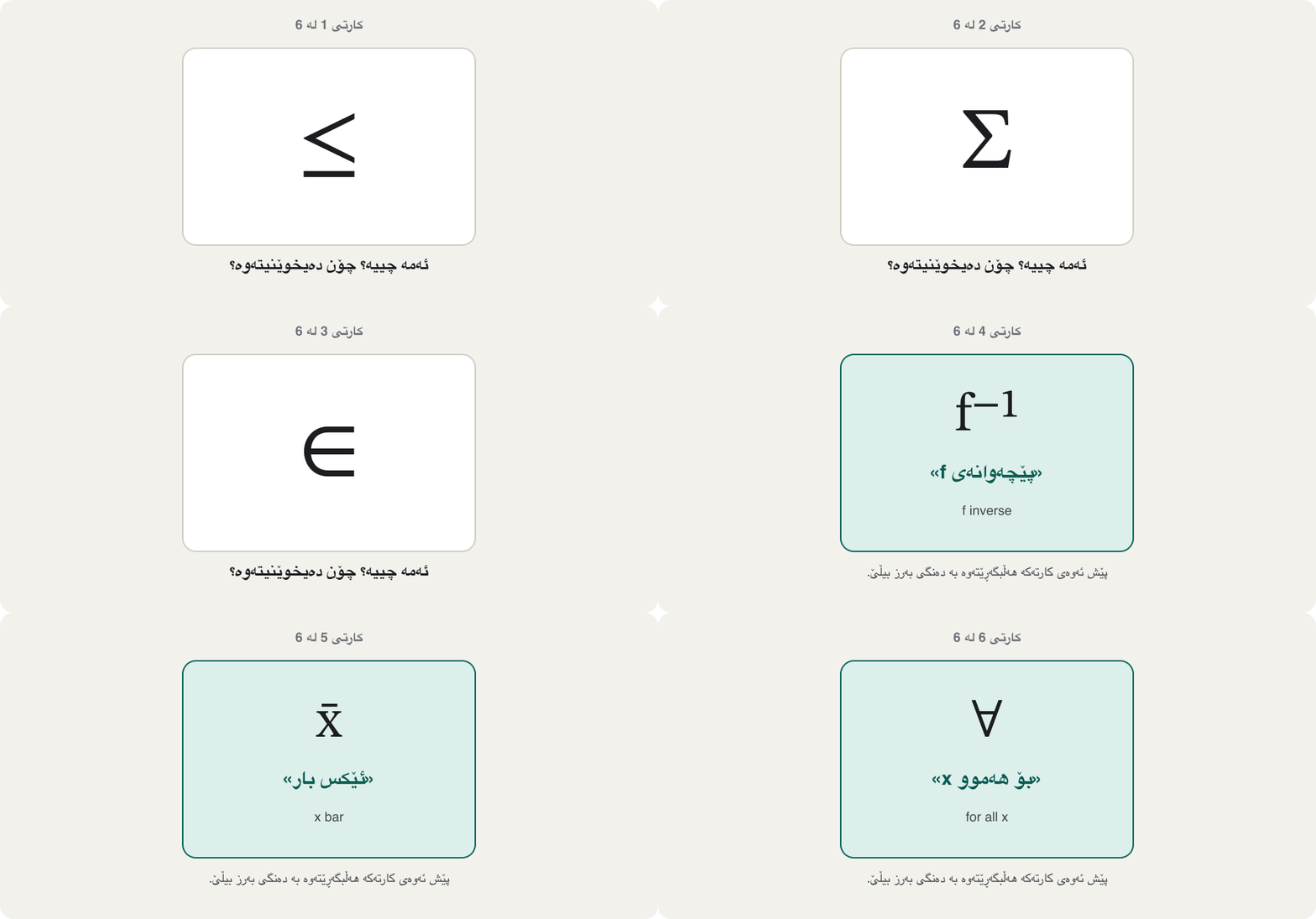
سەیری کارتەکان بکە و پێش ئەوەی هەر کارتێک هەڵبگەڕێتەوە، بە ئینگلیزی و بە کوردی بە دەنگی بەرز بڵێ. پاشان بە بیست لە هەر شەش بەشەکە خۆت تاقی بکەرەوە و بکەرەوە کە زۆرێک لەوانە پێکەوە بەکار دەهێنێت.
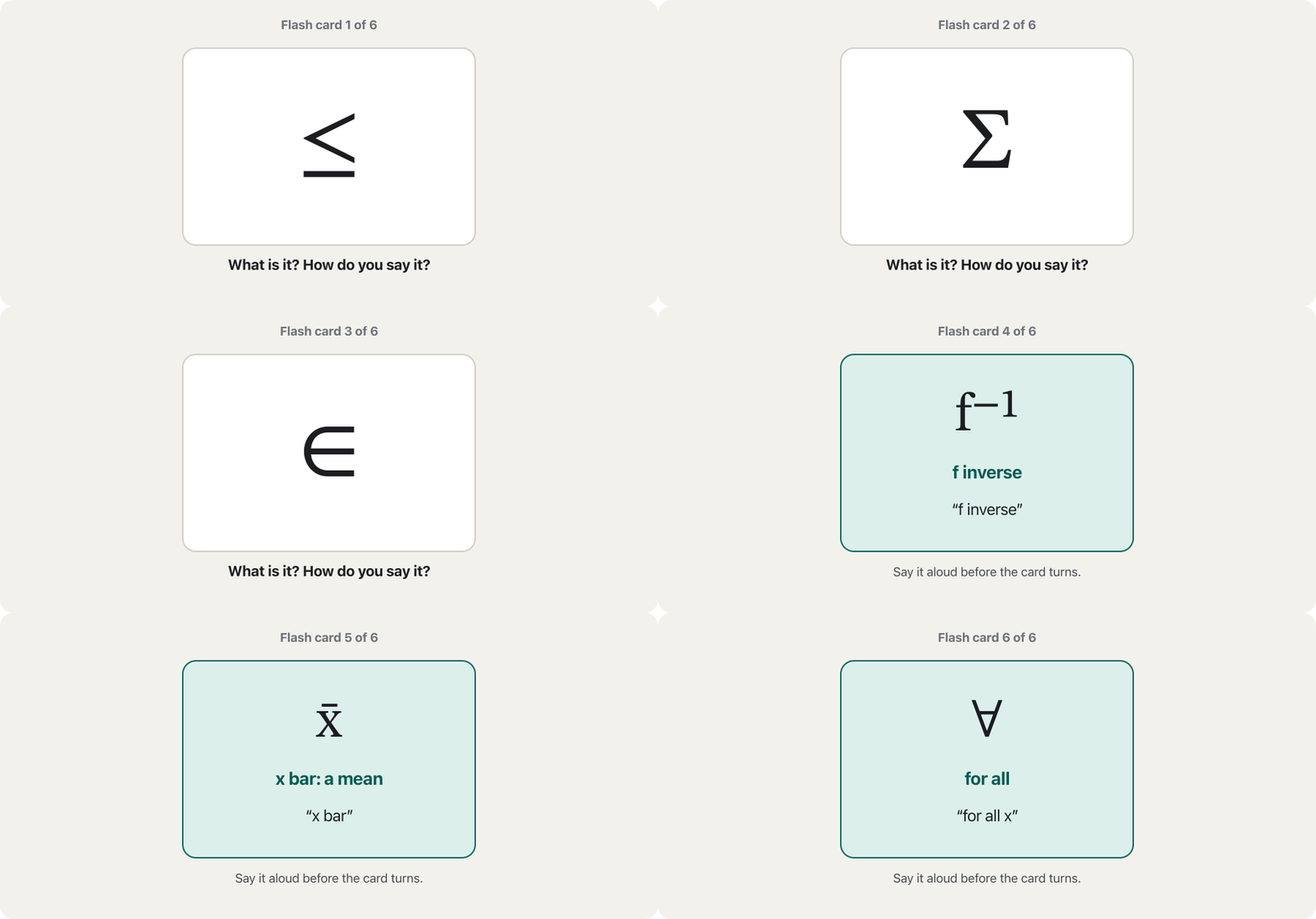
Say each one aloud in English and in Kurdish, then check: , , , , , , , , , , , , , , , , , , , .
هەریەکەیان بە ئینگلیزی و بە کوردی بە دەنگی بەرز بڵێ، پاشان بیپشکنە: ، ، ، ، ، ، ، ، ، ، ، ، ، ، ، ، ، ، ، .
Show answerوەڵامەکە پیشان بدە
| Symbol | Say itخوێندنەوە (کوردی) |
|---|---|
| x sub i«x ژێر i» | |
| mu«میو» (هەروەها «موو») | |
| twelve divided by three«12 دابەش بەسەر 3» | |
| plus or minus«کۆ یان کەم» | |
| x cubed«x سێجا» | |
| the cube root of eight« 8» | |
| is not equal to«یەکسان نییە بە» | |
| is greater than or equal to«گەورەترە لە … یان یەکسانە پێی» | |
| the interval from a to b, open at both ends« a تا b، هەردوو لا کراوە» | |
| f of x«fـی x» | |
| f after g«f لە دوای g» | |
| log base 2 of 8« 8 بە 2» | |
| sine squared x«دووجای x» | |
| the sum from i = 1 to n«کۆ لە i = 1ـەوە تا n» | |
| is not an element of« … نییە» | |
| union«» | |
| not p«نا p» | |
| for all«بۆ هەموو» | |
| dee y by dee x«dy لەسەر dx» | |
| a mod n«a مۆد n» |
This line from a calculus book defines a limit. Read it aloud and say what it means: .
ئەم دێڕەی کتێبێکی کالکولەس پێناسە دەکات. بە دەنگی بەرز بیخوێنەوە و بڵێ واتای چییە: .
Hintئاماژە
Read from left to right, one symbol at a time; is the distance from x to a.
لە چەپەوە بۆ ڕاست بخوێنەوە، بە ؛ دووریی x لە aـیە.
Show answerوەڵامەکە پیشان بدە
- Say it: “for every epsilon greater than 0 there exists a delta greater than 0 such that, if the distance from x to a is greater than 0 and less than delta, then the distance from f of x to L is less than epsilon.”
- Symbols used: (quantifiers), (Greek letters), (absolute value, a distance), (inequalities), (implies).
- Meaning: gets as close as you like to L when x is close enough to a; that is (lim).
- بیخوێنەوە: «بۆ هەموو ئێپسیلۆنێک کە لە 0 گەورەتر بێت، دێلتایەک هەیە کە لە 0 گەورەترە، بە جۆرێک کە ئەگەر دووریی x لە a لە 0 گەورەتر و لە دێلتا بچووکتر بێت، ئەوا دووریی fـی x لە L لە ئێپسیلۆن بچووکترە.»
- بەکارهاتوو: ()، (پیتی یۆنانی)، (، دووری)، ()، (دەگەیەنێت).
- واتا: هەر ئەوەندە نزیک دەبێتەوە لە L کە بتەوێت، کاتێک x بەسی لە a نزیک بێت؛ ئەوە ـە (lim).
The end of the courseکۆتایی خوولەکە
You have reached the end of Mathematical Notation. The course began with one question from students in Kurdistan: what do the symbols in our books and handouts mean? Now you can read a formula from left to right, name its pieces, say it in English and in Kurdish, type it, and spot the traps of look-alikes, handout habits and right-to-left lines. These are the six chapters and their 21 lessons:
گەیشتیتە کۆتایی خوولی بیرکاری. خوولەکە بە پرسیارێکی خوێندکارانی کوردستان دەستی پێکرد: ناو کتێب و مەلزەمەکانمان واتای چییە؟ ئێستا دەتوانیت لە چەپەوە بۆ ڕاست بخوێنیتەوە، بەشەکانی ناو بنێیت، بە ئینگلیزی و بە کوردی بیڵێیت، بینووسیت و تەڵەکانی هاوشێوەکان، خووەکانی مەلزەمە و دێڕەکانی بناسیتەوە. ئەمانە شەش بەشەکە و 21 وانەکەیانن:
- Start here: how to read maths
- Arithmetic and algebra signs
- Functions, logarithms and trigonometry
- Sums, sets and logic
- Calculus, matrices and statistics
- Notation at work: code, keyboards and books
- لێرەوە دەست پێ بکە: چۆن بیرکاری بخوێنیتەوە
- نیشانەکانی ژمێرکاری و جەبر
- ، و سێگۆشەزانی
- کۆ، و لۆجیک
- کالکولەس، و
- لە کاردا: کۆد، و کتێب
Where next?دواتر بۆ کوێ؟
The symbols are tools; the mathematics lives in the topic courses: Calculus, Statistics and probability, Logic design and the programming lessons. When a symbol stops you there, come back to this dictionary. Keep reading formulas aloud: it is the fastest way to make the symbols your own.
ئامرازن؛ بیرکارییەکە لە خوولەکانی بابەتەکاندایە: کالکولەس، ئامار و ئەگەر، دیزاینی لۆجیکی دیجیتاڵ و وانەکانی بەرنامەسازی. کاتێک لەوێ ڕایگرتیت، بگەڕێوە بۆ ئەم فەرهەنگە. بەردەوام بە دەنگی بەرز بخوێنەوە: خێراترین ڕێگایە بۆ ئەوەی ببنە هی خۆت.
Where do you find how to say in Kurdish?لە کوێ دەزانیت بە کوردی چۆن دەخوێنرێتەوە؟
In family 8, Inequalities and intervals: a گەورەترە لە b یان یەکسانە پێی.
لە خێزانی 8، و : «a گەورەترە لە b یان یەکسانە پێی».
A symbol has two meanings. What decides which one?هێمایەک دوو واتای هەیە. چی دیاری دەکات کامیانە؟
The subject and the context: read the chapter and the book’s list of symbols.
بابەت و دەوروبەر: بەشەکە و لیستی کتێبەکە بخوێنەوە.
How do you find a symbol you cannot name?چۆن هێمایەک دەدۆزیتەوە کە ناوی نازانیت؟
By shape (this dictionary, Detexify), by its Unicode name, or in a glossary or notation index.
بە شێوە (ئەم فەرهەنگە، Detexify)، بە ناوی ، یان لە فەرهەنگۆک یان پێڕستێکی نووسیندا.
Lesson complete!وانەکە تەواو بوو!
Well done. Review the key terms, then go on to the next lesson.دەستخۆش. سەیرێکی زاراوە سەرەکییەکان بکەرەوە، پاشان بڕۆ بۆ وانەی داهاتوو.
Key termsزاراوە سەرەکییەکان
Related lecturesوانە پەیوەندیدارەکان
- How to Read a Formulaچۆن فۆرمولەیەک بخوێنیتەوە
- Letters, Subscripts, Superscripts and the Greek Alphabetپیتەکان، ژێرنووسەکان، ژوورنووسەکان و ئەلفوبێی یۆنانی
- Numbers and Digits: ١٢٣ and 123, Decimal Points and Scientific Notationژمارە و تاکژمارەکان: ١٢٣ و 123، فاریزە و شێوازی زانستی
- Plus, Minus, Times, Divide and the Fraction Barکۆ، کەم، جاران، دابەش و هێڵی کەرت
- Brackets and the Order of Operationsکەوانەکان و پێشینەیی کارپێکەرەکان
- Powers, Roots, Absolute Value, Factorial, Floor and Ceilingتوانەکان، ڕەگەکان، نرخی ڕووت، فاکتۆریێل، نەخشەی گەورەترین ژمارەی تەواو و نەخشەی بچووکترین ژمارەی تەواو
- Equals, Not Equal, Approximately and Other Relationsیەکسان، یەکسان نییە، نزیکەی یەکسان و پەیوەندییەکانی تر
- Inequalities, Infinity and Intervalsلاسەنگەکان، بێسنوور و ماوەکان
- Function Notation: f(x), Arrows, Inverses and Compositionنووسینی نەخشەیی: ، تیرەکان، پێچەوانە و ئاوێتەکردن
- Exponents and Logarithms: eˣ, log, ln, lg and lbتوانەکان و لۆگاریتمەکان: eˣ، log، ln، lg و lb
- Geometry and Trigonometry Symbolsهێماکانی ئەندازەزانی و سێگۆشەزانی
- Sequences, Sums (Σ) and Products (Π)یەکبەدوای یەکەکان، کۆ (Σ) و لێکدان (Π)
- Set Notation and the Number Sets ℕ ℤ ℚ ℝ ℂهێماکانی کۆمەڵە و کۆمەڵەکانی ژمارە ℕ ℤ ℚ ℝ ℂ
- Logic Symbols and Boolean Algebraهێماکانی لۆجیک و جەبری بوول
- Limits, Derivatives and Integrals: lim, dy/dx, ∂ and ∫ئامانجەکان، مشتەقەکان و تەواوکارییەکان: lim، dy/dx، ∂ و ∫
- Vectors and Matrices: Arrows, Bold Letters, Aᵀ, A⁻¹ and detئاڕاستەبڕەکان و ماتریکسەکان: تیر، پیتی تۆخ، Aᵀ، A⁻¹ و det
- Probability and Statistics Symbolsهێماکانی ئەگەر و ئامار
- Notation in Computing: mod, Bases, Big-O and Code Operatorsهێماکان لە کۆمپیوتەردا: mod، بنچینەکان، نیشانەی O-ی گەورە و کارپێکەرەکانی کۆد
- Typing Mathematics: Keyboards, Word, LaTeX and Unicodeچۆن بیرکاری بنووسیت: کیبۆرد، Word، LaTeX و Unicode
- Reading Maths in Kurdish, Arabic and English Booksخوێندنەوەی بیرکاری لە کتێبی کوردی، عەرەبی و ئینگلیزیدا
References and further readingسەرچاوەکان و خوێندنەوەی زیاتر
- Wikipedia: Glossary of mathematical symbols (organised by subject; symbols with several meanings)
- NIST Digital Library of Mathematical Functions: Notations (each symbol with its meaning and a link to its definition)
- NIST DLMF: Common Notations and Definitions
- Detexify: LaTeX handwritten symbol recognition
- Unicode Technical Report #25: Unicode Support for Mathematics
This lecture is a first edition. The Kurdish text and terminology are waiting for review by Kurdish IT teachers.ئەم وانەیە چاپی یەکەمە. دەقە کوردییەکە و زاراوەکانی چاوەڕێی پێداچوونەوەی مامۆستایانی کوردی بواری IT ن.