Chapterبەش 5 · Lectureوانە 5.3

Continuous Random Variables and Density Functionsگۆڕاوە هەڕەمەکییە بەردەوامەکان و نەخشەی چڕیی ئەگەر

Probability as area under a density curve: the two rules of a pdf, why single points have probability 0, the uniform and exponential densities, the integrals you need (power rule, exe^x, limits, integration by parts), the course's examples with the corrected 727\frac{7}{27}, and the continuous CDF with f=F′f = F'.

وەک ڕووبەری ژێر هێڵی چڕی: دوو یاساکەی ، بۆچی تاکە خاڵ 0ـە، چڕیی یەکنەواخت و توانی، ئەو پێویستن (یاسای توان، exe^x، و )، نموونەکانی کۆرسەکە بە 727\frac{7}{27}ـی ڕاستکراوە و بەردەوام بە f=F′f = F'.

21 min read23 خولەک خوێندنەوە · 24 stepsهەنگاو

What you will learnچی فێر دەبیت

  • Explain why probabilities of a continuous variable are areas and why P(X=a)=0P(X = a) = 0.
  • Check the two rules of a pdf and find an unknown constant.
  • Compute probabilities with definite integrals, including exponentials and integration by parts.
  • Move between a density ff and its CDF FF.
  • ڕوون بکەیتەوە بۆچی گۆڕاوی بەردەوام ڕووبەرن و بۆچی P(X=a)=0P(X = a) = 0.
  • دوو یاساکەی بپشکنیت و نەگۆڕێکی نەناسراو بدۆزیتەوە.
  • بە بژمێریت، بە و .
  • لە نێوان چڕیی ff و FFدا بگوازیتەوە.

From bars to a smooth curveلە ستوونەوە بۆ هێڵێکی چەماوەی نەرم

A continuous random variable can take any value in an interval: a waiting time, a height, a temperature. Between any two values there are infinitely many others, so we cannot list the values with a probability next to each one, as we did with a pmf.

دەتوانێت هەر بەهایەکی ناو ماوەیەک وەربگرێت: کاتی چاوەڕوانی، باڵا، پلەی گەرمی. لە نێوان هەر دوو بەهایەکدا بێسنوور بەهای تر هەیە، بۆیە ناتوانین بەهاکان لیست بکەین و لە تەنیشت هەر یەکەیان بنووسین، وەک ئەوەی بە نەخشەی بارستەی ئەگەر کردمان.

Think of a relative frequency histogram drawn so that each bar's area is the share of the data in its class. Make the classes thinner and thinner: the tops of the bars settle onto a smooth curve. That curve is the probability density function f(x)f(x), and areas under it are probabilities.

بهێنە بەرچاو کە بە شێوەیەک کێشراوە کە ڕووبەری هەر ستوونێک بەشی ئەو بێت کە لە . باریکتر و باریکتر بکە: سەری ستوونەکان لە سەر هێڵێکی چەماوەی نەرم دادەنیشن. ئەو هێڵە f(x)f(x)ـە و ڕووبەرەکانی ژێری .

Three histograms of the same distribution on 0 to 3 with class widths 1, 0.5 and 0.1. The bars get thinner and their tops approach the curve f(x) = x²/9, which is drawn dashed over the first two and solid over the third.سێ هیستۆگرام بۆ هەمان دابەشبوون لە 0 تا 3 بە پانیی کلاس 1، 0.5 و 0.1. ستوونەکان باریکتر دەبن و سەریان لە هێڵە چەماوەکەی f(x) = x²/9 نزیک دەبێتەوە، کە لە سەر دوو یەکەمیان پچڕپچڕ و لە سەر سێیەمیان پڕ کێشراوە.
Thinner classes, smoother picture: in the limit the bars become the density curve. باریکتر، وێنەی نەرمتر: لە کۆتاییدا ستوونەکان دەبن بە هێڵی چڕییەکە.CêIT
Quick checkپشکنینی خێراWhy can a continuous random variable not have a pmf table?بۆچی ناتوانێت خشتەی هەبێت؟

Probability is areaئەگەر ڕووبەرە

A function f(x)f(x) is a probability density function (pdf) of XX when the probability that XX lands between aa and bb is the area under ff from aa to bb:

نەخشەی f(x)f(x) XXـە کاتێک ئەوەی XX لە نێوان aa و bbدا بکەوێت ڕووبەری ژێر ff بێت لە aaـەوە بۆ bb:

P(a≤X≤b)=∫abf(x) dx(b≥a)P(a \le X \le b) = \int_a^b f(x)\,dx \quad (b \ge a)

The integral sign ∫\int means “the area under the curve”; the next screens show how to compute it.

نیشانەی ∫\int واتە «ڕووبەری ژێر هێڵە چەماوەکە»؛ شاشەکانی داهاتوو نیشان دەدەن چۆن دەژمێردرێت.

(1)  f(x)≥0 for every x(2)  ∫−∞∞f(x) dx=1\text{(1)}\ \ f(x) \ge 0 \text{ for every } x \qquad\qquad \text{(2)}\ \ \int_{-\infty}^{\infty} f(x)\,dx = 1

The two rules of every pdf: no negative heights, total area exactly 1. If ff is positive only on [a,b][a, b] and 0 elsewhere, rule (2) becomes ∫abf(x) dx=1\int_a^b f(x)\,dx = 1.

دوو یاساکەی هەموو : هیچ بەرزییەکی نەرێنی و کۆی ڕووبەر ڕێک 1. گەر ff تەنها لە سەر [a,b][a, b] ئەرێنی بێت و لە شوێنی تر 0، یاسای ⁦(2)⁩ دەبێت بە ∫abf(x) dx=1\int_a^b f(x)\,dx = 1.

Definitionپێناسە

For a , a curve f(x)≥0f(x) \ge 0 with total area 1; the probability of an interval is the area under it: P(a<X<b)=∫abf(x) dxP(a < X < b) = \int_a^b f(x)\,dx.

بۆ ، چەماوەیەکە f(x)≥0f(x) \ge 0 کە کۆی ڕووبەرەکەی 1ـە؛ ئەگەری ماوەیەک ڕووبەری ژێر چەماوەکەیە: P(a<X<b)=∫abf(x) dxP(a < X < b) = \int_a^b f(x)\,dx.

Probability is areaئەگەر ڕووبەرە

Checking densities with school geometryپشکنینی چڕی بە ئەندازەی قوتابخانە

You can already check simple densities with school geometry. A flat line f(x)=14f(x) = \frac14 on [0,4][0, 4] is a rectangle of area 4×14=14 \times \frac14 = 1; the line f(x)=x2f(x) = \frac{x}{2} on [0,2][0, 2] is a triangle of area 12⋅2⋅1=1\frac12 \cdot 2 \cdot 1 = 1. Both are pdfs.

دەتوانیت ئێستا بە ئەندازەی قوتابخانە چڕییە سادەکان بپشکنیت. هێڵێکی ڕاستی f(x)=14f(x) = \frac14 لە سەر [0,4][0, 4] لاکێشەیەکە بە ڕووبەری 4×14=14 \times \frac14 = 1؛ هێڵی f(x)=x2f(x) = \frac{x}{2} لە سەر [0,2][0, 2] سێگۆشەیەکە بە ڕووبەری 12⋅2⋅1=1\frac12 \cdot 2 \cdot 1 = 1. هەردووکیان .

Left: a rectangle density f(x) = 1/4 on 0 to 4, total area 4 × 1/4 = 1, with the strip from 1 to 3 shaded: 2 × 1/4 = 1/2. Right: a triangle density f(x) = x/2 on 0 to 2, total area ½ · 2 · 1 = 1, with the part from 0 to 1 shaded: ½ · 1 · ½ = 1/4.چەپ: چڕییەکی لاکێشەیی f(x) = 1/4 لە 0 تا 4، کۆی ڕووبەر 4 × 1/4 = 1، بەشی نێوان 1 و 3 ڕەنگ کراوە: 2 × 1/4 = 1/2. ڕاست: چڕییەکی سێگۆشەیی f(x) = x/2 لە 0 تا 2، کۆی ڕووبەر ½ · 2 · 1 = 1، بەشی 0 تا 1 ڕەنگ کراوە: ½ · 1 · ½ = 1/4.
Shaded area = probability: P(1<X<3)=12P(1 < X < 3) = \frac12 on the left, P(0<X<1)=14P(0 < X < 1) = \frac14 on the right.ڕووبەری ڕەنگکراو : لە چەپ P(1<X<3)=12P(1 < X < 3) = \frac12 و لە ڕاست P(0<X<1)=14P(0 < X < 1) = \frac14.CêIT
Quick checkپشکنینی خێراIs f(x)=3f(x) = 3 on [0,1][0, 1] (and 0 elsewhere) a pdf?ئایا f(x)=3f(x) = 3 لە سەر [0,1][0, 1] (و 0 لە شوێنی تر) ؟

A single point has probability 0تاکە خاڵێک ئەگەری 0ـە

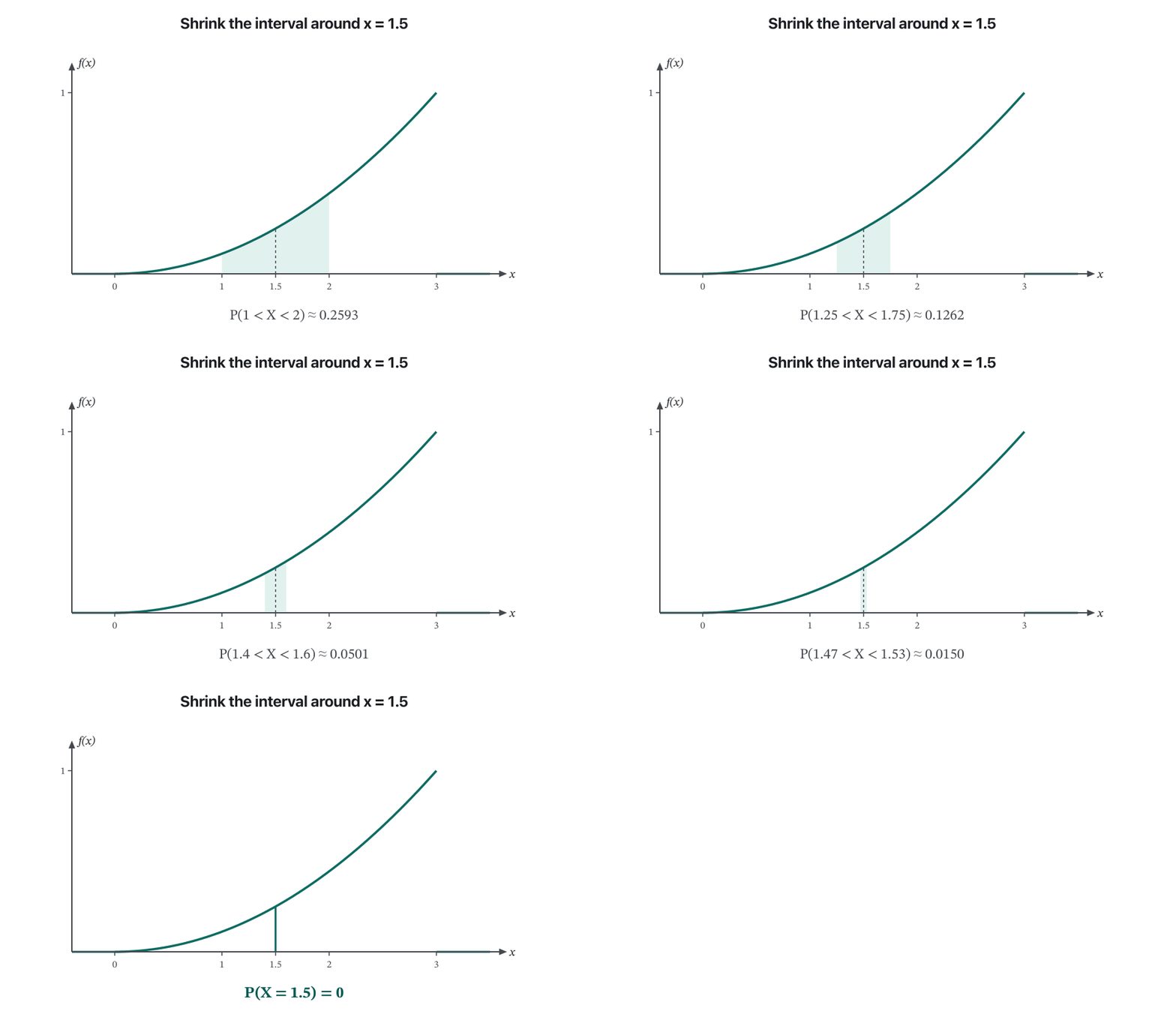
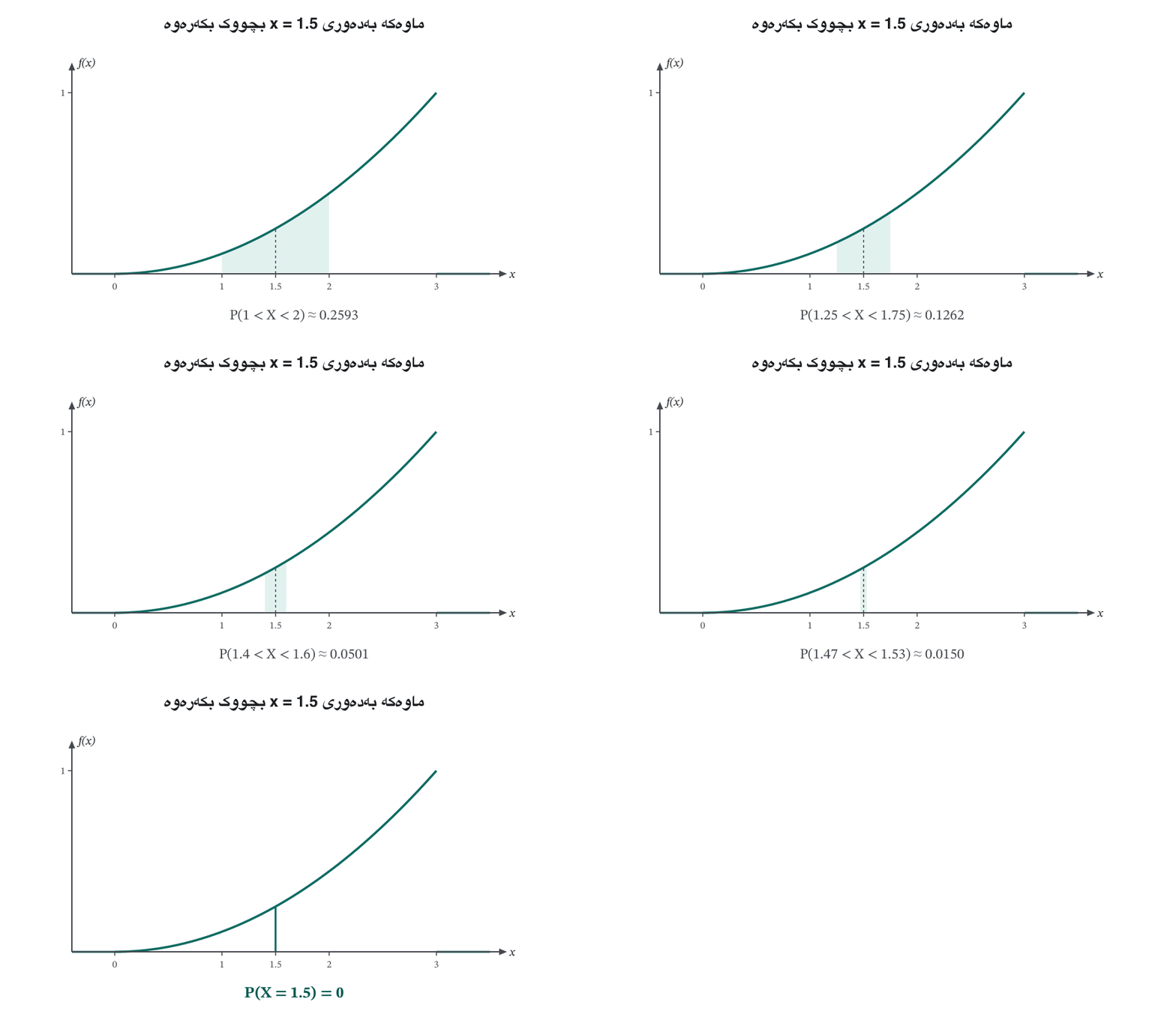
What is P(X=a)P(X = a)? It is the area over the interval from aa to aa, a line with no width:

P(X=a)P(X = a) چەندە؟ ڕووبەری سەر aa تا aaـیە، هێڵێک کە هیچ پانییەکی نییە:

P(X=a)=P(a≤X≤a)=∫aaf(x) dx=0P(X = a) = P(a \le X \le a) = \int_a^a f(x)\,dx = 0
Animation: under the curve f(x) = x²/9 the shaded interval around x = 1.5 shrinks: P(1 < X < 2) ≈ 0.2593, P(1.25 < X < 1.75) ≈ 0.1262, P(1.4 < X < 1.6) ≈ 0.0501, P(1.47 < X < 1.53) ≈ 0.0150, and finally a single line with P(X = 1.5) = 0.
As the interval shrinks to a point, its area shrinks to 0.کاتێک بچووک دەبێتەوە بۆ خاڵێک، ڕووبەرەکەی دەبێت بە 0.CêIT

So for a continuous variable it does not matter whether the ends are included:

کەواتە بۆ گۆڕاوی بەردەوام گرنگ نییە کۆتاییەکان تێدا بن یان نا:

P(a≤X≤b)=P(a≤X<b)=P(a<X≤b)=P(a<X<b)=∫abf(x) dxP(a \le X \le b) = P(a \le X < b) = P(a < X \le b) = P(a < X < b) = \int_a^b f(x)\,dx
Quick checkپشکنینی خێراXX is continuous and P(2≤X≤5)=0.4P(2 \le X \le 5) = 0.4. What is P(2<X<5)P(2 < X < 5)?XX بەردەوامە و P(2≤X≤5)=0.4P(2 \le X \le 5) = 0.4. P(2<X<5)P(2 < X < 5) چەندە؟

Why “probability of 0” does not mean “impossible” | Probabilities of probabilities, part 23Blue1Brown · Englishئینگلیزی · 3.3M viewsبینین · 84K likesلایک · Partبەشی 2:37–6:51 (ofلە 10:00)

Why one exact value of a continuous variable has probability 0, and why probability must come from areas under a density curve.

بۆچی یەک نرخی ورد لە 0ـە، هەروەها بۆچی دەبێت لە ڕووبەری ژێر هێڵی چەماوەی چڕییەوە بێت.

Chapters 'Probabilities over continuous values' and 'Probability density' (2:37-6:51). The first 2:37 recap part 1 and the end goes into measure theory.

بەشەکانی « بۆ نرخی بەردەوام» و «چڕیی » (⁦2:37⁩ تا ⁦6:51). 0:00⁩ تا ⁦2:37⁩ پێداچوونەوەی بەشی یەکەمی زنجیرەکەیە و کۆتایی ڤیدیۆکە دەچێتە ناو تیۆریی پێوانە (measure theory).

The simplest density: waiting for a minibusسادەترین چڕی: چاوەڕوانیی پاس

A minibus leaves the stop every 12 minutes. You arrive at a random moment, knowing nothing about the timetable. Your waiting time XX can be anything from 0 to 12 minutes, and no part of that range is more likely than another. The density is flat: f(x)=112f(x) = \frac{1}{12} on [0,12][0, 12], so that the rectangle has area 12×112=112 \times \frac{1}{12} = 1.

پاسێک هەموو ⁦12⁩ خولەک جارێک لە وێستگەکە دەڕوات. تۆ لە کاتێکی هەڕەمەکیدا دەگەیت و هیچ دەربارەی خشتەی کاتەکان نازانیت. کاتی چاوەڕوانیت XX دەتوانێت هەر شتێک بێت لە 0 تا ⁦12⁩ خولەک و هیچ بەشێکی ئەو لە بەشێکی تر زیاتری نییە. چڕییەکە ڕاستە: f(x)=112f(x) = \frac{1}{12} لە سەر [0,12][0, 12]، بۆ ئەوەی ڕووبەری لاکێشەکە 12×112=112 \times \frac{1}{12} = 1 بێت.

A flat density at height 1/12 from x = 0 to x = 12 (minutes waited). The strip from 4 to 10 is shaded and labelled P(4 < X < 10) = 6 × 1/12 = 0.5.چڕییەکی ڕاست بە بەرزیی 1/12 لە x = 0 تا x = 12 (خولەکەکانی چاوەڕوانی). بەشی نێوان 4 و 10 ڕەنگ کراوە و لەسەری نووسراوە P(4 < X < 10) = 6 × 1/12 = 0.5.
Every probability is a rectangle: width ×112\times \frac{1}{12}.هەموو لاکێشەیەکە: پانی ×112\times \frac{1}{12}.CêIT
P(X<3)=3⋅112=14,P(4<X<10)=6⋅112=12,P(X>9)=3⋅112=14P(X < 3) = 3 \cdot \tfrac{1}{12} = \tfrac14, \qquad P(4 < X < 10) = 6 \cdot \tfrac{1}{12} = \tfrac12, \qquad P(X > 9) = 3 \cdot \tfrac{1}{12} = \tfrac14

This is the uniform distribution on [0,12][0, 12]. In general, on [a,b][a, b] the height is 1b−a\frac{1}{b - a}.

ئەمە لە سەر [0,12][0, 12]. بە گشتی، لە سەر [a,b][a, b] بەرزییەکە 1b−a\frac{1}{b - a}ـە.

Quick checkپشکنینی خێراWith the same minibus, what is the probability of waiting more than 8 minutes?بە هەمان پاس، چاوەڕوانیی زیاتر لە 8 خولەک چەندە؟

The calculus you need: areas under curvesئەو کالکولەسەی پێویستتە: ڕووبەری ژێر هێڵی چەماوە

Rectangles and triangles are not enough for a curve like f(x)=x29f(x) = \frac{x^2}{9}. For curves we use the definite integral ∫abf(x) dx\int_a^b f(x)\,dx, the exact area under ff from aa to bb. This course needs only four tools, explained on the next screens: what an integral is, the power rule, exponentials with limits, and integration by parts.

لاکێشە و سێگۆشە بەس نین بۆ هێڵێکی چەماوەی وەک f(x)=x29f(x) = \frac{x^2}{9}. بۆ هێڵی چەماوە ∫abf(x) dx\int_a^b f(x)\,dx بەکار دەهێنین، ڕووبەری ورد لە ژێر ff لە aaـەوە بۆ bb. ئەم کۆرسە تەنها پێویستی بە چوار ئامراز هەیە، کە لە شاشەکانی داهاتوودا ڕوون کراونەتەوە: چییە، یاسای توان، لەگەڵ و .

The calculus you need: areas under curvesئەو کالکولەسەی پێویستتە: ڕووبەری ژێر هێڵی چەماوە

Areas from antiderivativesڕووبەر لە ڕێگەی پێچەوانەی مشتەق

Integration is the reverse of differentiation. If you find a function GG whose derivative is ff (G′=fG' = f), the area is simply “G at the end minus G at the start”:

پێچەوانەی دەرهێنانی . گەر نەخشەیەکی GG بدۆزیتەوە کە ff بێت (G′=fG' = f)، ڕووبەرەکە بە سادەیی «G لە کۆتایی کەم G لە سەرەتا»ـیە:

∫abf(x) dx=[ G(x) ]ab=G(b)−G(a)\int_a^b f(x)\,dx = \Big[\,G(x)\,\Big]_a^b = G(b) - G(a)

The fundamental theorem of calculus. The bracket [G(x)]ab\Big[G(x)\Big]_a^b is shorthand for G(b)−G(a)G(b) - G(a).

. کەوانەی [G(x)]ab\Big[G(x)\Big]_a^b کورتکراوەی G(b)−G(a)G(b) - G(a)ـە.

Check it on the triangle f(x)=x2f(x) = \frac{x}{2}: G(x)=x24G(x) = \frac{x^2}{4} has G′(x)=2x4=x2G'(x) = \frac{2x}{4} = \frac{x}{2}, so ∫02x2 dx=44−0=1\int_0^2 \frac{x}{2}\,dx = \frac{4}{4} - 0 = 1, the same as 12⋅2⋅1\frac12 \cdot 2 \cdot 1. Without limits, ∫x2 dx=x24+C\int \frac{x}{2}\,dx = \frac{x^2}{4} + C is an indefinite integral: + C+\,C because x24+5\frac{x^2}{4} + 5 has the same derivative. In a definite integral CC cancels.

لە سەر سێگۆشەکە f(x)=x2f(x) = \frac{x}{2} بیپشکنە: G(x)=x24G(x) = \frac{x^2}{4} بریتییە لە G′(x)=2x4=x2G'(x) = \frac{2x}{4} = \frac{x}{2}، بۆیە ∫02x2 dx=44−0=1\int_0^2 \frac{x}{2}\,dx = \frac{4}{4} - 0 = 1، هەمان 12⋅2⋅1\frac12 \cdot 2 \cdot 1. بەبێ سنوور، ∫x2 dx=x24+C\int \frac{x}{2}\,dx = \frac{x^2}{4} + C : + C+\,C چونکە x24+5\frac{x^2}{4} + 5 هەمان هەیە. لە CC لادەچێت.

Quick checkپشکنینی خێراG(x)=x2G(x) = x^2 has G′(x)=2xG'(x) = 2x. What is ∫132x dx\int_1^3 2x\,dx? G(x)=x2G(x) = x^2 بریتییە لە G′(x)=2xG'(x) = 2x. ∫132x dx\int_1^3 2x\,dx چەندە؟

Integration and the fundamental theorem of calculus | Chapter 8, Essence of calculus3Blue1Brown · Englishئینگلیزی · 3.2M viewsبینین · 69K likesلایک · Partبەشی 8:20–16:20 (ofلە 20:46)

An integral is the area under a graph, and the fundamental theorem says: find a function whose derivative is f, then subtract its end values.

ڕووبەری ژێر ؛ دەڵێت: بدۆزەرەوە کە ff بێت، پاشان نرخەکانی دوو سەرەکەی لە یەک کەم بکەرەوە.

Chapters 'Areas under graphs' and 'Fundamental theorem of calculus' (8:20-16:20): area from thin rectangles and G(b) - G(a).

بەشەکانی «ڕووبەری ژێر » و «» (⁦8:20⁩ تا ⁦16:20⁩): ڕووبەر لە لاکێشەی باریکەوە و G(b)−G(a)G(b) - G(a).

The calculus you need: areas under curvesئەو کالکولەسەی پێویستتە: ڕووبەری ژێر هێڵی چەماوە

Why an integral is an area: thin rectanglesبۆچی تەواوکاری ڕووبەرە: لاکێشەی باریک

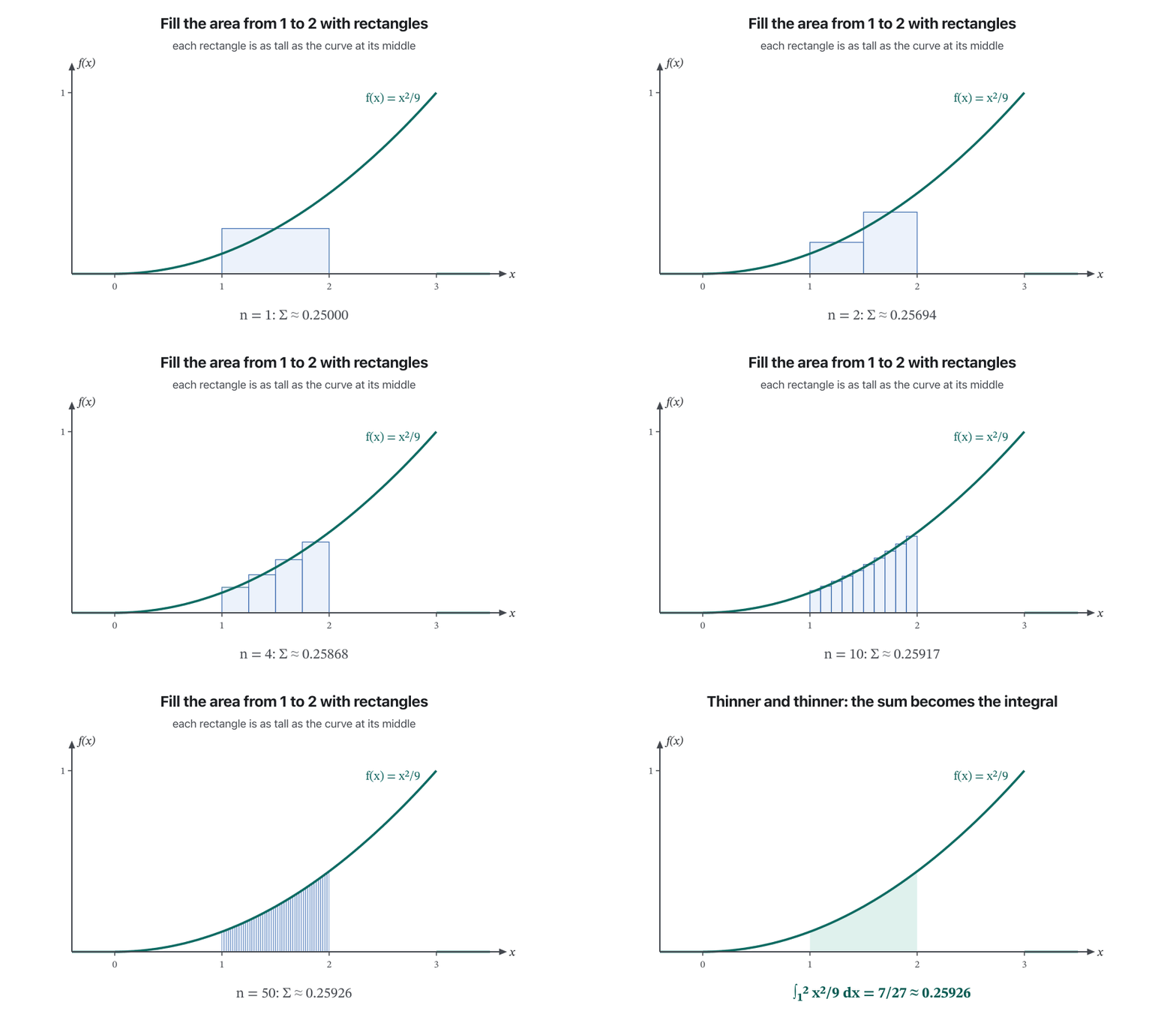
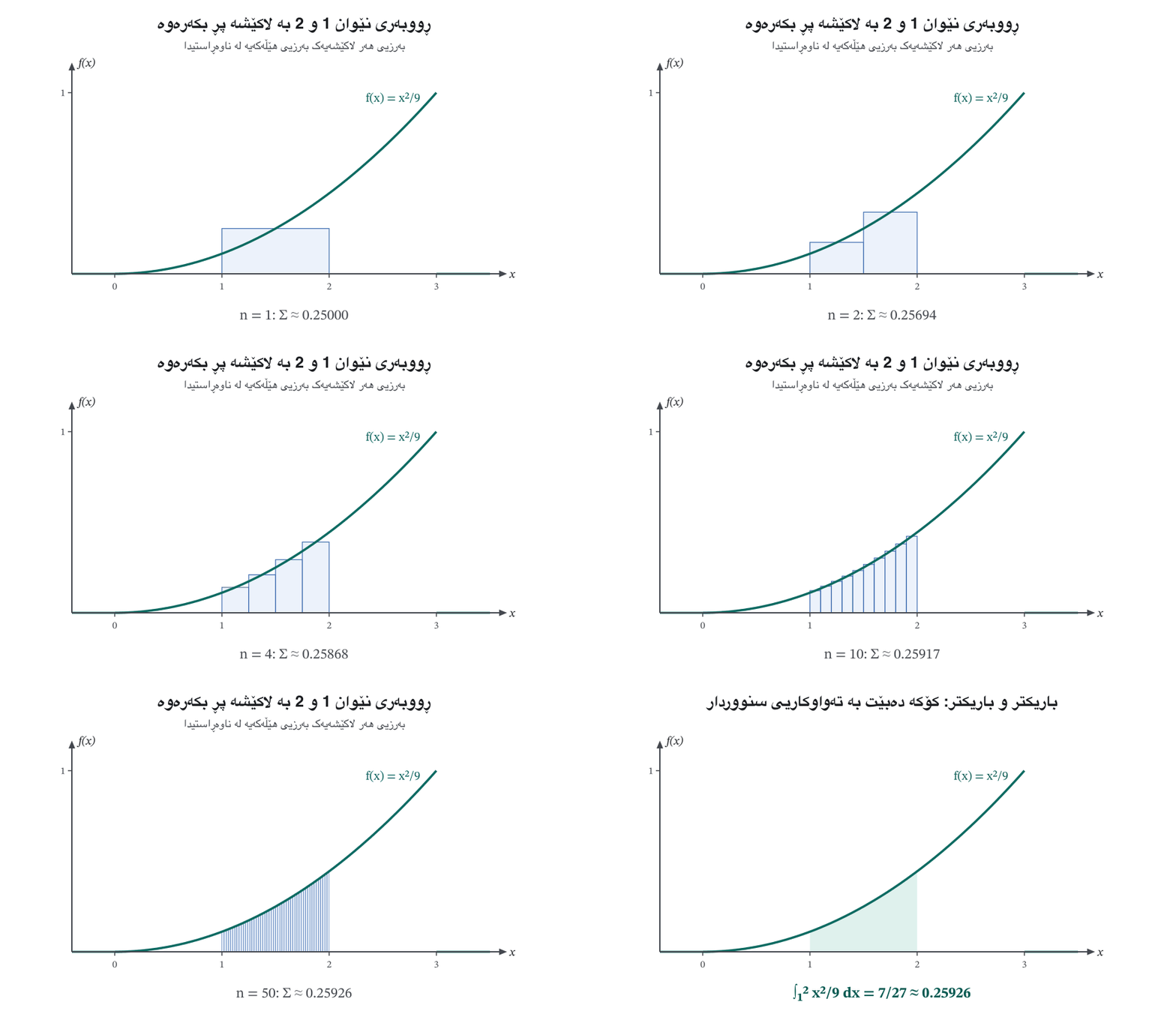
Why is an integral an area? Fill the area with thin rectangles, each as tall as the curve at its middle, and add their areas (width × height, school geometry again). For x29\frac{x^2}{9} between 1 and 2, 4 rectangles give 0.25868, 10 give 0.25917 and 50 give 0.25926. The thinner the rectangles, the closer the sum gets to the exact value 727=0.259259…\frac{7}{27} = 0.259259\ldots: the definite integral is the limit of these sums.

بۆچی ڕووبەرە؟ ڕووبەرەکە بە لاکێشەی باریک پڕ بکەرەوە، کە بەرزیی هەر یەکەیان بەرزیی هێڵەکەیە لە ناوەڕاستیدا. پاشان ڕووبەرەکانیان کۆ بکەرەوە (پانی × بەرزی، دیسان ئەندازەی قوتابخانە). بۆ x29\frac{x^2}{9} لە نێوان 1 و 2، 4 لاکێشە ⁦0.25868⁩ دەدەن، ⁦10⁩ لاکێشە ⁦0.25917⁩ و ⁦50⁩ لاکێشە ⁦0.25926⁩. تا لاکێشەکان باریکتر بن، کۆکە زیاتر لە بەهای وردی 727=0.259259…\frac{7}{27} = 0.259259\ldots نزیک دەبێتەوە: ئەم کۆکردنەوانەیە.

Animation: under the curve f(x) = x²/9, the area from x = 1 to x = 2 is filled with 1, 2, 4, 10 and then 50 rectangles, each as tall as the curve at its middle. The sums are 0.25000, 0.25694, 0.25868, 0.25917 and 0.25926. The last frame shades the exact area: the integral from 1 to 2 of x²/9 equals 7/27 ≈ 0.25926.
More and thinner rectangles: the sum settles at the area, 727\frac{7}{27}.لاکێشەی زیاتر و باریکتر: کۆکە لە سەر ڕووبەرەکە، 727\frac{7}{27}، جێگیر دەبێت.CêIT
Quick checkپشکنینی خێراThe rectangles get thinner and thinner, but there are more of them. What happens to the sum of their areas?لاکێشەکان باریکتر و باریکتر دەبن، بەڵام ژمارەیان زیاد دەبێت. چی بە کۆی ڕووبەرەکانیان دێت؟

The calculus you need: areas under curvesئەو کالکولەسەی پێویستتە: ڕووبەری ژێر هێڵی چەماوە

The power rule, both waysیاسای توان، بە هەردوو ئاراستە

Derivative of a power: bring the power down and lower it by one. Integral of a power: raise the power by one and divide by the new power.

توانێک: توانەکە بهێنە پێشەوە و یەکێکی لێ کەم بکەرەوە. توانێک: توانەکە یەکێک زیاد بکە و دابەشی بکە بەسەر توانە نوێیەکەدا.

ddx xn=n xn−1∫xn dx=xn+1n+1+C  (n≠−1),∫k dx=kx+C\frac{d}{dx}\,x^n = n\,x^{n-1} \qquad\qquad \int x^n\,dx = \frac{x^{n+1}}{n+1} + C \ \ (n \ne -1), \qquad \int k\,dx = kx + C
The examples from the course's integration notes, plus 1x2\frac{1}{x^2}, which Example 6 needs.نموونەکانی تێبینییەکانی کۆرسەکە، لەگەڵ 1x2\frac{1}{x^2} کە نموونەی 6 پێویستیەتی.
FunctionDerivativeIntegral
2x2x22x2+Cx^2 + C
x2x^22x2xx33+C\frac{x^3}{3} + C
x3x^33x23x^2x44+C\frac{x^4}{4} + C
2x22x^24x4x2x33+C\frac{2x^3}{3} + C
5x45x^420x320x^3x5+Cx^5 + C
x−2=1x2x^{-2} = \frac{1}{x^2}−2x−3-2x^{-3}x−1−1=−1x+C\frac{x^{-1}}{-1} = -\frac{1}{x} + C
Quick checkپشکنینی خێراWhat is ∫03x2 dx\int_0^3 x^2\,dx?∫03x2 dx\int_0^3 x^2\,dx چەندە؟

The calculus you need: areas under curvesئەو کالکولەسەی پێویستتە: ڕووبەری ژێر هێڵی چەماوە

Exponentials: the integral of eaxe^{ax}نەخشە توانییەکان: تەواوکاریی eaxe^{ax}

The number e≈2.718e \approx 2.718 has a special property: exe^x is its own derivative. From the chain of derivatives one gets the integral of eaxe^{ax}:

ژمارەی e (e≈2.718e \approx 2.718) تایبەتمەندییەکی تایبەتی هەیە: exe^x خۆیەتی. لێرەوە eaxe^{ax} دەدۆزرێتەوە:

∫eax dx=1a eax+Ce.g. ∫e2xdx=12e2x+C,  ∫e−5xdx=−15e−5x+C,  ∫e3xdx=13e3x+C,  ∫exdx=ex+C\int e^{ax}\,dx = \frac{1}{a}\,e^{ax} + C \qquad \text{e.g. } \int e^{2x}dx = \tfrac12 e^{2x} + C,\ \ \int e^{-5x}dx = -\tfrac15 e^{-5x} + C,\ \ \int e^{3x}dx = \tfrac13 e^{3x} + C,\ \ \int e^{x}dx = e^x + C

Going the other way, (eax)′=a eax(e^{ax})' = a\,e^{ax}, so you can check each answer by differentiating: (12e2x)′=12⋅2e2x=e2x(\tfrac12 e^{2x})' = \tfrac12 \cdot 2e^{2x} = e^{2x}. In particular ∫e−x dx=−e−x+C\int e^{-x}\,dx = -e^{-x} + C, which this lesson uses again and again.

بە پێچەوانەوە (eax)′=a eax(e^{ax})' = a\,e^{ax}، بۆیە دەتوانیت هەر وەڵامێک بە دەرهێنانی بپشکنیت: (12e2x)′=12⋅2e2x=e2x(\tfrac12 e^{2x})' = \tfrac12 \cdot 2e^{2x} = e^{2x}. بە تایبەتی ∫e−x dx=−e−x+C\int e^{-x}\,dx = -e^{-x} + C، کە ئەم وانەیە چەندین جار بەکاری دەهێنێت.

Quick checkپشکنینی خێراWhat is ∫e4x dx\int e^{4x}\,dx?∫e4x dx\int e^{4x}\,dx چەندە؟

The calculus you need: areas under curvesئەو کالکولەسەی پێویستتە: ڕووبەری ژێر هێڵی چەماوە

Limits at infinityئامانجەکان لە بێسنووردا

Densities often run to ∞\infty, so we need limits: what a function approaches as xx grows without end.

چڕییەکان زۆر جار تا ∞\infty درێژ دەبنەوە، بۆیە پێویستمان بە هەیە: ئەوەی نەخشەیەک لێی نزیک دەبێتەوە کاتێک xx بێسنوور گەورە دەبێت.

lim⁡x→∞e−x=0,lim⁡x→∞ex=∞,lim⁡x→∞3x=0,lim⁡x→∞x−3=−∞,lim⁡x→∞x e−x=0\lim_{x\to\infty} e^{-x} = 0, \qquad \lim_{x\to\infty} e^{x} = \infty, \qquad \lim_{x\to\infty} \frac{3}{x} = 0, \qquad \lim_{x\to\infty} \frac{x}{-3} = -\infty, \qquad \lim_{x\to\infty} x\,e^{-x} = 0

A fixed number divided by a growing xx shrinks to 0; a growing xx divided by a fixed negative number grows without end in the negative direction. The last limit matters most here: e−xe^{-x} shrinks much faster than xx grows (x=10x = 10 gives 10e−10≈0.0004510e^{-10} \approx 0.00045).

ژمارەیەکی نەگۆڕ دابەش بەسەر xxـێکی گەورەبوودا بەرەو 0 دەچێت؛ xxـێکی گەورەبوو دابەش بەسەر ژمارەیەکی نەرێنیی نەگۆڕدا بێسنوور بەرەو لای نەرێنی دەچێت. دوایین لێرە لە هەموویان گرنگترە: e−xe^{-x} زۆر خێراتر لەوەی xx گەورە دەبێت بچووک دەبێتەوە (x=10x = 10 دەدات 10e−10≈0.0004510e^{-10} \approx 0.00045).

Quick checkپشکنینی خێراWhat is ∫0∞2e−2x dx\int_0^\infty 2e^{-2x}\,dx?∫0∞2e−2x dx\int_0^\infty 2e^{-2x}\,dx چەندە؟

The calculus you need: areas under curvesئەو کالکولەسەی پێویستتە: ڕووبەری ژێر هێڵی چەماوە

Integration by partsتەواوکاری بە بەشکردن

To integrate a product of two different kinds of function, such as x exx\,e^{x}, use the product rule of derivatives backwards:

بۆ لێکدانی دوو جۆری جیاوازی نەخشە، وەک x exx\,e^{x}، یاسای لێکدانی بە پێچەوانەوە بەکار بهێنە:

∫u dv=u v−∫v du\int u\,dv = u\,v - \int v\,du

Choose uu (it will be differentiated) and dvdv (it will be integrated). A good choice makes ∫v du\int v\,du simpler than the start.

uu هەڵبژێرە ( لێ وەردەگیرێت) و dvdv ( لێ وەردەگیرێت). هەڵبژاردنێکی باش ∫v du\int v\,du لە سەرەتاکە سادەتر دەکات.

Which part is uu? Take the first kind in the list LIPET (also written LIATE): Logarithm (logarithms), Inverse trig function (inverse trigonometric functions), Polynomial or Algebraic (polynomials), Exponential (exponential functions), Trig function (trigonometric functions). Powers of xx come before exe^x, so u=xu = x or u=x2u = x^2.

کامیان uuـیە؟ یەکەم جۆری ناو لیستی LIPET وەربگرە (هەروەها بە LIATE دەنووسرێت): L لۆگاریتم، I نەخشەی سێگۆشەیی پێچەوانە، P ڕادەدار، E نەخشەی توانی و T نەخشەی سێگۆشەیی. توانەکانی xx لە پێش exe^xـەوە دێن، بۆیە u=xu = x یان u=x2u = x^2.

  1. Example: ∫xex dx\int x e^x\,dxنموونە: ∫xex dx\int x e^x\,dx

    u=x, dv=exdx⇒du=dx, v=exu = x,\ dv = e^x dx \Rightarrow du = dx,\ v = e^x. So ∫xexdx=xex−∫exdx=xex−ex+C\int x e^x dx = x e^x - \int e^x dx = x e^x - e^x + C.

    u=x, dv=exdx⇒du=dx, v=exu = x,\ dv = e^x dx \Rightarrow du = dx,\ v = e^x. کەواتە ∫xexdx=xex−∫exdx=xex−ex+C\int x e^x dx = x e^x - \int e^x dx = x e^x - e^x + C.

  2. ∫x2ex dx\int x^2 e^x\,dx: two rounds∫x2ex dx\int x^2 e^x\,dx: دوو جار

    u=x2, dv=exdx⇒du=2x dx, v=exu = x^2,\ dv = e^x dx \Rightarrow du = 2x\,dx,\ v = e^x: x2ex−2∫xexdxx^2 e^x - 2\int x e^x dx. The leftover integral is the one above: x2ex−2xex+2ex+Cx^2 e^x - 2x e^x + 2e^x + C.

    u=x2, dv=exdx⇒du=2x dx, v=exu = x^2,\ dv = e^x dx \Rightarrow du = 2x\,dx,\ v = e^x: x2ex−2∫xexdxx^2 e^x - 2\int x e^x dx. ئەو کە دەمێنێتەوە هەمان ئەوەی سەرەوەیە: x2ex−2xex+2ex+Cx^2 e^x - 2x e^x + 2e^x + C.

  3. Checkپشکنین

    Differentiate the answer: (x2ex−2xex+2ex)′=x2ex+2xex−2ex−2xex+2ex=x2ex(x^2e^x - 2xe^x + 2e^x)' = x^2e^x + 2xe^x - 2e^x - 2xe^x + 2e^x = x^2 e^x. ✓

    وەڵامەکە وەربگرە: (x2ex−2xex+2ex)′=x2ex+2xex−2ex−2xex+2ex=x2ex(x^2e^x - 2xe^x + 2e^x)' = x^2e^x + 2xe^x - 2e^x - 2xe^x + 2e^x = x^2 e^x. ✓

The tabular shortcut: differentiate down to 0, integrate the other column, multiply along the diagonals with the signs +,−,++, -, +: x2ex−2xex+2ex+Cx^2e^x - 2xe^x + 2e^x + C.ڕێگای خشتەیی: وەربگرە تا 0، ستوونەکەی تر بکە و بە درێژایی لارەکان لێک بدە بە نیشانەکانی +,−,++, -, +: x2ex−2xex+2ex+Cx^2e^x - 2xe^x + 2e^x + C.
Signنیشانەuu and its derivativesuu و dvdv and its integralsdvdv و
++x2x^2exe^x
−-2x2xexe^x
++22exe^x
00exe^x
Quick checkپشکنینی خێراFor ∫x e−x dx\int x\,e^{-x}\,dx, which choice follows LIPET?بۆ ∫x e−x dx\int x\,e^{-x}\,dx، کام هەڵبژاردن پەیڕەوی LIPET دەکات؟

Chp5 Sec3 Integration Methods هەژمارکردنی تەواوکاریDana Rostam · Kurdish (Sorani)کوردی (سۆرانی) · 8.3K viewsبینین · 210 likesلایک · Partبەشی 0:42–7:48 (ofلە 42:37)

In Kurdish: the integration by parts rule, choosing u with the LATE order, and worked examples such as the integral of x times e to the x.

بە کوردی: یاسای ، هەڵبژاردنی uu بە ڕیزبەندیی LATE، هەروەها نموونەی چارەسەرکراو وەک ∫xex dx\int x e^x\,dx.

Chapter 'Integration by Parts' (0:42-7:48): ∫u dv = uv - ∫v du, choosing u with LATE (same choice as LIPET here: polynomial before exponential), ∫x e^x dx and ∫x cos x dx.

بەشی (⁦0:42⁩ تا ⁦7:48⁩): ∫u dv=uv−∫v du\int u\,dv = uv - \int v\,du، هەڵبژاردنی uu بە LATE (لێرەدا هەمان هەڵبژاردنی LIPETـە: پێش )، ∫xex dx\int x e^x\,dx و ∫xcos⁡x dx\int x \cos x\,dx.

Example 5: find cc, then P(1<X<2)P(1 < X < 2)نموونەی 5: cc بدۆزەوە، پاشان P(1<X<2)P(1 < X < 2)

Lecture 4, Example 5 (Lecture 3, Example 3): f(x)=c x2f(x) = c\,x^2 for 0<x<30 < x < 3 and 0 otherwise. Find cc, then P(1<X<2)P(1 < X < 2).

وانەی 4، نموونەی 5 (وانەی 3، نموونەی ⁦3⁩): f(x)=c x2f(x) = c\,x^2 بۆ 0<x<30 < x < 3 و 0 لە شوێنی تر. cc بدۆزەوە، پاشان P(1<X<2)P(1 < X < 2).

  1. Total area 1 gives ccکۆی ڕووبەر 1ـە: لەمەوە cc دەدۆزرێتەوە

    The area under ff must be 1:

    ڕووبەری ژێر ff دەبێت 1 بێت:

    ∫03c x2 dx=c[x33]03=c(273−0)=9c=1  ⇒  c=19,f(x)=x29\int_0^3 c\,x^2\,dx = c\left[\frac{x^3}{3}\right]_0^3 = c\left(\frac{27}{3} - 0\right) = 9c = 1 \;\Rightarrow\; c = \frac19, \qquad f(x) = \frac{x^2}{9}
  2. The area from 1 to 2ڕووبەر لە 1 تا 2

    Use the antiderivative and subtract its value at 1:

    پێچەوانەی بەکار بهێنە و بەهاکەی لە 1 کەم بکەرەوە:

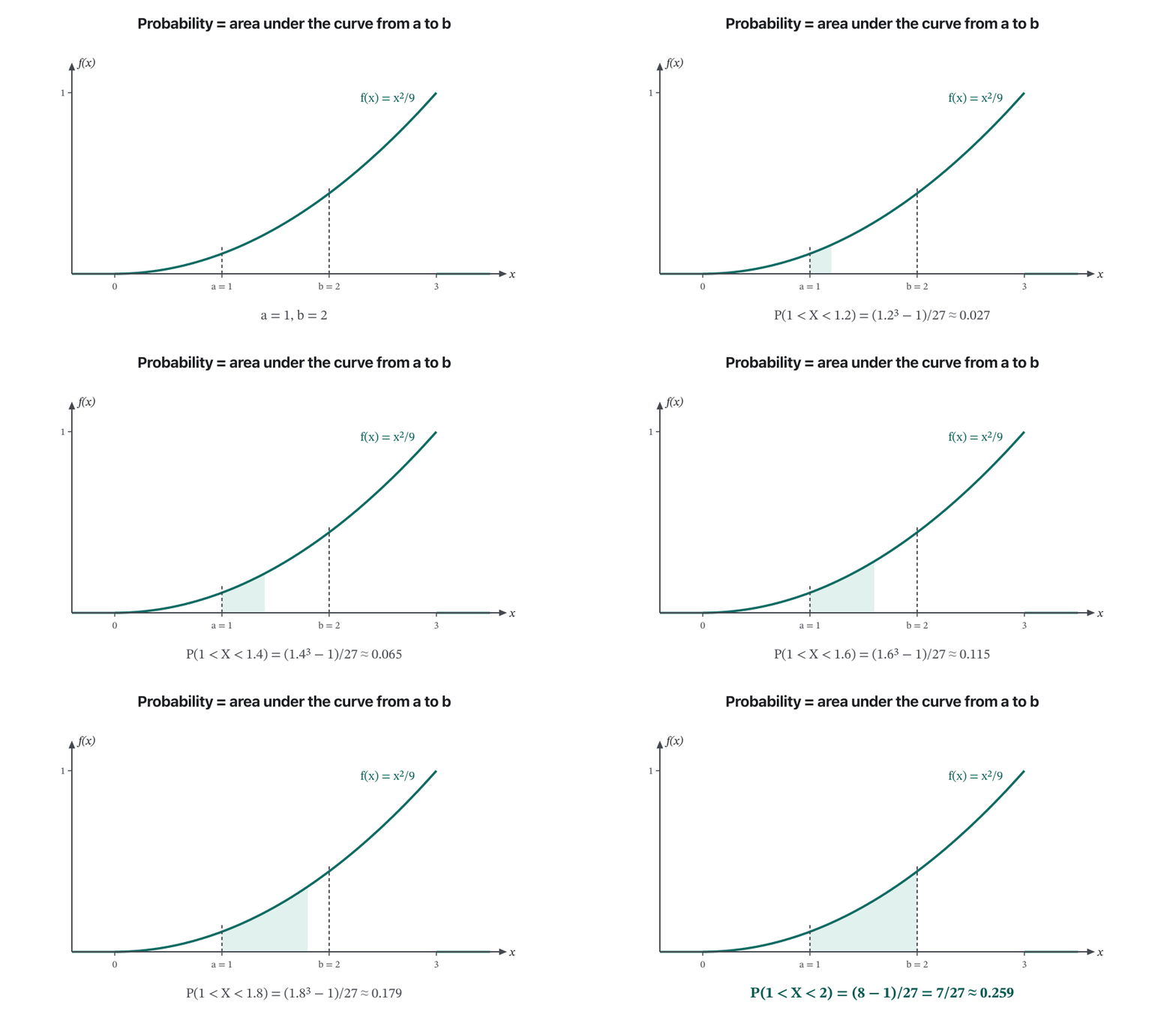
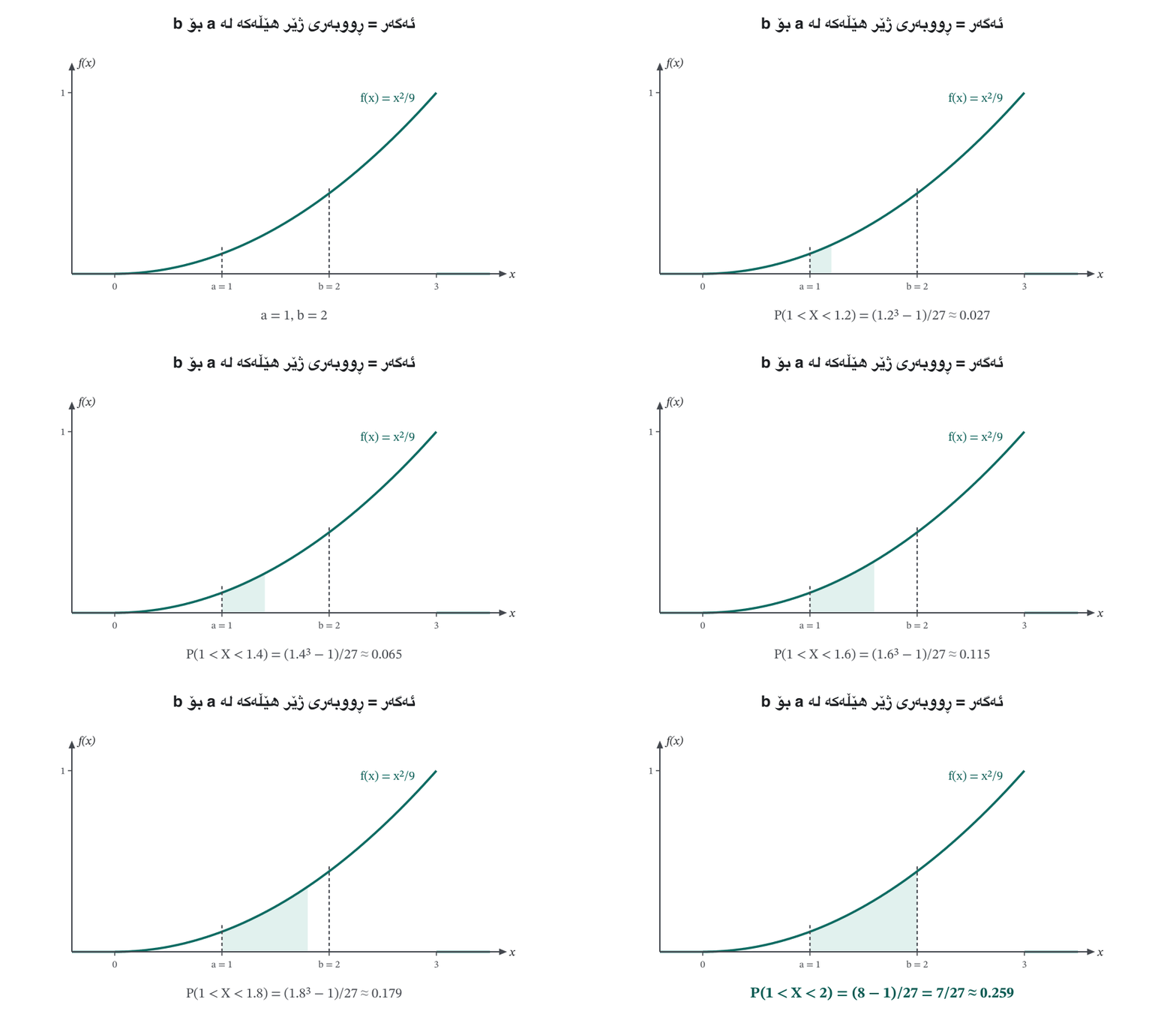
    P(1<X<2)=∫12x29 dx=[x327]12=827−127=727≈0.259P(1 < X < 2) = \int_1^2 \frac{x^2}{9}\,dx = \left[\frac{x^3}{27}\right]_1^2 = \frac{8}{27} - \frac{1}{27} = \frac{7}{27} \approx 0.259
The curve f(x) = x²/9 from 0 to 3. The area between x = 1 and x = 2 is shaded green and labelled 7/27 ≈ 0.259; the small area between 0 and 1 is shaded orange and labelled 1/27. A note says green + orange = the area from 0 to 2 = 8/27, the result when the lower limit is forgotten.هێڵی f(x) = x²/9 لە 0 تا 3. ڕووبەری نێوان x = 1 و x = 2 بە سەوز ڕەنگ کراوە و لەسەری نووسراوە 7/27 ≈ 0.259؛ ڕووبەرە بچووکەکەی نێوان 0 و 1 بە پرتەقاڵی ڕەنگ کراوە و لەسەری نووسراوە 1/27. تێبینییەک دەڵێت سەوز + پرتەقاڵی = ڕووبەری 0 تا 2 = 8/27، ئەو ئەنجامەی کاتێک سنووری خوارەوە لەبیر دەکرێت.
727\frac{7}{27} is the green area only; 827\frac{8}{27} also counts the orange part.727\frac{7}{27} تەنها ڕووبەرە سەوزەکەیە؛ 827\frac{8}{27} بەشە پرتەقاڵییەکەش دەژمێرێت.CêIT
Quick checkپشکنینی خێراWith f(x)=x29f(x) = \frac{x^2}{9} on (0,3)(0, 3), what is P(0<X<1)P(0 < X < 1)?بە f(x)=x29f(x) = \frac{x^2}{9} لە سەر (0,3)(0, 3)، P(0<X<1)P(0 < X < 1) چەندە؟

Example 5: find cc, then P(1<X<2)P(1 < X < 2)نموونەی 5: cc بدۆزەوە، پاشان P(1<X<2)P(1 < X < 2)

Watch the area fill upسەیری پڕبوونی ڕووبەرەکە بکە

Move the right edge from 1 towards 2 and watch P(1<X<t)=t3−127P(1 < X < t) = \frac{t^3 - 1}{27} grow until it reaches 727\frac{7}{27}.

لێواری ڕاست لە 1ـەوە بەرەو 2 ببە و سەیر بکە چۆن P(1<X<t)=t3−127P(1 < X < t) = \frac{t^3 - 1}{27} گەورە دەبێت تا دەگاتە 727\frac{7}{27}.

Animation: under f(x) = x²/9, with a = 1 and b = 2 marked, the shaded area starts at x = 1 and its right edge moves to 1.2, 1.4, 1.6, 1.8 and 2, with the values 0.027, 0.065, 0.115, 0.179 and finally P(1 < X < 2) = (8 − 1)/27 = 7/27 ≈ 0.259.
The area grows from 0 at x=1x = 1 to 727\frac{7}{27} at x=2x = 2.ڕووبەرەکە لە 0 (لە x=1x = 1) گەورە دەبێت تا 727\frac{7}{27} (لە x=2x = 2).CêIT

Example 6: a density that never endsنموونەی 6: چڕییەک کە کۆتایی نایەت

f(x)=1x2f(x) = \frac{1}{x^2} for 1<x<∞1 < x < \infty. Let A={x:1<x<2}A = \{x : 1 < x < 2\} and B={x:4<x<5}B = \{x : 4 < x < 5\}. Find P(A)P(A) and P(B)P(B). First, is the total area 1 even though the curve never stops?

f(x)=1x2f(x) = \frac{1}{x^2} بۆ 1<x<∞1 < x < \infty. با A={x:1<x<2}A = \{x : 1 < x < 2\} و B={x:4<x<5}B = \{x : 4 < x < 5\} بن. P(A)P(A) و P(B)P(B) بدۆزەوە. سەرەتا، ئایا کۆی ڕووبەر 1ـە، هەرچەندە هێڵەکە هەرگیز ناوەستێت؟

∫1∞dxx2=lim⁡t→∞[−1x]1t=lim⁡t→∞(1−1t)=1 ✓\int_1^{\infty} \frac{dx}{x^2} = \lim_{t\to\infty}\left[-\frac1x\right]_1^t = \lim_{t\to\infty}\left(1 - \frac1t\right) = 1 \ \checkmark

An area that goes on for ever can still be finite: the curve falls fast enough.

ڕووبەرێک کە بێکۆتا درێژ دەبێتەوە دەتوانێت هێشتا سنووردار بێت: هێڵەکە بە خێرایی پێویست دادەبەزێت.

P(A)=∫12dxx2=[−1x]12=−12−(−1)=12P(B)=∫45dxx2=[−1x]45=−15+14=120\begin{aligned} P(A) &= \int_1^2 \frac{dx}{x^2} = \left[-\frac1x\right]_1^2 = -\frac12 - (-1) = \frac12 \\ P(B) &= \int_4^5 \frac{dx}{x^2} = \left[-\frac1x\right]_4^5 = -\frac15 + \frac14 = \frac{1}{20} \end{aligned}

Both intervals have length 1, but A holds 10 times as much probability: the density is much higher near 1.

هەردوو درێژییان 1ـە، بەڵام ⁦A 10⁩ هێندە زیاتری تێدایە: چڕییەکە نزیک 1 زۆر بەرزترە.

The curve f(x) = 1/x² starting at height 1 at x = 1 and falling towards 0. The area from 1 to 2 is shaded green (A: 1/2); the thin area from 4 to 5 is shaded orange (B: 1/20). The curve goes on for ever, but the total area is 1.هێڵی f(x) = 1/x² کە لە بەرزیی 1 لە x = 1 دەست پێ دەکات و بەرەو 0 دادەبەزێت. ڕووبەری 1 تا 2 بە سەوز ڕەنگ کراوە (A: 1/2)؛ ڕووبەرە باریکەکەی 4 تا 5 بە پرتەقاڵی (B: 1/20). هێڵەکە بێکۆتا درێژ دەبێتەوە، بەڵام کۆی ڕووبەر 1ـە.
Same width, very different areas.هەمان پانی، ڕووبەری زۆر جیاواز.CêIT
Quick checkپشکنینی خێراWith f(x)=1x2f(x) = \frac{1}{x^2} for x>1x > 1, what is P(X>2)P(X > 2)?بە f(x)=1x2f(x) = \frac{1}{x^2} بۆ x>1x > 1، P(X>2)P(X > 2) چەندە؟

H.W 4: the exponential densityڕاهێنانی 4: چڕیی توانی

f(x)=e−xf(x) = e^{-x} for 0<x<∞0 < x < \infty (and 0 for x≤0x \le 0). (1) Show that it is a pdf. (2) Find P(0<X<1)P(0 < X < 1). (3) Find P(−1<X<1)P(-1 < X < 1).

f(x)=e−xf(x) = e^{-x} بۆ 0<x<∞0 < x < \infty (و 0 بۆ x≤0x \le 0). ⁦(1)⁩ نیشانی بدە کە . ⁦(2)⁩ P(0<X<1)P(0 < X < 1) بدۆزەوە. ⁦(3)⁩ P(−1<X<1)P(-1 < X < 1) بدۆزەوە.

(1)e−x>0,∫0∞e−xdx=lim⁡t→∞[−e−x]0t=lim⁡t→∞(1−e−t)=1(2)P(0<X<1)=[−e−x]01=1−e−1≈0.632(3)P(−1<X<1)=∫−100 dx+∫01e−xdx=0+0.632=0.632\begin{aligned} &(1)\quad e^{-x} > 0, \qquad \int_0^{\infty} e^{-x}dx = \lim_{t\to\infty}\left[-e^{-x}\right]_0^t = \lim_{t\to\infty}\left(1 - e^{-t}\right) = 1 \\ &(2)\quad P(0 < X < 1) = \left[-e^{-x}\right]_0^1 = 1 - e^{-1} \approx 0.632 \\ &(3)\quad P(-1 < X < 1) = \int_{-1}^{0} 0\,dx + \int_0^1 e^{-x}dx = 0 + 0.632 = 0.632 \end{aligned}

In (3) the integral is split at 0, because the formula e−xe^{-x} only holds for x>0x > 0; to the left of 0 the density is 0.

لە ⁦(3)⁩ لە 0 دابەش دەکرێت، چونکە e−xe^{-x} تەنها بۆ x>0x > 0 ڕاستە؛ لە چەپی 0 چڕییەکە 0ـە.

The exponential density f(x) = e⁻ˣ: zero for x < 0 (open dot at the origin), height 1 at x = 0 (filled dot), then falling smoothly towards 0. The area from 0 to 1 is shaded and labelled 1 − e⁻¹ ≈ 0.632; a note says f = 0 for x < 0, so P(−1 < X < 1) is the same area.چڕیی توانیی f(x) = e⁻ˣ: سفر بۆ x < 0 (خاڵی بەتاڵ لە سەرەتای تەوەرەکان)، بەرزیی 1 لە x = 0 (خاڵی پڕ)، پاشان بە نەرمی بەرەو 0 دادەبەزێت. ڕووبەری 0 تا 1 ڕەنگ کراوە و لەسەری نووسراوە 1 − e⁻¹ ≈ 0.632؛ تێبینییەک دەڵێت f = 0 بۆ x < 0، بۆیە P(−1 < X < 1) هەمان ڕووبەرە.
63% of the probability lies between 0 and 1.⁦63%⁩ی لە نێوان 0 و 1دایە.CêIT

This density has a name: the exponential distribution. It describes waiting times, such as the time until the next customer arrives at a shop or until a light bulb fails. The general form is f(x)=m e−mxf(x) = m\,e^{-mx} for x≥0x \ge 0, with mean waiting time 1m\frac1m; the course's example is m=1m = 1.

ئەم چڕییە ناوی هەیە: . کاتی چاوەڕوانی وەسف دەکات، وەک کات تا گەیشتنی کڕیاری داهاتوو بۆ دوکانێک یان تا سووتانی گڵۆپێک. شێوە گشتییەکەی f(x)=m e−mxf(x) = m\,e^{-mx}ـە بۆ x≥0x \ge 0، بە کاتی چاوەڕوانی 1m\frac1m؛ نموونەکەی کۆرسەکە m=1m = 1ـە.

Quick checkپشکنینی خێراFor f(x)=e−xf(x) = e^{-x}, what is P(X>1)P(X > 1)?بۆ f(x)=e−xf(x) = e^{-x}، P(X>1)P(X > 1) چەندە؟

Homework: find the constantڕاهێنانی ماڵەوە: نەگۆڕەکە بدۆزەوە

Several homework questions give a density with an unknown number in front (kk, KK, CC). The recipe is always the same: set the total area equal to 1 and solve. Then check rule (1): the function must not be negative anywhere on its interval.

چەند پرسیارێکی ماڵەوە چڕییەک دەدەن بە ژمارەیەکی نەناسراو لە پێشیەوە (kk، KK، CC). ڕێگاکە هەمیشە هەمانە: کۆی ڕووبەر بکە بە 1 و چارەسەری بکە. پاشان یاسای ⁦(1)⁩ بپشکنە: نەخشەکە نابێت لە هیچ شوێنێکی نەرێنی بێت.

Homework: find the constantڕاهێنانی ماڵەوە: نەگۆڕەکە بدۆزەوە

Kx2(3−x)Kx^2(3 - x): watch the intervalKx2(3−x)Kx^2(3 - x): ئاگاداری ماوەکە بە

Lecture 3 H.W 4 and Lecture 4 H.W 5: f(x)=Kx2(3−x)f(x) = Kx^2(3 - x) for 0<x<∞0 < x < \infty. Find KK (and, in Lecture 3, P(1<X<2)P(1 < X < 2)).

وانەی 3 ڕاهێنانی 4 و وانەی 4 ڕاهێنانی 5: f(x)=Kx2(3−x)f(x) = Kx^2(3 - x) بۆ 0<x<∞0 < x < \infty. KK بدۆزەوە (و لە وانەی 3دا P(1<X<2)P(1 < X < 2)).

∫03K(3x2−x3) dx=K[x3−x44]03=K(27−814)=274K=1  ⇒  K=427P(1<X<2)=427[x3−x44]12=427[(8−4)−(1−14)]=427⋅134=1327≈0.481\begin{aligned} \int_0^3 K(3x^2 - x^3)\,dx &= K\left[x^3 - \frac{x^4}{4}\right]_0^3 = K\left(27 - \frac{81}{4}\right) = \frac{27}{4}K = 1 \;\Rightarrow\; K = \frac{4}{27} \\ P(1 < X < 2) &= \frac{4}{27}\left[x^3 - \frac{x^4}{4}\right]_1^2 = \frac{4}{27}\left[(8 - 4) - \left(1 - \frac14\right)\right] = \frac{4}{27}\cdot\frac{13}{4} = \frac{13}{27} \approx 0.481 \end{aligned}

Multiply out first: x2(3−x)=3x2−x3x^2(3 - x) = 3x^2 - x^3, then use the power rule on each term. K=427K = \frac{4}{27} matches the answer noted in the course notes.

سەرەتا لێکی بدە: x2(3−x)=3x2−x3x^2(3 - x) = 3x^2 - x^3، پاشان یاسای توان لە سەر هەر بەشێک بەکار بهێنە. K=427K = \frac{4}{27} لەگەڵ ئەو وەڵامەی لە تێبینییەکانی کۆرسەکەدا نووسراوە یەک دەگرێتەوە.

Quick checkپشکنینی خێراWithout the fix, what would f(4)f(4) be for f(x)=427x2(3−x)f(x) = \frac{4}{27}x^2(3 - x)?بەبێ ڕاستکردنەوەکە، f(4)f(4) بۆ f(x)=427x2(3−x)f(x) = \frac{4}{27}x^2(3 - x) چەند دەبوو؟

Homework: find the constantڕاهێنانی ماڵەوە: نەگۆڕەکە بدۆزەوە

Cx e−xCx\,e^{-x}: integration by parts at workCx e−xCx\,e^{-x}: تەواوکاری بە بەشکردن لە کاردا

Lecture 3 H.W 5 and Lecture 4 H.W 6: f(x)=Cx e−xf(x) = Cx\,e^{-x} for 0<x<∞0 < x < \infty. Find CC. This is the homework the course notes solve in full; here is the same solution, step by step.

وانەی 3 ڕاهێنانی 5 و وانەی 4 ڕاهێنانی 6: f(x)=Cx e−xf(x) = Cx\,e^{-x} بۆ 0<x<∞0 < x < \infty. CC بدۆزەوە. ئەمە ئەو ڕاهێنانەیە کە تێبینییەکانی کۆرسەکە بە تەواوی چارەسەری دەکەن؛ ئەمە هەمان چارەسەرە، هەنگاو بە هەنگاو.

  1. Set upئامادەکردن

    C∫0∞x e−xdx=1C\int_0^\infty x\,e^{-x}dx = 1. Parts with u=xu = x, dv=e−xdxdv = e^{-x}dx, so du=dxdu = dx, v=−e−xv = -e^{-x}.

    C∫0∞x e−xdx=1C\int_0^\infty x\,e^{-x}dx = 1. بە بەشکردن: u=xu = x، dv=e−xdxdv = e^{-x}dx، بۆیە du=dxdu = dx، v=−e−xv = -e^{-x}.

  2. Antiderivativeپێچەوانەی مشتەق

    ∫xe−xdx=−xe−x−∫(−e−x)dx=−xe−x−e−x+C1\int x e^{-x}dx = -x e^{-x} - \int(-e^{-x})dx = -x e^{-x} - e^{-x} + C_1.

    ∫xe−xdx=−xe−x−∫(−e−x)dx=−xe−x−e−x+C1\int x e^{-x}dx = -x e^{-x} - \int(-e^{-x})dx = -x e^{-x} - e^{-x} + C_1.

  3. Limitsسنوورەکان

    At ∞\infty: lim⁡x→∞(−xe−x−e−x)=0−0\lim_{x\to\infty}(-xe^{-x} - e^{-x}) = 0 - 0. At 0: −0⋅1−1=−1-0 \cdot 1 - 1 = -1. So the area is 0−(−1)=10 - (-1) = 1.

    لە ∞\infty: lim⁡x→∞(−xe−x−e−x)=0−0\lim_{x\to\infty}(-xe^{-x} - e^{-x}) = 0 - 0. لە 0: −0⋅1−1=−1-0 \cdot 1 - 1 = -1. کەواتە ڕووبەرەکە 0−(−1)=10 - (-1) = 1ـە.

  4. Answerوەڵام

    C⋅1=1⇒C=1C \cdot 1 = 1 \Rightarrow C = 1: f(x)=x e−xf(x) = x\,e^{-x} is already a pdf.

    C⋅1=1⇒C=1C \cdot 1 = 1 \Rightarrow C = 1: f(x)=x e−xf(x) = x\,e^{-x} خۆی .

The tabular shortcut gives the same antiderivative: derivatives x,1,0x, 1, 0 with signs +,−+, - against integrals e−x,−e−x,e−xe^{-x}, -e^{-x}, e^{-x}: −xe−x−e−x-xe^{-x} - e^{-x}.

ڕێگای خشتەیی هەمان پێچەوانەی دەدات: x,1,0x, 1, 0 بە نیشانەکانی +,−+, - بەرامبەر e−x,−e−x,e−xe^{-x}, -e^{-x}, e^{-x}: −xe−x−e−x-xe^{-x} - e^{-x}.

The CDF of a continuous variableنەخشەی دابەشبوونی کەڵەکەبووی گۆڕاوی بەردەوام

The cumulative distribution function is the area to the left of xx. Going the other way, the density is the slope of the CDF:

نەخشەی دابەشبوونی کەڵەکەبوو ڕووبەری لای چەپی xxـە. بە پێچەوانەوە، چڕییەکە لێژیی :

F(x)=P(X≤x)=∫−∞xf(u) du,f(x)=dFdx=F′(x)F(x) = P(X \le x) = \int_{-\infty}^{x} f(u)\,du, \qquad f(x) = \frac{dF}{dx} = F'(x)
  1. Example 7 (= Lecture 3 H.W 6): from ff to FFنموونەی 7 (وانەی 3، ڕاهێنانی ⁦6⁩): لە ffـەوە بۆ FF

    f(x)=1x2f(x) = \frac{1}{x^2}, x≥1x \ge 1: F(x)=∫1xduu2=[−1u]1x=1−1xF(x) = \int_1^x \frac{du}{u^2} = \left[-\frac1u\right]_1^x = 1 - \frac1x for x≥1x \ge 1, and F(x)=0F(x) = 0 for x<1x < 1. Check: (1−1x)′=1x2\left(1 - \frac1x\right)' = \frac{1}{x^2} ✓.

    f(x)=1x2f(x) = \frac{1}{x^2}، x≥1x \ge 1: F(x)=∫1xduu2=[−1u]1x=1−1xF(x) = \int_1^x \frac{du}{u^2} = \left[-\frac1u\right]_1^x = 1 - \frac1x بۆ x≥1x \ge 1 و F(x)=0F(x) = 0 بۆ x<1x < 1. پشکنین: (1−1x)′=1x2\left(1 - \frac1x\right)' = \frac{1}{x^2} ✓.

  2. Example 8: from FF to ffنموونەی 8: لە FFـەوە بۆ ff

    F(x)=x3F(x) = x^3 on 0<x<10 < x < 1: f(x)=3x2f(x) = 3x^2 on (0,1)(0, 1).

    F(x)=x3F(x) = x^3 لە سەر 0<x<10 < x < 1: f(x)=3x2f(x) = 3x^2 لە سەر (0,1)(0, 1).

  3. H.W 7 (Lecture 4)ڕاهێنانی 7 (وانەی ⁦4⁩)

    F(x)=14x2F(x) = \frac14 x^2 on 0<x<20 < x < 2: f(x)=14⋅2x=x2f(x) = \frac14 \cdot 2x = \frac{x}{2}, the triangle density from the start of this lesson.

    F(x)=14x2F(x) = \frac14 x^2 لە سەر 0<x<20 < x < 2: f(x)=14⋅2x=x2f(x) = \frac14 \cdot 2x = \frac{x}{2}، چڕییە سێگۆشەییەکەی سەرەتای ئەم وانەیە.

Left: the density f(x) = 1/x² for x ≥ 1 with the area from 1 to 3 shaded and labelled 2/3. Right: its CDF F(x) = 1 − 1/x, zero before 1 and rising towards 1, with the point (3, 2/3) marked. Arrows between them: 'add up area' to the right, 'f = F′' to the left.چەپ: چڕیی f(x) = 1/x² بۆ x ≥ 1 کە ڕووبەری 1 تا 3 ڕەنگ کراوە و لەسەری نووسراوە 2/3. ڕاست: نەخشەی دابەشبوونی کەڵەکەبووەکەی F(x) = 1 − 1/x، سفر پێش 1 و بەرز دەبێتەوە بەرەو 1، خاڵی (3، 2/3) نیشان کراوە. تیرەکانی نێوانیان: «ڕووبەر کۆ بکەرەوە» بەرەو ڕاست، «f = F′» بەرەو چەپ.
The shaded area under ff from 1 to 3 is the height of FF at 3.ڕووبەری ڕەنگکراوی ژێر ff لە 1 تا 3 بەرزیی FFـە لە 3.CêIT

For Example 5 the same idea gives F(x)=x327F(x) = \frac{x^3}{27} on [0,3][0, 3], and P(1<X<2)=F(2)−F(1)=8−127P(1 < X < 2) = F(2) - F(1) = \frac{8 - 1}{27} again.

بۆ نموونەی 5 هەمان بیرۆکە دەدات F(x)=x327F(x) = \frac{x^3}{27} لە سەر [0,3][0, 3] و دووبارە P(1<X<2)=F(2)−F(1)=8−127P(1 < X < 2) = F(2) - F(1) = \frac{8 - 1}{27}.

Quick checkپشکنینی خێراF(x)=1−1xF(x) = 1 - \frac1x for x≥1x \ge 1. What is P(2<X<4)P(2 < X < 4)?F(x)=1−1xF(x) = 1 - \frac1x بۆ x≥1x \ge 1. P(2<X<4)P(2 < X < 4) چەندە؟

Common mistakesهەڵە باوەکان

  • Forgetting the lower limit. [G(x)]ab=G(b)−G(a)[G(x)]_a^b = G(b) - G(a), not just G(b)G(b). This is the 827\frac{8}{27} versus 727\frac{7}{27} mistake.
  • Reading f(x)f(x) as a probability. Only areas are probabilities; f(x)f(x) can be 2 or 10.
  • Using the formula outside its interval. e−xe^{-x} only holds for x>0x > 0; to the left the density is 0. Kx2(3−x)Kx^2(3 - x) only works on (0,3)(0, 3).
  • Arithmetic with ∞\infty. Write lim⁡x→∞xe−x=0\lim_{x\to\infty} xe^{-x} = 0, not “∞⋅e−∞=0\infty \cdot e^{-\infty} = 0”.
  • Wrong factor for exponentials. ∫eaxdx=1aeax+C\int e^{ax}dx = \frac1a e^{ax} + C: divide by aa, keep the power.
  • Worrying about << and ≤\le. For a continuous XX they give the same probability; for a discrete XX they do not.
  • لەبیرکردنی سنووری خوارەوە. [G(x)]ab=G(b)−G(a)[G(x)]_a^b = G(b) - G(a)، نەک تەنها G(b)G(b). ئەمە هەڵەی 827\frac{8}{27} بەرامبەر 727\frac{7}{27}ـە.
  • خوێندنەوەی f(x)f(x) وەک . تەنها ڕووبەرەکان ؛ f(x)f(x) دەتوانێت 2 یان ⁦10⁩ بێت.
  • بەکارهێنانی لە دەرەوەی . e−xe^{-x} تەنها بۆ x>0x > 0 ڕاستە؛ لە چەپ چڕییەکە 0ـە. Kx2(3−x)Kx^2(3 - x) تەنها لە سەر (0,3)(0, 3) کار دەکات.
  • ژماردن لەگەڵ ∞\infty. بنووسە lim⁡x→∞xe−x=0\lim_{x\to\infty} xe^{-x} = 0، نەک «∞⋅e−∞=0\infty \cdot e^{-\infty} = 0».
  • هۆکاری هەڵە بۆ . ∫eaxdx=1aeax+C\int e^{ax}dx = \frac1a e^{ax} + C: دابەشی بکە بەسەر aaدا و توانەکە بهێڵەرەوە.
  • نیگەرانی دەربارەی << و ≤\le. بۆ XXـی بەردەوام هەمان دەدەن؛ بۆ XXـی پچڕاو نا.

Exercisesڕاهێنانەکان

ExerciseڕاهێنانA triangle densityچڕییەکی سێگۆشەیی

f(x)=x2f(x) = \frac{x}{2} on [0,2][0, 2]. Find P(X>1)P(X > 1) in two ways: with geometry and with an integral.

f(x)=x2f(x) = \frac{x}{2} لە سەر [0,2][0, 2]. P(X>1)P(X > 1) بە دوو ڕێگا بدۆزەوە: بە ئەندازە و بە .

Show answerوەڵامەکە پیشان بدە

Geometry: the whole triangle has area 1 and the part from 0 to 1 is a small triangle of area 12⋅1⋅12=14\frac12 \cdot 1 \cdot \frac12 = \frac14, so P(X>1)=1−14=34P(X > 1) = 1 - \frac14 = \frac34.

ئەندازە: هەموو سێگۆشەکە ڕووبەری 1ـە و بەشی 0 تا 1 سێگۆشەیەکی بچووکە بە ڕووبەری 12⋅1⋅12=14\frac12 \cdot 1 \cdot \frac12 = \frac14، بۆیە P(X>1)=1−14=34P(X > 1) = 1 - \frac14 = \frac34.

∫12x2 dx=[x24]12=1−14=34\int_1^2 \frac{x}{2}\,dx = \left[\frac{x^2}{4}\right]_1^2 = 1 - \frac14 = \frac34
ExerciseڕاهێنانFrom FF to ff to a probabilityلە FFـەوە بۆ ff و بۆ ئەگەر

A waiting time has F(x)=1−e−2xF(x) = 1 - e^{-2x} for x≥0x \ge 0 (in hours). Find the density ff and P(X>1)P(X > 1).

کاتێکی چاوەڕوانی F(x)=1−e−2xF(x) = 1 - e^{-2x}ـی هەیە بۆ x≥0x \ge 0 (بە کاتژمێر). چڕیی ff و P(X>1)P(X > 1) بدۆزەوە.

Show answerوەڵامەکە پیشان بدە
f(x)=F′(x)=2e−2x,P(X>1)=1−F(1)=e−2≈0.135f(x) = F'(x) = 2e^{-2x}, \qquad P(X > 1) = 1 - F(1) = e^{-2} \approx 0.135

This is the exponential distribution with m=2m = 2: on average a wait of 12\frac12 hour.

ئەمە بە m=2m = 2: بە تێکڕا نیو کاتژمێر چاوەڕوانی.

ExerciseڕاهێنانExample 8, one step furtherنموونەی 8، هەنگاوێک زیاتر

With F(x)=x3F(x) = x^3 on (0,1)(0, 1), find P(X<12)P(X < \frac12) from FF and from ff.

بە F(x)=x3F(x) = x^3 لە سەر (0,1)(0, 1)، P(X<12)P(X < \frac12) لە FF و لە ff بدۆزەوە.

Show answerوەڵامەکە پیشان بدە
F(12)=18,∫01/23x2 dx=[x3]01/2=18F\left(\tfrac12\right) = \tfrac18, \qquad \int_0^{1/2} 3x^2\,dx = \left[x^3\right]_0^{1/2} = \tfrac18
ExerciseڕاهێنانIs it a pdf?نەخشەی چڕیی ئەگەرە؟

Which of these are pdfs? (a) f(x)=2xf(x) = 2x on [0,1][0, 1]; (b) f(x)=x−1f(x) = x - 1 on [0,2][0, 2]; (c) f(x)=38x2f(x) = \frac{3}{8}x^2 on [0,2][0, 2].

کامیان ؟ (أ) f(x)=2xf(x) = 2x لە سەر [0,1][0, 1]؛ (ب) f(x)=x−1f(x) = x - 1 لە سەر [0,2][0, 2]؛ (ج) f(x)=38x2f(x) = \frac{3}{8}x^2 لە سەر [0,2][0, 2].

Show answerوەڵامەکە پیشان بدە

(a) Yes: ∫012x dx=1\int_0^1 2x\,dx = 1 and 2x≥02x \ge 0. (b) No: x−1<0x - 1 < 0 for x<1x < 1 (its total area is 0). (c) Yes: ∫0238x2dx=38⋅83=1\int_0^2 \frac38 x^2 dx = \frac38 \cdot \frac83 = 1.

(أ) بەڵێ: ∫012x dx=1\int_0^1 2x\,dx = 1 و 2x≥02x \ge 0. (ب) نەخێر: x−1<0x - 1 < 0 بۆ x<1x < 1 (کۆی ڕووبەرەکەی 0ـە). (ج) بەڵێ: ∫0238x2dx=38⋅83=1\int_0^2 \frac38 x^2 dx = \frac38 \cdot \frac83 = 1.

Summaryکورتە

  • A continuous random variable takes any value in an interval; probabilities are areas under its density ff.
  • A pdf satisfies f(x)≥0f(x) \ge 0 and total area 1. f(x)f(x) itself is not a probability and can exceed 1.
  • P(X=a)=0P(X = a) = 0, so << and ≤\le give the same answers. The uniform density is a rectangle; the exponential density e−xe^{-x} describes waiting times.
  • Tools: ∫abf(x) dx=G(b)−G(a)\int_a^b f(x)\,dx = G(b) - G(a); the power rule; ∫eaxdx=1aeax+C\int e^{ax}dx = \frac1a e^{ax} + C; limits at ∞\infty; integration by parts with LIPET.
  • Course answers: c=19c = \frac19 and P(1<X<2)=727P(1 < X < 2) = \frac{7}{27} (not 827\frac{8}{27}); for 1x2\frac{1}{x^2}: P(A)=12P(A) = \frac12, P(B)=120P(B) = \frac{1}{20}; for e−xe^{-x}: 0.632; K=427K = \frac{4}{27} on (0,3)(0, 3); C=1C = 1; F(x)=1−1xF(x) = 1 - \frac1x; f(x)=3x2f(x) = 3x^2 and x2\frac{x}{2}.
  • F(x)=∫−∞xf(u) duF(x) = \int_{-\infty}^{x} f(u)\,du, and f=F′f = F'.
  • هەر بەهایەکی ناو وەردەگرێت؛ ڕووبەرەکانی ژێر چڕییەکەی ffـن.
  • مەرجەکانی f(x)≥0f(x) \ge 0 و کۆی ڕووبەر 1 دەپارێزێت. خودی f(x)f(x) نییە و دەتوانێت لە 1 زیاتر بێت.
  • P(X=a)=0P(X = a) = 0، بۆیە << و ≤\le هەمان وەڵام دەدەن. چڕیی یەکنەواخت لاکێشەیەکە؛ چڕیی توانیی e−xe^{-x} کاتی چاوەڕوانی وەسف دەکات.
  • ئامرازەکان: ∫abf(x) dx=G(b)−G(a)\int_a^b f(x)\,dx = G(b) - G(a)؛ یاسای توان؛ ∫eaxdx=1aeax+C\int e^{ax}dx = \frac1a e^{ax} + C؛ لە ∞\infty؛ بە LIPET.
  • وەڵامەکانی کۆرسەکە: c=19c = \frac19 و P(1<X<2)=727P(1 < X < 2) = \frac{7}{27} (نەک 827\frac{8}{27})؛ بۆ 1x2\frac{1}{x^2}: P(A)=12P(A) = \frac12، P(B)=120P(B) = \frac{1}{20}؛ بۆ e−xe^{-x}: ⁦0.632⁩؛ K=427K = \frac{4}{27} لە سەر (0,3)(0, 3)؛ C=1C = 1؛ F(x)=1−1xF(x) = 1 - \frac1x؛ f(x)=3x2f(x) = 3x^2 و x2\frac{x}{2}.
  • F(x)=∫−∞xf(u) duF(x) = \int_{-\infty}^{x} f(u)\,du و f=F′f = F'.

Next: the average value of a random variable, discrete or continuous, in Expected Value.

دواتر: بەهای ناوەندیی ، پچڕاو یان بەردەوام، لە نرخی پێشبینیکراو.

Videoڤیدیۆ

Watch a videoسەیری ڤیدیۆیەک بکە

A video that viewers liked a lot and praised in their comments, chosen for this lesson.ڤیدیۆیەک کە بینەران زۆریان پێ خۆش بووە و لە کۆمێنتەکانیاندا ستایشیان کردووە، بۆ ئەم وانەیە هەڵبژێردراوە.

What is a Probability Density Function (pdf)? ("by far the best and easy to understand explanation")Iain Explains Signals, Systems, and Digital Comms · Englishئینگلیزی · 216K viewsبینین · 5.1K likesلایک

A histogram of measured times becomes a smooth curve; the area under that curve between two values is the probability.

کاتە پێوراوەکان دەبێتە هێڵێکی چەماوەی نەرم؛ ڕووبەری ژێر ئەو هێڵە لە نێوان دوو نرخدا .

Whole video: from histogram bars to a density curve, then the definition of a pdf as an area (integral).

هەموو ڤیدیۆکە: لە ستوونەکانی بۆ هێڵی چەماوەی چڕی، پاشان پێناسەی وەک ڕووبەر ().

Lesson complete!وانەکە تەواو بوو!

Well done. Review the key terms, then go on to the next lesson.دەستخۆش. سەیرێکی زاراوە سەرەکییەکان بکەرەوە، پاشان بڕۆ بۆ وانەی داهاتوو.

Key termsزاراوە سەرەکییەکان

Next lessonوانەی داهاتوو

Expected Value (Mathematical Expectation)نرخی پێشبینیکراو (چاوەڕوانیی بیرکاری)

References and further readingسەرچاوەکان و خوێندنەوەی زیاتر

This lecture is a first edition. The Kurdish text and terminology are waiting for review by Kurdish IT teachers.ئەم وانەیە چاپی یەکەمە. دەقە کوردییەکە و زاراوەکانی چاوەڕێی پێداچوونەوەی مامۆستایانی کوردی بواری IT ن.