Chapterبەش 4 · Lectureوانە 4.3

Inverse Functions and Inverse Trigonometric Functionsپێچەوانەکانی نەخشە و نەخشە سێگۆشەییە پێچەوانەکان

What an inverse function is and when it exists: one-to-one functions, the horizontal line test, finding f−1f^{-1}, the mirror image in y=xy=x and restricted domains — then the six inverse trigonometric functions with their domains and ranges.

چییە و کەی هەیە: ، ، دۆزینەوەی f−1f^{-1}، وێنەی ئاوێنەیی بەرامبەر y=xy=x و سنووردارکردنی — پاشان ، هەر شەشیان، لەگەڵ و .

13 min read14 خولەک خوێندنەوە · 16 stepsهەنگاو

What you will learnچی فێر دەبیت

  • Explain what an inverse function does and why only one-to-one functions have one.
  • Use the horizontal line test and find f−1f^{-1} algebraically, checking both compositions.
  • Sketch f−1f^{-1} as the reflection of ff in y=xy=x and restrict a domain to make a function invertible.
  • State the domains and ranges of the six inverse trigonometric functions and evaluate them exactly.
  • ڕوونی بکەیتەوە چی دەکات و بۆچی تەنها پێچەوانەیان هەیە.
  • بەکار بهێنیت و f−1f^{-1} بە جەبر بدۆزیتەوە و هەردوو ئاوێتەکردنەکە بپشکنیت.
  • f−1f^{-1} وەک ff بەرامبەر y=xy=x بکێشیت و سنووردار بکەیت بۆ ئەوەی پێچەوانەی هەبێت.
  • و (هەر شەشیان) بڵێیت و بە وردی هەژماریان بکەیت.

Undoing a functionهەڵوەشاندنەوەی کاری نەخشەیەک

Chapter Two lists inverse trigonometric functions (and, later, logarithms) but never says what an inverse is. This lesson fills that gap first. The idea is simple: a function takes an input to an output; its inverse takes the output back to the input.

بەشی دووەمی تێبینییەکان (و دواتر لۆگاریتمەکان) دەنووسێت، بەڵام هەرگیز ناڵێت پێچەوانە چییە. ئەم وانەیە سەرەتا ئەو کەلێنە پڕ دەکاتەوە. بیرۆکەکە سادەیە: نرخێک دەبات بۆ ئەنجامێک؛ پێچەوانەکەی ئەنجامەکە دەگەڕێنێتەوە بۆ نرخە سەرەتاییەکە.

Take f(x)=2x+3f(x)=2x+3: “double, then add 3”. To undo it, do the opposite steps in the opposite order: “subtract 3, then halve”. So the inverse is f−1(x)=x−32f^{-1}(x)=\frac{x-3}{2}. Check: f(4)=11f(4)=11 and f−1(11)=11−32=4f^{-1}(11)=\frac{11-3}{2}=4.

f(x)=2x+3f(x)=2x+3 وەربگرە: «دوو هێندەی بکە، پاشان 3 زیاد بکە». بۆ هەڵوەشاندنەوەی، هەنگاوە پێچەوانەکان بە ڕیزبەندیی پێچەوانە بکە: «3 لێ دەربکە، پاشان نیوەی بکە». کەواتە پێچەوانەکەی f−1(x)=x−32f^{-1}(x)=\frac{x-3}{2}ـە. پشکنین: f(4)=11f(4)=11 و f−1(11)=11−32=4f^{-1}(11)=\frac{11-3}{2}=4.

Two ovals: X with 1, 2, 3, 4 and Y with 5, 7, 9, 11. Green arrows labelled f(x) = 2x + 3, “double, then add 3”, go from 1 to 5, 2 to 7, 3 to 9 and 4 to 11. Orange arrows labelled f⁻¹(x) = (x − 3)/2, “subtract 3, then halve”, go back from each number in Y to the number it came from in X.دوو هێلکەیی: X بە 1، 2، 3، 4 و Y بە 5، 7، 9، 11. تیرە سەوزەکان بە ناونیشانی f(x) = 2x + 3، «دوو هێندەی بکە، پاشان 3 زیاد بکە»، لە 1ـەوە دەچن بۆ 5، لە 2ـەوە بۆ 7، لە 3ـەوە بۆ 9 و لە 4ـەوە بۆ 11. تیرە پرتەقاڵییەکان بە ناونیشانی f⁻¹(x) = (x − 3)/2، «3 لێ دەربکە، پاشان نیوەی بکە»، لە هەر ژمارەیەکی Yـەوە دەگەڕێنەوە بۆ ئەو ژمارەیەی Xـی کە لێیەوە هاتووە.
ff takes every xx to its yy; f−1f^{-1} brings every yy back.ff هەر xxێک دەبات بۆ yyـی خۆی؛ f−1f^{-1} هەر yyێک دەگەڕێنێتەوە.CêIT
Everyday analogyنموونەیەک لە ژیانی ڕۆژانەوە

In the bazaar a money changer turns dinars into dollars at a fixed rate. Changing the dollars back at the same rate gives you exactly the dinars you started with. The second exchange is the inverse of the first.

لە بازاڕدا سەرافێک بە نرخێکی جێگیر دینار دەکاتە دۆلار. گۆڕینەوەی دۆلارەکان بە هەمان نرخ ڕێک ئەو دینارانەت دەداتەوە کە پێی دەستت پێکرد. گۆڕینەوەی دووەم پێچەوانەی یەکەمە.

Where the analogy stops workingسنووری ئەم نموونەیە

Real money changers buy and sell at slightly different rates, so in real life you lose a little. A mathematical inverse gives back the input exactly.

سەرافی ڕاستەقینە بە دوو نرخی کەمێک جیاواز دەکڕێت و دەفرۆشێت، بۆیە لە ژیانی ڕاستەقینەدا کەمێک دەدۆڕێنیت. بیرکاری ڕێک هەمان نرخی سەرەتا دەداتەوە.

Quick checkپشکنینی خێراg(x)=x2−5g(x)=\frac{x}{2}-5 means “halve, then subtract 5”. What undoes it?g(x)=x2−5g(x)=\frac{x}{2}-5 واتە «نیوەی بکە، پاشان 5 لێ دەربکە». چی کارەکەی هەڵدەوەشێنێتەوە؟

Inverse Functions - GCSE Higher Maths1st Class Maths · Englishئینگلیزی · 378K viewsبینین · 6.1K likesلایک · Partبەشی 0:00–3:52 (ofلە 11:00)

A function as a machine of steps, and its inverse as the opposite steps in reverse order, with a first worked example.

وەک ئامێرێک لە چەند هەنگاوێک و وەک هەنگاوە پێچەوانەکان لە دواوە بۆ پێشەوە، لەگەڵ یەکەم نموونەی چارەسەرکراو.

Watch 0:00–3:52: what an inverse function is (function machines) and the first example of finding one.

لە ⁦0:00⁩ تا ⁦3:52⁩ سەیر بکە: چییە (ئامێری ) و یەکەم نموونەی دۆزینەوەی.

Definition and notationپێناسە و نیشانەکان

Definitionپێناسە

The function f−1f^{-1} that undoes f: if f(a)=bf(a)=b then f−1(b)=af^{-1}(b)=a. Only a function has one; its graph is the mirror image of f's graph in the line y=xy=x.

نەخشەی f−1f^{-1} کە کاری f هەڵدەوەشێنێتەوە: ئەگەر f(a)=bf(a)=b، ئەوا f−1(b)=af^{-1}(b)=a. تەنها پێچەوانەی هەیە؛ هێڵکارییەکەی وێنەی ئاوێنەی هێڵکاریی fـە بەرامبەر هێڵی y=xy=x.

Let ff be a one-to-one function with domain DD and range RR. Its inverse f−1f^{-1} has domain RR and range DD, and

با ff بێت بە DD و RR. پێچەوانەکەی، f−1f^{-1}، RRـە و DDـە و

f−1(y)=x  ⟺  f(x)=yf^{-1}(y)=x\iff f(x)=y

Domain and range swap places.

و جێگۆڕکێ دەکەن.

f−1(f(x))=xf(f−1(y))=yf^{-1}\big(f(x)\big)=x\qquad\qquad f\big(f^{-1}(y)\big)=y

The first holds for every xx in DD, the second for every yy in RR. Doing ff and then f−1f^{-1} (or the other way round) changes nothing: the composition of the two acts like the identity function.

یەکەمیان بۆ هەموو xxێک لە DD ڕاستە و دووەمیان بۆ هەموو yyێک لە RR. کردنی ff و پاشان f−1f^{-1} (یان بە پێچەوانەوە) هیچ ناگۆڕێت: ئاوێتەکردنی نەخشەکانی هەردووکیان وەک نەخشەی هەرئەوێتی کار دەکات.

Quick checkپشکنینی خێراA one-to-one function has f(2)=9f(2)=9. What is f−1(9)f^{-1}(9)? f(2)=9f(2)=9ـی هەیە. f−1(9)f^{-1}(9) چەندە؟

Only one-to-one functions have an inverseتەنها نەخشە یەک بۆ یەکەکان پێچەوانەیان هەیە

Look at f(x)=x2f(x)=x^2. It sends both 22 and −2-2 to 44. An inverse would have to send 44 back to 22 and to −2-2 at the same time — but a function gives only one output for each input. So a function has an inverse only when it is one-to-one: different inputs always give different outputs (see one-to-one functions).

سەیری f(x)=x2f(x)=x^2 بکە. هەم 22 و هەم −2-2 دەبات بۆ 44. پێچەوانەیەک دەبێت 44 لە یەک کاتدا بگەڕێنێتەوە بۆ 22 و بۆ −2-2 — بەڵام بۆ هەر نرخێک تەنها یەک ئەنجام دەدات. کەواتە تەنها کاتێک پێچەوانەی هەیە کە یەک بۆ یەک بێت: نرخی جیاواز هەمیشە ئەنجامی جیاواز دەدات (بڕوانە نەخشە یەک بۆ یەکەکان).

Two graphs. Left: the parabola y = x² with the dashed horizontal line y = 4 crossing it at two points, x = −2 and x = 2; text: the line y = 4 meets it twice, so it is not one-to-one and has no inverse on ℝ. Right: the curve y = x³ with the same line crossing it once; text: every horizontal line meets it only once, so it is one-to-one and has an inverse.دوو هێڵکاری. چەپ: بڕگەی هاوتای y = x² لەگەڵ هێڵی ئاسۆیی پچڕپچڕی y = 4 کە لە دوو خاڵدا دەیبڕێت، x = −2 و x = 2؛ دەق: هێڵی y = 4 دوو جار دەیبڕێت، بۆیە نەخشەی یەک بۆ یەک نییە و لەسەر ℝ پێچەوانەی نییە. ڕاست: هێڵی y = x³ کە هەمان هێڵ یەک جار دەیبڕێت؛ دەق: هەر هێڵێکی ئاسۆیی تەنها یەک جار دەیبڕێت، بۆیە نەخشەی یەک بۆ یەکە و پێچەوانەی هەیە.
The horizontal line test: x2x^2 fails, x3x^3 passes.: x2x^2 دەکەوێت، x3x^3 دەردەچێت.CêIT

You met this test in the horizontal line test. Why does it fit inverses so well? A horizontal line y=cy=c collects every input that gives the output cc. One hit means exactly one input — just what f−1(c)f^{-1}(c) needs.

ئەم تاقیکردنەوەیەت لە تاقیکردنەوەی هێڵی ئاسۆیی ناسی. بۆچی ئەوەندە بۆ پێچەوانە گونجاوە؟ هێڵی ئاسۆیی y=cy=c هەموو ئەو نرخانە کۆ دەکاتەوە کە ئەنجامی cc دەدەن. یەک خاڵی بڕین واتە ڕێک یەک نرخ — ڕێک ئەوەی f−1(c)f^{-1}(c) پێویستی پێیەتی.

Quick checkپشکنینی خێراWhich function has an inverse on the whole real line?کام لەسەر هەموو پێچەوانەی هەیە؟

Finding the inverse step by stepدۆزینەوەی پێچەوانە هەنگاو بە هەنگاو

The methodڕێگاکە
  1. Check that ff is one-to-one (horizontal line test or algebra).

    دڵنیا ببەرەوە کە ff ( یان جەبر).

  2. Write y=f(x)y=f(x) and solve the equation for xx.

    بنووسە y=f(x)y=f(x) و بۆ xx شیکار بکە.

  3. Swap the letters xx and yy. The result is y=f−1(x)y=f^{-1}(x).

    پیتەکانی xx و yy جێگۆڕکێ پێ بکە. ئەنجامەکە y=f−1(x)y=f^{-1}(x)ـە.

  4. Check both compositions: f(f−1(x))=xf\big(f^{-1}(x)\big)=x and f−1(f(x))=xf^{-1}\big(f(x)\big)=x. The domain of f−1f^{-1} is the range of ff.

    هەردوو ئاوێتەکردنەکە بپشکنە: f(f−1(x))=xf\big(f^{-1}(x)\big)=x و f−1(f(x))=xf^{-1}\big(f(x)\big)=x. f−1f^{-1} هەمان ffـە.

Two worked examplesدوو نموونەی چارەسەرکراو
  1. f(x)=2x+3f(x)=2x+3f(x)=2x+3f(x)=2x+3

    Solve y=2x+3y=2x+3 for xx, swap, and check:

    y=2x+3y=2x+3 بۆ xx شیکار بکە، جێگۆڕکێیان پێ بکە و بیپشکنە:

    y=2x+3 ⇒ x=y−32 ⇒ f−1(x)=x−32;f(f−1(x))=2⋅x−32+3=x ✓y=2x+3\ \Rightarrow\ x=\frac{y-3}{2}\ \Rightarrow\ f^{-1}(x)=\frac{x-3}{2};\qquad f\big(f^{-1}(x)\big)=2\cdot\frac{x-3}{2}+3=x\ \checkmark
  2. f(x)=x3+1f(x)=x^3+1f(x)=x3+1f(x)=x^3+1

    x3+1x^3+1 is one-to-one on R\mathbb{R}, so the inverse exists everywhere:

    x3+1x^3+1 لەسەر R\mathbb{R} ، بۆیە پێچەوانەکەی لە هەموو شوێنێک هەیە:

    y=x3+1 ⇒ x=y−13 ⇒ f−1(x)=x−13y=x^3+1\ \Rightarrow\ x=\sqrt[3]{y-1}\ \Rightarrow\ f^{-1}(x)=\sqrt[3]{x-1}

    Check with one point: f(−2)=−7f(-2)=-7 and f−1(−7)=−83=−2f^{-1}(-7)=\sqrt[3]{-8}=-2.

    بە یەک خاڵ بیپشکنە: f(−2)=−7f(-2)=-7 و f−1(−7)=−83=−2f^{-1}(-7)=\sqrt[3]{-8}=-2.

Quick checkپشکنینی خێراWhat is the inverse of f(x)=5−4xf(x)=5-4x?پێچەوانەی f(x)=5−4xf(x)=5-4x چییە؟

Inverse FunctionsProfessor Dave Explains · Englishئینگلیزی · 174K viewsبینین · 3.3K likesلایک

What an inverse function is, how to find it with algebra, why domain and range swap, how to check it, and its mirror-image graph.

چییە، چۆن بە دەیدۆزیتەوە، بۆچی و شوێن دەگۆڕنەوە، چۆن دەیپشکنیت و بۆچی هێڵکارییەکەی وێنەی ئاوێنەییە.

The method (swap and solve), why domain and range swap, checking with both compositions, and the mirror-image graph.

ڕێگاکە (شوێن گۆڕینەوە و چارەسەرکردن)، بۆچی و شوێن دەگۆڕنەوە، پشکنین بە f(f−1(x))f(f^{-1}(x)) و f−1(f(x))f^{-1}(f(x))، هەروەها هێڵکارییە ئاوێنەییەکە.

The graph of f−1f^{-1} is a mirror imageهێڵکاریی f−1f^{-1} وێنەیەکی ئاوێنەییە

If the point (a,b)(a,b) is on the graph of ff (so f(a)=bf(a)=b), then f−1(b)=af^{-1}(b)=a, so (b,a)(b,a) is on the graph of f−1f^{-1}. Swapping the two coordinates of every point is exactly a reflection in the line y=xy=x.

ئەگەر خاڵی (a,b)(a,b) لەسەر هێڵکاریی ff بێت (واتە f(a)=bf(a)=b)، ئەوا f−1(b)=af^{-1}(b)=a، بۆیە (b,a)(b,a) لەسەر هێڵکاریی f−1f^{-1}ـە. جێگۆڕکێی هەردوو هەموو خاڵێک ڕێک بەرامبەر هێڵی y=xy=x.

Equal-scale axes from 0 to 4. The curve y = x² for x ≥ 0 (green) and the curve y = √x (orange) are mirror images in the dashed line y = x. The point (2, 4) on the green curve and the point (4, 2) on the orange curve are joined by a dotted segment that crosses the mirror line at right angles at (3, 3). Both curves meet the mirror line at (0, 0) and (1, 1). A note says: (a, b) on f, (b, a) on f⁻¹.تەوەرەکان بە هەمان پێوەر لە 0ـەوە تا 4. هێڵی y = x² بۆ x ≥ 0 (سەوز) و هێڵی y = √x (پرتەقاڵی) وێنەی ئاوێنەیی یەکترن بەرامبەر هێڵی پچڕپچڕی y = x. خاڵی (2, 4) لەسەر هێڵە سەوزەکە و خاڵی (4, 2) لەسەر هێڵە پرتەقاڵییەکە بە هێڵێکی خاڵخاڵ پێکەوە بەستراون کە بە گۆشەی وەستاو لە (3, 3) هێڵی ئاوێنەکە دەبڕێت. هەردوو هێڵەکە لە (0, 0) و (1, 1) هێڵی ئاوێنەکە دەبڕن. تێبینییەک دەڵێت: (a, b) لەسەر f، (b, a) لەسەر f⁻¹.
f(x)=x2f(x)=x^2 (x≥0x\ge0) and its inverse x\sqrt{x} are mirror images in y=xy=x.f(x)=x2f(x)=x^2 (x≥0x\ge0) و پێچەوانەکەی x\sqrt{x} وێنەی ئاوێنەیی یەکترن بەرامبەر y=xy=x.CêIT
Quick checkپشکنینی خێراThe point (3, 7)(3,\ 7) is on the graph of a one-to-one function ff. Which point is on the graph of f−1f^{-1}?خاڵی (3, 7)(3,\ 7) لەسەر هێڵکاریی ffـە. کام خاڵ لەسەر هێڵکاریی f−1f^{-1}ـە؟

Restricting the domainسنووردارکردنی بوار

A function that is not one-to-one can still get an inverse if we keep only a piece of its domain where it is one-to-one. Choose the piece so that the function still takes every value of its range. For f(x)=x2f(x)=x^2 there are two natural choices:

کە یەک بۆ یەک نییە هێشتا دەتوانێت پێچەوانەی هەبێت، ئەگەر تەنها پارچەیەک لە بهێڵینەوە کە تێیدا یەک بۆ یەکە. پارچەکە بە شێوەیەک هەڵبژێرە کە هێشتا هەموو نرخەکانی وەربگرێت. بۆ f(x)=x2f(x)=x^2 دوو هەڵبژاردەی سروشتی هەن:

Two ways to make x2x^2 invertibleدوو ڕێگا بۆ ئەوەی x2x^2 پێچەوانەی هەبێت
Restricted domain سنووردارکراوInverseپێچەوانەDomain of the inverse پێچەوانەکەRange of the inverse پێچەوانەکە
x≥0x\ge0x\sqrt{x}[0,∞)[0,\infty)[0,∞)[0,\infty)
x≤0x\le0−x-\sqrt{x}[0,∞)[0,\infty)(−∞,0](-\infty,0]

This is why x2\sqrt{x^2} is not always xx: the square root undoes squaring only on x≥0x\ge0. For negative xx you get x2=∣x∣\sqrt{x^2}=|x| (see absolute value) — the same fact that put the absolute value into the trigonometric identities homework.

بۆیە x2\sqrt{x^2} هەمیشە xx نییە: تەنها لەسەر x≥0x\ge0 کاری دووجاکردن هەڵدەوەشێنێتەوە. بۆ xxـی سالب x2=∣x∣\sqrt{x^2}=|x| دەبێت (بڕوانە نرخی ڕووت) — هەمان ڕاستی کە هێنایە ناو ئەرکی ماڵەوەی هاوئەنجامە سێگۆشەییەکان.

Quick checkپشکنینی خێراWhich function is the inverse of f(x)=x2f(x)=x^2 restricted to x≤0x\le0?کام پێچەوانەی f(x)=x2f(x)=x^2ـە کاتێک بە x≤0x\le0 سنووردار کراوە؟

Inverse trigonometric functionsنەخشە سێگۆشەییە پێچەوانەکان

The notes list the inverse trigonometric functions “such as sin⁡−1x\sin^{-1}x, cos⁡−1x\cos^{-1}x, tan⁡−1x\tan^{-1}x, …”. But the trigonometric functions are periodic, so they fail the horizontal line test badly: sin⁡x=12\sin x=\frac12 at π6\frac{\pi}{6}, 5π6\frac{5\pi}{6}, 13π6\frac{13\pi}{6}, … To build an inverse we restrict each one to a piece where it is one-to-one.

تێبینییەکان دەنووسن «وەک sin⁡−1x\sin^{-1}x، cos⁡−1x\cos^{-1}x، tan⁡−1x\tan^{-1}x، …». بەڵام خولاوەن، بۆیە بە خراپی لە دەکەون: sin⁡x=12\sin x=\frac12ـە لە π6\frac{\pi}{6}، 5π6\frac{5\pi}{6}، 13π6\frac{13\pi}{6}، … بۆ دروستکردنی پێچەوانە، هەریەکەیان بە پارچەیەک سنووردار دەکەین کە تێیدا یەک بۆ یەکە.

Definitionپێناسە

The inverse of a trigonometric function on a restricted domain, such as sin⁡−1x=arcsin⁡x\sin^{-1}x=\arcsin x: it gives back the angle. sin⁡−1x\sin^{-1}x is not 1sin⁡x\frac{1}{\sin x}.

پێچەوانەی لەسەر بوارێکی سنووردارکراو، وەک sin⁡−1x=arcsin⁡x\sin^{-1}x=\arcsin x: گۆشەکە دەگەڕێنێتەوە. sin⁡−1x\sin^{-1}x هەمان 1sin⁡x\frac{1}{\sin x} نییە.

For sine the chosen piece is [−π2,π2]\left[-\frac{\pi}{2},\frac{\pi}{2}\right]: there sine increases from −1-1 to 11 and takes each value exactly once. So sin⁡−1x\sin^{-1}x (also written arcsin⁡x\arcsin x) is the angle in [−π2,π2]\left[-\frac{\pi}{2},\frac{\pi}{2}\right] whose sine is xx. Its domain is [−1,1][-1,1] and its range is [−π2,π2]\left[-\frac{\pi}{2},\frac{\pi}{2}\right].

بۆ پارچە هەڵبژێردراوەکە [−π2,π2]\left[-\frac{\pi}{2},\frac{\pi}{2}\right]ـە: لەوێدا لە −1-1ـەوە بۆ 11 بەرز دەبێتەوە و هەر نرخێک ڕێک یەک جار وەردەگرێت. کەواتە sin⁡−1x\sin^{-1}x (هەروەها دەنووسرێت arcsin⁡x\arcsin x) ئەو گۆشەیەیە لە [−π2,π2]\left[-\frac{\pi}{2},\frac{\pi}{2}\right]دا کە xxـە. [−1,1][-1,1]ـە و [−π2,π2]\left[-\frac{\pi}{2},\frac{\pi}{2}\right].

Quick checkپشکنینی خێراWhy is sine restricted to [−π2,π2]\left[-\frac{\pi}{2},\frac{\pi}{2}\right] before taking its inverse?بۆچی پێش وەرگرتنی پێچەوانەکەی بە [−π2,π2]\left[-\frac{\pi}{2},\frac{\pi}{2}\right] سنووردار دەکرێت؟

Inverse trigonometric functionsنەخشە سێگۆشەییە پێچەوانەکان

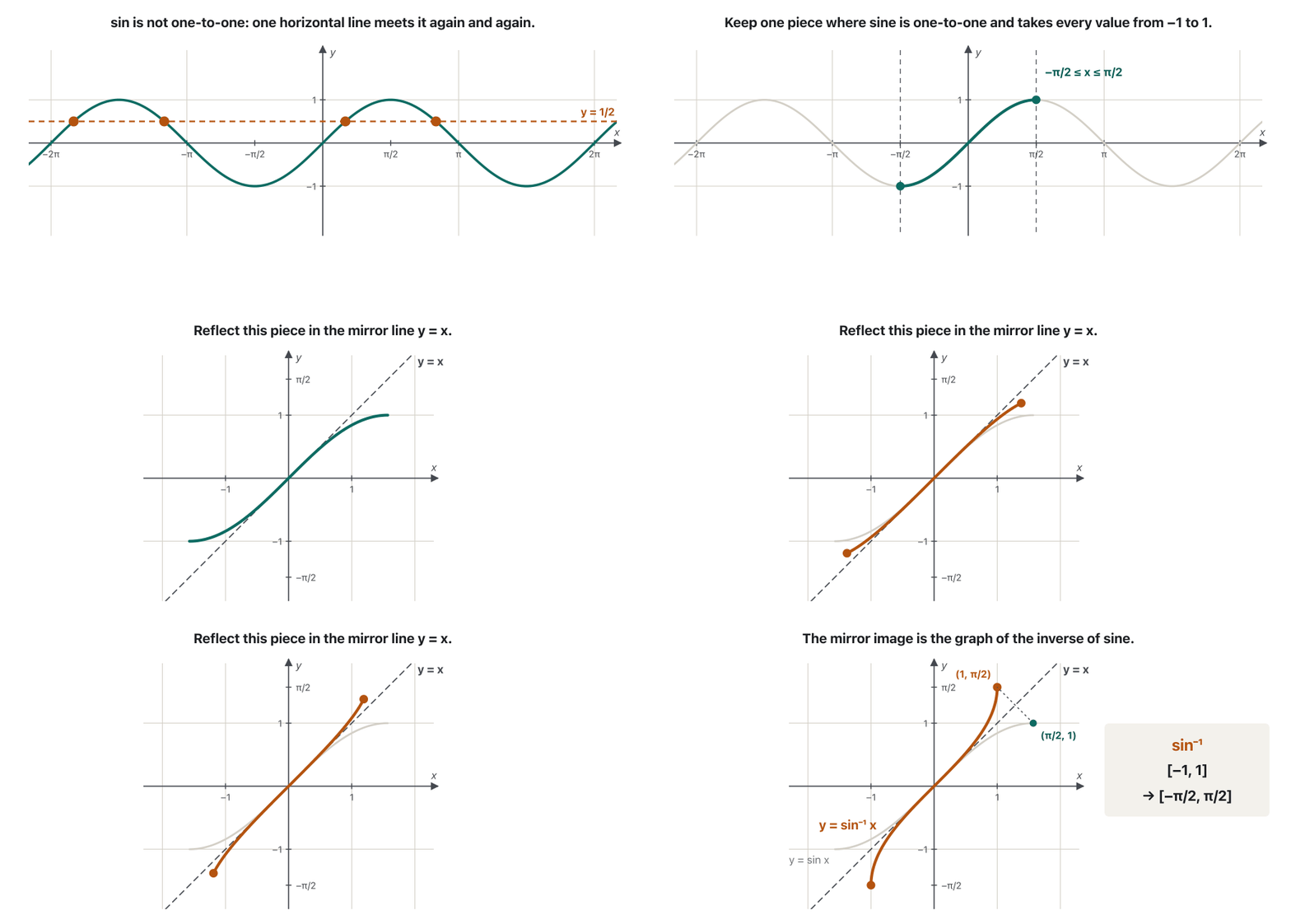
Watch sine turn into arcsinسەیری گۆڕانی ساین بۆ arcsin بکە

The animation puts the three ideas of this lesson together: a horizontal line shows that sine is not one-to-one, one piece is kept, and that piece is reflected in y=xy=x.

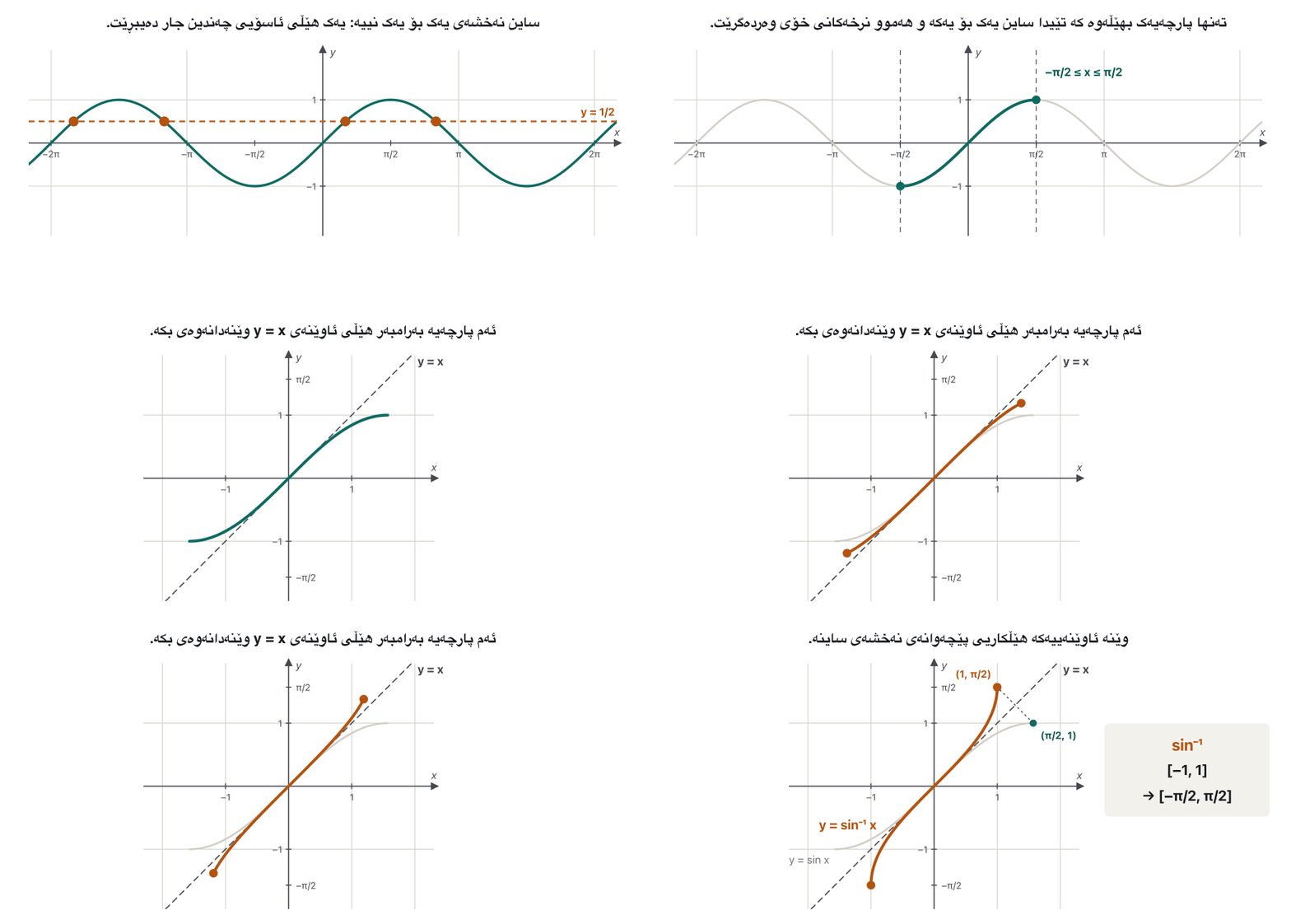
ئەنیمەیشنەکە سێ بیرۆکەکەی ئەم وانەیە پێکەوە دادەنێت: هێڵێکی ئاسۆیی پیشان دەدات کە یەک بۆ یەک نییە، پارچەیەک دەهێڵرێتەوە و ئەو پارچەیە بەرامبەر y=xy=x بۆ دەکرێت.

Animation in six steps. 1: the sine wave from −2π to 2π with the dashed line y = 1/2 crossing it at four marked points; sine is not one-to-one. 2: only the piece from −π/2 to π/2 stays bold, the rest fades; this piece is one-to-one. 3: a zoomed view with the dashed mirror line y = x. 4 and 5: the piece moves across the mirror line. 6: its mirror image, the graph of y = sin⁻¹ x from (−1, −π/2) to (1, π/2), with the end point (π/2, 1) of sine joined to its image (1, π/2); a box says sin⁻¹ takes [−1, 1] to [−π/2, π/2].
Restrict, then reflect: the birth of arcsin.سنووردارکردن، پاشان : لەدایکبوونی arcsin.CêIT
Quick checkپشکنینی خێراThe point (π6, 12)\left(\frac{\pi}{6},\ \frac12\right) lies on the restricted sine graph. Which point lies on the graph of sin⁡−1\sin^{-1}?خاڵی (π6, 12)\left(\frac{\pi}{6},\ \frac12\right) لەسەر هێڵکاریی سنووردارکراوە. کام خاڵ لەسەر هێڵکاریی sin⁡−1\sin^{-1}ـە؟

Inverse trigonometric functionsنەخشە سێگۆشەییە پێچەوانەکان

All six inverse trigonometric functionsهەموو نەخشە سێگۆشەییە پێچەوانەکان

Each function is restricted to a piece where it is one-to-one; the inverse then has that piece as its range. The table follows the notes (the same choices as most calculus textbooks).

هەر بە پارچەیەک سنووردار دەکرێت کە تێیدا یەک بۆ یەکە؛ پاشان ئەو پارچەیە دەبێتە پێچەوانەکە. خشتەکە شوێنی تێبینییەکان دەکەوێت (هەمان هەڵبژاردەی زۆربەی کتێبەکانی کالکولەس).

Domains and ranges of the inverse trigonometric functions و
FunctionDomainRange
y=sin⁡−1xy=\sin^{-1}x−1≤x≤1-1\le x\le1−π2≤y≤π2-\frac{\pi}{2}\le y\le\frac{\pi}{2}
y=cos⁡−1xy=\cos^{-1}x−1≤x≤1-1\le x\le10≤y≤π0\le y\le\pi
y=tan⁡−1xy=\tan^{-1}x−∞<x<∞-\infty<x<\infty−π2<y<π2-\frac{\pi}{2}<y<\frac{\pi}{2}
y=sec⁡−1xy=\sec^{-1}xx≤−1x\le-1 or x≥1x\ge1x≤−1x\le-1 یان x≥1x\ge10≤y≤π, y≠π20\le y\le\pi,\ y\ne\frac{\pi}{2}
y=csc⁡−1xy=\csc^{-1}xx≤−1x\le-1 or x≥1x\ge1x≤−1x\le-1 یان x≥1x\ge1−π2≤y≤π2, y≠0-\frac{\pi}{2}\le y\le\frac{\pi}{2},\ y\ne0
y=cot⁡−1xy=\cot^{-1}x−∞<x<∞-\infty<x<\infty0<y<π0<y<\pi
Six small graphs. sin⁻¹ x rises from (−1, −π/2) to (1, π/2). cos⁻¹ x falls from (−1, π) to (1, 0). tan⁻¹ x rises across the whole x-axis between the dashed asymptotes y = −π/2 and y = π/2. sec⁻¹ x has two branches: from (1, 0) rising towards π/2, and from (−1, π) falling towards π/2, with a dashed asymptote at y = π/2. csc⁻¹ x has two branches: from (1, π/2) falling towards 0 and from (−1, −π/2) rising towards 0. cot⁻¹ x falls across the whole x-axis between the asymptotes y = π and y = 0, passing (0, π/2).شەش هێڵکاریی بچووک. sin⁻¹ x لە (−1, −π/2)ـەوە بەرز دەبێتەوە بۆ (1, π/2). cos⁻¹ x لە (−1, π)ـەوە دادەبەزێت بۆ (1, 0). tan⁻¹ x بە درێژایی هەموو تەوەرەی x بەرز دەبێتەوە لە نێوان دەرکەنارەکانی پچڕپچڕی y = −π/2 و y = π/2. sec⁻¹ x دوو لقی هەیە: لە (1, 0)ـەوە بەرەو π/2 بەرز دەبێتەوە و لە (−1, π)ـەوە بەرەو π/2 دادەبەزێت، لەگەڵ دەرکەنارێکی پچڕپچڕ لە y = π/2. csc⁻¹ x دوو لقی هەیە: لە (1, π/2)ـەوە بەرەو 0 دادەبەزێت و لە (−1, −π/2)ـەوە بەرەو 0 بەرز دەبێتەوە. cot⁻¹ x بە درێژایی هەموو تەوەرەی x دادەبەزێت لە نێوان دەرکەنارەکانی y = π و y = 0 و بە (0, π/2)دا تێدەپەڕێت.
The six inverse trigonometric functions, redrawn from the notes’ figure.، هەر شەشیان، لە وێنەکەی تێبینییەکانەوە دووبارە کێشراونەتەوە.CêIT
Quick checkپشکنینی خێراWhat is the range of cos⁡−1x\cos^{-1}x? cos⁡−1x\cos^{-1}x چییە؟

Inverse trigonometric functionsنەخشە سێگۆشەییە پێچەوانەکان

Evaluating inverse trigonometric functionsهەژمارکردنی نەخشە سێگۆشەییە پێچەوانەکان

To find sin⁡−1a\sin^{-1}a, ask: “which angle in the range [−π2,π2]\left[-\frac{\pi}{2},\frac{\pi}{2}\right] has sine aa?” Many angles have that sine, but only one is in the range.

بۆ دۆزینەوەی sin⁡−1a\sin^{-1}a بپرسە: «کام گۆشە لە ناو [−π2,π2]\left[-\frac{\pi}{2},\frac{\pi}{2}\right]دا aaـە؟» زۆر گۆشە ئەو هەیە، بەڵام تەنها یەکیان لە ناو .

sin⁡−112=π6cos⁡−1(−12)=2π3tan⁡−11=π4tan⁡−1(−3)=−π3cos⁡−10=π2sin⁡−11=π2\begin{aligned}\sin^{-1}\tfrac12&=\tfrac{\pi}{6} & \cos^{-1}\left(-\tfrac12\right)&=\tfrac{2\pi}{3} & \tan^{-1}1&=\tfrac{\pi}{4}\\ \tan^{-1}\left(-\sqrt3\right)&=-\tfrac{\pi}{3} & \cos^{-1}0&=\tfrac{\pi}{2} & \sin^{-1}1&=\tfrac{\pi}{2}\end{aligned}

sin⁡−112\sin^{-1}\frac12 is π6\frac{\pi}{6}, not 5π6\frac{5\pi}{6}: only π6\frac{\pi}{6} is in the range. sin⁡−12\sin^{-1}2 does not exist: no angle has sine 2, so 2 is not in the domain [−1,1][-1,1].

sin⁡−112\sin^{-1}\frac12 یەکسانە بە π6\frac{\pi}{6}، نەک 5π6\frac{5\pi}{6}: تەنها π6\frac{\pi}{6} لە ناو . sin⁡−12\sin^{-1}2 بوونی نییە: هیچ گۆشەیەک 2 نییە، بۆیە 2 لە [−1,1][-1,1]دا نییە.

Composing a function with its inverse needs care. sin⁡(sin⁡−1x)=x\sin(\sin^{-1}x)=x for every xx in [−1,1][-1,1]. But sin⁡−1(sin⁡x)=x\sin^{-1}(\sin x)=x only when xx is in [−π2,π2]\left[-\frac{\pi}{2},\frac{\pi}{2}\right]: for example sin⁡−1(sin⁡3π4)=sin⁡−122=π4\sin^{-1}\left(\sin\frac{3\pi}{4}\right)=\sin^{-1}\frac{\sqrt2}{2}=\frac{\pi}{4}, not 3π4\frac{3\pi}{4}.

ئاوێتەکردنی لەگەڵ پێچەوانەکەی وریایی دەوێت. sin⁡(sin⁡−1x)=x\sin(\sin^{-1}x)=x بۆ هەموو xxێک لە [−1,1][-1,1]. بەڵام sin⁡−1(sin⁡x)=x\sin^{-1}(\sin x)=x تەنها کاتێک ڕاستە کە xx لە [−π2,π2]\left[-\frac{\pi}{2},\frac{\pi}{2}\right]دا بێت: بۆ نموونە sin⁡−1(sin⁡3π4)=sin⁡−122=π4\sin^{-1}\left(\sin\frac{3\pi}{4}\right)=\sin^{-1}\frac{\sqrt2}{2}=\frac{\pi}{4}، نەک 3π4\frac{3\pi}{4}.

Quick checkپشکنینی خێراWhat is cos⁡−1(cos⁡(−π3))\cos^{-1}\left(\cos\left(-\frac{\pi}{3}\right)\right)?cos⁡−1(cos⁡(−π3))\cos^{-1}\left(\cos\left(-\frac{\pi}{3}\right)\right) چەندە؟

Evaluating Inverse Trigonometric Functions (arcsin, arccos, arctan) Using Unit CircleMario's Math Tutoring · Englishئینگلیزی · 247K viewsبینین · 5.1K likesلایک

How to find arcsin, arccos and arctan of a value with the unit circle, choosing the one angle that lies in the allowed range.

چۆن arcsin⁡\arcsin، arccos⁡\arccos و arctan⁡\arctan بۆ ژمارەیەک بە دەدۆزیتەوە، بە هەڵبژاردنی تاکە گۆشەیەک کە لە .

Exact values of sin⁻¹, cos⁻¹ and tan⁻¹ read from the unit circle, with the restricted ranges.

نرخە وردەکانی sin⁡−1\sin^{-1}، cos⁡−1\cos^{-1} و tan⁡−1\tan^{-1} لەسەر دەخوێنرێنەوە، لەگەڵ .

sin⁡−1x\sin^{-1}x is not 1sin⁡x\frac{1}{\sin x}sin⁡−1x\sin^{-1}x هەمان 1sin⁡x\frac{1}{\sin x} نییە

sin⁡−112=π6≈0.5241sin⁡12≈2.086\sin^{-1}\tfrac12=\tfrac{\pi}{6}\approx0.524\qquad\qquad \frac{1}{\sin\frac12}\approx2.086

Left: the angle whose sine is 12\frac12. Right: the reciprocal of sin⁡12\sin\frac12. The same symbols, two very different numbers.

لای چەپ: ئەو گۆشەیەی 12\frac12ـە. لای ڕاست: sin⁡12\sin\frac12. هەمان هێماکان، دوو ژمارەی زۆر جیاواز.

Quick checkپشکنینی خێراWhich expression equals csc⁡x\csc x?کام یەکسانە بە csc⁡x\csc x؟

Inverse functions in your codeپێچەوانەکانی نەخشە لە کۆدەکەتدا

Quick checkپشکنینی خێراWhat does math.asin(2) do in Python?math.asin(2) لە Pythonـدا چی دەکات؟

You will meet one more famous pair in this chapter: the exponential function and its inverse, the logarithm.

لەم بەشەدا جووتێکی ناسراوی تر دەبینیت: نەخشەی توانی و پێچەوانەکەی، لۆگاریتم.

Common mistakesهەڵە باوەکان

MistakeهەڵەWhy it is wrongبۆچی هەڵەیەCorrectڕاست
f−1(x)=1f(x)f^{-1}(x)=\frac{1}{f(x)}f−1(x)=1f(x)f^{-1}(x)=\frac{1}{f(x)}−1-1 is not an exponent hereلێرەدا −1-1 نییەf−1f^{-1} undoes ff; 1f\frac{1}{f} is the reciprocalf−1f^{-1} کاری ff هەڵدەوەشێنێتەوە؛ 1f\frac{1}{f}
Looking for the inverse of x2x^2 on all of R\mathbb{R}گەڕان بەدوای پێچەوانەی x2x^2 لەسەر هەموو R\mathbb{R}x2x^2 is not one-to-one: 22 and −2-2 both give 44x2x^2 یەک بۆ یەک نییە: 22 و −2-2 هەردووکیان 44 دەدەنRestrict first: x≥0x\ge0 gives x\sqrt{x}سەرەتا سنووردار بکە: x≥0x\ge0 دەکاتە x\sqrt{x}
Undoing the steps in the same orderهەڵوەشاندنەوەی هەنگاوەکان بە هەمان ڕیزبەندیFor 2x+32x+3, “halve then subtract 3” gives x2−3\frac{x}{2}-3, which is wrongبۆ 2x+32x+3، «نیوەی بکە پاشان 3 لێ دەربکە» x2−3\frac{x}{2}-3 دەدات کە هەڵەیەUndo the last step first: x−32\frac{x-3}{2}دوایین هەنگاو یەکەم جار هەڵبوەشێنەوە: x−32\frac{x-3}{2}
sin⁡−112=5π6\sin^{-1}\frac12=\frac{5\pi}{6}sin⁡−112=5π6\sin^{-1}\frac12=\frac{5\pi}{6}5π6\frac{5\pi}{6} has sine 12\frac12 but is outside [−π2,π2]\left[-\frac{\pi}{2},\frac{\pi}{2}\right] 5π6\frac{5\pi}{6} یەکسانە بە 12\frac12 بەڵام لە دەرەوەی [−π2,π2]\left[-\frac{\pi}{2},\frac{\pi}{2}\right]ـەThe answer must lie in the range: π6\frac{\pi}{6}وەڵامەکە دەبێت لە ناو بێت: π6\frac{\pi}{6}
sin⁡−1(sin⁡x)=x\sin^{-1}(\sin x)=x for every xxsin⁡−1(sin⁡x)=x\sin^{-1}(\sin x)=x بۆ هەموو xxێکsin⁡−1(sin⁡3π4)=π4\sin^{-1}\left(\sin\frac{3\pi}{4}\right)=\frac{\pi}{4}, not 3π4\frac{3\pi}{4}sin⁡−1(sin⁡3π4)=π4\sin^{-1}\left(\sin\frac{3\pi}{4}\right)=\frac{\pi}{4}، نەک 3π4\frac{3\pi}{4}True only for xx in [−π2,π2]\left[-\frac{\pi}{2},\frac{\pi}{2}\right]تەنها بۆ xx لە [−π2,π2]\left[-\frac{\pi}{2},\frac{\pi}{2}\right]دا ڕاستە
Calculator in degree mode for sin⁡−1\sin^{-1} لە دۆخی بۆ sin⁡−1\sin^{-1}You get 30 instead of 0.5236لە جیاتی ⁦0.5236⁩ ئەنجامی ⁦30⁩ وەردەگریتIn calculus give inverse trig values in radiansلە کالکولەسدا نرخی بە بدە

Exercisesڕاهێنانەکان

Exerciseڕاهێنان1. Which ones have an inverse?1. کامیان پێچەوانەیان هەیە؟

On their whole domain, which of these have an inverse? (a) f(x)=3x−7f(x)=3x-7 (b) g(x)=x2+1g(x)=x^2+1 (c) h(x)=x3h(x)=x^3 (d) k(x)=∣x∣k(x)=|x|

لەسەر هەموو ، کامیان پێچەوانەیان هەیە؟ (أ) f(x)=3x−7f(x)=3x-7 (ب) g(x)=x2+1g(x)=x^2+1 (ج) h(x)=x3h(x)=x^3 (د) k(x)=∣x∣k(x)=|x|

Show answerوەڵامەکە پیشان بدە
  • (a) Yes: a line that is not horizontal passes the horizontal line test. f−1(x)=x+73f^{-1}(x)=\frac{x+7}{3}.
  • (b) No: g(1)=g(−1)=2g(1)=g(-1)=2.
  • (c) Yes: x3x^3 always increases; h−1(x)=x3h^{-1}(x)=\sqrt[3]{x}.
  • (d) No: k(3)=k(−3)=3k(3)=k(-3)=3.
  • (أ) بەڵێ: هێڵێکی ڕاست کە ئاسۆیی نەبێت لە دەردەچێت. f−1(x)=x+73f^{-1}(x)=\frac{x+7}{3}.
  • (ب) نەخێر: g(1)=g(−1)=2g(1)=g(-1)=2.
  • (ج) بەڵێ: x3x^3 هەمیشە بەرز دەبێتەوە؛ h−1(x)=x3h^{-1}(x)=\sqrt[3]{x}.
  • (د) نەخێر: k(3)=k(−3)=3k(3)=k(-3)=3.
Exerciseڕاهێنان2. The inverse of a fraction2. پێچەوانەی کەرتێک

Find the inverse of f(x)=x+1x−2f(x)=\frac{x+1}{x-2} (x≠2x\ne2). Give the domain and range of f−1f^{-1}.

پێچەوانەی f(x)=x+1x−2f(x)=\frac{x+1}{x-2} (x≠2x\ne2) بدۆزەرەوە. و f−1f^{-1} بنووسە.

Hintئاماژە

Multiply by (x−2)(x-2), collect the xx terms on one side and factor out xx.

لێکدان لە (x−2)(x-2) بکە، بڕەکانی xx بخە یەک لا و xx دەربهێنە دەرەوەی کەوانە.

Show answerوەڵامەکە پیشان بدە
y=x+1x−2 ⇒ y(x−2)=x+1 ⇒ xy−x=2y+1 ⇒ x=2y+1y−1y=\frac{x+1}{x-2}\ \Rightarrow\ y(x-2)=x+1\ \Rightarrow\ xy-x=2y+1\ \Rightarrow\ x=\frac{2y+1}{y-1}
f−1(x)=2x+1x−1f^{-1}(x)=\frac{2x+1}{x-1}

Domain of f−1f^{-1}: x≠1x\ne1 (the range of ff). Range of f−1f^{-1}: y≠2y\ne2 (the domain of ff).

f−1f^{-1}: x≠1x\ne1 ( ff). f−1f^{-1}: y≠2y\ne2 ( ff).

Exerciseڕاهێنان3. Restrict and invert3. سنووردار بکە و پێچەوانەکەی بدۆزەرەوە

f(x)=(x−1)2f(x)=(x-1)^2 is not one-to-one. Restrict its domain so that it has an inverse, and find the inverse with its domain and range.

f(x)=(x−1)2f(x)=(x-1)^2 نییە. سنووردار بکە بۆ ئەوەی پێچەوانەی هەبێت و پێچەوانەکەی لەگەڵ و بدۆزەرەوە.

Show answerوەڵامەکە پیشان بدە

Keep x≥1x\ge1 (the right half of the parabola). Then y=(x−1)2⇒x−1=yy=(x-1)^2\Rightarrow x-1=\sqrt y (positive, because x≥1x\ge1), so f−1(x)=1+xf^{-1}(x)=1+\sqrt x with domain [0,∞)[0,\infty) and range [1,∞)[1,\infty). (Keeping x≤1x\le1 instead gives 1−x1-\sqrt x.)

x≥1x\ge1 بهێڵەوە (نیوەی ڕاستی ). پاشان y=(x−1)2⇒x−1=yy=(x-1)^2\Rightarrow x-1=\sqrt y (موجەبە، چونکە x≥1x\ge1)، کەواتە f−1(x)=1+xf^{-1}(x)=1+\sqrt x بە [0,∞)[0,\infty) و [1,∞)[1,\infty). (ئەگەر لە جیاتی ئەوە x≤1x\le1 بهێڵیتەوە، 1−x1-\sqrt x دەردەچێت.)

Exerciseڕاهێنان4. Exact values4. نرخە وردەکان

Find exactly: sin⁡−1(−22)\sin^{-1}\left(-\frac{\sqrt2}{2}\right), cos⁡−132\cos^{-1}\frac{\sqrt3}{2}, sec⁡−12\sec^{-1}2, csc⁡−1(−2)\csc^{-1}(-2), cot⁡−11\cot^{-1}1.

بە وردی بیدۆزەرەوە: sin⁡−1(−22)\sin^{-1}\left(-\frac{\sqrt2}{2}\right)، cos⁡−132\cos^{-1}\frac{\sqrt3}{2}، sec⁡−12\sec^{-1}2، csc⁡−1(−2)\csc^{-1}(-2)، cot⁡−11\cot^{-1}1.

Hintئاماژە

sec⁡−1a=cos⁡−11a\sec^{-1}a=\cos^{-1}\frac{1}{a} and csc⁡−1a=sin⁡−11a\csc^{-1}a=\sin^{-1}\frac{1}{a}.

sec⁡−1a=cos⁡−11a\sec^{-1}a=\cos^{-1}\frac{1}{a} و csc⁡−1a=sin⁡−11a\csc^{-1}a=\sin^{-1}\frac{1}{a}.

Show answerوەڵامەکە پیشان بدە
sin⁡−1(−22)=−π4,cos⁡−132=π6,sec⁡−12=π3 (cos⁡=12),csc⁡−1(−2)=−π6 (sin⁡=−12),cot⁡−11=π4\sin^{-1}\left(-\tfrac{\sqrt2}{2}\right)=-\tfrac{\pi}{4},\quad \cos^{-1}\tfrac{\sqrt3}{2}=\tfrac{\pi}{6},\quad \sec^{-1}2=\tfrac{\pi}{3}\ (\cos=\tfrac12),\quad \csc^{-1}(-2)=-\tfrac{\pi}{6}\ (\sin=-\tfrac12),\quad \cot^{-1}1=\tfrac{\pi}{4}
Exerciseڕاهێنان5. Compositions5. ئاوێتەکردن

Find cos⁡−1(cos⁡5π4)\cos^{-1}\left(\cos\frac{5\pi}{4}\right), tan⁡−1(tan⁡3π4)\tan^{-1}\left(\tan\frac{3\pi}{4}\right) and cos⁡(sin⁡−145)\cos\left(\sin^{-1}\frac45\right).

cos⁡−1(cos⁡5π4)\cos^{-1}\left(\cos\frac{5\pi}{4}\right)، tan⁡−1(tan⁡3π4)\tan^{-1}\left(\tan\frac{3\pi}{4}\right) و cos⁡(sin⁡−145)\cos\left(\sin^{-1}\frac45\right) بدۆزەرەوە.

Show answerوەڵامەکە پیشان بدە
  • cos⁡5π4=−22\cos\frac{5\pi}{4}=-\frac{\sqrt2}{2}; the angle in [0,π][0,\pi] with this cosine is 3π4\frac{3\pi}{4}.
  • tan⁡3π4=−1\tan\frac{3\pi}{4}=-1; the angle in (−π2,π2)\left(-\frac{\pi}{2},\frac{\pi}{2}\right) with tangent −1-1 is −π4-\frac{\pi}{4}.
  • Let θ=sin⁡−145\theta=\sin^{-1}\frac45, so sin⁡θ=45\sin\theta=\frac45 and θ∈[−π2,π2]\theta\in\left[-\frac{\pi}{2},\frac{\pi}{2}\right], where cosine is not negative: cos⁡θ=1−1625=35\cos\theta=\sqrt{1-\frac{16}{25}}=\frac35.
  • cos⁡5π4=−22\cos\frac{5\pi}{4}=-\frac{\sqrt2}{2}؛ ئەو گۆشەیەی لە [0,π][0,\pi]دا ئەم هەیە 3π4\frac{3\pi}{4}ـە.
  • tan⁡3π4=−1\tan\frac{3\pi}{4}=-1؛ ئەو گۆشەیەی لە (−π2,π2)\left(-\frac{\pi}{2},\frac{\pi}{2}\right)دا −1-1ـە −π4-\frac{\pi}{4}ـە.
  • با θ=sin⁡−145\theta=\sin^{-1}\frac45 بێت، کەواتە sin⁡θ=45\sin\theta=\frac45 و θ∈[−π2,π2]\theta\in\left[-\frac{\pi}{2},\frac{\pi}{2}\right]، کە تێیدا سالب نییە: cos⁡θ=1−1625=35\cos\theta=\sqrt{1-\frac{16}{25}}=\frac35.
Exerciseڕاهێنان6. Spot the mistake6. هەڵەکە بدۆزەرەوە

Lana computes sin⁡−112\sin^{-1}\frac12 as 1sin⁡12≈2.09\frac{1}{\sin\frac12}\approx2.09. What went wrong?

لانا sin⁡−112\sin^{-1}\frac12 وەها هەژمار دەکات: 1sin⁡12≈2.09\frac{1}{\sin\frac12}\approx2.09. چی هەڵە بوو؟

Show answerوەڵامەکە پیشان بدە

She read −1-1 as a power and computed the reciprocal of a sine. sin⁡−112\sin^{-1}\frac12 is the angle in [−π2,π2]\left[-\frac{\pi}{2},\frac{\pi}{2}\right] whose sine is 12\frac12: π6≈0.524\frac{\pi}{6}\approx0.524.

−1-1ـی وەک خوێندەوە و هەژمار کرد. sin⁡−112\sin^{-1}\frac12 ئەو گۆشەیەیە لە [−π2,π2]\left[-\frac{\pi}{2},\frac{\pi}{2}\right]دا کە 12\frac12ـە: π6≈0.524\frac{\pi}{6}\approx0.524.

Summaryپوختە

  • The inverse f−1f^{-1} undoes ff: f−1(y)=xf^{-1}(y)=x exactly when f(x)=yf(x)=y. Domain and range swap.
  • Only one-to-one functions have an inverse; the horizontal line test checks this on a graph.
  • To find f−1f^{-1}: solve y=f(x)y=f(x) for xx, swap xx and yy, check both compositions.
  • The graph of f−1f^{-1} is the reflection of the graph of ff in the line y=xy=x.
  • Trigonometric functions are restricted before inverting: sin⁡\sin to [−π2,π2]\left[-\frac{\pi}{2},\frac{\pi}{2}\right], cos⁡\cos to [0,π][0,\pi], tan⁡\tan to (−π2,π2)\left(-\frac{\pi}{2},\frac{\pi}{2}\right). The results are sin⁡−1\sin^{-1}, cos⁡−1\cos^{-1} and tan⁡−1\tan^{-1} (and sec⁡−1\sec^{-1}, csc⁡−1\csc^{-1}, cot⁡−1\cot^{-1}).
  • sin⁡−1x\sin^{-1}x is an angle, not 1sin⁡x\frac{1}{\sin x}.
  • f−1f^{-1} کاری ff هەڵدەوەشێنێتەوە: f−1(y)=xf^{-1}(y)=x تەنها کاتێک کە f(x)=yf(x)=y. و جێگۆڕکێ دەکەن.
  • تەنها پێچەوانەیان هەیە؛ ئەمە لەسەر هێڵکاری دەپشکنێت.
  • بۆ دۆزینەوەی f−1f^{-1}: y=f(x)y=f(x) بۆ xx شیکار بکە، xx و yy جێگۆڕکێ پێ بکە و هەردوو ئاوێتەکردنەکە بپشکنە.
  • هێڵکاریی f−1f^{-1} هێڵکاریی ffـە بەرامبەر هێڵی y=xy=x.
  • پێش پێچەوانەکردن سنووردار دەکرێن: sin⁡\sin بە [−π2,π2]\left[-\frac{\pi}{2},\frac{\pi}{2}\right]، cos⁡\cos بە [0,π][0,\pi]، tan⁡\tan بە (−π2,π2)\left(-\frac{\pi}{2},\frac{\pi}{2}\right). ئەنجامەکان sin⁡−1\sin^{-1}، cos⁡−1\cos^{-1} و tan⁡−1\tan^{-1}ن (هەروەها sec⁡−1\sec^{-1}، csc⁡−1\csc^{-1} و cot⁡−1\cot^{-1}).
  • sin⁡−1x\sin^{-1}x گۆشەیەکە، نەک 1sin⁡x\frac{1}{\sin x}.
Review questionsپرسیارەکانی پێداچوونەوە
Why does x2x^2 have no inverse on R\mathbb{R}?بۆچی x2x^2 لەسەر R\mathbb{R} پێچەوانەی نییە؟

Because it is not one-to-one: xx and −x-x give the same square, so f−1f^{-1} would not know which one to return.

چونکە یەک بۆ یەک نییە: xx و −x-x هەمان دووجا دەدەن، بۆیە f−1f^{-1} نازانێت کامیان بگەڕێنێتەوە.

What are the domain and range of tan⁡−1x\tan^{-1}x?بوار و مەودای tan⁡−1x\tan^{-1}x چین؟

Domain all real numbers; range the open interval (−π2,π2)\left(-\frac{\pi}{2},\frac{\pi}{2}\right).

: هەموو ؛ : (−π2,π2)\left(-\frac{\pi}{2},\frac{\pi}{2}\right).

Is sin⁡−1(sin⁡π)\sin^{-1}(\sin\pi) equal to π\pi?ئایا sin⁡−1(sin⁡π)\sin^{-1}(\sin\pi) یەکسانە بە π\pi؟

No. sin⁡π=0\sin\pi=0 and sin⁡−10=0\sin^{-1}0=0, because the answer must lie in [−π2,π2]\left[-\frac{\pi}{2},\frac{\pi}{2}\right].

نەخێر. sin⁡π=0\sin\pi=0 و sin⁡−10=0\sin^{-1}0=0، چونکە وەڵامەکە دەبێت لە [−π2,π2]\left[-\frac{\pi}{2},\frac{\pi}{2}\right]دا بێت.

Videoڤیدیۆ

Watch a videoسەیری ڤیدیۆیەک بکە

A video that viewers liked a lot and praised in their comments, chosen for this lesson.ڤیدیۆیەک کە بینەران زۆریان پێ خۆش بووە و لە کۆمێنتەکانیاندا ستایشیان کردووە، بۆ ئەم وانەیە هەڵبژێردراوە.

بیرکاری پۆلی ١١ی زانستی بەشی چوارەم وانەی دووەمIbrahim Ismahil · Kurdish (Sorani)کوردی (سۆرانی) · 32K viewsبینین · 725 likesلایک

In Kurdish: the inverse of a function, from the Grade 11 book, lesson 4-2, page 219.

بە کوردی: ، لە کتێبی پۆلی ⁦11⁩، وانەی ⁦4-2⁩، لاپەڕە ⁦219⁩.

Sorani, Grade 11 science lesson (4-2) Inverse Function (پێچەوانەی نەخشە), page 219.

بە سۆرانی، وانەی پۆلی ⁦11⁩ـی زانستی ⁦(4-2)⁩: ، لاپەڕە ⁦219⁩.

Lesson complete!وانەکە تەواو بوو!

Well done. Review the key terms, then go on to the next lesson.دەستخۆش. سەیرێکی زاراوە سەرەکییەکان بکەرەوە، پاشان بڕۆ بۆ وانەی داهاتوو.

Key termsزاراوە سەرەکییەکان

Next lessonوانەی داهاتوو

Exponential Functions and the Number eنەخشە توانییەکان و ژمارەی e

References and further readingسەرچاوەکان و خوێندنەوەی زیاتر

This lecture is a first edition. The Kurdish text and terminology are waiting for review by Kurdish IT teachers.ئەم وانەیە چاپی یەکەمە. دەقە کوردییەکە و زاراوەکانی چاوەڕێی پێداچوونەوەی مامۆستایانی کوردی بواری IT ن.