Chapterبەش 6 · Lectureوانە 6.8

Partitioned (Block) Matricesماتریکسە بلۆکییەکان

The chapter's advanced lesson: cutting a matrix into blocks, adding and scaling block by block, the block product with conformable cuts (keeping the order), and the inverse by partitioning with the Schur complement E=A22−A21A11−1A12E = A_{22} - A_{21}A_{11}^{-1}A_{12} — the notes' example checked, and a new homework matrix.

وانەی پێشکەوتووی ئەم بەشە: بڕینی بۆ بلۆک، کۆکردنەوە و لێکدان لە ژمارە بلۆک بە بلۆک، لێکدانی بلۆکی بە بڕینی گونجاو (بە پاراستنی ڕیزبەندی) و پێچەوانە بە دابەشکردن لەگەڵ E=A22−A21A11−1A12E = A_{22} - A_{21}A_{11}^{-1}A_{12} — نموونەکەی تێبینییەکان پشکنراوە و ئەرکێکی نوێ.

12 min read13 خولەک خوێندنەوە · 12 stepsهەنگاو

What you will learnچی فێر دەبیت

  • Partition a matrix and name its blocks and their sizes.
  • Add, scale and multiply block matrices, checking that the cuts are conformable.
  • Find an inverse by partitioning with the Schur complement and check it.
  • دابەش بکەیت و ناو و قەبارەی بلۆکەکانی بنووسیت.
  • کۆ بکەیتەوە و لێکیان بدەیت و بپشکنیت کە بڕینەکان گونجاون.
  • پێچەوانەیەک بە دابەشکردن و بدۆزیتەوە و بیپشکنیت.

Why cut a matrix into blocks?بۆچی ماتریکسێک دەکەینە بلۆک؟

A big matrix can be cut by horizontal and vertical lines into smaller matrices called blocks. The result is a (the notes say a partitioned matrix). Blocks can then be handled almost like single numbers, so one big calculation becomes a few small ones.

گەورە دەکرێت بە هێڵی ئاسۆیی و ستوونی ببڕدرێت بۆ چەند بچووکتر بە ناوی بلۆک. ئەنجامەکە (تێبینییەکان دەڵێن دابەشکراو). پاشان بلۆکەکان نزیکەی وەک ژمارەی تاک مامەڵەیان لەگەڵ دەکرێت، بۆیە ژمێریارییەکی گەورە دەبێتە چەند ژمێریارییەکی بچووک.

  • A digital picture is a matrix of ; programs often work on it tile by tile.
  • A very large product can be shared out: each processor core multiplies a few blocks at the same time.
  • وێنەیەکی لە ؛ زۆر جار پارچە بە پارچە کاری لەسەر دەکەن.
  • لێکدانێکی زۆر گەورە دەکرێت دابەش بکرێت: هەر لە هەمان کاتدا چەند بلۆکێک لێک دەدات.
Quick checkپشکنینی خێراWhat is a block of a matrix?بلۆکی چییە؟

Partitioning: names and sizes of blocksدابەشکردن: ناو و قەبارەی بلۆکەکان

The notes' example cuts a 4×54 \times 5 matrix after row 3 and after column 3. The block in block-row ii and block-column jj is called AijA_{ij} — row first, as for entries.

نموونەکەی تێبینییەکان 4×54 \times 5 دوای ڕیزی 3 و دوای ستوونی 3 دەبڕێت. ئەو بلۆکەی لە ڕیزی بلۆکیی ii و ستوونی بلۆکیی jjدایە پێی دەگوترێت AijA_{ij} — سەرەتا ڕیز، وەک ژمارەکان.

The 4 by 5 matrix with rows (5, 6, −7, 4, 5), (−3, 10, −2, 8, 3), (5, −6, 4, 0, −2), (1, 3, 8, −2, 4), cut by a dashed line after row 3 and after column 3. A11 (blue) is 3 × 3, A12 (orange) is 3 × 2, A21 (green) is 1 × 3, A22 (purple) is 1 × 2.ماتریکسە چوار لە پێنجەکە بە ڕیزەکانی (5، 6، −7، 4، 5)، (−3، 10، −2، 8، 3)، (5، −6، 4، 0، −2)، (1، 3، 8، −2، 4) کە بە هێڵێکی پچڕپچڕ دوای ڕیزی 3 و دوای ستوونی 3 بڕدراوە. A11 (شین) 3 × 3ـە، A12 (پرتەقاڵی) 3 × 2ـە، A21 (سەوز) 1 × 3ـە، A22 (مۆر) 1 × 2ـە.
Four blocks: A=[A11A12A21A22]A = \begin{bmatrix} A_{11} & A_{12} \\ A_{21} & A_{22} \end{bmatrix}.چوار بلۆک: A=[A11A12A21A22]A = \begin{bmatrix} A_{11} & A_{12} \\ A_{21} & A_{22} \end{bmatrix}.CêIT
A11=[56−7−310−25−64]3×3A12=[45830−2]3×2A21=[138]1×3A22=[−24]1×2A_{11} = \begin{bmatrix} 5 & 6 & -7 \\ -3 & 10 & -2 \\ 5 & -6 & 4 \end{bmatrix}_{3\times3} \quad A_{12} = \begin{bmatrix} 4 & 5 \\ 8 & 3 \\ 0 & -2 \end{bmatrix}_{3\times2} \quad A_{21} = \begin{bmatrix} 1 & 3 & 8 \end{bmatrix}_{1\times3} \quad A_{22} = \begin{bmatrix} -2 & 4 \end{bmatrix}_{1\times2}

Blocks in the same block-row have the same number of rows (3, or 1); blocks in the same block-column have the same number of columns (3, or 2). You may choose the cut, but these rules always hold.

بلۆکەکانی یەک ڕیزی بلۆکی هەمان ژمارەی ڕیزیان هەیە (⁦3⁩ یان ⁦1⁩)؛ بلۆکەکانی یەک ستوونی بلۆکی هەمان ژمارەی ستوونیان هەیە (⁦3⁩ یان ⁦2⁩). دەتوانیت شوێنی بڕینەکە هەڵبژێریت، بەڵام ئەم یاسایانە هەمیشە ڕاستن.

Quick checkپشکنینی خێراA 5×65 \times 6 matrix is cut after row 2 and after column 4. What is the size of A21A_{21}? 5×65 \times 6 دوای ڕیزی 2 و دوای ستوونی 4 دەبڕدرێت. قەبارەی A21A_{21} چەندە؟

Adding blocks and multiplying by a numberکۆکردنەوەی بلۆکەکان و لێکدان لە ژمارە

If two matrices of the same order are cut in the same way, add them block by block: A+B=[A11+B11A12+B12A21+B21A22+B22]A + B = \begin{bmatrix} A_{11} + B_{11} & A_{12} + B_{12} \\ A_{21} + B_{21} & A_{22} + B_{22} \end{bmatrix}. The notes' exercise, cut 2∣22 \mid 2 both ways:

ئەگەر دوو بە هەمان قەبارە بە هەمان شێوە ببڕدرێن، بلۆک بە بلۆک کۆیان بکەرەوە: A+B=[A11+B11A12+B12A21+B21A22+B22]A + B = \begin{bmatrix} A_{11} + B_{11} & A_{12} + B_{12} \\ A_{21} + B_{21} & A_{22} + B_{22} \end{bmatrix}. ڕاهێنانەکەی تێبینییەکان، هەردوو لا 2∣22 \mid 2 بڕدراون:

[23483−6308−432−58−91]+[−3−8−254−39768−3−2−1649]=[−1−52137−912714400−614−510]\left[\begin{array}{cc|cc} 2 & 3 & 4 & 8 \\ 3 & -6 & 3 & 0 \\ \hline 8 & -4 & 3 & 2 \\ -5 & 8 & -9 & 1 \end{array}\right] + \left[\begin{array}{cc|cc} -3 & -8 & -2 & 5 \\ 4 & -3 & 9 & 7 \\ \hline 6 & 8 & -3 & -2 \\ -1 & 6 & 4 & 9 \end{array}\right] = \left[\begin{array}{cc|cc} -1 & -5 & 2 & 13 \\ 7 & -9 & 12 & 7 \\ \hline 14 & 4 & 0 & 0 \\ -6 & 14 & -5 & 10 \end{array}\right]

For example the top-right block: [4830]+[−2597]=[213127]\begin{bmatrix} 4 & 8 \\ 3 & 0 \end{bmatrix} + \begin{bmatrix} -2 & 5 \\ 9 & 7 \end{bmatrix} = \begin{bmatrix} 2 & 13 \\ 12 & 7 \end{bmatrix}. It is ordinary addition, done in pieces.

بۆ نموونە بلۆکی سەرەوەی ڕاست: [4830]+[−2597]=[213127]\begin{bmatrix} 4 & 8 \\ 3 & 0 \end{bmatrix} + \begin{bmatrix} -2 & 5 \\ 9 & 7 \end{bmatrix} = \begin{bmatrix} 2 & 13 \\ 12 & 7 \end{bmatrix}. هەمان کۆکردنەوەی ئاساییە، بە پارچە کراوە.

A number times a block matrix multiplies every block, so every entry: cA=[cA11cA12cA21cA22]cA = \begin{bmatrix} cA_{11} & cA_{12} \\ cA_{21} & cA_{22} \end{bmatrix}. The notes' example:

لێکدانی ژمارەیەک لە هەموو بلۆکێک لەو ژمارەیە دەدات، واتە هەموو ژمارەیەکی ناوی: cA=[cA11cA12cA21cA22]cA = \begin{bmatrix} cA_{11} & cA_{12} \\ cA_{21} & cA_{22} \end{bmatrix}. نموونەکەی تێبینییەکان:

c[502−4−34−2−15−2−6−476−39]=[5c02c−4c−3c4c−2c−c5c−2c−6c−4c7c6c−3c9c]c\begin{bmatrix} 5 & 0 & 2 & -4 \\ -3 & 4 & -2 & -1 \\ 5 & -2 & -6 & -4 \\ 7 & 6 & -3 & 9 \end{bmatrix} = \begin{bmatrix} 5c & 0 & 2c & -4c \\ -3c & 4c & -2c & -c \\ 5c & -2c & -6c & -4c \\ 7c & 6c & -3c & 9c \end{bmatrix}

However the matrix is cut, every block, and so every entry, is multiplied by cc.

بە هەر شێوەیەک ببڕدرێت، هەموو بلۆکێک، واتە هەموو ژمارەیەک، لە cc دەدرێت.

Quick checkپشکنینی خێراAA is cut 2∣22 \mid 2 and BB (same order) is cut 3∣13 \mid 1. Can you add them block by block?AA بە 2∣22 \mid 2 و BB (هەمان قەبارە) بە 3∣13 \mid 1 بڕدراوە. دەتوانیت بلۆک بە بلۆک کۆیان بکەیتەوە؟

Multiplying block matricesلێکدانی ماتریکسە بلۆکییەکان

Treat the blocks as if they were entries and use the row-times-column rule: Cij=Ai1B1j+Ai2B2jC_{ij} = A_{i1}B_{1j} + A_{i2}B_{2j}. Two things are new compared with numbers:

بلۆکەکان وەک ژمارە دابنێ و یاسای ڕیز جاران ستوون بەکاربهێنە: Cij=Ai1B1j+Ai2B2jC_{ij} = A_{i1}B_{1j} + A_{i2}B_{2j}. دوو شت بە بەراورد لەگەڵ ژمارەکان نوێن:

  • Keep the order. Each piece is a matrix product, so A12B21A_{12}B_{21} must not be written B21A12B_{21}A_{12}.
  • The cuts must be conformable: the way the columns of AA are cut must be the way the rows of BB are cut. Then every block product AikBkjA_{ik}B_{kj} has matching inner sizes. The notes do not say this; it is the condition that makes the method work.
  • ڕیزبەندی مەگۆڕە. هەر پارچەیەک لێکدانی ، بۆیە A12B21A_{12}B_{21} نابێت بنووسرێت B21A12B_{21}A_{12}.
  • بڕینەکان دەبێت گونجاو بن: شێوەی بڕینی ستوونەکانی AA دەبێت هەمان شێوەی بڕینی ڕیزەکانی BB بێت. ئەوکات هەموو لێکدانێکی بلۆکی AikBkjA_{ik}B_{kj} قەبارە ناوەکییەکانی یەک دەگرنەوە. تێبینییەکان ئەمە نالێن؛ ئەمە ئەو مەرجەیە کە ڕێگەکە کار پێدەکات.
A 2 by 2 block matrix A (blocks A11, A21 blue in column 1; A12, A22 orange in column 2) times B (B11, B12 blue in row 1; B21, B22 orange in row 2) equals the block matrix with A11B11 + A12B21, A11B12 + A12B22, A21B11 + A22B21, A21B12 + A22B22. Notes: blue meets blue, orange meets orange; the column cut of A must match the row cut of B; A12B21 is not B21A12.ماتریکسێکی بلۆکی A دوو لە دوو (بلۆکەکانی A11، A21 شین لە ستوونی 1؛ A12، A22 پرتەقاڵی لە ستوونی 2) جاران B (B11، B12 شین لە ڕیزی 1؛ B21، B22 پرتەقاڵی لە ڕیزی 2) یەکسانە بە ماتریکسی بلۆکییەکە بە A11B11 + A12B21، A11B12 + A12B22، A21B11 + A22B21، A21B12 + A22B22. تێبینی: شین بە شین، پرتەقاڵی بە پرتەقاڵی؛ ستوونەکانی یەکەم وەک ڕیزەکانی دووەم دەبڕدرێن؛ A12B21 یەکسان نییە بە B21A12.
The block product: a 2×22 \times 2 “matrix of matrices”.لێکدانی بلۆکی: « »ی 2×22 \times 2.CêIT

The notes' short form: with one block-row and one block-column, [A11A12][B1B2]=A11B1+A12B2\begin{bmatrix} A_{11} & A_{12} \end{bmatrix}\begin{bmatrix} B_1 \\ B_2 \end{bmatrix} = A_{11}B_1 + A_{12}B_2.

شێوە کورتەکەی تێبینییەکان: بە یەک ڕیزی بلۆکی و یەک ستوونی بلۆکی، [A11A12][B1B2]=A11B1+A12B2\begin{bmatrix} A_{11} & A_{12} \end{bmatrix}\begin{bmatrix} B_1 \\ B_2 \end{bmatrix} = A_{11}B_1 + A_{12}B_2.

Quick checkپشکنینی خێراAA is 3×53 \times 5 with its columns cut 3∣23 \mid 2. How must the rows of BB (5×45 \times 4) be cut?AA 3×53 \times 5ـە و ستوونەکانی بە 3∣23 \mid 2 بڕدراون. ڕیزەکانی BB (5×45 \times 4) دەبێت چۆن ببڕدرێن؟

A block product, step by stepلێکدانێکی بلۆکی، هەنگاو بە هەنگاو

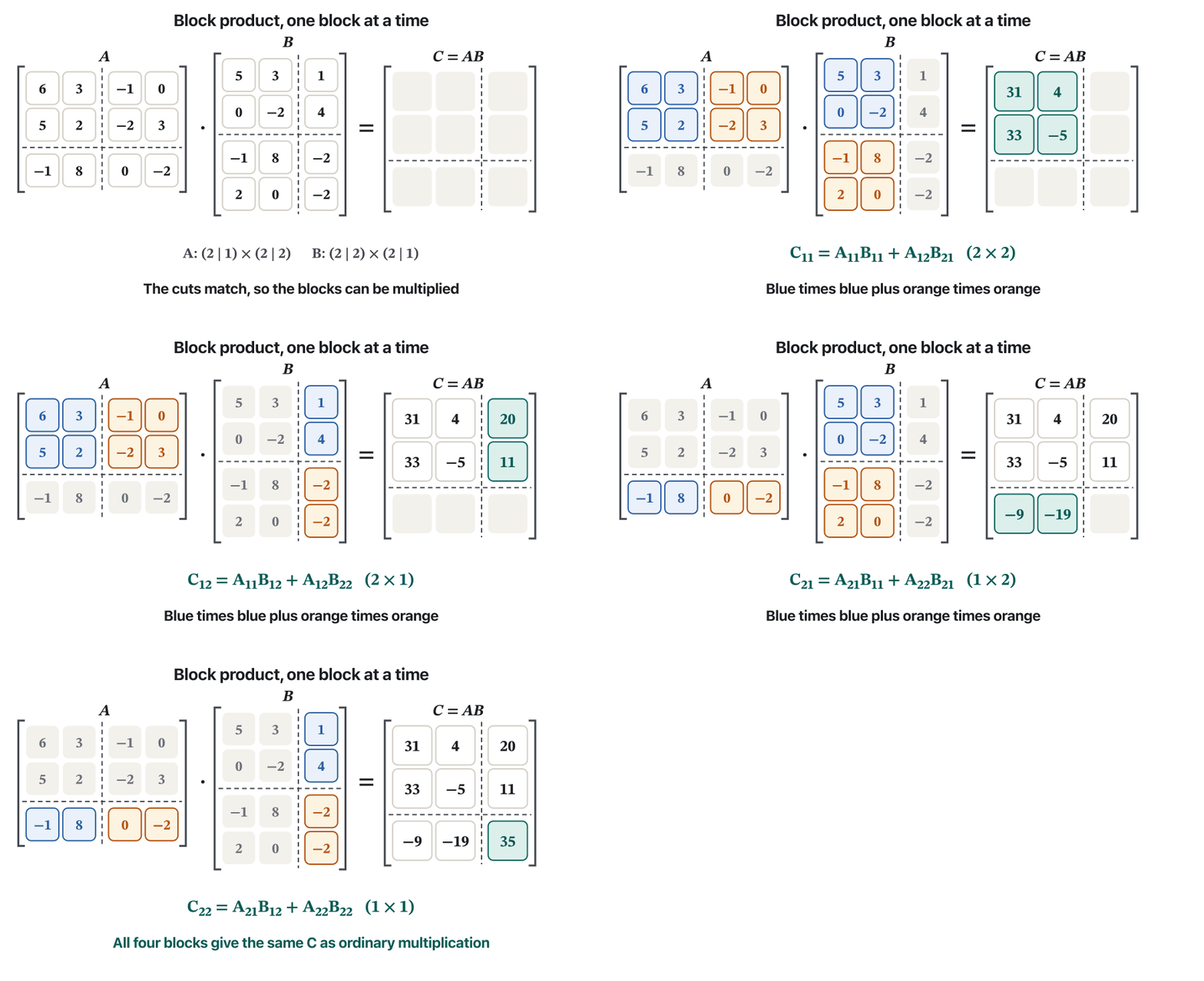
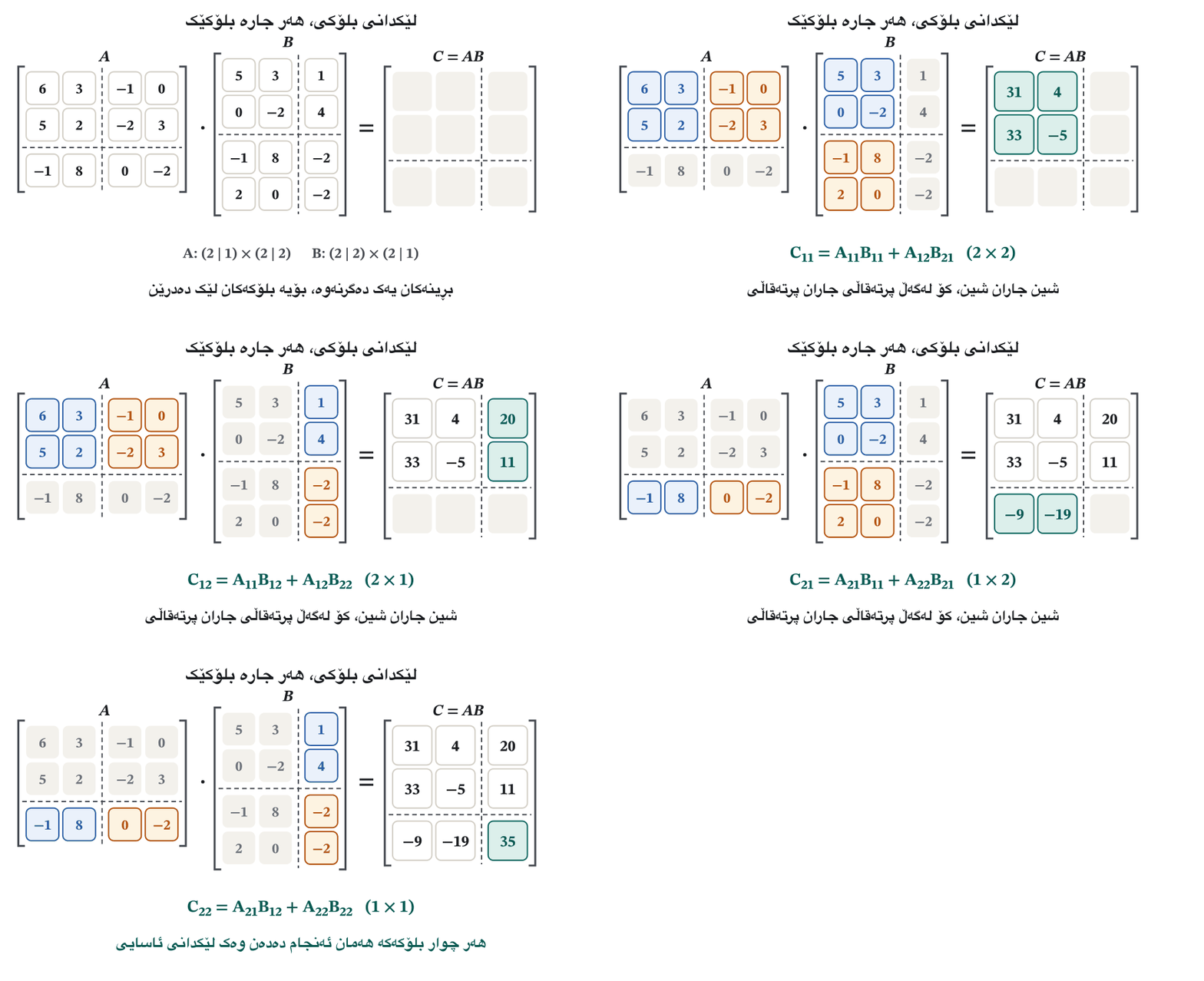
The notes' exercise: multiply the partitioned AA (3×43 \times 4) and BB (4×34 \times 3). Cut the columns of AA 2∣22 \mid 2 and the rows of BB 2∣22 \mid 2 (conformable), and also the rows of AA 2∣12 \mid 1 and the columns of BB 2∣12 \mid 1:

ڕاهێنانەکەی تێبینییەکان: AA (3×43 \times 4) و BB (4×34 \times 3)ـی دابەشکراو لێک بدە. ستوونەکانی AA بە 2∣22 \mid 2 و ڕیزەکانی BB بە 2∣22 \mid 2 ببڕە (گونجاو)، هەروەها ڕیزەکانی AA بە 2∣12 \mid 1 و ستوونەکانی BB بە 2∣12 \mid 1:

A=[63−1052−23−180−2]B=[5310−24−18−220−2]A = \left[\begin{array}{cc|cc} 6 & 3 & -1 & 0 \\ 5 & 2 & -2 & 3 \\ \hline -1 & 8 & 0 & -2 \end{array}\right] \qquad B = \left[\begin{array}{cc|c} 5 & 3 & 1 \\ 0 & -2 & 4 \\ \hline -1 & 8 & -2 \\ 2 & 0 & -2 \end{array}\right]
Five frames. Frame 1: A (3 × 4, cut after row 2 and column 2) and B (4 × 3, cut after row 2 and column 2) with an empty result C. Each next frame lights up one block-row of A and one block-column of B and fills one block of C: C11 = A11B11 + A12B21 gives (31, 4; 33, −5); C12 = A11B12 + A12B22 gives (20; 11); C21 = A21B11 + A22B21 gives (−9, −19); C22 = A21B12 + A22B22 gives 35. The last frame says all four blocks give the same C as ordinary multiplication.
Each block of C=ABC = AB is a sum of two block products.هەر بلۆکێکی C=ABC = AB کۆی دوو لێکدانی بلۆکییە.CêIT
C11=[6352][530−2]+[−10−23][−1820]=[30122511]+[1−88−16]=[31433−5]C12=[1813]+[2−2]=[2011],C21=[−5−19]+[−40]=[−9−19],C22=31+4=35\begin{aligned} C_{11} &= \begin{bmatrix} 6 & 3 \\ 5 & 2 \end{bmatrix}\begin{bmatrix} 5 & 3 \\ 0 & -2 \end{bmatrix} + \begin{bmatrix} -1 & 0 \\ -2 & 3 \end{bmatrix}\begin{bmatrix} -1 & 8 \\ 2 & 0 \end{bmatrix} = \begin{bmatrix} 30 & 12 \\ 25 & 11 \end{bmatrix} + \begin{bmatrix} 1 & -8 \\ 8 & -16 \end{bmatrix} = \begin{bmatrix} 31 & 4 \\ 33 & -5 \end{bmatrix} \\ C_{12} &= \begin{bmatrix} 18 \\ 13 \end{bmatrix} + \begin{bmatrix} 2 \\ -2 \end{bmatrix} = \begin{bmatrix} 20 \\ 11 \end{bmatrix}, \quad C_{21} = \begin{bmatrix} -5 & -19 \end{bmatrix} + \begin{bmatrix} -4 & 0 \end{bmatrix} = \begin{bmatrix} -9 & -19 \end{bmatrix}, \quad C_{22} = 31 + 4 = 35 \end{aligned}

So AB=[3142033−511−9−1935]AB = \begin{bmatrix} 31 & 4 & 20 \\ 33 & -5 & 11 \\ -9 & -19 & 35 \end{bmatrix} — the same as ordinary multiplication (checked with sympy). The notes' simpler cut, A11B1+A12B2A_{11}B_1 + A_{12}B_2 with only the 2∣22 \mid 2 cut, gives the same matrix too.

کەواتە AB=[3142033−511−9−1935]AB = \begin{bmatrix} 31 & 4 & 20 \\ 33 & -5 & 11 \\ -9 & -19 & 35 \end{bmatrix} — هەمان ئەنجامی لێکدانی ئاسایی (بە sympy پشکنراوە). بڕینە سادەترەکەی تێبینییەکان، A11B1+A12B2A_{11}B_1 + A_{12}B_2 تەنها بە بڕینی 2∣22 \mid 2، هەمان دەدات.

Method 4: the inverse by partitioningڕێگەی 4: پێچەوانە بە دابەشکردن

Cut a square matrix AA and its inverse B=A−1B = A^{-1} in the same way, with square diagonal blocks A11A_{11} and A22A_{22}. Then AB=IAB = I in blocks gives four equations:

AA و پێچەوانەکەی B=A−1B = A^{-1} بە هەمان شێوە ببڕە، بە بلۆکی چوارگۆشەیی لەسەر تیرەکە A11A_{11} و A22A_{22}. ئەوکات AB=IAB = I بە بلۆک چوار دەدات:

[A11A12A21A22][B11B12B21B22]=[I00I]  ⟹  A11B11+A12B21=IA11B12+A12B22=0A21B11+A22B21=0A21B12+A22B22=I\begin{bmatrix} A_{11} & A_{12} \\ A_{21} & A_{22} \end{bmatrix}\begin{bmatrix} B_{11} & B_{12} \\ B_{21} & B_{22} \end{bmatrix} = \begin{bmatrix} I & 0 \\ 0 & I \end{bmatrix} \;\Longrightarrow\; \begin{aligned} A_{11}B_{11} + A_{12}B_{21} &= I \\ A_{11}B_{12} + A_{12}B_{22} &= 0 \\ A_{21}B_{11} + A_{22}B_{21} &= 0 \\ A_{21}B_{12} + A_{22}B_{22} &= I \end{aligned}

Solving them (if A11A_{11} is invertible) brings in one key block, the EE:

شیکارکردنیان (ئەگەر A11A_{11} بێت) بلۆکێکی سەرەکی دەهێنێتە ناوەوە، EE:

E=A22−A21A11−1A12B22=E−1B12=−A11−1A12E−1B21=−E−1A21A11−1B11=A11−1+A11−1A12E−1A21A11−1E = A_{22} - A_{21}A_{11}^{-1}A_{12} \qquad \begin{aligned} B_{22} &= E^{-1} & B_{12} &= -A_{11}^{-1}A_{12}E^{-1} \\ B_{21} &= -E^{-1}A_{21}A_{11}^{-1} & B_{11} &= A_{11}^{-1} + A_{11}^{-1}A_{12}E^{-1}A_{21}A_{11}^{-1} \end{aligned}

The method needs both A11A_{11} and EE to be invertible.

ڕێگەکە پێویستی بەوەیە A11A_{11} و EE هەردووکیان بن.

Quick checkپشکنینی خێراWhich block of A−1A^{-1} is simply E−1E^{-1}?کام بلۆکی A−1A^{-1} تەنها E−1E^{-1}ـە؟

Method 4: the inverse by partitioningڕێگەی 4: پێچەوانە بە دابەشکردن

Where the formulas come fromفۆرمولەکان لە کوێوە دێن

The four formulas are not magic: they come from the four block equations, solved like a system of two equations in two unknowns — but the unknowns are matrices, so the order of every product is kept.

چوار جادوو نین: لە چوار بلۆکییەکەوە دێن کە وەک سیستەمێکی دوو بە دوو نەزانراو شیکار دەکرێن — بەڵام نەزانراوەکان ، بۆیە ڕیزبەندیی هەموو لێکدانێک دەپارێزرێت.

  1. From equation 2لە هاوکێشەی 2ەوە

    B12=−A11−1A12B22B_{12} = -A_{11}^{-1}A_{12}B_{22}.

    B12=−A11−1A12B22B_{12} = -A_{11}^{-1}A_{12}B_{22}.

  2. Into equation 4دەیخەینە هاوکێشەی 4ەوە

    (A22−A21A11−1A12)B22=I(A_{22} - A_{21}A_{11}^{-1}A_{12})B_{22} = I, that is EB22=IEB_{22} = I, so B22=E−1B_{22} = E^{-1} and B12=−A11−1A12E−1B_{12} = -A_{11}^{-1}A_{12}E^{-1}.

    (A22−A21A11−1A12)B22=I(A_{22} - A_{21}A_{11}^{-1}A_{12})B_{22} = I، واتە EB22=IEB_{22} = I، بۆیە B22=E−1B_{22} = E^{-1} و B12=−A11−1A12E−1B_{12} = -A_{11}^{-1}A_{12}E^{-1}.

  3. Equations 1 and 3 the same wayهاوکێشەکانی 1 و 3 بە هەمان شێوە

    Equation 1 gives B11=A11−1(I−A12B21)B_{11} = A_{11}^{-1}(I - A_{12}B_{21}); put it into equation 3: EB21=−A21A11−1EB_{21} = -A_{21}A_{11}^{-1}, so B21=−E−1A21A11−1B_{21} = -E^{-1}A_{21}A_{11}^{-1}, and then B11B_{11} as above.

    1 دەدات B11=A11−1(I−A12B21)B_{11} = A_{11}^{-1}(I - A_{12}B_{21})؛ بیخە 3ەوە: EB21=−A21A11−1EB_{21} = -A_{21}A_{11}^{-1}، بۆیە B21=−E−1A21A11−1B_{21} = -E^{-1}A_{21}A_{11}^{-1} و پاشان B11B_{11} وەک سەرەوە.

Quick checkپشکنینی خێراEquation 2 gives B12=−A11−1A12B22B_{12} = -A_{11}^{-1}A_{12}B_{22}. Into which equation is it put to find B22B_{22}? 2 دەدات B12=−A11−1A12B22B_{12} = -A_{11}^{-1}A_{12}B_{22}. دەخرێتە ناو کام بۆ دۆزینەوەی B22B_{22}؟

The notes' example, checkedنموونەکەی تێبینییەکان، پشکنراو

Find the inverse of A=[−321−115003]A = \begin{bmatrix} -3 & 2 & 1 \\ -1 & 1 & 5 \\ 0 & 0 & 3 \end{bmatrix}, cut after row 2 and column 2:

پێچەوانەی A=[−321−115003]A = \begin{bmatrix} -3 & 2 & 1 \\ -1 & 1 & 5 \\ 0 & 0 & 3 \end{bmatrix} بدۆزەرەوە، کە دوای ڕیزی 2 و ستوونی 2 بڕدراوە:

  1. The blocksبلۆکەکان

    A11=[−32−11]A_{11} = \begin{bmatrix} -3 & 2 \\ -1 & 1 \end{bmatrix}, A12=[15]A_{12} = \begin{bmatrix} 1 \\ 5 \end{bmatrix}, A21=[00]A_{21} = \begin{bmatrix} 0 & 0 \end{bmatrix}, A22=[3]A_{22} = [3].

    A11=[−32−11]A_{11} = \begin{bmatrix} -3 & 2 \\ -1 & 1 \end{bmatrix}، A12=[15]A_{12} = \begin{bmatrix} 1 \\ 5 \end{bmatrix}، A21=[00]A_{21} = \begin{bmatrix} 0 & 0 \end{bmatrix}، A22=[3]A_{22} = [3].

  2. Invert A11A_{11} with the shortcutپێچەوانەی A11A_{11} بە ڕێگە کورتەکە

    det⁡A11=−3+2=−1\det A_{11} = -3 + 2 = -1, so A11−1=1−1[1−21−3]=[−12−13]A_{11}^{-1} = \frac{1}{-1}\begin{bmatrix} 1 & -2 \\ 1 & -3 \end{bmatrix} = \begin{bmatrix} -1 & 2 \\ -1 & 3 \end{bmatrix}.

    det⁡A11=−3+2=−1\det A_{11} = -3 + 2 = -1، بۆیە A11−1=1−1[1−21−3]=[−12−13]A_{11}^{-1} = \frac{1}{-1}\begin{bmatrix} 1 & -2 \\ 1 & -3 \end{bmatrix} = \begin{bmatrix} -1 & 2 \\ -1 & 3 \end{bmatrix}.

  3. The Schur complementتەواوکەری شوور

    A21=0A_{21} = 0, so E=3−0=[3]E = 3 - 0 = [3] and E−1=[13]E^{-1} = [\tfrac13].

    A21=0A_{21} = 0، بۆیە E=3−0=[3]E = 3 - 0 = [3] و E−1=[13]E^{-1} = [\tfrac13].

  4. The four blocksچوار بلۆکەکە

    A11−1A12=[−1+10−1+15]=[914]A_{11}^{-1}A_{12} = \begin{bmatrix} -1 + 10 \\ -1 + 15 \end{bmatrix} = \begin{bmatrix} 9 \\ 14 \end{bmatrix}, so B12=−13[914]=[−3−143]B_{12} = -\tfrac13\begin{bmatrix} 9 \\ 14 \end{bmatrix} = \begin{bmatrix} -3 \\ -\frac{14}{3} \end{bmatrix}. Because A21=0A_{21} = 0: B21=[00]B_{21} = \begin{bmatrix} 0 & 0 \end{bmatrix} and B11=A11−1B_{11} = A_{11}^{-1}. Finally B22=13B_{22} = \tfrac13.

    A11−1A12=[−1+10−1+15]=[914]A_{11}^{-1}A_{12} = \begin{bmatrix} -1 + 10 \\ -1 + 15 \end{bmatrix} = \begin{bmatrix} 9 \\ 14 \end{bmatrix}، بۆیە B12=−13[914]=[−3−143]B_{12} = -\tfrac13\begin{bmatrix} 9 \\ 14 \end{bmatrix} = \begin{bmatrix} -3 \\ -\frac{14}{3} \end{bmatrix}. چونکە A21=0A_{21} = 0: B21=[00]B_{21} = \begin{bmatrix} 0 & 0 \end{bmatrix} و B11=A11−1B_{11} = A_{11}^{-1}. لە کۆتاییدا B22=13B_{22} = \tfrac13.

  5. Put the blocks togetherبلۆکەکان پێکەوە دابنێ

    A−1=[−12−3−13−1430013]A^{-1} = \begin{bmatrix} -1 & 2 & -3 \\ -1 & 3 & -\frac{14}{3} \\ 0 & 0 & \frac13 \end{bmatrix}. Check: this is exactly the inverse that sympy (or Gauss–Jordan) gives; det⁡A=−3\det A = -3.

    A−1=[−12−3−13−1430013]A^{-1} = \begin{bmatrix} -1 & 2 & -3 \\ -1 & 3 & -\frac{14}{3} \\ 0 & 0 & \frac13 \end{bmatrix}. پشکنین: ئەمە ڕێک ئەو پێچەوانەیەیە کە sympy (یان ) دەیدات؛ det⁡A=−3\det A = -3.

Quick checkپشکنینی خێراIn this example, why is B21B_{21} a block of zeros?لەم نموونەیەدا، بۆچی B21B_{21} بلۆکێکی سفرە؟

In computing: blocks in practiceلە کۆمپیوتەردا: بلۆکەکان لە کردەوەدا

Common mistakesهەڵە باوەکان

MistakeهەڵەWhat is trueڕاستییەکە
Writing B21A12B_{21}A_{12} instead of A12B21A_{12}B_{21}نووسینی B21A12B_{21}A_{12} لە جیاتی A12B21A_{12}B_{21}Blocks are matrices: keep the order AikBkjA_{ik}B_{kj}.بلۆکەکان : ڕیزبەندیی AikBkjA_{ik}B_{kj} بپارێزە.
Cutting the columns of AA and the rows of BB differentlyبڕینی ستوونەکانی AA و ڕیزەکانی BB بە شێوەی جیاوازThe cuts must be conformable, or the block products are not defined.بڕینەکان دەبێت گونجاو بن، دەنا لێکدانە بلۆکییەکان پێناسە نەکراون.
Adding matrices that are cut differently, block by blockکۆکردنەوەی بلۆک بە بلۆکی کە بە جیاوازی بڕدراونBlock addition needs the same cut.کۆکردنەوەی بلۆکی پێویستی بە هەمان بڕینە.
Writing 1A11\frac{1}{A_{11}} for A11−1A_{11}^{-1}نووسینی 1A11\frac{1}{A_{11}} بۆ A11−1A_{11}^{-1}There is no matrix division; find A11−1A_{11}^{-1} by a method (unless the block is 1×11 \times 1).دابەشکردنی نییە؛ A11−1A_{11}^{-1} بە ڕێگەیەک بدۆزەرەوە (مەگەر بلۆکەکە 1×11 \times 1 بێت).
Using partitioning when A11A_{11} is singularبەکارهێنانی دابەشکردن کاتێک A11A_{11} Choose another cut, or use Gauss–Jordan.بڕینێکی تر هەڵبژێرە، یان بەکاربهێنە.

Exercisesڕاهێنانەکان

ExerciseڕاهێنانExercise 1: add by blocksڕاهێنانی 1: بە بلۆک کۆی بکەرەوە

Cut U=[10321−1042]U = \begin{bmatrix} 1 & 0 & 3 \\ 2 & 1 & -1 \\ 0 & 4 & 2 \end{bmatrix} and V=[25−10311−24]V = \begin{bmatrix} 2 & 5 & -1 \\ 0 & 3 & 1 \\ 1 & -2 & 4 \end{bmatrix} after row 2 and column 2. Find U+VU + V block by block, and 3U3U.

U=[10321−1042]U = \begin{bmatrix} 1 & 0 & 3 \\ 2 & 1 & -1 \\ 0 & 4 & 2 \end{bmatrix} و V=[25−10311−24]V = \begin{bmatrix} 2 & 5 & -1 \\ 0 & 3 & 1 \\ 1 & -2 & 4 \end{bmatrix} دوای ڕیزی 2 و ستوونی 2 ببڕە. U+VU + V بلۆک بە بلۆک بدۆزەرەوە، هەروەها 3U3U.

Show answerوەڵامەکە پیشان بدە
U11+V11=[3524],  U12+V12=[20],  U21+V21=[12],  U22+V22=[6]  ⇒  U+V=[352240126],3U=[30963−30126]U_{11} + V_{11} = \begin{bmatrix} 3 & 5 \\ 2 & 4 \end{bmatrix},\; U_{12} + V_{12} = \begin{bmatrix} 2 \\ 0 \end{bmatrix},\; U_{21} + V_{21} = \begin{bmatrix} 1 & 2 \end{bmatrix},\; U_{22} + V_{22} = [6] \;\Rightarrow\; U + V = \left[\begin{array}{cc|c} 3 & 5 & 2 \\ 2 & 4 & 0 \\ \hline 1 & 2 & 6 \end{array}\right], \quad 3U = \begin{bmatrix} 3 & 0 & 9 \\ 6 & 3 & -3 \\ 0 & 12 & 6 \end{bmatrix}
ExerciseڕاهێنانExercise 2: a product by blocksڕاهێنانی 2: لێکدانێک بە بلۆک

Let K=[121013201]K = \begin{bmatrix} 1 & 2 & 1 \\ 0 & 1 & 3 \\ 2 & 0 & 1 \end{bmatrix} with its columns cut 2∣12 \mid 1, and W=[102113]W = \begin{bmatrix} 1 & 0 \\ 2 & 1 \\ 1 & 3 \end{bmatrix}. How must WW be cut? Find KW=K1W1+K2W2KW = K_1W_1 + K_2W_2.

با K=[121013201]K = \begin{bmatrix} 1 & 2 & 1 \\ 0 & 1 & 3 \\ 2 & 0 & 1 \end{bmatrix} بێت بە ستوونی بڕدراوی 2∣12 \mid 1 و W=[102113]W = \begin{bmatrix} 1 & 0 \\ 2 & 1 \\ 1 & 3 \end{bmatrix}. WW دەبێت چۆن ببڕدرێت؟ KW=K1W1+K2W2KW = K_1W_1 + K_2W_2 بدۆزەرەوە.

Show answerوەڵامەکە پیشان بدە
[120120][1021]+[131][13]=[522120]+[133913]=[6551033]\begin{bmatrix} 1 & 2 \\ 0 & 1 \\ 2 & 0 \end{bmatrix}\begin{bmatrix} 1 & 0 \\ 2 & 1 \end{bmatrix} + \begin{bmatrix} 1 \\ 3 \\ 1 \end{bmatrix}\begin{bmatrix} 1 & 3 \end{bmatrix} = \begin{bmatrix} 5 & 2 \\ 2 & 1 \\ 2 & 0 \end{bmatrix} + \begin{bmatrix} 1 & 3 \\ 3 & 9 \\ 1 & 3 \end{bmatrix} = \begin{bmatrix} 6 & 5 \\ 5 & 10 \\ 3 & 3 \end{bmatrix}

Cut the rows of WW 2∣12 \mid 1, the same way as the columns of KK. The result is the same as ordinary multiplication.

ڕیزەکانی WW بە 2∣12 \mid 1 ببڕە، هەمان شێوەی بڕینی ستوونەکانی KK. ئەنجامەکە هەمان ئەنجامی لێکدانی ئاساییە.

ExerciseڕاهێنانExercise 3: block-diagonal matricesڕاهێنانی 3: ماتریکسە بلۆکییە تیرەییەکان

X=[120340005]X = \begin{bmatrix} 1 & 2 & 0 \\ 3 & 4 & 0 \\ 0 & 0 & 5 \end{bmatrix} and Y=[200110002]Y = \begin{bmatrix} 2 & 0 & 0 \\ 1 & 1 & 0 \\ 0 & 0 & 2 \end{bmatrix} have zero blocks off the diagonal. Find XYXY and X−1X^{-1} block by block.

X=[120340005]X = \begin{bmatrix} 1 & 2 & 0 \\ 3 & 4 & 0 \\ 0 & 0 & 5 \end{bmatrix} و Y=[200110002]Y = \begin{bmatrix} 2 & 0 & 0 \\ 1 & 1 & 0 \\ 0 & 0 & 2 \end{bmatrix} لە دەرەوەی تیرەکە بلۆکی سفریان هەیە. XYXY و X−1X^{-1} بلۆک بە بلۆک بدۆزەرەوە.

Show answerوەڵامەکە پیشان بدە
XY=[[1234][2011]005⋅2]=[42010400010],X−1=[−21032−1200015]XY = \begin{bmatrix} \begin{bmatrix} 1 & 2 \\ 3 & 4 \end{bmatrix}\begin{bmatrix} 2 & 0 \\ 1 & 1 \end{bmatrix} & 0 \\ 0 & 5 \cdot 2 \end{bmatrix} = \begin{bmatrix} 4 & 2 & 0 \\ 10 & 4 & 0 \\ 0 & 0 & 10 \end{bmatrix}, \qquad X^{-1} = \begin{bmatrix} -2 & 1 & 0 \\ \tfrac32 & -\tfrac12 & 0 \\ 0 & 0 & \tfrac15 \end{bmatrix}

Each diagonal block is multiplied or inverted on its own: [1234]−1\begin{bmatrix} 1 & 2 \\ 3 & 4 \end{bmatrix}^{-1} by the shortcut, and 5−1=155^{-1} = \frac15.

هەر بلۆکێکی تیرە بە تەنها لێک دەدرێت یان پێچەوانە دەکرێتەوە: [1234]−1\begin{bmatrix} 1 & 2 \\ 3 & 4 \end{bmatrix}^{-1} بە ڕێگە کورتەکە و 5−1=155^{-1} = \frac15.

ExerciseڕاهێنانExercise 4 (the notes' homework, with a new matrix)ڕاهێنانی 4 (ئەرکی تێبینییەکان، بە ماتریکسێکی نوێ)

The notes' homework repeats the example's matrix, so use a new one: find the inverse of A=[211110123]A = \begin{bmatrix} 2 & 1 & 1 \\ 1 & 1 & 0 \\ 1 & 2 & 3 \end{bmatrix} by partitioning after row 2 and column 2. Here A21≠0A_{21} \ne 0, so all four formulas are needed.

ئەرکەکەی تێبینییەکان نموونەکە دووبارە دەکاتەوە، بۆیە نوێ بەکاربهێنە: پێچەوانەی A=[211110123]A = \begin{bmatrix} 2 & 1 & 1 \\ 1 & 1 & 0 \\ 1 & 2 & 3 \end{bmatrix} بدۆزەرەوە بە دابەشکردن دوای ڕیزی 2 و ستوونی 2. لێرەدا A21≠0A_{21} \ne 0، بۆیە هەر چوار پێویستن.

Hintئاماژە

det⁡A11=2−1=1\det A_{11} = 2 - 1 = 1: use the 2×22 \times 2 shortcut for A11−1A_{11}^{-1}.

det⁡A11=2−1=1\det A_{11} = 2 - 1 = 1: بۆ A11−1A_{11}^{-1} ڕێگە کورتەکەی 2×22 \times 2 بەکاربهێنە.

Show answerوەڵامەکە پیشان بدە
A11−1=[1−1−12],  A11−1A12=[1−1],  A21A11−1=[−13]E=3−A21A11−1A12=3−(−1)=4,E−1=14B11=[1−1−12]+14[−131−3]=[34−14−3454]B12=−14[1−1],B21=−14[−13],B22=14A−1=14[3−1−1−3511−31]\begin{aligned} A_{11}^{-1} &= \begin{bmatrix} 1 & -1 \\ -1 & 2 \end{bmatrix},\; A_{11}^{-1}A_{12} = \begin{bmatrix} 1 \\ -1 \end{bmatrix},\; A_{21}A_{11}^{-1} = \begin{bmatrix} -1 & 3 \end{bmatrix} \\ E &= 3 - A_{21}A_{11}^{-1}A_{12} = 3 - (-1) = 4, \quad E^{-1} = \tfrac14 \\ B_{11} &= \begin{bmatrix} 1 & -1 \\ -1 & 2 \end{bmatrix} + \tfrac14\begin{bmatrix} -1 & 3 \\ 1 & -3 \end{bmatrix} = \begin{bmatrix} \tfrac34 & -\tfrac14 \\ -\tfrac34 & \tfrac54 \end{bmatrix} \\ B_{12} &= -\tfrac14\begin{bmatrix} 1 \\ -1 \end{bmatrix},\quad B_{21} = -\tfrac14\begin{bmatrix} -1 & 3 \end{bmatrix},\quad B_{22} = \tfrac14 \\ A^{-1} &= \frac14\begin{bmatrix} 3 & -1 & -1 \\ -3 & 5 & 1 \\ 1 & -3 & 1 \end{bmatrix} \end{aligned}

Checked with sympy; also det⁡A=det⁡A11⋅det⁡E=1⋅4=4\det A = \det A_{11} \cdot \det E = 1 \cdot 4 = 4.

بە sympy پشکنراوە؛ هەروەها det⁡A=det⁡A11⋅det⁡E=1⋅4=4\det A = \det A_{11} \cdot \det E = 1 \cdot 4 = 4.

ExerciseڕاهێنانExercise 5: spot the mistakeڕاهێنانی 5: هەڵەکە بدۆزەرەوە

Karwan wrote the top-left block of ABAB as A11B11+B21A12A_{11}B_{11} + B_{21}A_{12}. What is wrong?

کاروان بلۆکی سەرەوەی چەپی ABABـی وا نووسی A11B11+B21A12A_{11}B_{11} + B_{21}A_{12}. چی هەڵەیە؟

Show answerوەڵامەکە پیشان بدە

The second product is in the wrong order. Blocks do not commute: it must be A12B21A_{12}B_{21} (block (1, 2) of AA times block (2, 1) of BB).

لێکدانی دووەم ڕیزبەندییەکەی هەڵەیە. بلۆکەکان ئاڵوگۆڕ ناکەن: دەبێت A12B21A_{12}B_{21} بێت (بلۆکی (⁦1⁩، ⁦2⁩)ی AA جاران بلۆکی (⁦2⁩، ⁦1⁩)ی BB).

Summaryپوختە

  • Partitioning cuts a matrix into blocks AijA_{ij}; blocks in one block-row share their rows, in one block-column their columns.
  • Add and scale block by block (same cut for addition).
  • Multiply blocks like entries, keeping the order: Cij=∑kAikBkjC_{ij} = \sum_k A_{ik}B_{kj}; the column cut of AA must match the row cut of BB.
  • Inverse by partitioning: E=A22−A21A11−1A12E = A_{22} - A_{21}A_{11}^{-1}A_{12} (the Schur complement), B22=E−1B_{22} = E^{-1}, and three more formulas; A11A_{11} and EE must be invertible.
  • دابەشکردن دەکاتە بلۆکی AijA_{ij}؛ بلۆکەکانی یەک ڕیزی بلۆکی ڕیزەکانیان هاوبەشە، هی یەک ستوونی بلۆکی ستوونەکانیان.
  • بلۆک بە بلۆک کۆ بکەرەوە و لێک بدە (هەمان بڕین بۆ کۆکردنەوە).
  • بلۆکەکان وەک ژمارە لێک بدە بە پاراستنی ڕیزبەندی: Cij=∑kAikBkjC_{ij} = \sum_k A_{ik}B_{kj}؛ بڕینی ستوونەکانی AA دەبێت لەگەڵ بڕینی ڕیزەکانی BB یەک بگرێتەوە.
  • پێچەوانە بە دابەشکردن: E=A22−A21A11−1A12E = A_{22} - A_{21}A_{11}^{-1}A_{12} ()، B22=E−1B_{22} = E^{-1} و سێ تر؛ A11A_{11} و EE دەبێت بن.
Review questionsپرسیارەکانی پێداچوونەوە
When is the block product allowed?لێکدانی بلۆکی کەی ڕێگەپێدراوە؟

When the cuts are conformable: every block product AikBkjA_{ik}B_{kj} has matching inner sizes.

کاتێک بڕینەکان گونجاو بن: هەموو لێکدانێکی بلۆکیی AikBkjA_{ik}B_{kj} قەبارە ناوەکییەکانی یەک بگرنەوە.

Why learn inverse by partitioning if Gauss–Jordan works?بۆچی پێچەوانە بە دابەشکردن فێر ببین ئەگەر لابردنی گاوس–جۆردان کار دەکات؟

Because it reuses work: if A11−1A_{11}^{-1} is already known (or a block is 0), the big inverse comes from small pieces.

چونکە کار دووبارە بەکاردەهێنێتەوە: ئەگەر A11−1A_{11}^{-1} پێشتر زانراو بێت (یان بلۆکێک 0 بێت)، پێچەوانە گەورەکە لە پارچە بچووکەکانەوە دێت.

This is the last lesson of the chapter “Matrices and Determinants” and of the whole course. For all six chapters at a glance and what comes later in calculus, see the course so far and what comes next.

ئەمە دوایین وانەی بەشی « و » و دوایین وانەی هەموو کۆرسەکەیە. بۆ هەر شەش بەشەکە بە یەک سەیرکردن و ئەوەی دواتر لە کالکولەسدا دێت، بڕوانە کۆرسەکە تا ئێرە و هەنگاوی داهاتوو.

Lesson complete!وانەکە تەواو بوو!

Well done. Review the key terms, then go on to the next lesson.دەستخۆش. سەیرێکی زاراوە سەرەکییەکان بکەرەوە، پاشان بڕۆ بۆ وانەی داهاتوو.

Key termsزاراوە سەرەکییەکان

References and further readingسەرچاوەکان و خوێندنەوەی زیاتر

This lecture is a first edition. The Kurdish text and terminology are waiting for review by Kurdish IT teachers.ئەم وانەیە چاپی یەکەمە. دەقە کوردییەکە و زاراوەکانی چاوەڕێی پێداچوونەوەی مامۆستایانی کوردی بواری IT ن.