Chapterبەش 2 · Lectureوانە 2.11
Practice: One Data Set from Table to Averagesڕاهێنان: یەک کۆمەڵەدراوە لە خشتەوە بۆ پێوەرەکانی ڕووکردنە چەق
Exam practice: the class test (Group B) solved end to end — 50 raw values into a frequency table with relative frequencies, then the arithmetic, harmonic and quadratic means, the median and the mode — and a daily quiz with real slips to find and fix.
ڕاهێنان بۆ تاقیکردنەوە: تاقیکردنەوەی پۆلی گرووپی B لە سەرەتاوە تا کۆتایی چارەسەر دەکرێت — 50 نرخی خاو دەبنە لەگەڵ ، پاشان ، و ، و — هەروەها تاقیکردنەوەیەکی ڕۆژانە کە هەڵەی ڕاستەقینەی تێدایە بۆ دۆزینەوە و ڕاستکردنەوە.
What you will learnچی فێر دەبیت
- Turn raw whole-number data into a frequency table with relative frequencies, step by step.
- Compute the arithmetic, harmonic, quadratic (and geometric) means of grouped data from one working table.
- Find the median and the mode of grouped data with class boundaries.
- Check your own work and find slips in a worked solution.
- خاو () هەنگاو بە هەنگاو بکەیت بە لەگەڵ .
- ، ، (و ) ـی لە یەک خشتەی کارەوە بژمێریت.
- و بە بدۆزیتەوە.
- کاری خۆت بپشکنیت و هەڵە بچووکەکانی چارەسەرێک بدۆزیتەوە.
One problem, every stepیەک پرسیار، هەموو هەنگاوەکان
This lesson is exam practice. You solve one whole test question from the first number to the last answer: first you turn 50 raw values into a frequency table, then you find every average from that table. Each step has its own lesson; here you see how the steps fit together and how to check your own work.
ئەم وانەیە ڕاهێنانە بۆ تاقیکردنەوە. پرسیارێکی تەواوی تاقیکردنەوە لە یەکەم ژمارەوە تا دوایین وەڵام چارەسەر دەکەیت: سەرەتا 50 نرخی خاو دەکەیت بە ، پاشان هەموو لەو خشتەیەوە دەدۆزیتەوە. هەر هەنگاوێک وانەی تایبەتی خۆی هەیە؛ لێرەدا دەبینیت هەنگاوەکان چۆن پێکەوە دەبەسترێن و چۆن کارەکەی خۆت بپشکنیت.
The steps come from four earlier lessons: Grouping data: frequency tables (steps 1–6), The arithmetic and weighted mean (steps 7–9), Geometric, harmonic and quadratic means (step 9) and Median and mode (steps 10–11). Open them again if a step feels new.
هەنگاوەکان لە چوار وانەی پێشووەوە دێن: خشتەکانی دووبارەبوونەوە (هەنگاوەکانی 1–6)، ناوەند و ناوەندی قورسکراو (هەنگاوەکانی 7–9)، ناوەندی ئەندازەیی، ناوەندی هارمۆنیک و ناوەندی دووجایی (هەنگاوی 9) و ناوەڕاستە و باو (هەنگاوەکانی 10–11). ئەگەر هەنگاوێک نامۆ بوو، دیسان سەیری ئەو وانانە بکەرەوە.
The test: 50 values and two questionsتاقیکردنەوەکە: 50 نرخ و دوو پرسیار
A class test (Group B) gives these 50 values:
تاقیکردنەوەیەکی پۆل (گرووپی B) ئەم 50 نرخە دەدات:
| 1 | 2 | 3 | 4 | 5 | 6 | 7 | 8 | 9 | 10 |
|---|---|---|---|---|---|---|---|---|---|
| 50 | 40 | 41 | 17 | 11 | 7 | 22 | 4 | 28 | 21 |
| 19 | 23 | 37 | 51 | 54 | 42 | 86 | 41 | 78 | 56 |
| 72 | 56 | 17 | 7 | 69 | 30 | 80 | 56 | 29 | 33 |
| 46 | 31 | 39 | 20 | 18 | 29 | 34 | 59 | 73 | 77 |
| 36 | 39 | 30 | 62 | 54 | 67 | 39 | 31 | 53 | 44 |
- Change these ungrouped data into grouped data with a frequency table, then find the relative frequency of each class.
- Find the arithmetic, harmonic and quadratic means, the mode and the median.
- ئەم بکە بە بە ، پاشان بۆ هەر بدۆزەرەوە.
- ، و ، و بدۆزەرەوە.
Before you calculate anything, look at the data. All 50 values are whole numbers, the smallest is 4 and the largest is 86. That the values are whole numbers decides how we write the classes in step 4.
پێش ئەوەی هیچ شتێک بژمێریت، سەیری بکە. هەموو 50 نرخەکە ، بچووکترینیان 4 و گەورەترینیان 86ـە. ئەوەی نرخەکان بڕیار دەدات کە لە هەنگاوی 4دا چۆن بنووسین.
Steps 1–3: range, number of classes, class widthهەنگاوەکانی 1–3: مەودا، ژمارەی کلاسەکان، پانیی کلاس
The total range T.R, the number of classes m (the course uses Yule's rule) and the class width L.
T.R، ژمارەی m (کۆرسەکە بەکار دەهێنێت) و L.
The two roundings are different on purpose. The number of classes is rounded in the usual way (). The width is always rounded up (), because the classes must reach the largest value: , but would leave 81 and 86 without a class.
ئەم دوو بە مەبەست جیاوازن. ژمارەی بە شێوەی ئاسایی نزیک دەکرێتەوە (). بەڵام هەمیشە بەرەو سەرەوە نزیک دەکرێتەوە ()، چونکە دەبێت بگەنە گەورەترین نرخ: ، بەڵام 81 و 86 بێ بەجێ دەهێڵێت.
Sturges' rule, , also gives 7 classes, so both rules of the course agree here. More about both rules and about rounding up: Step 3: the class width.
، ، ئەویش 7 دەدات، کەواتە لێرەدا هەردوو یاساکەی کۆرسەکە ڕێک دەکەون. زیاتر دەربارەی هەردوو یاساکە و بەرەو سەرەوە: هەنگاوی 3: پانیی کلاس.
Step 4: the seven classesهەنگاوی 4: حەوت کلاسەکە
The values are whole numbers, so each class is a block of 12 whole numbers. A class starts at its lower limit LL and ends 11 units later: . The next class starts at the next whole number. The first class starts at the smallest value, 4.
نرخەکان ، بۆیە هەر کۆمەڵەیەکی 12 . لە خوارەوە LL دەست پێدەکات و 11 یەکە دواتر کۆتایی دێت: . دواتر لە ژمارە تەواوەکەی دواتر دەست پێدەکات. یەکەم لە بچووکترین نرخ، واتە 4، دەست پێدەکات.
| Class | Upper limitسنووری سەرەوە | Limits | Boundaries |
|---|---|---|---|
| 1 | 4–15 | 3.5 – 15.5 | |
| 2 | 16–27 | 15.5 – 27.5 | |
| 3 | 28–39 | 27.5 – 39.5 | |
| 4 | 40–51 | 39.5 – 51.5 | |
| 5 | 52–63 | 51.5 – 63.5 | |
| 6 | 64–75 | 63.5 – 75.5 | |
| 7 | 76–87 | 75.5 – 87.5 |
Check the last class: 76–87 contains the largest value 86 ✓. The boundaries (3.5, 15.5, 27.5, …) close the gaps between classes; you need them in steps 10 and 11. Why : Class boundaries.
دوایین بپشکنە: 76–87 گەورەترین نرخ، 86، لەخۆ دەگرێت ✓. (3.5، 15.5، 27.5، …) بۆشایی نێوان دادەخەن؛ لە هەنگاوەکانی 10 و 11دا پێویستیانە. بۆچی : سنوورە ڕاستەقینەکانی کلاس.
Steps 5–6: count the values, then the relative frequencyهەنگاوەکانی 5–6: نرخەکان بژمێرە، پاشان دووبارەبوونەوەی ڕێژەیی
Put every value into its class (with tally marks or straight from the sorted list) and count. Then divide each frequency by for the relative frequency, and multiply by 100 for a percentage:
هەر نرخێک بخەرە ناو خۆی (بە یان ڕاستەوخۆ لە لیستە ڕیزکراوەکەوە) و بیانژمێرە. پاشان هەر دابەشی بکە بۆ . بۆ ئەنجامەکە لێک بدە لە 100:
| Class | Values in the classنرخەکانی ناو | F | (%) | |
|---|---|---|---|---|
| 4–15 | 4, 7, 7, 114، 7، 7، 11 | 4 | 0.08 | 8 |
| 16–27 | 17, 17, 18, 19, 20, 21, 22, 2317، 17، 18، 19، 20، 21، 22، 23 | 8 | 0.16 | 16 |
| 28–39 | 28, 29, 29, 30, 30, 31, 31, 33, 34, 36, 37, 39, 39, 3928، 29، 29، 30، 30، 31، 31، 33، 34، 36، 37، 39، 39، 39 | 14 | 0.28 | 28 |
| 40–51 | 40, 41, 41, 42, 44, 46, 50, 5140، 41، 41، 42، 44، 46، 50، 51 | 8 | 0.16 | 16 |
| 52–63 | 53, 54, 54, 56, 56, 56, 59, 6253، 54، 54، 56، 56، 56، 59، 62 | 8 | 0.16 | 16 |
| 64–75 | 67, 69, 72, 7367، 69، 72، 73 | 4 | 0.08 | 8 |
| 76–87 | 77, 78, 80, 8677، 78، 80، 86 | 4 | 0.08 | 8 |
| Totalکۆ | 50 | 1 | 100 |
Two checks before you go on: the frequencies add up to , and the percentages add up to 100.
پێش ئەوەی بەردەوام بیت دوو پشکنین بکە: کۆی دەکاتە و کۆی دەکاتە 100.
Steps 7–8: midpoints and one working tableهەنگاوەکانی 7–8: خاڵە ناوەڕاستەکانی کلاس و یەک خشتەی کار
In a grouped table the single values are gone, so each class is represented by its midpoint : , then 21.5, 33.5 and so on, always 12 apart. Then add one column for each mean you need. Doing all columns in one table saves time and keeps the numbers together.
لە خشتەیەکی پۆلێنکراودا نرخە تاکەکان نەماون، بۆیە هەر بە نوێنەرایەتی دەکرێت : ، پاشان 21.5، 33.5 و هەروەها، هەمیشە 12 لە یەکەوە دوور. پاشان بۆ هەر ناوەندێک کە پێویستە ستوونێک زیاد بکە. کردنی هەموو ستوونەکان لە یەک خشتەدا کات دەگەڕێنێتەوە و ژمارەکان پێکەوە دەهێڵێتەوە.
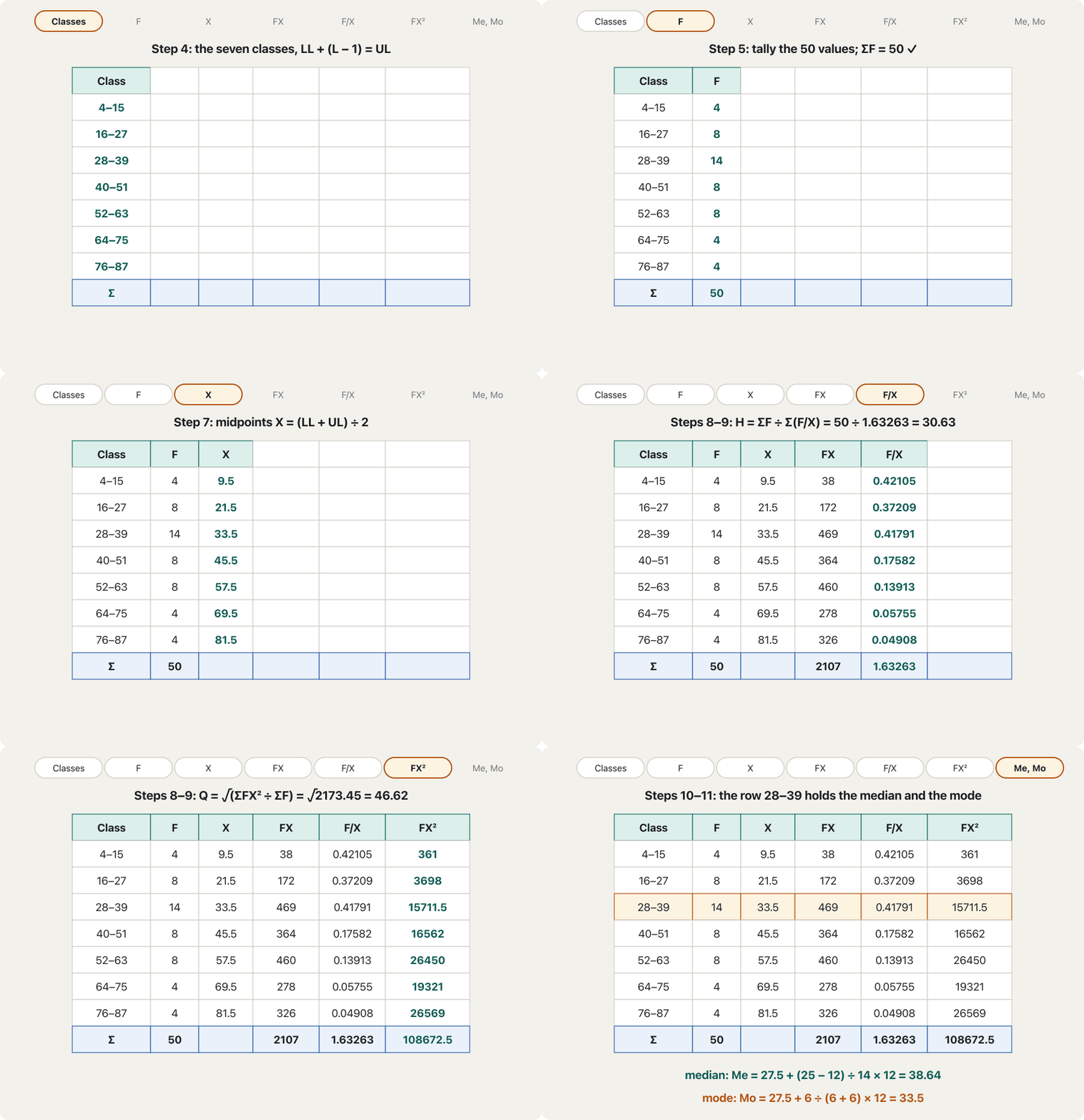
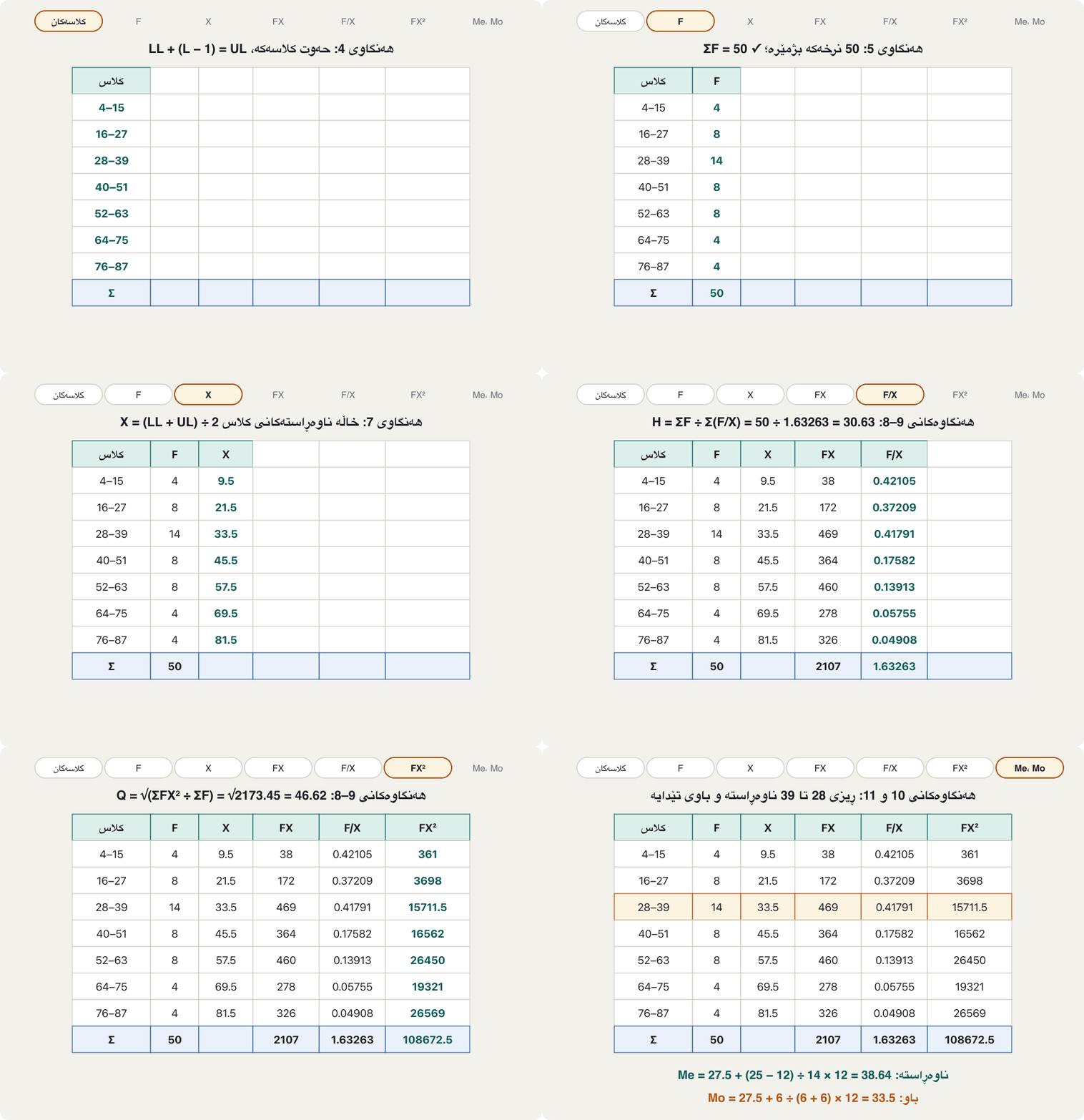
- FX for the arithmetic mean .
- for the harmonic mean .
- for the quadratic mean .
- for the geometric mean (not asked here, but useful as a check).
- FX بۆ .
- بۆ .
- بۆ .
- بۆ (لێرەدا داوا نەکراوە، بەڵام بۆ پشکنین بەسوودە).
Step 9: the three means, and a fourth one for checkingهەنگاوی 9: سێ ناوەندەکە و چوارەمێک بۆ پشکنین
| Class | F | X | FX | |||
|---|---|---|---|---|---|---|
| 4–15 | 4 | 9.5 | 38 | 0.42105 | 361 | 3.9109 |
| 16–27 | 8 | 21.5 | 172 | 0.37209 | 3698 | 10.6595 |
| 28–39 | 14 | 33.5 | 469 | 0.41791 | 15711.5 | 21.3506 |
| 40–51 | 8 | 45.5 | 364 | 0.17582 | 16562 | 13.2641 |
| 52–63 | 8 | 57.5 | 460 | 0.13913 | 26450 | 14.0773 |
| 64–75 | 4 | 69.5 | 278 | 0.05755 | 19321 | 7.3679 |
| 76–87 | 4 | 81.5 | 326 | 0.04908 | 26569 | 7.6446 |
| Σ | 50 | 2107 | 1.63263 | 108672.5 | 78.2749 |
The three means the test asks for.
ئەو سێ ناوەندەی تاقیکردنەوەکە داوایان دەکات.
The geometric mean is not asked, but it completes the order check: , so holds ✓.
داوا نەکراوە، بەڵام پشکنینی ڕیزبەندییەکە تەواو دەکات: ، کەواتە ڕاستە ✓.
Steps 10–11: the median and the modeهەنگاوەکانی 10–11: ناوەڕاستە و باو
| Class | F | Cumulative FF ـی کەڵەکەبوو | |
|---|---|---|---|
| 4–15 | 4 | 4 | |
| 16–27 | 8 | 12 | |
| 28–39 | 14 | 26 | ← |
| 40–51 | 8 | 34 | |
| 52–63 | 8 | 42 | |
| 64–75 | 4 | 46 | |
| 76–87 | 4 | 50 |
- Find the median classکلاسی ناوەڕاستە بدۆزەرەوە
Half of the values: . The cumulative frequencies are 4, 12, 26, … The first one that reaches 25 is 26, so the median class is 28–39.
نیوەی نرخەکان: . ئەمانەن: 4، 12، 26، … یەکەمیان کە دەگاتە 25 ژمارە 26ـە، کەواتە 28–39ـە.
- Read the four numbersچوار ژمارەکە بخوێنەرەوە
Lower boundary ; cumulative frequency before the class ; frequency of the class ; width .
خوارەوە ؛ پێش ؛ ؛ پانی .
- Medianناوەڕاستە
- Modeباو
The modal class is the one with the largest frequency, 28–39 . (class before), (class after): .
ئەوەیە کە گەورەترین هەیە، 28–39 . ( پێشوو)، ( دواتر): .
Here : the classes on both sides of the modal class are equally full, so the mode sits exactly in the middle of its class (33.5 is also the midpoint of 28–39). That is a quick way to check the mode formula.
لێرەدا : هەردوو لای بە یەکسانی پڕن، بۆیە ڕێک لە ناوەڕاستی (33.5 خاڵی ناوەڕاستی 28–39یشە). ئەمە ڕێگایەکی خێرایە بۆ پشکنینی فۆرمولەی .
The full answer, and what grouping costsوەڵامی تەواو و نرخی پۆلێنکردن
| Measureپێوەر | From the tableلە خشتەکەوە | From the 50 raw valuesلە 50 نرخە خاوەکەوە |
|---|---|---|
| Arithmetic mean | 42.14 | 41.16 |
| Harmonic mean H H | 30.63 | 26.35 |
| Quadratic mean Q Q | 46.62 | 46.01 |
| Median | 38.64 | 39 |
| Mode | 33.5 | 39 and 56 (each appears 3 times)39 و 56 (هەریەکەیان 3 جار دێت) |
The grouped answers are estimates: the table pretends that every value sits at its class midpoint. The mean and the median move only a little. The harmonic mean moves most, because it is very sensitive to small values: the table replaces 4, 7 and 7 by 9.5, and is much bigger than . The raw values even have two modes; the grouped mode 33.5 only describes where the tallest class is.
وەڵامە پۆلێنکراوەکان خەمڵاندنن: خشتەکە وا دادەنێت کە هەموو نرخێک لەسەر خۆیەتی. و تەنها کەمێک دەجووڵێن. زیاتر لە هەموویان دەجووڵێت، چونکە زۆر هەستیارە بە نرخە بچووکەکان: خشتەکە 4، 7 و 7 بە 9.5 دەگۆڕێتەوە. زۆر گەورەترە لە . نرخە خاوەکان تەنانەت دوو هەیە؛ پۆلێنکراوی 33.5 تەنها دەڵێت بەرزترین لە کوێیە.
Check your work: a daily quiz with slipsکارەکەت بپشکنە: تاقیکردنەوەیەکی ڕۆژانە لەگەڵ هەڵەی بچووک
Now play the examiner. Below is a real daily quiz from this course, solved by a student. Most of the work is right, but there are a few slips. Use the checks of this lesson (, the order , recomputing sums) to find them before you open the answers.
ئێستا ببە بە مامۆستای پشکنەر. لە خوارەوە تاقیکردنەوەیەکی ڕۆژانەی ڕاستەقینەی ئەم کۆرسە هەیە کە قوتابییەک چارەسەری کردووە. زۆربەی کارەکە دروستە، بەڵام چەند هەڵەیەکی بچووکی تێدایە. پشکنینەکانی ئەم وانەیە بەکاربهێنە (، ڕیزبەندیی ، دووبارە ژماردنەوەی کۆکان) بۆ دۆزینەوەیان پێش ئەوەی وەڵامەکان بکەیتەوە.
Check your work: a daily quiz with slipsکارەکەت بپشکنە: تاقیکردنەوەیەکی ڕۆژانە لەگەڵ هەڵەی بچووک
Quiz question 1: the table and the modeپرسیاری 1ی تاقیکردنەوەکە: خشتەکە و باو
The quiz gave 30 raw values (only part of the question sheet can be read today, for example 37, 43, 18, 21, 25, 27, 36, 34, 18, 23, 29, 44, 22, 13, …). It asked for a frequency table with relative frequencies, and then , G, H, Q and the mode. The student began like this:
تاقیکردنەوەکە 30 نرخی خاوی دابوو (ئەمڕۆ تەنها بەشێکی پەڕەی پرسیارەکە دەخوێنرێتەوە، بۆ نموونە 37، 43، 18، 21، 25، 27، 36، 34، 18، 23، 29، 44، 22، 13، …). داوای لەگەڵ کردبوو، پاشان ، G، H، Q و . قوتابییەکە بەم شێوەیە دەستی پێکرد:
All three are right.
هەر سێکیان دروستن.
| Tryهەوڵ | Classes written (نووسراو) | What is wrongچی هەڵەیە |
|---|---|---|
| 1 (crossed out)1 (هێڵی بەسەردا کێشراوە) | 13–18, 18–23, 23–28, 28–33, 33–38, 38–43 | Each class starts on the last value of the previous one, so 18, 23, … are in two classes; and 44–48 have no class.هەر لەسەر دوایین نرخی پێشووەکە دەست پێدەکات، بۆیە 18، 23، … لە دوو ؛ و 44–48 نییە. |
| 2 (crossed out)2 (هێڵی بەسەردا کێشراوە) | 13–19, 20–26, 27–33, 34–40, 41–47, 48–54 | puts 7 whole numbers in each class (width 7, not 6), and the classes run on to 54. حەوت دەخاتە هەر (پانی 7، نەک 6) و تا 54 دەڕۆن. |
| 3 (final)3 (کۆتایی) | 13–18, 19–24, 25–30, 31–36, 37–42, 43–48 | Correct: . The working shows “”, but is simply 48; no patch is needed.دروستە: . لە کارەکەدا نووسراوە «»، بەڵام خۆی 48ـە؛ پێویستی بە پینە نییە. |
| Class | F | X | FX |
|---|---|---|---|
| 13–18 | 4 | 15.5 | 62 |
| 19–24 | 6 | 21.5 | 129 |
| 25–30 | 8 | 27.5 | 220 |
| 31–36 | 4 | 33.5 | 134 |
| 37–42 | 3 | 39.5 | 118.5 |
| 43–48 | 5 | 45.5 | 227.5 |
| Σ | 30 | 891 |
The mode is right too.
دروستە.
Under the table the student started to write and stopped. What is wrong? Write the correct formula and find the six relative frequencies.
لە ژێر خشتەکەدا قوتابییەکە دەستی کرد بە نووسینی و وەستا. چی هەڵەیە؟ فۆرمولە دروستەکە بنووسە و شەش بدۆزەرەوە.
Show answerوەڵامەکە پیشان بدە
The relative frequency compares one class with all values; it has nothing to do with FX. : , 20, 26.67, 13.33, 10, 16.67 (%). They add up to 100.
یەک بەراورد دەکات لەگەڵ هەموو نرخەکان؛ هیچ پەیوەندییەکی بە FX ـەوە نییە. : ، 20، 26.67، 13.33، 10، 16.67 (%). کۆیان دەکاتە 100.
Check your work: a daily quiz with slipsکارەکەت بپشکنە: تاقیکردنەوەیەکی ڕۆژانە لەگەڵ هەڵەی بچووک
Quiz question 2: four means, two slipsپرسیاری 2ی تاقیکردنەوەکە: چوار ناوەند، دوو هەڵە
| Meanناوەند | Student's workingکاری قوتابییەکە | Checkپشکنین | Correct valueنرخی دروست |
|---|---|---|---|
| ✓ | 29.7 | ||
| G | ✗ | 28.08 | |
| H | ✗ | 26.47 | |
| Q | ✓ | 31.25 |
The student's log column was 1.19, 1.33, 1.43, 1.52, 1.59, 1.65, with , and then . Find two problems and the correct G.
ستوونی log ـی قوتابییەکە ئەمە بوو: 1.19، 1.33، 1.43، 1.52، 1.59، 1.65، لەگەڵ ، پاشان . دوو کێشە و G ـی دروست بدۆزەرەوە.
Show answerوەڵامەکە پیشان بدە
(1) The division: , not 1.4606. (2) The logs were cut after 2 decimals instead of being kept: is closer to 1.44, to 1.60. With 5 decimals the column is 4.76132, 7.99464, 11.51464, 6.10016, 4.78980, 8.29005:
(1) دابەشکردنەکە: ، نەک 1.4606. (2) لە دوای 2 بڕدراون لە جیاتی ئەوەی بهێڵدرێنەوە: نزیکترە لە 1.44، لە 1.60. بە 5 ستوونەکە دەبێتە 4.76132، 7.99464، 11.51464، 6.10016، 4.78980، 8.29005:
The student wrote . Recompute the column and H.
قوتابییەکە نووسیبووی . ستوونی و H دووبارە بژمێرەوە.
Show answerوەڵامەکە پیشان بدە
Common mistakesهەڵە باوەکان
| Mistakeهەڵە | What goes wrongچی تێک دەچێت | Do this insteadلە جیاتی ئەوە ئەمە بکە |
|---|---|---|
| Rounding the width down پانی بەرەو خوار | The classes stop at 80; 81 and 86 have no class. لە 80دا دەوەستن؛ 81 و 86 نییە. | Always round L up.هەمیشە L بەرەو سەرەوە نزیک بکەرەوە. |
| Overlapping classes (4–16, 16–28) سەریەککەوتوو (4–16، 16–28) | Values on a shared limit are counted twice; .نرخەکانی سەر سنووری هاوبەش دوو جار دەژمێردرێن؛ . | Whole numbers: .: . |
| Dividing by the number of classes (7)دابەشکردن بە ژمارەی (7) | The mean comes out 7 times too big. 7 جار گەورەتر دەردەچێت. | Divide by .دابەش بکە بە . |
| Using class limits instead of midpointsبەکارهێنانی لە جیاتی | Every product FX is shifted.هەموو لێکدانەکانی FX دەجووڵێن. | . بەکاربهێنە. |
| Cutting logs or to 2 decimalsبڕینی log یان بۆ 2 | G and H drift (the quiz above).G و H لادەدەن (تاقیکردنەوەکەی سەرەوە). | Keep 4–5 decimals; round only the answer.4–5 بهێڵەرەوە؛ تەنها وەڵامەکە نزیک بکەرەوە. |
| Median class = class with the largest F = ئەو گەورەترین F ـی هەیە | That is the modal class.ئەوە . | Use the first cumulative F that reaches .یەکەم F ـی کەڵەکەبوو بەکاربهێنە کە دەگاتە . |
| Using the limit 28 instead of the boundary 27.5بەکارهێنانی سنووری 28 لە جیاتی 27.5 | Median and mode come out 0.5 too big. و 0.5 گەورەتر دەردەچن. | For whole-number classes start from .بۆ لە دەست پێبکە. |
Exercisesڕاهێنانەکان
The quiz did not ask for it, but find the median of the quiz table (classes 13–18 … 43–48 with frequencies 4, 6, 8, 4, 3, 5).
تاقیکردنەوەکە داوای نەکردبوو، بەڵام خشتەی تاقیکردنەوەکە بدۆزەرەوە ( 13–18 … 43–48 بە 4، 6، 8، 4، 3، 5).
Hintئاماژە
Use the cumulative frequencies and the lower boundary 24.5.
و خوارەوەی 24.5 بەکاربهێنە.
Show answerوەڵامەکە پیشان بدە
. Cumulative F: 4, 10, 18, … → the median class is 25–30 (boundary 24.5), with , , :
. F ـی کەڵەکەبوو: 4، 10، 18، … ← 25–30ـە ( 24.5)، لەگەڵ ، ، :
Check: (mode, then median, then mean), the same order as in the Group B test.
پشکنین: (سەرەتا ، پاشان ، پاشان )، هەمان ڕیزبەندیی تاقیکردنەوەی گرووپی B.
Suppose you chose classes for the Group B data. Find L, the classes, the frequencies, the mean, the median and the mode, and compare them with the 7-class answers.
وا دابنێ بۆ گرووپی B ژمارەی هەڵبژێریت. L، ، ، ، و بدۆزەرەوە و بەراوردیان بکە لەگەڵ وەڵامەکانی 7 .
Show answerوەڵامەکە پیشان بدە
→ 14. Classes 4–17, 18–31, 32–45, 46–59, 60–73, 74–87 with frequencies 6, 13, 12, 10, 5, 4 (). Midpoints 10.5, 24.5, …, 80.5 give . Median: falls in 32–45 (cumulative 6, 19, 31): . Mode: modal class 18–31 , , : .
← 14. 4–17، 18–31، 32–45، 46–59، 60–73، 74–87 بە 6، 13، 12، 10، 5، 4 (). 10.5، 24.5، …، 80.5 دەدەن . : دەکەوێتە 32–45 (کەڵەکەبوو 6، 19، 31): . : 18–31ـە ، : .
The median hardly moves (38.64 → 38.5), the mean moves a little (42.14 → 40.46) and the mode moves most (33.5 → 29.75). Grouped answers depend on how you group; the mode is the most fragile.
بە زەحمەت دەجووڵێت (38.64 ← 38.5)، کەمێک دەجووڵێت (42.14 ← 40.46) و زیاتر لە هەموویان (33.5 ← 29.75). وەڵامە پۆلێنکراوەکان پشت بە شێوازی پۆلێنکردن دەبەستن؛ لە هەموویان ناسکترە.
Write a short Python program that builds the Group B frequency table (Yule's rule, width rounded up, whole-number classes) and prints the arithmetic, harmonic and quadratic means.
بەرنامەیەکی کورتی Python بنووسە کە گرووپی B دروست بکات (، پانیی بەرەو سەرەوە، ) و ، و چاپ بکات.
Show answerوەڵامەکە پیشان بدە
import math

data = [50, 40, 41, 17, 11, 7, 22, 4, 28, 21, 19, 23, 37, 51, 54, 42, 86,
        41, 78, 56, 72, 56, 17, 7, 69, 30, 80, 56, 29, 33, 46, 31, 39, 20,
        18, 29, 34, 59, 73, 77, 36, 39, 30, 62, 54, 67, 39, 31, 53, 44]

n = len(data)
m = round(2.5 * n ** 0.25)                      # Yule: number of classes
L = math.ceil((max(data) - min(data)) / m)      # class width, rounded up

F, X = [], []
for k in range(m):
    low = min(data) + k * L
    high = low + L - 1                          # whole numbers: LL + (L - 1)
    F.append(sum(low <= x <= high for x in data))
    X.append((low + high) / 2)
    print(f"{low:>2}-{high:<2}  F = {F[-1]:>2}  X = {X[-1]}")

mean = sum(f * x for f, x in zip(F, X)) / n
H = n / sum(f / x for f, x in zip(F, X))
Q = math.sqrt(sum(f * x * x for f, x in zip(F, X)) / n)
print(f"n = {n}, sum of F = {sum(F)}")
print(f"mean = {mean:.2f}, H = {H:.2f}, Q = {Q:.2f}")4-15 F = 4 X = 9.5 16-27 F = 8 X = 21.5 28-39 F = 14 X = 33.5 40-51 F = 8 X = 45.5 52-63 F = 8 X = 57.5 64-75 F = 4 X = 69.5 76-87 F = 4 X = 81.5 n = 50, sum of F = 50 mean = 42.14, H = 30.63, Q = 46.62
Explain the codeڕوونکردنەوەی کۆدەکە
- Lineدێڕی 8-9
round()gives ;math.ceil()always rounds the width up to 12.round()دەدات؛math.ceil()هەمیشە پانییەکە بەرەو سەرەوە بۆ 12 نزیک دەکاتەوە.- Lineدێڕی 14
Whole-number classes end at .
لە دا کۆتایی دێن.
- Lineدێڕی 15
low <= x <= highis True (1) or False (0), sosum()counts the values in the class.low <= x <= highیان True (1)ـە یان False (0)، بۆیەsum()نرخەکانی ناو دەژمێرێت.
Summaryپوختە
- Question 1 (the table): range → number of classes (round normally) → width (round up) → classes → tally → F (check ) → relative frequency.
- Question 2 (the averages): midpoints → one working table with FX, , (and ) → , H, Q (and G); cumulative F → median; largest F → mode.
- Group B: , , , , (and ).
- Checks: , percentages add to 100, , every average lies between the smallest and largest value. A passed check is not a proof.
- Grouped answers are estimates; the next chapter (Measuring spread) measures how spread out these same values are.
- پرسیاری 1 (خشتەکە): ← ژمارەی (ئاسایی نزیک بکەرەوە) ← پانی (بەرەو سەرەوە) ← ← ژماردن ← F (پشکنینی ) ← .
- پرسیاری 2 (): ← یەک خشتەی کار بە FX، ، (و ) ← ، H، Q (و G)؛ F ـی کەڵەکەبوو ← ؛ گەورەترین F ← .
- گرووپی B: ، ، ، ، (و ).
- پشکنینەکان: ، کۆی 100ـە، ، هەموو ناوەندێک لە نێوان بچووکترین و گەورەترین نرخدایە. پشکنینێکی سەرکەوتوو بەڵگە نییە.
- وەڵامە پۆلێنکراوەکان خەمڵاندنن؛ بەشی داهاتوو (پێوانی پەرتبوون) دەپێوێت کە هەمان ئەم نرخانە چەند پەرتن.
Why is the width rounded up but the number of classes rounded normally?بۆچی پانی بەرەو سەرەوە نزیک دەکرێتەوە، بەڵام ژمارەی کلاسەکان بە ئاسایی؟
The classes must cover the whole range . A slightly different number of classes is harmless.
دەبێت هەموو بگرنەوە . ژمارەیەکی کەمێک جیاوازی زیانی نییە.
Why use the boundary 27.5 and not the limit 28 in the median formula?بۆچی لە فۆرمولەی ناوەڕاستەدا سنووری ڕاستەقینەی کلاسی 27.5 بەکار دەهێنرێت نەک سنووری 28؟
With whole numbers a class really covers 27.5 to 39.5; the formula measures how far into the class the middle value lies.
بە لە ڕاستیدا لە 27.5 تا 39.5 دەگرێتەوە؛ فۆرمولەکە دەپێوێت نرخی ناوەڕاست چەند چووەتە ناو .
Which mean changes most when values are grouped?کاتێک نرخەکان پۆلێن دەکرێن کام ناوەند زیاتر دەگۆڕێت؟
Usually the harmonic mean, because small values dominate it (30.63 grouped vs 26.35 raw here).
زۆرجار ، چونکە نرخە بچووکەکان بەسەریدا زاڵن (لێرەدا 30.63 پۆلێنکراو بەرامبەر 26.35 خاو).
Videoڤیدیۆ
Watch a videoسەیری ڤیدیۆیەک بکە
A video that viewers liked a lot and praised in their comments, chosen for this lesson.ڤیدیۆیەک کە بینەران زۆریان پێ خۆش بووە و لە کۆمێنتەکانیاندا ستایشیان کردووە، بۆ ئەم وانەیە هەڵبژێردراوە.
The mean of a grouped frequency table: find each class midpoint, multiply by its frequency, add the products and divide by the total frequency.
پۆلێنکراو: بۆ هەر ، لە بدە، لێکدراوەکان کۆ بکەرەوە و دابەشی کۆی بکە.
Whole video: one grouped table from midpoints to the mean, median and mode
هەموو ڤیدیۆکە: یەک پۆلێنکراو لە تا ، و .
Lesson complete!وانەکە تەواو بوو!
Well done. Review the key terms, then go on to the next lesson.دەستخۆش. سەیرێکی زاراوە سەرەکییەکان بکەرەوە، پاشان بڕۆ بۆ وانەی داهاتوو.
Key termsزاراوە سەرەکییەکان
Measuring Spread: Range and Mean Deviationپێوانی پەرتبوون: مەودا و لادانی نێوانەیی
Related lecturesوانە پەیوەندیدارەکان
References and further readingسەرچاوەکان و خوێندنەوەی زیاتر
- OpenStax, Introductory Statistics 2e, 2.2 Histograms, Frequency Polygons, and Time Series Graphs (frequency tables, relative frequency, boundaries)
- OpenStax, Introductory Statistics 2e, 2.7 Measures of the Spread of the Data (mean of a frequency table with midpoints)
- Python documentation: statistics — Mathematical statistics functions
This lecture is a first edition. The Kurdish text and terminology are waiting for review by Kurdish IT teachers.ئەم وانەیە چاپی یەکەمە. دەقە کوردییەکە و زاراوەکانی چاوەڕێی پێداچوونەوەی مامۆستایانی کوردی بواری IT ن.