Chapterبەش 6 · Lectureوانە 6.5

Properties of Determinantsتایبەتمەندییەکانی دیتەرمینانت

The notes' eight properties of determinants, each with a new example (transpose, zero and equal rows, row swaps, scaling a row, det⁡(kA)=kndet⁡A\det(kA) = k^n\det A, triangular matrices, det⁡(AB)=det⁡Adet⁡B\det(AB) = \det A\det B), the row-replacement rule, and the method that turns any matrix triangular with a running factor — with a worked 4×44 \times 4 example.

هەشت تایبەتمەندییەکەی لە تێبینییەکاندا، هەریەکەیان بە نموونەیەکی نوێ (، ڕیزی سفر و یەکسان، گۆڕینەوەی ڕیز، لێکدانی ڕیزێک، det⁡(kA)=kndet⁡A\det(kA) = k^n\det A، سێگۆشەییەکان، det⁡(AB)=det⁡Adet⁡B\det(AB) = \det A\det B)، یاسای زیادکردنی چەند هێندەی ڕیزێک و ئەو ڕێگەیەی هەر بە لێکدەری تا ئێستا دەکات بە سێگۆشەیی — لەگەڵ نموونەیەکی شیکراوەی 4×44 \times 4.

18 min read20 خولەک خوێندنەوە · 18 stepsهەنگاو

What you will learnچی فێر دەبیت

  • Use the properties to find a determinant at a glance (zero row, equal or proportional rows, triangular).
  • Say what each elementary row operation does to the determinant, and why det⁡(kA)=kndet⁡A\det(kA) = k^n\det A.
  • Reduce a 3×33 \times 3 or 4×44 \times 4 matrix to triangular form with a running factor.
  • Use det⁡(AB)=det⁡Adet⁡B\det(AB) = \det A\det B and its consequences, and avoid the false “sum rule”.
  • تایبەتمەندییەکان بەکاربهێنیت بۆ دۆزینەوەی بە یەک سەیرکردن (ڕیزی سفر، ڕیزی یەکسان یان ڕێژەیی، سێگۆشەیی).
  • بڵێیت هەر چی بە دەکات و بۆچی det⁡(kA)=kndet⁡A\det(kA) = k^n\det A.
  • 3×33 \times 3 یان 4×44 \times 4 بە لێکدەری تا ئێستا بکەیت بە سێگۆشەیی.
  • det⁡(AB)=det⁡Adet⁡B\det(AB) = \det A\det B و ئەنجامەکانی بەکاربهێنیت و خۆت لە «یاسای کۆ»ی هەڵە بپارێزیت.

Why learn the properties?بۆچی تایبەتمەندییەکان فێر ببین؟

In Determinants, Minors and Cofactors you found determinants by cofactor expansion. It always works, but the work grows fast: a 4×44 \times 4 determinant becomes four 3×33 \times 3 ones, and a 5×55 \times 5 becomes five 4×44 \times 4 ones (about 5!=1205! = 120 products).

لە دیتەرمینانتەکان، ماینەرەکان و کۆفاکتەرەکاندا بە کردنەوە بە دۆزییەوە. هەمیشە کار دەکات، بەڵام کارەکە خێرا گەورە دەبێت: 4×44 \times 4 دەبێتە چوار 3×33 \times 3 و 5×55 \times 5 دەبێتە پێنج 4×44 \times 4 (نزیکەی 5!=1205! = 120 لێکدان).

The properties in this lesson are shortcuts for a AA of order n×nn \times n. Some give the answer at a glance (very often 0). Others let you change the matrix into an easy one and keep track of what each change did to the determinant. The notes number the properties 1 to 8; this lesson takes them in the order that builds a method, and each screen says which number the notes use.

تایبەتمەندییەکانی ئەم وانەیە ڕێگەی کورتن بۆ AA بە قەبارەی n×nn \times n. هەندێکیان بە یەک سەیرکردن وەڵامەکە دەدەن (زۆر جار ⁦0⁩). هەندێکی تریان ڕێگە دەدەن بکەیت بە ئاسان و ئاگات لەوە بێت هەر گۆڕانکارییەک چی بە کردووە. تێبینییەکان تایبەتمەندییەکان لە 1 تا 8 ژمارە دەکەن؛ ئەم وانەیە بەو ڕیزبەندییە دەیانخوێنێت کە ڕێگەیەکی کار دروست دەکات و هەر شاشەیەک دەڵێت تێبینییەکان چ ژمارەیەکیان پێداوە.

Quick checkپشکنینی خێراExpanding a 5×55 \times 5 determinant along one row needs how many 4×44 \times 4 determinants (if the row has no zeros)?کردنەوەی 5×55 \times 5 بە درێژایی یەک ڕیز چەند 4×44 \times 4 پێویستە (ئەگەر ڕیزەکە سفری تێدا نەبێت)؟

Property 1: det⁡AT=det⁡A\det A^T = \det Aتایبەتمەندیی 1: det⁡AT=det⁡A\det A^T = \det A

Turning the rows into columns — the Transpose — does not change the determinant. Take a new 3×33 \times 3 example and expand both along their first row:

کردنی ڕیزەکان بە ستوون — جێگۆڕکێی ماتریکس — ناگۆڕێت. نموونەیەکی نوێی 3×33 \times 3 وەربگرە و هەردووکیان بە درێژایی ڕیزی یەکەمیان بکەرەوە:

det⁡P=∣120031402∣=1(6−0)−2(0−4)+0=14det⁡PT=∣104230012∣=1(6−0)−0+4(2−0)=14\begin{aligned} \det P &= \begin{vmatrix} 1 & 2 & 0 \\ 0 & 3 & 1 \\ 4 & 0 & 2 \end{vmatrix} = 1(6 - 0) - 2(0 - 4) + 0 = 14 \\ \det P^T &= \begin{vmatrix} 1 & 0 & 4 \\ 2 & 3 & 0 \\ 0 & 1 & 2 \end{vmatrix} = 1(6 - 0) - 0 + 4(2 - 0) = 14 \end{aligned}

The notes' example is smaller: ∣1324∣=4−6=−2\begin{vmatrix} 1 & 3 \\ 2 & 4 \end{vmatrix} = 4 - 6 = -2 and ∣1234∣=4−6=−2\begin{vmatrix} 1 & 2 \\ 3 & 4 \end{vmatrix} = 4 - 6 = -2.

نموونەکەی تێبینییەکان بچووکترە: ∣1324∣=4−6=−2\begin{vmatrix} 1 & 3 \\ 2 & 4 \end{vmatrix} = 4 - 6 = -2 و ∣1234∣=4−6=−2\begin{vmatrix} 1 & 2 \\ 3 & 4 \end{vmatrix} = 4 - 6 = -2.

Why it is true: expanding AA along row ii is the same calculation as expanding ATA^T along column ii, and any row or column gives the same answer. The useful part: every rule below that speaks about rows is also true for columns.

بۆچی ڕاستە: کردنەوەی AA بە درێژایی ڕیزی ii هەمان ژمێریارییە وەک کردنەوەی ATA^T بە درێژایی ستوونی ii و هەر ڕیز یان ستوونێک هەمان وەڵام دەدات. بەشە بەسوودەکەی: هەر یاسایەکی خوارەوە کە باسی ڕیز دەکات، بۆ ستوونیش ڕاستە.

Quick checkپشکنینی خێراA 3×33 \times 3 matrix has det⁡A=7\det A = 7. What is det⁡AT\det A^T? 3×33 \times 3 هەیە کە det⁡A=7\det A = 7. det⁡AT\det A^T چەندە؟

A row or column of zeros gives 0ڕیز یان ستوونێکی سفر 0 دەدات

If one row (or one column) is all zeros, the determinant is 0. This is property 3 in the notes. Expand along that row: every term is 0×0 \times a cofactor.

ئەگەر ڕیزێک (یان ستوونێک) هەمووی سفر بێت، 0ـە. ئەمە تایبەتمەندیی 3ـە لە تێبینییەکاندا. بە درێژایی ئەو ڕیزە بیکەرەوە: هەموو بڕێک 0×0 \times .

∣4−72000519∣=0⋅C21+0⋅C22+0⋅C23=0∣0013∣=0−0=0\begin{vmatrix} 4 & -7 & 2 \\ 0 & 0 & 0 \\ 5 & 1 & 9 \end{vmatrix} = 0\cdot C_{21} + 0\cdot C_{22} + 0\cdot C_{23} = 0 \qquad \begin{vmatrix} 0 & 0 \\ 1 & 3 \end{vmatrix} = 0 - 0 = 0

Left: a new example. Right: the notes' example. The other numbers do not matter at all.

چەپ: نموونەیەکی نوێ. ڕاست: نموونەکەی تێبینییەکان. ژمارەکانی تر هیچ گرنگییەکیان نییە.

Quick checkپشکنینی خێراWhat is ∣08−1036025∣\begin{vmatrix} 0 & 8 & -1 \\ 0 & 3 & 6 \\ 0 & 2 & 5 \end{vmatrix}?∣08−1036025∣\begin{vmatrix} 0 & 8 & -1 \\ 0 & 3 & 6 \\ 0 & 2 & 5 \end{vmatrix} چەندە؟

Swapping two rows changes the signگۆڕینەوەی شوێنی دوو ڕیز هێما دەگۆڕێت

If BB is AA with two rows (or two columns) swapped, then det⁡B=−det⁡A\det B = -\det A. This is property 4 in the notes. A new example:

ئەگەر BB هەمان AA بێت بەڵام شوێنی دوو ڕیز (یان دوو ستوون) گۆڕدرابێتەوە، ئەوا det⁡B=−det⁡A\det B = -\det A. ئەمە تایبەتمەندیی 4ـە لە تێبینییەکاندا. نموونەیەکی نوێ:

∣1237∣=7−6=1→  R1↔R2  ∣3712∣=6−7=−1\begin{vmatrix} 1 & 2 \\ 3 & 7 \end{vmatrix} = 7 - 6 = 1 \qquad \xrightarrow{\;R_1 \leftrightarrow R_2\;} \qquad \begin{vmatrix} 3 & 7 \\ 1 & 2 \end{vmatrix} = 6 - 7 = -1

R1↔R2R_1 \leftrightarrow R_2 means “swap row 1 and row 2”. Swap again and the sign comes back: an even number of swaps keeps the sign, an odd number flips it.

R1↔R2R_1 \leftrightarrow R_2 واتە «شوێنی ڕیزی 1 و ڕیزی 2 بگۆڕەوە». دووبارە بیگۆڕەوە و هێماکە دەگەڕێتەوە: ژمارەیەکی جووت گۆڕینەوە هێما دەپارێزێت، ژمارەیەکی تاک هەڵیدەگەڕێنێتەوە.

The notes' example: A=[1324]A = \begin{bmatrix} 1 & 3 \\ 2 & 4 \end{bmatrix} has det⁡A=4−6=−2\det A = 4 - 6 = -2; with the rows swapped, B=[2413]B = \begin{bmatrix} 2 & 4 \\ 1 & 3 \end{bmatrix} has det⁡B=6−4=2\det B = 6 - 4 = 2.

نموونەکەی تێبینییەکان: A=[1324]A = \begin{bmatrix} 1 & 3 \\ 2 & 4 \end{bmatrix} det⁡A=4−6=−2\det A = 4 - 6 = -2ـە؛ دوای گۆڕینەوەی ڕیزەکان، B=[2413]B = \begin{bmatrix} 2 & 4 \\ 1 & 3 \end{bmatrix} det⁡B=6−4=2\det B = 6 - 4 = 2ـە.

Quick checkپشکنینی خێراdet⁡A=6\det A = 6. You swap rows 1 and 3, then swap rows 2 and 3. What is the determinant now?det⁡A=6\det A = 6. شوێنی ڕیزی 1 و 3 دەگۆڕیتەوە، پاشان شوێنی ڕیزی 2 و 3. ئێستا چەندە؟

Two equal rows give 0دوو ڕیزی یەکسان 0 دەدەن

If two rows (or two columns) are equal, the determinant is 0. This is property 2 in the notes. The swap rule explains why: swap the two equal rows. The matrix does not change, so its determinant dd stays the same — but the swap rule says it must become −d-d. The only number with d=−dd = -d is 0.

ئەگەر دوو ڕیز (یان دوو ستوون) یەکسان بن، 0ـە. ئەمە تایبەتمەندیی 2ـە لە تێبینییەکاندا. یاسای گۆڕینەوە ڕوونی دەکاتەوە بۆچی: شوێنی دوو ڕیزە یەکسانەکە بگۆڕەوە. ناگۆڕێت، بۆیە dd وەک خۆی دەمێنێتەوە — بەڵام یاسای گۆڕینەوە دەڵێت دەبێت ببێتە −d-d. تاکە ژمارە کە d=−dd = -d بێت 0ـە.

∣2513−14251∣=0∣1122∣=2−2=0\begin{vmatrix} 2 & 5 & 1 \\ 3 & -1 & 4 \\ 2 & 5 & 1 \end{vmatrix} = 0 \qquad \begin{vmatrix} 1 & 1 \\ 2 & 2 \end{vmatrix} = 2 - 2 = 0

Left: rows 1 and 3 are equal (a new example). Right: the notes' example, where the two columns are equal.

چەپ: ڕیزی 1 و 3 یەکسانن (نموونەیەکی نوێ). ڕاست: نموونەکەی تێبینییەکان کە تێیدا دوو ستوونەکە یەکسانن.

Quick checkپشکنینی خێراWhich matrix has determinant 0?کام 0ـە؟

Multiplying one row by kkلێکدانی یەک ڕیز لە kk

If BB is AA with one row (or column) multiplied by a number kk, then det⁡B=kdet⁡A\det B = k \det A. This is property 5 in the notes. Every term of the expansion along that row gets the factor kk once. Read it backwards too: a common factor of one row can be taken out in front of the determinant.

ئەگەر BB هەمان AA بێت بەڵام یەک ڕیز (یان ستوون) لە ژمارەی kk درابێت، ئەوا det⁡B=kdet⁡A\det B = k \det A. ئەمە تایبەتمەندیی 5ـە لە تێبینییەکاندا. هەر بڕێکی کردنەوە بە درێژایی ئەو ڕیزە یەک جار هۆکاری kk وەردەگرێت. بە پێچەوانەشەوە بیخوێنەوە: هۆکاری هاوبەشی یەک ڕیز دەکرێت ببرێتە پێش .

∣51027∣=35−20=15∣51027∣=5∣1227∣=5(7−4)=15\begin{aligned} \begin{vmatrix} 5 & 10 \\ 2 & 7 \end{vmatrix} &= 35 - 20 = 15 \\ \begin{vmatrix} 5 & 10 \\ 2 & 7 \end{vmatrix} &= 5\begin{vmatrix} 1 & 2 \\ 2 & 7 \end{vmatrix} = 5(7 - 4) = 15 \end{aligned}

A new example: row 1 has the common factor 5. The notes' example doubles row 1 of AA: ∣2624∣=8−12=−4=2⋅(−2)\begin{vmatrix} 2 & 6 \\ 2 & 4 \end{vmatrix} = 8 - 12 = -4 = 2 \cdot (-2).

نموونەیەکی نوێ: ڕیزی 1 هۆکاری هاوبەشی 5ـی هەیە. نموونەکەی تێبینییەکان ڕیزی 1ی AA دوو هێندە دەکات: ∣2624∣=8−12=−4=2⋅(−2)\begin{vmatrix} 2 & 6 \\ 2 & 4 \end{vmatrix} = 8 - 12 = -4 = 2 \cdot (-2).

A useful result: if one row is a multiple of another (the rows are proportional), the determinant is 0. Take the factor out and two equal rows are left:

ئەنجامێکی بەسوود: ئەگەر ڕیزێک چەند هێندەی ڕیزێکی تر بێت، 0ـە. هۆکارەکە دەربهێنە و دوو ڕیزی یەکسان دەمێننەوە:

∣123246015∣=2∣123123015∣=2⋅0=0\begin{vmatrix} 1 & 2 & 3 \\ 2 & 4 & 6 \\ 0 & 1 & 5 \end{vmatrix} = 2\begin{vmatrix} 1 & 2 & 3 \\ 1 & 2 & 3 \\ 0 & 1 & 5 \end{vmatrix} = 2 \cdot 0 = 0
Quick checkپشکنینی خێرا∣1214∣=2\begin{vmatrix} 1 & 2 \\ 1 & 4 \end{vmatrix} = 2. What is ∣3614∣\begin{vmatrix} 3 & 6 \\ 1 & 4 \end{vmatrix}?∣1214∣=2\begin{vmatrix} 1 & 2 \\ 1 & 4 \end{vmatrix} = 2. ∣3614∣\begin{vmatrix} 3 & 6 \\ 1 & 4 \end{vmatrix} چەندە؟

Scaling the whole matrix: det⁡(kA)=kndet⁡A\det(kA) = k^n \det Aلێکدانی هەموو ماتریکسەکە: det⁡(kA)=kndet⁡A\det(kA) = k^n \det A

The matrix kAkA multiplies every entry by kk — that is, every one of the nn rows. Each row gives one factor kk, so for an n×nn \times n matrix:

kAkA هەموو ژمارەیەک لە kk دەدات — واتە هەر nn ڕیزەکە. هەر ڕیزێک یەک هۆکاری kk دەدات، بۆیە بۆ n×nn \times n:

det⁡(kA)=kndet⁡A\det(kA) = k^n \det A

This is property 8 in the notes. For a 2×22 \times 2 matrix det⁡(2A)=4det⁡A\det(2A) = 4\det A; for a 3×33 \times 3 matrix det⁡(2A)=8det⁡A\det(2A) = 8\det A.

ئەمە تایبەتمەندیی 8ـە لە تێبینییەکاندا. بۆ 2×22 \times 2 det⁡(2A)=4det⁡A\det(2A) = 4\det A؛ بۆ 3×33 \times 3 det⁡(2A)=8det⁡A\det(2A) = 8\det A.

  1. A new 2×22 \times 2 exampleنموونەیەکی نوێی 2×22 \times 2

    A=[3142]A = \begin{bmatrix} 3 & 1 \\ 4 & 2 \end{bmatrix} has det⁡A=6−4=2\det A = 6 - 4 = 2. Then 3A=[93126]3A = \begin{bmatrix} 9 & 3 \\ 12 & 6 \end{bmatrix} has 54−36=18=32⋅254 - 36 = 18 = 3^2 \cdot 2.

    A=[3142]A = \begin{bmatrix} 3 & 1 \\ 4 & 2 \end{bmatrix} det⁡A=6−4=2\det A = 6 - 4 = 2ـە. کەواتە 3A=[93126]3A = \begin{bmatrix} 9 & 3 \\ 12 & 6 \end{bmatrix} 54−36=18=32⋅254 - 36 = 18 = 3^2 \cdot 2ـە.

  2. A 3×33 \times 3 exampleنموونەیەکی 3×33 \times 3

    PP of the first screen has det⁡P=14\det P = 14, so det⁡(2P)=23⋅14=112\det(2P) = 2^3 \cdot 14 = 112.

    PPی شاشەی یەکەم det⁡P=14\det P = 14ـە، بۆیە det⁡(2P)=23⋅14=112\det(2P) = 2^3 \cdot 14 = 112.

  3. The notes' exampleنموونەکەی تێبینییەکان

    det⁡[2648]=16−24=−8=22⋅(−2)\det\begin{bmatrix} 2 & 6 \\ 4 & 8 \end{bmatrix} = 16 - 24 = -8 = 2^2 \cdot (-2).

    det⁡[2648]=16−24=−8=22⋅(−2)\det\begin{bmatrix} 2 & 6 \\ 4 & 8 \end{bmatrix} = 16 - 24 = -8 = 2^2 \cdot (-2).

  4. A minus signهێمای سالب

    −A=(−1)A-A = (-1)A, so det⁡(−A)=(−1)ndet⁡A\det(-A) = (-1)^n\det A: the same for a 2×22 \times 2 matrix, the opposite sign for a 3×33 \times 3 one (det⁡(−P)=−14\det(-P) = -14).

    −A=(−1)A-A = (-1)A، بۆیە det⁡(−A)=(−1)ndet⁡A\det(-A) = (-1)^n\det A: بۆ 2×22 \times 2 هەمان شتە، بۆ 3×33 \times 3 هێماکەی پێچەوانە دەبێتەوە (det⁡(−P)=−14\det(-P) = -14).

Quick checkپشکنینی خێراAA is 3×33 \times 3 with det⁡A=5\det A = 5. What is det⁡(2A)\det(2A)?AA 3×33 \times 3ـە و det⁡A=5\det A = 5. det⁡(2A)\det(2A) چەندە؟

Adding a multiple of a row changes nothingزیادکردنی چەند هێندەی ڕیزێک هیچ ناگۆڕێت

The notes do not list this rule, but it does most of the work: adding a multiple of one row to another row does not change the determinant. We write it R2→R2−3R1R_2 \to R_2 - 3R_1: “replace row 2 by row 2 minus 3 times row 1”. Only row 2 changes; row 1 stays as it is.

تێبینییەکان ئەم یاسایە ناهێنن، بەڵام زۆربەی کارەکە ئەو دەیکات: زیادکردنی چەند هێندەی ڕیزێک بۆ ڕیزێکی تر ناگۆڕێت. بەم شێوەیە دەینووسین R2→R2−3R1R_2 \to R_2 - 3R_1: «ڕیزی 2 بگۆڕە بە ڕیزی 2 کەم 3 هێندەی ڕیزی 1». تەنها ڕیزی 2 دەگۆڕێت؛ ڕیزی 1 وەک خۆی دەمێنێتەوە.

∣2165∣=10−6=4→  R2→R2−3R1  ∣2102∣=4−0=4\begin{vmatrix} 2 & 1 \\ 6 & 5 \end{vmatrix} = 10 - 6 = 4 \qquad \xrightarrow{\;R_2 \to R_2 - 3R_1\;} \qquad \begin{vmatrix} 2 & 1 \\ 0 & 2 \end{vmatrix} = 4 - 0 = 4
∣abc+kad+kb∣=a(d+kb)−b(c+ka)=ad−bc\begin{vmatrix} a & b \\ c + ka & d + kb \end{vmatrix} = a(d + kb) - b(c + ka) = ad - bc

Why it works for every 2×22 \times 2 matrix: the two kabkab terms cancel. For bigger matrices the new determinant splits into the old one plus kk times a determinant with two equal rows, which is 0.

بۆچی بۆ هەموو 2×22 \times 2 کار دەکات: دوو بڕی kabkab یەکتر لادەبەن. بۆ گەورەترەکان نوێیەکە دابەش دەبێت بۆ کۆنەکە لەگەڵ kk هێندەی دوو ڕیزی یەکسان کە 0ـە.

Quick checkپشکنینی خێرا∣1429∣=1\begin{vmatrix} 1 & 4 \\ 2 & 9 \end{vmatrix} = 1. What is the determinant after R2→R2−2R1R_2 \to R_2 - 2R_1?∣1429∣=1\begin{vmatrix} 1 & 4 \\ 2 & 9 \end{vmatrix} = 1. دوای R2→R2−2R1R_2 \to R_2 - 2R_1 چەندە؟

The three row operations in one pictureسێ کاری سەرەتایی ڕیز لە یەک وێنەدا

Swapping two rows, multiplying a row by a number and adding a multiple of another row are called the three . The card shows what each one does to the determinant. The same three operations find inverses in Finding the Inverse by Row Operations; here we only watch the determinant.

گۆڕینەوەی شوێنی دوو ڕیز، لێکدانی ڕیزێک لە ژمارەیەک و زیادکردنی چەند هێندەی ڕیزێکی تر پێیان دەگوترێت سێ . کارتەکە پیشان دەدات هەریەکەیان چی بە دەکات. هەمان ئەم سێ کارە لە دۆزینەوەی پێچەوانە بە کارە سەرەتاییەکانی ڕیزدا پێچەوانە دەدۆزنەوە؛ لێرەدا تەنها چاودێری دەکەین.

A card with three coloured rows. Swap two rows, R1 ↔ R2: the determinant is multiplied by −1 (the sign flips). Multiply one row by k, R2 → k R2: the determinant is multiplied by k. Add a multiple of another row, R2 → R2 + k R1: multiplied by 1, no change. Bottom line: then a triangular matrix has determinant equal to the product of its main diagonal.کارتێک بە سێ ڕیزی ڕەنگاوڕەنگ. گۆڕینەوەی شوێنی دوو ڕیز، R1 ↔ R2: دیتەرمینانت لە −1 دەدرێت (هێماکەی دەگۆڕێت). لێکدانی یەک ڕیز لە k، R2 → k R2: دیتەرمینانت لە k دەدرێت. زیادکردنی چەند هێندەی ڕیزێکی تر، R2 → R2 + k R1: لە 1 دەدرێت، ناگۆڕێت. دێڕی خوارەوە: پاشان ماتریکسی سێگۆشەیی دیتەرمینانتەکەی یەکسانە بە لێکدراوی تیرە سەرەکییەکەی.
The three row operations and their effect on the determinant.سێ و کاریگەرییان لەسەر .CêIT
Quick checkپشکنینی خێراWhich row operation never changes the determinant?کام هەرگیز ناگۆڕێت؟

Determinant and Elementary Row OperationPrime Newtons · Englishئینگلیزی · 113K viewsبینین · 2.8K likesلایک · Partبەشی 3:15–8:02 (ofلە 14:31)

What each row operation does to a determinant: a swap changes its sign, scaling a row scales it, adding a row multiple changes nothing.

و : گۆڕینەوەی دوو ڕیز هێماکەی پێچەوانە دەکاتەوە، لێکدانی ڕیزێک لە k ئەویش k هێندە دەکات و زیادکردنی چەند هێندەی ڕیزێک نایگۆڕێت.

Plays 3:15-8:02 ('Elementary row operations'). The rest of the video uses them to find a determinant.

لە ⁦3:15⁩ تا ⁦8:02⁩ پەخش دەبێت (بەشی «Elementary row operations»). ئەوەی تری ڤیدیۆکە بەکاریان دەهێنێت بۆ دۆزینەوەی .

Triangular matrices: multiply the diagonalماتریکسە سێگۆشەییەکان: تیرەکە لێک بدە

A matrix is upper triangular when every entry below the is 0, and lower triangular when every entry above it is 0 (see Types of matrices). The notes' property 6: the determinant of a triangular matrix is the product of its main diagonal.

سێگۆشەیی سەرەوەیە کاتێک هەموو ژمارەکانی ژێر 0 بن و سێگۆشەیی خوارەوەیە کاتێک هەموو ژمارەکانی سەرووی 0 بن (بڕوانە جۆرەکانی ماتریکس). تایبەتمەندیی 6ی تێبینییەکان: سێگۆشەیی لێکدراوی ژمارەکانی .

∣27−30−15004∣=2⋅(−1)⋅4=−8∣300520−181∣=3⋅2⋅1=6∣119450234003∣=1⋅2⋅3=6\begin{aligned} \begin{vmatrix} 2 & 7 & -3 \\ 0 & -1 & 5 \\ 0 & 0 & 4 \end{vmatrix} &= 2 \cdot (-1) \cdot 4 = -8 \qquad \begin{vmatrix} 3 & 0 & 0 \\ 5 & 2 & 0 \\ -1 & 8 & 1 \end{vmatrix} = 3 \cdot 2 \cdot 1 = 6 \\ \begin{vmatrix} 1 & 19 & 45 \\ 0 & 2 & 34 \\ 0 & 0 & 3 \end{vmatrix} &= 1 \cdot 2 \cdot 3 = 6 \end{aligned}

Top: new upper and lower examples. Bottom: the notes' example — the big numbers 19, 45 and 34 play no part.

سەرەوە: نموونەی نوێی سەرەوە و خوارەوە. خوارەوە: نموونەکەی تێبینییەکان — ژمارە گەورەکانی ⁦19⁩، ⁦45⁩ و ⁦34⁩ هیچ ڕۆڵێکیان نییە.

Why: expand along column 1. Only a11a_{11} is not 0, and its minor is again triangular, so the same thing happens again, down the diagonal. A diagonal matrix is both upper and lower triangular: det⁡[200030005]=30\det\begin{bmatrix} 2 & 0 & 0 \\ 0 & 3 & 0 \\ 0 & 0 & 5 \end{bmatrix} = 30, and det⁡I=1\det I = 1.

بۆچی: بە درێژایی ستوونی 1 بیکەرەوە. تەنها a11a_{11} سفر نییە و دیسان سێگۆشەییە، بۆیە هەمان شت دووبارە دەبێتەوە بە درێژایی تیرەکە. تیرەیی هەم سێگۆشەیی سەرەوەیە هەم خوارەوە: det⁡[200030005]=30\det\begin{bmatrix} 2 & 0 & 0 \\ 0 & 3 & 0 \\ 0 & 0 & 5 \end{bmatrix} = 30 و det⁡I=1\det I = 1.

Quick checkپشکنینی خێراWhat is ∣20073019−1∣\begin{vmatrix} 2 & 0 & 0 \\ 7 & 3 & 0 \\ 1 & 9 & -1 \end{vmatrix}?∣20073019−1∣\begin{vmatrix} 2 & 0 & 0 \\ 7 & 3 & 0 \\ 1 & 9 & -1 \end{vmatrix} چەندە؟

The method: make it triangularڕێگەکە: بیکە بە سێگۆشەیی

Now put the rules together. Use row operations to make zeros below the main diagonal. Keep a number ff, the running factor, so that det⁡A=f×\det A = f \times (the determinant of the matrix you have now). Start with f=1f = 1, then:

ئێستا یاساکان پێکەوە بەکاربهێنە. بە لە ژێر سفر دروست بکە. ژمارەیەک ff بهێڵەرەوە، لێکدەری تا ئێستا، بە شێوەیەک کە det⁡A=f×\det A = f \times ( ئەو ئێستا هەتە). بە f=1f = 1 دەست پێبکە، پاشان:

  • swap two rows → ff becomes −f-f;
  • take a common factor kk out of a row → ff becomes k⋅fk \cdot f;
  • add a multiple of another row → ff stays the same.
  • گۆڕینەوەی شوێنی دوو ڕیز ← ff دەبێتە −f-f؛
  • دەرهێنانی هۆکاری هاوبەشی kk لە ڕیزێک ← ff دەبێتە k⋅fk \cdot f؛
  • زیادکردنی چەند هێندەی ڕیزێکی تر ← ff وەک خۆی دەمێنێتەوە.

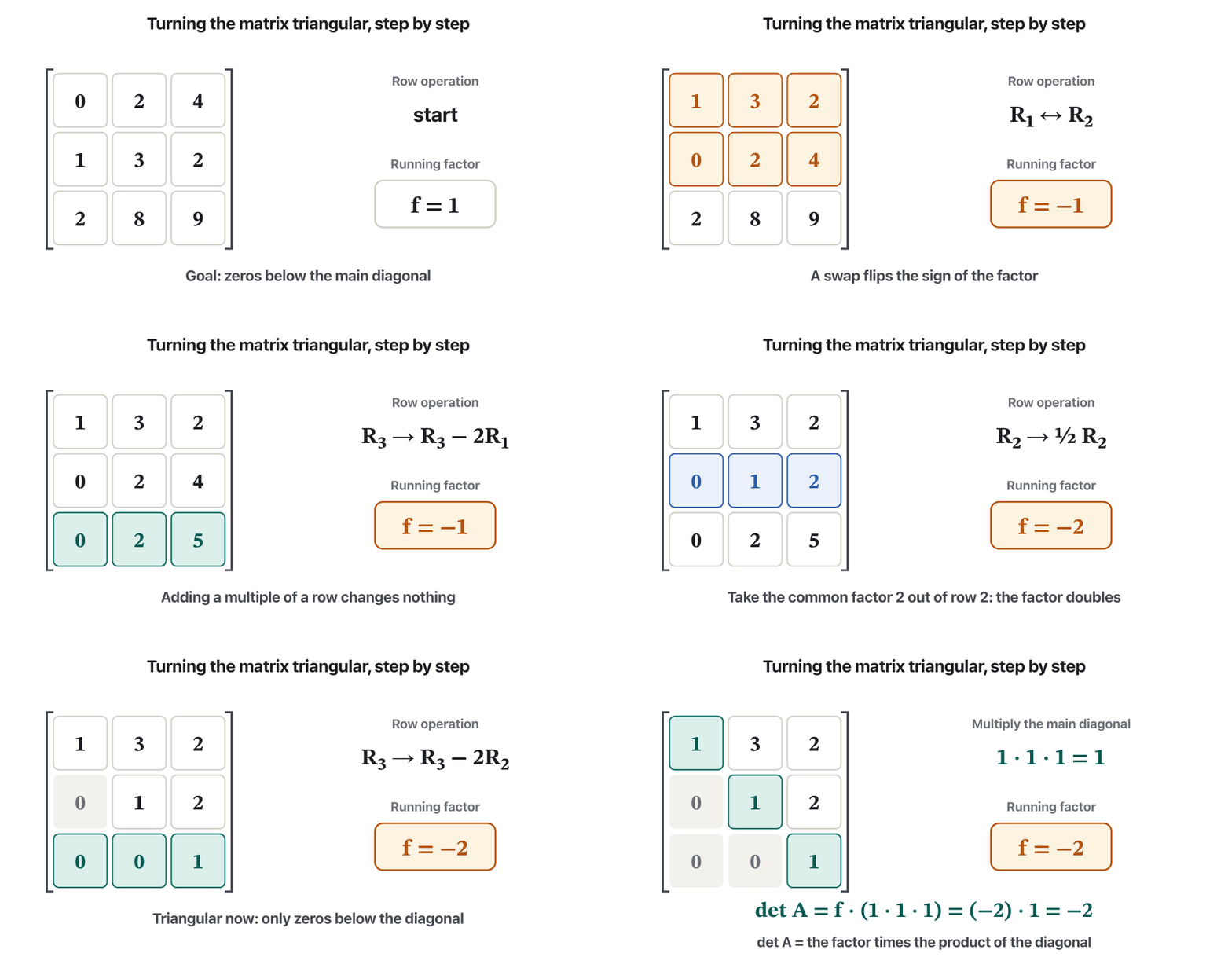
When the matrix is triangular, multiply its diagonal and then by ff. Watch it on A=[024132289]A = \begin{bmatrix} 0 & 2 & 4 \\ 1 & 3 & 2 \\ 2 & 8 & 9 \end{bmatrix}:

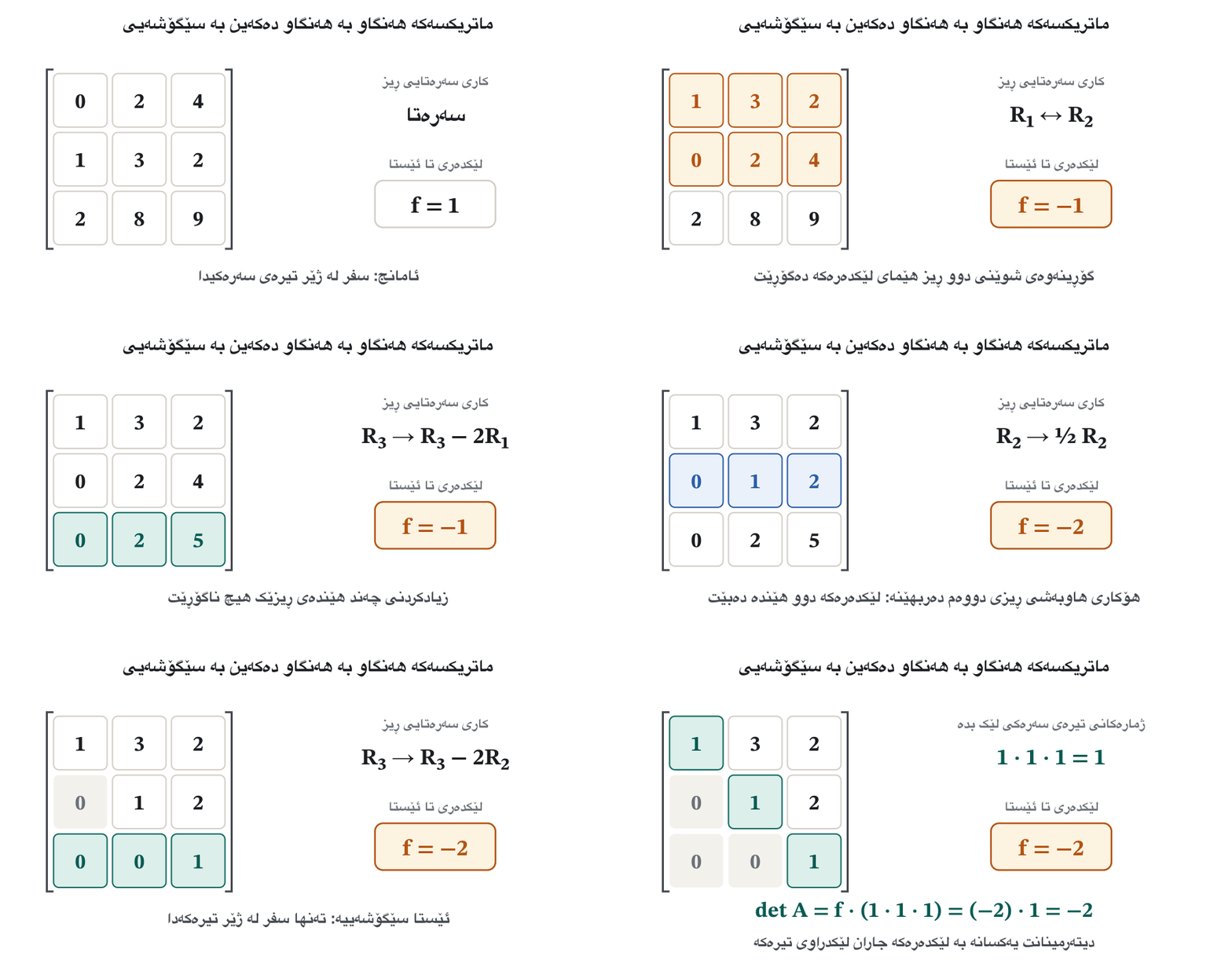
کاتێک سێگۆشەیی بوو، ژمارەکانی تیرەکەی لێک بدە و پاشان لە ff. لەسەر A=[024132289]A = \begin{bmatrix} 0 & 2 & 4 \\ 1 & 3 & 2 \\ 2 & 8 & 9 \end{bmatrix} سەیری بکە:

Six frames. The matrix rows (0, 2, 4), (1, 3, 2), (2, 8, 9) with running factor f = 1. Frame 2: R1 and R2 swapped, f = −1. Frame 3: R3 → R3 − 2R1 gives row (0, 2, 5), f stays −1. Frame 4: the factor 2 is taken out of row 2, which becomes (0, 1, 2), f = −2. Frame 5: R3 → R3 − 2R2 gives (0, 0, 1); the matrix is triangular. Frame 6: the diagonal 1, 1, 1 is highlighted and det A = (−2) · 1 = −2.
Row operations with a running factor: det⁡A=−2\det A = -2. لەگەڵ لێکدەری تا ئێستا: det⁡A=−2\det A = -2.CêIT
R1↔R2f=−1R3→R3−2R1f=−1R2→12R2f=−1⋅2=−2R3→R3−2R2f=−2det⁡A=−2⋅(1⋅1⋅1)=−2\begin{aligned} &R_1 \leftrightarrow R_2 && f = -1 \\ &R_3 \to R_3 - 2R_1 && f = -1 \\ &R_2 \to \tfrac12 R_2 && f = -1 \cdot 2 = -2 \\ &R_3 \to R_3 - 2R_2 && f = -2 \\ &\det A = -2 \cdot (1 \cdot 1 \cdot 1) = -2 \end{aligned}

In the third step the common factor 2 of row 2, (0,2,4)=2⋅(0,1,2)(0, 2, 4) = 2 \cdot (0, 1, 2), is taken out, so ff is multiplied by 2. Check by expansion along row 1: 0−2(9−4)+4(8−6)=−10+8=−20 - 2(9 - 4) + 4(8 - 6) = -10 + 8 = -2.

لە هەنگاوی سێیەمدا هۆکاری هاوبەشی 2 لە ڕیزی 2 دەردەهێنرێت، (0,2,4)=2⋅(0,1,2)(0, 2, 4) = 2 \cdot (0, 1, 2)، بۆیە ff لە 2 دەدرێت. پشکنین بە کردنەوە بە درێژایی ڕیزی 1: 0−2(9−4)+4(8−6)=−10+8=−20 - 2(9 - 4) + 4(8 - 6) = -10 + 8 = -2.

Quick checkپشکنینی خێراYou swapped two rows once and took a factor 3 out of a row. The triangular matrix has diagonal 1, 2, 5. What is det⁡A\det A?یەک جار شوێنی دوو ڕیزت گۆڕییەوە و هۆکاری 3ت لە ڕیزێک دەرهێنا. سێگۆشەییەکە تیرەی 1، 2، 5ـی هەیە. det⁡A\det A چەندە؟

A 4×44 \times 4 by row operationsدیتەرمینانتێکی 4×44 \times 4 بە کارە سەرەتاییەکانی ڕیز

Expansion of this 4×44 \times 4 matrix would need three 3×33 \times 3 determinants. Row operations are quicker. Only swaps and “add a multiple” are needed, so ff only changes sign.

کردنەوەی ئەم 4×44 \times 4 سێ 3×33 \times 3ی پێویست دەبوو. خێراترن. تەنها گۆڕینەوە و «زیادکردنی چەند هێندە» پێویستن، بۆیە ff تەنها هێماکەی دەگۆڕێت.

F=[021311022415−1132]F = \begin{bmatrix} 0 & 2 & 1 & 3 \\ 1 & 1 & 0 & 2 \\ 2 & 4 & 1 & 5 \\ -1 & 1 & 3 & 2 \end{bmatrix}
  1. Get a 1 in the top-left corner1 بخە گۆشەی سەرەوەی چەپ

    R1↔R2R_1 \leftrightarrow R_2, so f=−1f = -1.

    R1↔R2R_1 \leftrightarrow R_2، بۆیە f=−1f = -1.

    [110202132415−1132]\begin{bmatrix} 1 & 1 & 0 & 2 \\ 0 & 2 & 1 & 3 \\ 2 & 4 & 1 & 5 \\ -1 & 1 & 3 & 2 \end{bmatrix}
  2. Clear column 1ستوونی 1 پاک بکەرەوە

    R3→R3−2R1R_3 \to R_3 - 2R_1 and R4→R4+R1R_4 \to R_4 + R_1; ff stays −1-1.

    R3→R3−2R1R_3 \to R_3 - 2R_1 و R4→R4+R1R_4 \to R_4 + R_1؛ ff هەر −1-1ـە.

    [1102021302110234]\begin{bmatrix} 1 & 1 & 0 & 2 \\ 0 & 2 & 1 & 3 \\ 0 & 2 & 1 & 1 \\ 0 & 2 & 3 & 4 \end{bmatrix}
  3. Clear column 2ستوونی 2 پاک بکەرەوە

    R3→R3−R2R_3 \to R_3 - R_2 and R4→R4−R2R_4 \to R_4 - R_2. Row 3 now has a 0 on the diagonal.

    R3→R3−R2R_3 \to R_3 - R_2 و R4→R4−R2R_4 \to R_4 - R_2. ئێستا ڕیزی 3 لەسەر تیرەکە 0ـی هەیە.

    [11020213000−20021]\begin{bmatrix} 1 & 1 & 0 & 2 \\ 0 & 2 & 1 & 3 \\ 0 & 0 & 0 & -2 \\ 0 & 0 & 2 & 1 \end{bmatrix}
  4. Swap to fix the diagonalبیگۆڕەوە بۆ چاککردنی تیرەکە

    R3↔R4R_3 \leftrightarrow R_4, so f=+1f = +1 (two swaps). The matrix is triangular.

    R3↔R4R_3 \leftrightarrow R_4، بۆیە f=+1f = +1 (دوو گۆڕینەوە). سێگۆشەییە.

    [110202130021000−2]\begin{bmatrix} 1 & 1 & 0 & 2 \\ 0 & 2 & 1 & 3 \\ 0 & 0 & 2 & 1 \\ 0 & 0 & 0 & -2 \end{bmatrix}
  5. Multiply the diagonalتیرەکە لێک بدە

    det⁡F=(+1)⋅(1⋅2⋅2⋅(−2))=−8\det F = (+1)\cdot(1 \cdot 2 \cdot 2 \cdot (-2)) = -8. A computer check (sympy) gives the same −8-8.

    det⁡F=(+1)⋅(1⋅2⋅2⋅(−2))=−8\det F = (+1)\cdot(1 \cdot 2 \cdot 2 \cdot (-2)) = -8. پشکنین بە ⁦(sympy)⁩ هەمان −8-8 دەدات.

Quick checkپشکنینی خێراWhy did the running factor end at +1+1?بۆچی لێکدەری تا ئێستا بە +1+1 کۆتایی هات؟

The product rule: det⁡(AB)=det⁡A⋅det⁡B\det(AB) = \det A \cdot \det Bیاسای لێکدان: det⁡(AB)=det⁡A⋅det⁡B\det(AB) = \det A \cdot \det B

The determinant of a product is the product of the determinants. This is property 7 in the notes. A new example:

لێکدراوێک لێکدراوی . ئەمە تایبەتمەندیی 7ـە لە تێبینییەکاندا. نموونەیەکی نوێ:

A=[2113],  det⁡A=5B=[1402],  det⁡B=2AB=[210110],  det⁡(AB)=20−10=10=5⋅2BA=[61326],  det⁡(BA)=36−26=10\begin{aligned} A &= \begin{bmatrix} 2 & 1 \\ 1 & 3 \end{bmatrix},\; \det A = 5 \qquad B = \begin{bmatrix} 1 & 4 \\ 0 & 2 \end{bmatrix},\; \det B = 2 \\ AB &= \begin{bmatrix} 2 & 10 \\ 1 & 10 \end{bmatrix},\; \det(AB) = 20 - 10 = 10 = 5 \cdot 2 \\ BA &= \begin{bmatrix} 6 & 13 \\ 2 & 6 \end{bmatrix},\; \det(BA) = 36 - 26 = 10 \end{aligned}

AB≠BAAB \ne BA (matrix multiplication is not commutative), but they have the same determinant, because det⁡A⋅det⁡B=det⁡B⋅det⁡A\det A \cdot \det B = \det B \cdot \det A.

AB≠BAAB \ne BA (لێکدانی ماتریکسەکان ئاڵوگۆڕی نییە)، بەڵام هەمان هەیە، چونکە det⁡A⋅det⁡B=det⁡B⋅det⁡A\det A \cdot \det B = \det B \cdot \det A.

The notes' example multiplies A=[1324]A = \begin{bmatrix} 1 & 3 \\ 2 & 4 \end{bmatrix} (det⁡A=−2\det A = -2) by B=[0013]B = \begin{bmatrix} 0 & 0 \\ 1 & 3 \end{bmatrix} (det⁡B=0\det B = 0, a zero row): AB=[39412]AB = \begin{bmatrix} 3 & 9 \\ 4 & 12 \end{bmatrix} and det⁡(AB)=36−36=0=(−2)(0)\det(AB) = 36 - 36 = 0 = (-2)(0).

نموونەکەی تێبینییەکان A=[1324]A = \begin{bmatrix} 1 & 3 \\ 2 & 4 \end{bmatrix} (det⁡A=−2\det A = -2) لە B=[0013]B = \begin{bmatrix} 0 & 0 \\ 1 & 3 \end{bmatrix} (det⁡B=0\det B = 0، ڕیزێکی سفر) دەدات: AB=[39412]AB = \begin{bmatrix} 3 & 9 \\ 4 & 12 \end{bmatrix} و det⁡(AB)=36−36=0=(−2)(0)\det(AB) = 36 - 36 = 0 = (-2)(0).

  • Powers: det⁡(An)=(det⁡A)n\det(A^n) = (\det A)^n. With AA above, det⁡(A3)=53=125\det(A^3) = 5^3 = 125.
  • A zero factor wins: if det⁡A=0\det A = 0, then det⁡(AB)=0\det(AB) = 0 for every BB.
  • Inverses: AA−1=IAA^{-1} = I gives det⁡A⋅det⁡A−1=det⁡I=1\det A \cdot \det A^{-1} = \det I = 1, so det⁡A−1=1det⁡A\det A^{-1} = \frac{1}{\det A} — see The Inverse of a Matrix.
  • : det⁡(An)=(det⁡A)n\det(A^n) = (\det A)^n. بە AAی سەرەوە، det⁡(A3)=53=125\det(A^3) = 5^3 = 125.
  • هۆکاری سفر دەباتەوە: ئەگەر det⁡A=0\det A = 0، ئەوا det⁡(AB)=0\det(AB) = 0 بۆ هەموو BBـێک.
  • پێچەوانەکان: AA−1=IAA^{-1} = I دەدات det⁡A⋅det⁡A−1=det⁡I=1\det A \cdot \det A^{-1} = \det I = 1، بۆیە det⁡A−1=1det⁡A\det A^{-1} = \frac{1}{\det A} — بڕوانە پێچەوانەی ماتریکس.
Quick checkپشکنینی خێراdet⁡A=3\det A = 3 and det⁡B=−2\det B = -2. What is det⁡(AB)\det(AB)?det⁡A=3\det A = 3 و det⁡B=−2\det B = -2. det⁡(AB)\det(AB) چەندە؟

Practice: which property?ڕاهێنان: کام تایبەتمەندی؟

Name the property first, then the answer. No expansion is needed.

سەرەتا ناوی تایبەتمەندییەکە بهێنە، پاشان وەڵامەکە. هیچ کردنەوەیەک پێویست نییە.

Quick checkپشکنینی خێراWhat is ∣3612∣\begin{vmatrix} 3 & 6 \\ 1 & 2 \end{vmatrix}?∣3612∣\begin{vmatrix} 3 & 6 \\ 1 & 2 \end{vmatrix} چەندە؟

Quick checkپشکنینی خێراdet⁡A=6\det A = 6 (3×33 \times 3). BB is made by R1↔R3R_1 \leftrightarrow R_3 and then R2→2R2R_2 \to 2R_2. What is det⁡B\det B?det⁡A=6\det A = 6 (3×33 \times 3). BB بە R1↔R3R_1 \leftrightarrow R_3 و پاشان R2→2R2R_2 \to 2R_2 دروست دەکرێت. det⁡B\det B چەندە؟

Quick checkپشکنینی خێراdet⁡A=−3\det A = -3. What is det⁡(ATA)\det(A^TA)?det⁡A=−3\det A = -3. det⁡(ATA)\det(A^TA) چەندە؟

In computing: how computers find determinantsلە کۆمپیوتەردا: کۆمپیوتەر چۆن دیتەرمینانت دەدۆزێتەوە

Common mistakesهەڵە باوەکان

MistakeهەڵەWhat is trueڕاستییەکە
det⁡(2A)=2det⁡A\det(2A) = 2\det A for a 2×22 \times 2 matrixdet⁡(2A)=2det⁡A\det(2A) = 2\det A بۆ 2×22 \times 2det⁡(kA)=kndet⁡A\det(kA) = k^n\det A: here 4det⁡A4\det A.det⁡(kA)=kndet⁡A\det(kA) = k^n\det A: لێرەدا 4det⁡A4\det A.
det⁡(A+B)=det⁡A+det⁡B\det(A + B) = \det A + \det Bdet⁡(A+B)=det⁡A+det⁡B\det(A + B) = \det A + \det BThere is no sum rule; only det⁡(AB)=det⁡Adet⁡B\det(AB) = \det A\det B.یاسای کۆ نییە؛ تەنها det⁡(AB)=det⁡Adet⁡B\det(AB) = \det A\det B.
Forgetting the sign after a swap.لەبیرچوونی هێما دوای گۆڕینەوە.Every swap multiplies the determinant by −1-1.هەر گۆڕینەوەیەک لە −1-1 دەدات.
Using R2→3R2−R1R_2 \to 3R_2 - R_1 as if nothing changed.بەکارهێنانی R2→3R2−R1R_2 \to 3R_2 - R_1 وەک ئەوەی هیچ نەگۆڕابێت.That step also multiplies row 2 by 3, so the determinant by 3.ئەو هەنگاوە ڕیزی 2یش لە 3 دەدات، بۆیە لە 3.
Multiplying the diagonal of a matrix that is not triangular.لێکدانی تیرەی کە سێگۆشەیی نییە.The diagonal rule needs zeros below (or above) the diagonal first.یاسای تیرە سەرەتا پێویستی بە سفرە لە ژێر (یان سەرووی) تیرەکەدا.
Taking a factor 5 out of ∣5101520∣\begin{vmatrix} 5 & 10 \\ 15 & 20 \end{vmatrix} only once.دەرهێنانی هۆکاری 5 لە ∣5101520∣\begin{vmatrix} 5 & 10 \\ 15 & 20 \end{vmatrix} تەنها یەک جار.One factor per row: 5⋅5⋅∣1234∣=25(−2)=−505 \cdot 5 \cdot \begin{vmatrix} 1 & 2 \\ 3 & 4 \end{vmatrix} = 25(-2) = -50.هۆکارێک بۆ هەر ڕیزێک: 5⋅5⋅∣1234∣=25(−2)=−505 \cdot 5 \cdot \begin{vmatrix} 1 & 2 \\ 3 & 4 \end{vmatrix} = 25(-2) = -50.

Exercisesڕاهێنانەکان

ExerciseڕاهێنانExercise 1: at a glanceڕاهێنانی 1: بە یەک سەیرکردن

Find without expanding: ∣147000258∣\begin{vmatrix} 1 & 4 & 7 \\ 0 & 0 & 0 \\ 2 & 5 & 8 \end{vmatrix}, ∣147258147∣\begin{vmatrix} 1 & 4 & 7 \\ 2 & 5 & 8 \\ 1 & 4 & 7 \end{vmatrix} and ∣147258369∣\begin{vmatrix} 1 & 4 & 7 \\ 2 & 5 & 8 \\ 3 & 6 & 9 \end{vmatrix}.

بێ کردنەوە بیاندۆزەرەوە: ∣147000258∣\begin{vmatrix} 1 & 4 & 7 \\ 0 & 0 & 0 \\ 2 & 5 & 8 \end{vmatrix}، ∣147258147∣\begin{vmatrix} 1 & 4 & 7 \\ 2 & 5 & 8 \\ 1 & 4 & 7 \end{vmatrix} و ∣147258369∣\begin{vmatrix} 1 & 4 & 7 \\ 2 & 5 & 8 \\ 3 & 6 & 9 \end{vmatrix}.

Hintئاماژە

For the third, subtract neighbouring rows.

بۆ سێیەم، ڕیزە دراوسێکان لە یەکتر دەربکە.

Show answerوەڵامەکە پیشان بدە

All three are 0: a zero row; two equal rows (1 and 3); and for the third, R3→R3−R2R_3 \to R_3 - R_2 and R2→R2−R1R_2 \to R_2 - R_1 make rows 2 and 3 both (1,1,1)(1, 1, 1) — two equal rows.

هەر سێکیان 0ـن: ڕیزێکی سفر؛ دوو ڕیزی یەکسان (⁦1⁩ و ⁦3⁩)؛ بۆ سێیەم، R3→R3−R2R_3 \to R_3 - R_2 و R2→R2−R1R_2 \to R_2 - R_1 ڕیزی 2 و 3 هەردووکیان دەکەن بە (1,1,1)(1, 1, 1) — دوو ڕیزی یەکسان.

ExerciseڕاهێنانExercise 2: what happens to det⁡A\det A?ڕاهێنانی 2: چی بەسەر det⁡A\det A دێت؟

AA is 3×33 \times 3 with det⁡A=5\det A = 5. Find the determinant after each change: (a) swap rows 1 and 3; (b) multiply row 1 by 3; (c) 2A2A; (d) ATA^T; (e) R2→R2+4R1R_2 \to R_2 + 4R_1; (f) A2A^2; (g) −A-A.

AA 3×33 \times 3ـە و det⁡A=5\det A = 5. دوای هەر گۆڕانکارییەک بدۆزەرەوە: (أ) شوێنی ڕیزی 1 و 3 بگۆڕەوە؛ (ب) ڕیزی 1 لە 3 بدە؛ (ج) 2A2A؛ (د) ATA^T؛ (هـ) R2→R2+4R1R_2 \to R_2 + 4R_1؛ (و) A2A^2؛ (ز) −A-A.

Show answerوەڵامەکە پیشان بدە
(a) −5(b) 15(c) 23⋅5=40(d) 5(e) 5(f) 52=25(g) (−1)3⋅5=−5\text{(a) } -5 \quad \text{(b) } 15 \quad \text{(c) } 2^3 \cdot 5 = 40 \quad \text{(d) } 5 \quad \text{(e) } 5 \quad \text{(f) } 5^2 = 25 \quad \text{(g) } (-1)^3 \cdot 5 = -5
ExerciseڕاهێنانExercise 3: reduce a 3×33 \times 3ڕاهێنانی 3: دیتەرمینانتێکی 3×33 \times 3 بکە بە سێگۆشەیی

Find ∣242134375∣\begin{vmatrix} 2 & 4 & 2 \\ 1 & 3 & 4 \\ 3 & 7 & 5 \end{vmatrix} by turning it triangular.

∣242134375∣\begin{vmatrix} 2 & 4 & 2 \\ 1 & 3 & 4 \\ 3 & 7 & 5 \end{vmatrix} بدۆزەرەوە بە کردنی بە سێگۆشەیی.

Show answerوەڵامەکە پیشان بدە
R1=2⋅(1,2,1):  f=2[121134375]R2→R2−R1,  R3→R3−3R1:[121013012]R3→R3−R2:[12101300−1]det⁡=2⋅(1⋅1⋅(−1))=−2\begin{aligned} &R_1 = 2 \cdot (1, 2, 1):\; f = 2 && \begin{bmatrix} 1 & 2 & 1 \\ 1 & 3 & 4 \\ 3 & 7 & 5 \end{bmatrix} \\ &R_2 \to R_2 - R_1,\; R_3 \to R_3 - 3R_1: && \begin{bmatrix} 1 & 2 & 1 \\ 0 & 1 & 3 \\ 0 & 1 & 2 \end{bmatrix} \\ &R_3 \to R_3 - R_2: && \begin{bmatrix} 1 & 2 & 1 \\ 0 & 1 & 3 \\ 0 & 0 & -1 \end{bmatrix} \\ &\det = 2 \cdot (1 \cdot 1 \cdot (-1)) = -2 && \end{aligned}

Take the common factor 2 out of row 1 (f=2f = 2), clear column 1, then column 2. No swaps were needed, so det⁡=2⋅(−1)=−2\det = 2 \cdot (-1) = -2.

هۆکاری هاوبەشی 2 لە ڕیزی 1 دەربهێنە (f=2f = 2)، ستوونی 1 پاک بکەرەوە، پاشان ستوونی 2. هیچ گۆڕینەوەیەک پێویست نەبوو، بۆیە det⁡=2⋅(−1)=−2\det = 2 \cdot (-1) = -2.

ExerciseڕاهێنانExercise 4: a 4×44 \times 4ڕاهێنانی 4: دیتەرمینانتێکی 4×44 \times 4

Find ∣1210253101241336∣\begin{vmatrix} 1 & 2 & 1 & 0 \\ 2 & 5 & 3 & 1 \\ 0 & 1 & 2 & 4 \\ 1 & 3 & 3 & 6 \end{vmatrix}.

∣1210253101241336∣\begin{vmatrix} 1 & 2 & 1 & 0 \\ 2 & 5 & 3 & 1 \\ 0 & 1 & 2 & 4 \\ 1 & 3 & 3 & 6 \end{vmatrix} بدۆزەرەوە.

Show answerوەڵامەکە پیشان بدە
R2→R2−2R1,  R4→R4−R1:[1210011101240126]R3→R3−R2,  R4→R4−R2:[1210011100130015]R4→R4−R3:[1210011100130002]det⁡=1⋅1⋅1⋅2=2\begin{aligned} &R_2 \to R_2 - 2R_1,\; R_4 \to R_4 - R_1: && \begin{bmatrix} 1 & 2 & 1 & 0 \\ 0 & 1 & 1 & 1 \\ 0 & 1 & 2 & 4 \\ 0 & 1 & 2 & 6 \end{bmatrix} \\ &R_3 \to R_3 - R_2,\; R_4 \to R_4 - R_2: && \begin{bmatrix} 1 & 2 & 1 & 0 \\ 0 & 1 & 1 & 1 \\ 0 & 0 & 1 & 3 \\ 0 & 0 & 1 & 5 \end{bmatrix} \\ &R_4 \to R_4 - R_3: && \begin{bmatrix} 1 & 2 & 1 & 0 \\ 0 & 1 & 1 & 1 \\ 0 & 0 & 1 & 3 \\ 0 & 0 & 0 & 2 \end{bmatrix} \\ &\det = 1 \cdot 1 \cdot 1 \cdot 2 = 2 && \end{aligned}

No swaps and no factors, so f=1f = 1 all the way.

نە گۆڕینەوە هەبوو نە هۆکار، بۆیە f=1f = 1 تا کۆتایی.

ExerciseڕاهێنانExercise 5: products and sumsڕاهێنانی 5: لێکدان و کۆ

Let A=[1234]A = \begin{bmatrix} 1 & 2 \\ 3 & 4 \end{bmatrix} and B=[2013]B = \begin{bmatrix} 2 & 0 \\ 1 & 3 \end{bmatrix}. Find det⁡(AB)\det(AB), det⁡(A2B)\det(A^2B) and det⁡(3A)\det(3A). Then compare det⁡(A+B)\det(A + B) with det⁡A+det⁡B\det A + \det B.

با A=[1234]A = \begin{bmatrix} 1 & 2 \\ 3 & 4 \end{bmatrix} و B=[2013]B = \begin{bmatrix} 2 & 0 \\ 1 & 3 \end{bmatrix} بن. det⁡(AB)\det(AB)، det⁡(A2B)\det(A^2B) و det⁡(3A)\det(3A) بدۆزەرەوە. پاشان det⁡(A+B)\det(A + B) لەگەڵ det⁡A+det⁡B\det A + \det B بەراورد بکە.

Show answerوەڵامەکە پیشان بدە
det⁡A=−2,det⁡B=6det⁡(AB)=(−2)(6)=−12det⁡(A2B)=(−2)2⋅6=24det⁡(3A)=32(−2)=−18det⁡(A+B)=∣3247∣=13≠−2+6=4\begin{aligned} \det A &= -2,\quad \det B = 6 \\ \det(AB) &= (-2)(6) = -12 \\ \det(A^2B) &= (-2)^2 \cdot 6 = 24 \\ \det(3A) &= 3^2(-2) = -18 \\ \det(A + B) &= \begin{vmatrix} 3 & 2 \\ 4 & 7 \end{vmatrix} = 13 \ne -2 + 6 = 4 \end{aligned}
ExerciseڕاهێنانExercise 6: spot the mistakeڕاهێنانی 6: هەڵەکە بدۆزەرەوە

Lana wrote: “AA is 3×33 \times 3 and det⁡A=2\det A = 2, so det⁡(3A)=3⋅2=6\det(3A) = 3 \cdot 2 = 6.” What is wrong?

لانا نووسی: «AA 3×33 \times 3ـە و det⁡A=2\det A = 2، بۆیە det⁡(3A)=3⋅2=6\det(3A) = 3 \cdot 2 = 6.» چی هەڵەیە؟

Show answerوەڵامەکە پیشان بدە

3A3A multiplies all three rows by 3, so det⁡(3A)=33⋅2=54\det(3A) = 3^3 \cdot 2 = 54. 3⋅2=63 \cdot 2 = 6 is the determinant after multiplying only one row by 3.

3A3A هەر سێ ڕیزەکە لە 3 دەدات، بۆیە det⁡(3A)=33⋅2=54\det(3A) = 3^3 \cdot 2 = 54. 3⋅2=63 \cdot 2 = 6 دوای لێکدانی تەنها یەک ڕیز لە 3.

ExerciseڕاهێنانExercise 7: when is it 0?ڕاهێنانی 7: کەی 0ـە؟

For which numbers kk is ∣k28k∣=0\begin{vmatrix} k & 2 \\ 8 & k \end{vmatrix} = 0?

بۆ کام ژمارەکانی kk ∣k28k∣=0\begin{vmatrix} k & 2 \\ 8 & k \end{vmatrix} = 0ـە؟

Show answerوەڵامەکە پیشان بدە

k2−16=0k^2 - 16 = 0, so k=4k = 4 or k=−4k = -4. Then the rows are proportional: (4,2)(4, 2) and (8,4)(8, 4), or (−4,2)(-4, 2) and (8,−4)(8, -4).

k2−16=0k^2 - 16 = 0، بۆیە k=4k = 4 یان k=−4k = -4. ئەوکات ڕیزەکان ڕێژەیین: (4,2)(4, 2) و (8,4)(8, 4)، یان (−4,2)(-4, 2) و (8,−4)(8, -4).

Summaryپوختە

  • det⁡AT=det⁡A\det A^T = \det A, so every row rule also works for columns.
  • Determinant 0 at a glance: a zero row, two equal rows, or two proportional rows.
  • Swap two rows: ×(−1)\times(-1). Multiply one row by kk: ×k\times k. Add a multiple of another row: no change.
  • det⁡(kA)=kndet⁡A\det(kA) = k^n\det A — for a 2×22 \times 2 matrix det⁡(2A)=4det⁡A\det(2A) = 4\det A.
  • Triangular (or diagonal): the determinant is the product of the main diagonal. Method: reduce to triangular with a running factor.
  • det⁡(AB)=det⁡A⋅det⁡B\det(AB) = \det A \cdot \det B, det⁡A−1=1/det⁡A\det A^{-1} = 1/\det A; there is no sum rule.
  • det⁡AT=det⁡A\det A^T = \det A، بۆیە هەر یاسایەکی ڕیز بۆ ستوونیش کار دەکات.
  • 0 بە یەک سەیرکردن: ڕیزێکی سفر، دوو ڕیزی یەکسان یان دوو ڕیزی ڕێژەیی.
  • گۆڕینەوەی دوو ڕیز: ×(−1)\times(-1). لێکدانی یەک ڕیز لە kk: ×k\times k. زیادکردنی چەند هێندەی ڕیزێکی تر: هیچ ناگۆڕێت.
  • det⁡(kA)=kndet⁡A\det(kA) = k^n\det A — بۆ 2×22 \times 2 det⁡(2A)=4det⁡A\det(2A) = 4\det A.
  • سێگۆشەیی (یان تیرەیی): یەکسانە بە لێکدراوی . ڕێگە: بیکە بە سێگۆشەیی لەگەڵ لێکدەری تا ئێستا.
  • det⁡(AB)=det⁡A⋅det⁡B\det(AB) = \det A \cdot \det B، det⁡A−1=1/det⁡A\det A^{-1} = 1/\det A؛ یاسای کۆ نییە.
Review questionsپرسیارەکانی پێداچوونەوە
Why does a swap change the sign, but adding a multiple does not?بۆچی گۆڕینەوە هێما دەگۆڕێت، بەڵام زیادکردنی چەند هێندە ناگۆڕێت؟

Adding kk times another row adds kk times a determinant with two equal rows, which is 0. A swap reverses the order of two rows, and the expansion's signs follow that order.

زیادکردنی kk هێندەی ڕیزێکی تر kk هێندەی دوو ڕیزی یەکسان زیاد دەکات کە 0ـە. گۆڕینەوە ڕیزبەندیی دوو ڕیز پێچەوانە دەکاتەوە و هێماکانی کردنەوە دوای ئەو ڕیزبەندییە دەکەون.

What is the running factor for?لێکدەری تا ئێستا بۆ چییە؟

It remembers what the swaps and the factors you took out did, so that det⁡A=f×\det A = f \times the determinant of the triangular matrix.

لەبیری دەهێڵێت گۆڕینەوەکان و ئەو هۆکارانەی دەرتهێنان چییان کرد، تا det⁡A=f×\det A = f \times سێگۆشەییەکە بێت.

Next: The Inverse of a Matrix — where a non-zero determinant is exactly what you need.

دواتر: پێچەوانەی ماتریکس — کە تێیدا ناسفر ڕێک ئەوەیە کە پێویستتە.

Lesson complete!وانەکە تەواو بوو!

Well done. Review the key terms, then go on to the next lesson.دەستخۆش. سەیرێکی زاراوە سەرەکییەکان بکەرەوە، پاشان بڕۆ بۆ وانەی داهاتوو.

Key termsزاراوە سەرەکییەکان

Next lessonوانەی داهاتوو

The Inverse of a Matrixپێچەوانەی ماتریکس

References and further readingسەرچاوەکان و خوێندنەوەی زیاتر

This lecture is a first edition. The Kurdish text and terminology are waiting for review by Kurdish IT teachers.ئەم وانەیە چاپی یەکەمە. دەقە کوردییەکە و زاراوەکانی چاوەڕێی پێداچوونەوەی مامۆستایانی کوردی بواری IT ن.