Chapterبەش 7 · Lectureوانە 7.2
The 12 Rules of Boolean Algebraدوازدە یاساکەی جەبری بوول
Twelve short rules for simplifying Boolean expressions — a variable with 0 and 1, with itself and with its complement, the double complement, and the three two-variable rules , and — each drawn as gates and proved with a truth table, including the course author's two proofs of rule 11.
دوازدە یاسای کورت بۆ سادەکردنەوەی — لەگەڵ 0 و 1، لەگەڵ خۆی و لەگەڵ ، دوو جار و سێ یاسا ، و — هەر یەکەیان وەک کێشراوە و بە سەلمێنراوە، لەگەڵ هەردوو خاوەنی کۆرسەکە بۆ یاسای 11.
What you will learnچی فێر دەبیت
- State the twelve rules and recognise which one is used in a step.
- Explain rules 1–9 with gates whose inputs are fixed or tied together.
- Prove rules 10, 11 and 12 with a truth table and with algebra.
- Use the rules to simplify short expressions.
- دوازدە یاساکە بڵێیت و بناسیتەوە کام یەکیان لە هەنگاوێکدا بەکار هاتووە.
- یاساکانی 1–9 بە ڕوون بکەیتەوە کە یەکێک لە جێگیرە یان پێکەوە بەستراون.
- یاساکانی 10، 11 و 12 بە و بە جەبر بسەلمێنیت.
- یاساکان بۆ سادەکردنەوەی کورت بەکار بهێنیت.
Twelve rules at a glanceدوازدە یاساکە بە یەک سەیرکردن
Besides the three laws of the last lesson, Boolean algebra has twelve short rules that we use again and again to simplify expressions. Rules 1–9 involve a single variable (and 0, 1 or its complement); rules 10–12 involve two or three variables. Every one of them can be checked with a small truth table, and this lesson does exactly that.
جگە لە سێ یاساکەی وانەی پێشوو، دوازدە یاسای کورتی هەیە کە بۆ دووبارە و دووبارە بەکاریان دەهێنین. یاساکانی 1–9 تەنها یەک تێدایە (لەگەڵ 0، 1 یان )؛ یاساکانی 10–12 دوو یان سێ تێدایە. هەموویان دەتوانرێت بە بچووک بپشکنرێن و ئەم وانەیە ڕێک ئەوە دەکات.
| Ruleیاسا | Formulaفۆرمولا | Common nameناوی باو | In wordsبە وشە |
|---|---|---|---|
| 1 | identity (OR)دانەی بێلایەن (OR) | OR with 0 changes nothingOR لەگەڵ 0 هیچ ناگۆڕێت | |
| 2 | null / dominance (OR)زاڵبوون (OR) | OR with 1 is always 1OR لەگەڵ 1 هەمیشە 1ـە | |
| 3 | null / dominance (AND)زاڵبوون (AND) | AND with 0 is always 0AND لەگەڵ 0 هەمیشە 0ـە | |
| 4 | identity (AND)دانەی بێلایەن (AND) | AND with 1 changes nothingAND لەگەڵ 1 هیچ ناگۆڕێت | |
| 5 | idempotent (OR) (OR) | a variable ORed with itself OR لەگەڵ خۆی | |
| 6 | complement (OR)تەواوکاری (OR) | one of A and is always 1یەکێک لە A و هەمیشە 1ـە | |
| 7 | idempotent (AND) (AND) | a variable ANDed with itself AND لەگەڵ خۆی | |
| 8 | complement (AND)تەواوکاری (AND) | one of A and is always 0یەکێک لە A و هەمیشە 0ـە | |
| 9 | double complementدوو جار پێچەوانەکردنەوە | NOT twice gives A backدوو جار NOT، A دەگەڕێنێتەوە | |
| 10 | absorptionهەڵمژین | A swallows the term ABA بڕی AB هەڵدەمژێت | |
| 11 | — (a complement drops out)— (تەواوکەرێک لادەچێت) | the in front of B is not neededـی پێش B پێویست نییە | |
| 12 | second distributive law دووەم | OR distributes over ANDOR بەسەر ANDـدا دابەش دەبێت |
Rules 1 and 2: OR with 0 or 1یاساکانی 1 و 2: OR لەگەڵ 0 یان 1
Picture an OR gate whose lower input is wired to a fixed value. Rule 1, : if the fixed input is 0, the output simply follows A — when A is 1 the output is 1, when A is 0 the output is 0. Rule 2, : if the fixed input is 1, the output is 1 whatever A does, because one HIGH input is enough for OR.
بهێنە پێش چاوت کە خوارەوەی بە نرخێکی جێگیرەوە بەستراوە. یاسای 1، : ئەگەر جێگیرەکە 0 بێت، تەنها شوێن A دەکەوێت — کاتێک A 1ـە 1ـە و کاتێک A 0ـە 0ـە. یاسای 2، : ئەگەر جێگیرەکە 1 بێت، 1ـە A هەرچی بکات، چونکە یەک HIGH بۆ OR بەسە.
A classroom light is wired so that it is on if the teacher's master switch or the student's switch is on. If the master switch is off (0), the light simply follows the student's switch (rule 1). If the master switch is on (1), the light is on no matter what the student does (rule 2).
گڵۆپی پۆلێک بە شێوەیەک بەستراوە کە هەڵدەبێت ئەگەر سەرەکیی مامۆستا یان قوتابی هەڵکرابێت. ئەگەر سەرەکی کوژاوە بێت (0)، گڵۆپەکە تەنها شوێن قوتابی دەکەوێت (یاسای 1). ئەگەر سەرەکی هەڵکرابێت (1)، گڵۆپەکە هەڵکراوە قوتابی هەرچی بکات (یاسای 2).
Where the analogy stops workingسنووری ئەم نموونەیە
Real wiring uses relays and safety rules; the analogy only shows the OR behaviour.
بەستنی ڕاستەقینە ڕیلە و یاسای سەلامەتی بەکار دەهێنێت؛ ئەم بەراوردە تەنها ڕەفتاری OR پیشان دەدات.
Draws AND-OR and OR-AND circuits from SOP and POS expressions, classifies expressions by form, and shows the identity and null rules with an OR gate.
لە SOP و POSـەوە AND-OR و OR-AND دەکێشێت، بە پێی شێوە پۆلێن دەکات و و بە OR پیشان دەدات.
49:17-52:16: identity rule (a + 0 = a, a·1 = a), then the null rule a + 1 = 1 with an OR gate and its truth table, and a·0 = 0.
لە 49:17 تا 52:16: (، )، پاشان یاسای بە و ، هەروەها .
Rules 3 and 4: AND with 0 or 1یاساکانی 3 و 4: AND لەگەڵ 0 یان 1
Now fix one input of an AND gate. Rule 3, : a 0 on any AND input makes the output 0, whatever the other input is. Rule 4, : with a 1 on the fixed input, the output follows A — 0 when A is 0, and 1 when A is 1 because then both inputs are 1.
ئێستا یەکێک لە جێگیر بکە. یاسای 3، : 0 لەسەر هەر AND دەکاتە 0، تر هەرچییەک بێت. یاسای 4، : بە 1 لەسەر جێگیرەکە، شوێن A دەکەوێت — کاتێک A 0ـە 0 و کاتێک A 1ـە 1، چونکە ئەو کاتە هەردوو 1ـن.
This is exactly how an AND gate works as an on/off gate: an enable input of 1 lets the signal through (rule 4), and an enable of 0 blocks it (rule 3).
ئەمە ڕێک ئەو شێوەیەیە کە گەیتی AND وەک دەرگای هەڵکردن/کوژاندنەوە کار دەکات: enable بە 1 ڕێگە بە دەدات تێبپەڕێت (یاسای 4) و enable بە 0 ڕێگەی لێ دەگرێت (یاسای 3).
Rules 5 and 6: A with itself or its complement (OR)یاساکانی 5 و 6: A لەگەڵ خۆی یان تەواوکەرەکەی (OR)
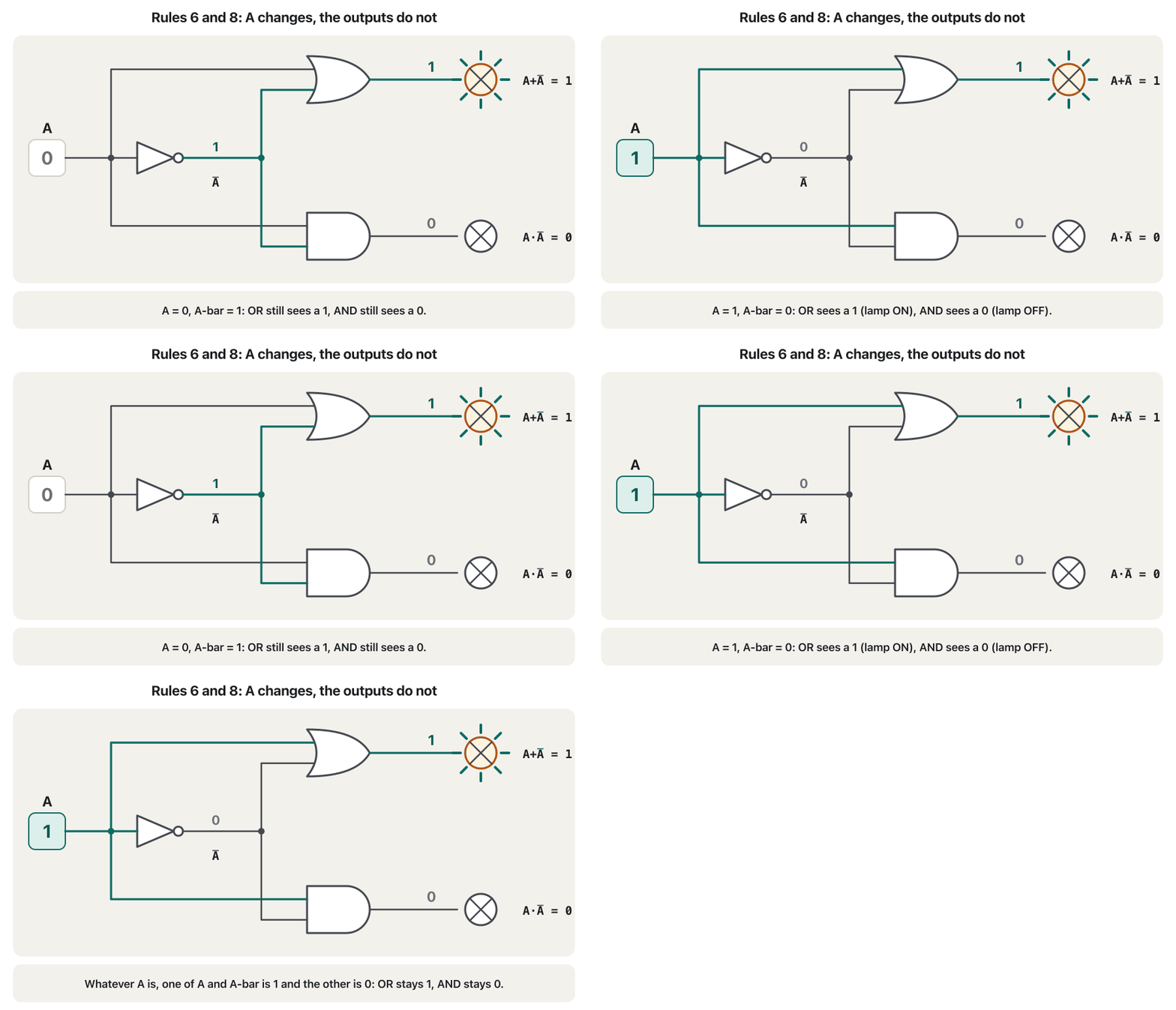
Rule 5, : if both OR inputs carry the same variable, the output equals that variable: and . Rule 6, : a variable ORed with its complement is always 1. If , then ; if , then . One of the two inputs is always 1.
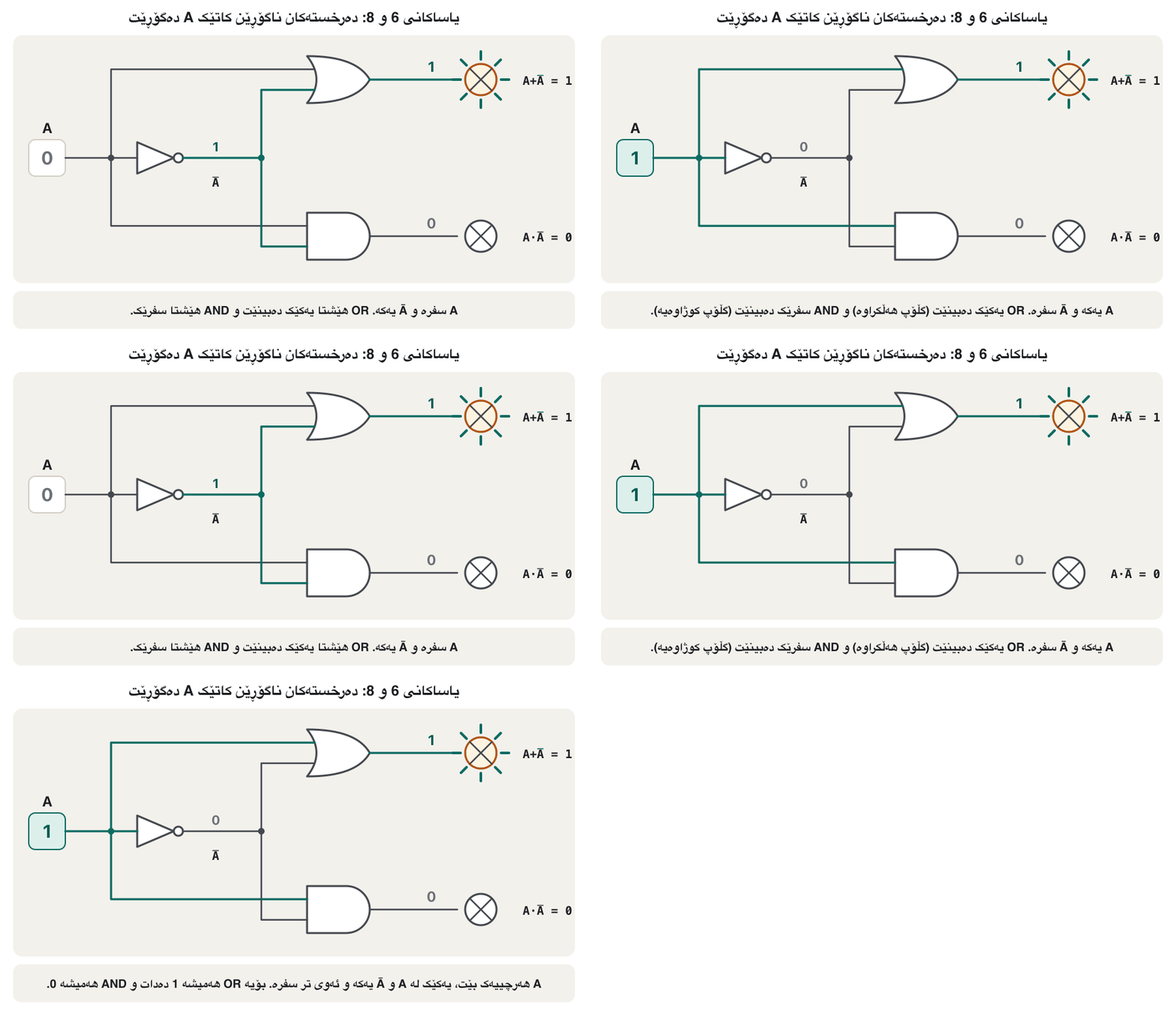
یاسای 5، : ئەگەر هەردوو OR هەمان هەڵبگرن، یەکسانە بەو : و . یاسای 6، : OR لەگەڵ هەمیشە 1ـە. ئەگەر بێت، ؛ ئەگەر بێت، . یەکێک لە دوو هەمیشە 1ـە.
Rules 7 and 8: A with itself or its complement (AND)یاساکانی 7 و 8: A لەگەڵ خۆی یان تەواوکەرەکەی (AND)
Rule 7, : and , so ANDing a variable with itself gives the variable. There are no powers in Boolean algebra: is just A, never “A squared”. Rule 8, : either A or is 0, and a 0 on an AND input makes the output 0.
یاسای 7، : و ، بۆیە AND کردنی لەگەڵ خۆی هەمان دەدات. لە توان نییە: تەنها Aـیە، هەرگیز «A دووجا» نییە. یاسای 8، : یان A یان 0ـە و 0 لەسەر AND دەکاتە 0.
Rule 9: the double complementیاسای 9: دوو جار تەواوکەر
Rule 9, : complement A once and you get ; complement that again and you are back at A. In hardware, two inverters in a row cancel: a 0 becomes 1 after the first and 0 again after the second.
یاسای 9، : یەک جار A وەربگرە، وەردەگریت؛ جارێکی تر وەربگرە، دەگەڕێیتەوە بۆ A. لە دوو بە دوای یەکدا یەکتر هەڵدەوەشێننەوە: 0 دوای یەکەمیان دەبێتە 1 و دوای دووەمیان دیسان دەبێتە 0.
The same idea helps when reading symbols: when a bubble meets another bubble on the same wire, the two inversions cancel.
هەمان بیرۆکە لە خوێندنەوەی یارمەتی دەدات: کاتێک بە بازنەیەکی تر دەگات لەسەر هەمان وایەر، دوو پێچەوانەکردنەوەکە یەکتر هەڵدەوەشێننەوە.
Rule 10: یاسای 10:
The slides list rules 10–12 without explaining them, so let us see why each is true. Start with the meaning of . If , the left side is , which is A. If , then too, and the left side is , which is A again. In both cases the answer is A, and B never matters. We say A absorbs the term AB.
سلایدەکان یاساکانی 10–12 بەبێ ڕوونکردنەوە ڕیز دەکەن، بۆیە با ببینین بۆچی هەر یەکێکیان ڕاستە. لە واتای ـەوە دەست پێبکە. ئەگەر بێت، لای چەپ دەبێتە کە هەمان Aـیە. ئەگەر بێت، ـیش 0ـە و لای چەپ دەبێتە کە دیسان هەمان Aـیە. لە هەردوو حاڵەتدا وەڵامەکە Aـیە و B هەرگیز گرنگ نییە. دەڵێین A بڕی AB هەڵدەمژێت.
— rule 4 (write A as )
— یاسای 4 (A وەک بنووسە)
— factor out A (distributive law)
— A بەرە دەرەوە ()
— rule 2:
— یاسای 2:
— rule 4
— یاسای 4
| A | B | ||
|---|---|---|---|
| 0 | 0 | 0 | 0 |
| 0 | 1 | 0 | 0 |
| 1 | 0 | 0 | 1 |
| 1 | 1 | 1 | 1 |
Rule 11: یاسای 11:
Again think it through. If , both sides are 1. If , then , so and both sides equal B. So the in front of B adds nothing and can be dropped. The course author proved this rule twice in his notes — once with a truth table and once with algebra.
دیسان بیری لێ بکەرەوە. ئەگەر بێت، هەردوو لا 1ـن. ئەگەر بێت، ، بۆیە و هەردوو لا یەکسانن بە B. کەواتە ئەو ـەی پێش B هیچ زیاد ناکات و دەتوانرێت لابدرێت. خاوەنی کۆرسەکە لە تێبینییەکانیدا ئەم یاسایەی دوو جار سەلماند — جارێک بە و جارێک بە جەبر.
| A | B | ||||
|---|---|---|---|---|---|
| 0 | 0 | 1 | 0 | 0 | 0 |
| 0 | 1 | 1 | 1 | 1 | 1 |
| 1 | 0 | 0 | 0 | 1 | 1 |
| 1 | 1 | 0 | 0 | 1 | 1 |
— rule 10: replace A by
— یاسای 10: A بە بگۆڕە
— rule 7: write A as AA
— یاسای 7: A وەک AA بنووسە
— rule 8: adding changes nothing
— یاسای 8: زیادکردنی هیچ ناگۆڕێت
— factor (multiply out to check)
— (بۆ پشکنین لێکیان بدە)
— rules 6 and 4
— یاساکانی 6 و 4
Rule 12: یاسای 12:
Rule 12 is the second distributive law: OR distributes over AND. It is the dual of , and it has no twin in ordinary arithmetic. Prove it by multiplying out the left side:
یاسای 12 دووەمە: OR بەسەر ANDـدا دابەش دەبێت. دووانەی ـە و لە ژمێریاریی ئاساییدا هاوتای نییە. بە لێکدانی لای چەپ بیسەلمێنە:
— distributive law
—
— rule 7:
— یاسای 7:
— factor A out of the first three terms
— A لە سێ بڕی یەکەم بەرە دەرەوە
— rules 2 and 4
— یاساکانی 2 و 4
| A | B | C | |||||
|---|---|---|---|---|---|---|---|
| 0 | 0 | 0 | 0 | 0 | 0 | 0 | 0 |
| 0 | 0 | 1 | 0 | 1 | 0 | 0 | 0 |
| 0 | 1 | 0 | 1 | 0 | 0 | 0 | 0 |
| 0 | 1 | 1 | 1 | 1 | 1 | 1 | 1 |
| 1 | 0 | 0 | 1 | 1 | 1 | 0 | 1 |
| 1 | 0 | 1 | 1 | 1 | 1 | 0 | 1 |
| 1 | 1 | 0 | 1 | 1 | 1 | 0 | 1 |
| 1 | 1 | 1 | 1 | 1 | 1 | 1 | 1 |
In circuit terms: two OR gates and an AND (left side) can be replaced by one AND and one OR (right side).
بە زمانی سووڕ: دوو و یەک AND (لای چەپ) دەتوانرێت بە یەک AND و یەک OR (لای ڕاست) بگۆڕدرێت.
Putting the rules to workبەکارهێنانی یاساکان
Simplifying means applying rules one step at a time and naming the rule each time. Two short examples:
سادەکردنەوە واتە بەکارهێنانی یاساکان هەنگاو بە هەنگاو و ناوبردنی یاساکە لە هەر هەنگاوێکدا. دوو نموونەی کورت:
Four rules turn a three-term expression into a single wire.
چوار یاسا سێ بڕی دەکەنە تەنها یەک وایەر.
Two AND gates and an OR gate disappear.
دوو و یەک نامێنن.
The next lessons of this chapter add De Morgan's theorems and then a full step-by-step strategy for longer expressions.
وانەکانی داهاتووی ئەم بەشە سەلمێنراوەکانی دی مۆرگان و پاشان ڕێگایەکی تەواوی هەنگاو بە هەنگاو بۆ درێژتر زیاد دەکەن.
Common mistakesهەڵە باوەکان
| Mistakeهەڵە | What is rightڕاستەکەی |
|---|---|
| Mixing up rules 10 and 11: writing .تێکەڵکردنی یاساکانی 10 و 11: نووسینی . | (rule 10). Only a complemented A in front of B drops out: . Check , : but . (یاسای 10). تەنها Aـی تەواوکراو لە پێش B لادەچێت: . و بپشکنە: بەڵام . |
| Writing .نووسینی . | There are no powers: (rule 7).توان نییە: (یاسای 7). |
| Writing or .نووسینی یان . | 1 dominates OR and 0 dominates AND: , .1 بەسەر ORـدا زاڵە و 0 بەسەر ANDـدا: ، . |
| Using a rule on only part of a term, e.g. turning into 1 because “”.بەکارهێنانی یاسایەک تەنها لەسەر بەشێکی بڕێک، بۆ نموونە کردنی بە 1 چونکە «». | is one product term; rule 6 needs exactly . The correct result is (rule 11). یەک ؛ یاسای 6 پێویستی بە ڕێک هەیە. ئەنجامی دروست ـە (یاسای 11). |
Exercisesڕاهێنانەکان
Prove (a) with a truth table and (b) with Boolean algebra, naming the rule used in each step.
بسەلمێنە (أ) بە و (ب) بە ، ناوی ئەو یاسایە بنووسە کە لە هەر هەنگاوێکدا بەکاری دەهێنیت.
Hintئاماژە
This is the course author's own exam-style note.
ئەمە تێبینیی خاوەنی کۆرسەکەیە بە شێوازی تاقیکردنەوە.
Show answerوەڵامەکە پیشان بدە
| A | B | ||||
|---|---|---|---|---|---|
| 0 | 0 | 1 | 0 | 0 | 0 |
| 0 | 1 | 1 | 1 | 1 | 1 |
| 1 | 0 | 0 | 0 | 1 | 1 |
| 1 | 1 | 0 | 0 | 1 | 1 |
Prove with a truth table.
بە بسەلمێنە.
Show answerوەڵامەکە پیشان بدە
| A | B | ||
|---|---|---|---|
| 0 | 0 | 0 | 0 |
| 0 | 1 | 0 | 0 |
| 1 | 0 | 0 | 1 |
| 1 | 1 | 1 | 1 |
The column (0 0 1 1) equals the column A (0 0 1 1).
ستوونی (0 0 1 1) یەکسانە بە ستوونی A (0 0 1 1).
Simplify, naming each rule: (a) (b) (c) (d) .
سادە بکەرەوە و ناوی هەر یاسایەک بنووسە: (أ) (ب) (ج) (د) .
Show answerوەڵامەکە پیشان بدە
- (a) — rule 10 with XY in the place of A.
- (b) — rule 12.
- (c) — rule 11 with in the place of A.
- (d) A — rule 4 (), rule 8 (), rule 1 (drop the 0s), rule 5 ().
- (أ) — یاسای 10 بە XY لە جیاتی A.
- (ب) — یاسای 12.
- (ج) — یاسای 11 بە لە جیاتی A.
- (د) A — یاسای 4 ()، یاسای 8 ()، یاسای 1 (0ـەکان لاببە)، یاسای 5 ().
Name the rule: (a) (b) (c) (d) (e) .
ناوی یاساکە بنووسە: (أ) (ب) (ج) (د) (هـ) .
Show answerوەڵامەکە پیشان بدە
(a) rule 1, (b) rule 8, (c) rule 9, (d) rule 5, (e) rule 2.
(أ) یاسای 1، (ب) یاسای 8، (ج) یاسای 9، (د) یاسای 5، (هـ) یاسای 2.
Write the dual of rules 1, 2, 5 and 6. Which rules do you get?
دووانەی یاساکانی 1، 2، 5 و 6 بنووسە. کام یاسایانە وەردەگریت؟
Show answerوەڵامەکە پیشان بدە
(rule 4), (rule 3), (rule 7) and (rule 8).
(یاسای 4)، (یاسای 3)، (یاسای 7) و (یاسای 8).
Summaryپوختە
- OR with 0 and AND with 1 change nothing (rules 1, 4); OR with 1 gives 1 and AND with 0 gives 0 (rules 2, 3).
- and (rules 5, 7); and (rules 6, 8).
- Two bars cancel: (rule 9).
- (10), (11), (12).
- Every rule can be proved with a truth table, and most come in dual pairs.
- OR لەگەڵ 0 و AND لەگەڵ 1 هیچ ناگۆڕن (یاساکانی 1 و 4)؛ OR لەگەڵ 1، 1 دەدات و AND لەگەڵ 0، 0 دەدات (یاساکانی 2 و 3).
- و (یاساکانی 5 و 7)؛ و (یاساکانی 6 و 8).
- دوو هێڵ یەکتر هەڵدەوەشێننەوە: (یاسای 9).
- (10)، (11)، (12).
- هەموو یاسایەک دەتوانرێت بە بسەلمێنرێت و زۆربەیان جووتی دووانەن.
What is ? چەندە؟
Always 1 (rule 6).
هەمیشە 1 (یاسای 6).
Is equal to A or to ? یەکسانە بە A یان بە ؟
To A (rule 10).
بە A (یاسای 10).
Which rule is the second distributive law?کام یاسا یاسای بەشینەوەی دووەمە؟
Rule 12, .
یاسای 12، .
Videoڤیدیۆ
Watch a videoسەیری ڤیدیۆیەک بکە
A video that viewers liked a lot and praised in their comments, chosen for this lesson.ڤیدیۆیەک کە بینەران زۆریان پێ خۆش بووە و لە کۆمێنتەکانیاندا ستایشیان کردووە، بۆ ئەم وانەیە هەڵبژێردراوە.
Kurdish (Sorani): commutative, associative and distributive laws with gate drawings, the 12 rules in the lesson's order, then De Morgan's theorems.
بە کوردیی سۆرانی: ، و بە وێنەی ، دوازدە یاساکە بە ڕیزبەندیی وانەکە، پاشان .
3:25-10:35: rules 1-12 (A+0=A ... (A+B)(A+C)=A+BC) with short proofs.
لە 3:25 تا 10:35: یاساکانی 1 تا 12 ( … ) لەگەڵ کورت.
Lesson complete!وانەکە تەواو بوو!
Well done. Review the key terms, then go on to the next lesson.دەستخۆش. سەیرێکی زاراوە سەرەکییەکان بکەرەوە، پاشان بڕۆ بۆ وانەی داهاتوو.
Key termsزاراوە سەرەکییەکان
De Morgan's Theoremsسەلمێنراوەکانی دی مۆرگان
Related lecturesوانە پەیوەندیدارەکان
References and further readingسەرچاوەکان و خوێندنەوەی زیاتر
- Wikipedia: Boolean algebra (basic laws: identity, annihilator, idempotence, complementation, double negation, absorption, distributivity; duality)
- Wikipedia: Algebra of sets (the same rules for sets, with names)
- T. L. Floyd, Digital Fundamentals, 11th ed. (the course reference book): section 4-2, used for topic order only
This lecture is a first edition. The Kurdish text and terminology are waiting for review by Kurdish IT teachers.ئەم وانەیە چاپی یەکەمە. دەقە کوردییەکە و زاراوەکانی چاوەڕێی پێداچوونەوەی مامۆستایانی کوردی بواری IT ن.