Chapterبەش 6 · Lectureوانە 6.3

Multiplying Matricesلێکدانی ماتریکسەکان

When a product ABAB exists and what size it has ((m×n)(n×p)→m×p(m \times n)(n \times p) \to m \times p), products of non-square matrices and vectors (a shopping bill in IQD), the associative and distributive laws, powers of square matrices and the transpose rules (A+B)T=AT+BT(A + B)^T = A^T + B^T and (AB)T=BTAT(AB)^T = B^TA^T.

کەی لێکدراوی ABAB هەیە و چ قەبارەیەکی هەیە ((m×n)(n×p)→m×p(m \times n)(n \times p) \to m \times p)، لێکدانی ناچوارگۆشەییەکان و (پسوولەی کڕین بە دینار)، و ، توانی و یاساکانی (A+B)T=AT+BT(A + B)^T = A^T + B^T و (AB)T=BTAT(AB)^T = B^TA^T.

16 min read18 خولەک خوێندنەوە · 18 stepsهەنگاو

What you will learnچی فێر دەبیت

  • Decide from the orders whether ABAB and BABA exist and give their sizes.
  • Multiply non-square matrices and vectors entry by entry with row times column.
  • Use the associative and distributive laws, AI=IA=AAI = IA = A, and avoid AB=BAAB = BA.
  • Compute powers of square matrices and transposes of sums and products.
  • لە قەبارەکانەوە بڕیار بدەیت ئایا ABAB و BABA هەن و قەبارەیان بڵێیت.
  • ناچوارگۆشەییەکان و بە ڕیز لە ستوون لێک بدەیت.
  • و و AI=IA=AAI = IA = A بەکاربهێنیت و خۆت لە AB=BAAB = BA بپارێزیت.
  • توانی و کۆ و لێکدراو بدۆزیتەوە.

Where we startلە کوێوە دەست پێدەکەین

You already multiplied two 2×22 \times 2 matrices in Multiplying matrices: row times column: every entry of the answer is a row of the first matrix times a column of the second — multiply the pairs and add. You also saw that the order matters: in general AB≠BAAB \ne BA.

پێشتر دوو 2×22 \times 2ت لە لێکدانی ماتریکسەکان: ڕیز لە ستووندا لێک دا: هەر ژمارەیەکی وەڵام ڕیزێکی یەکەمە لە ستوونێکی دووەم — جووتەکان لێک بدە و کۆیان بکەرەوە. هەروەها بینیت کە ڕیزبەندی گرنگە: بە گشتی AB≠BAAB \ne BA.

This lesson answers the questions that the 2×22 \times 2 case hides: when can two matrices of different shapes be multiplied, what size is the answer, how vectors work, which laws still hold, what A2A^2 means, and what happens to a product under the .

ئەم وانەیە وەڵامی ئەو پرسیارانە دەداتەوە کە حاڵەتی 2×22 \times 2 دەیانشارێتەوە: کەی دوو بە شێوەی جیاواز لێک دەدرێن، وەڵامەکە چ قەبارەیەکی دەبێت، چۆن کار دەکەن، کام یاسا هێشتا ڕاستن، A2A^2 واتای چییە و چی بەسەر لێکدراوێکدا دەهێنێت.

When does ABAB exist?کەی ABAB هەیە؟

A row of AA must have exactly as many numbers as a column of BB, otherwise the pairs do not match up. A row of AA has one number for each column of AA, and a column of BB has one number for each row of BB. So:

ڕیزێکی AA دەبێت ڕێک بە ئەندازەی ستوونێکی BB ژمارەی هەبێت، ئەگەرنا جووتەکان یەک ناگرنەوە. ڕیزێکی AA بۆ هەر ستوونێکی AA یەک ژمارەی هەیە و ستوونێکی BB بۆ هەر ڕیزێکی BB یەک ژمارە. کەواتە:

Am×n  Bn×p=(AB)m×pA_{m \times \mathbf{n}} \; B_{\mathbf{n} \times p} = (AB)_{m \times p}

ABAB is defined only when the number of columns of AA equals the number of rows of BB. The answer takes its rows from AA and its columns from BB. The product may be written ABAB, A(B)A(B) or (A)B(A)B.

ABAB تەنها کاتێک پێناسە کراوە کە ژمارەی ستوونەکانی AA یەکسان بێت بە ژمارەی ڕیزەکانی BB. وەڵامەکە ڕیزەکانی لە AA و ستوونەکانی لە BB وەردەگرێت. لێکدراوەکە دەتوانرێت بە ABAB، A(B)A(B) یان (A)B(A)B بنووسرێت.

Two domino tiles: the first reads 2 | 3 and the second 3 | 4. The two inner 3s touch and are joined with the words “must match”; the outer numbers 2 and 4 are circled and give the size of the answer, 2 × 4. Below, a second pair 2 | 3 and 2 | 3 whose inner numbers 3 and 2 do not match is crossed out: not defined.دوو پارچەی دۆمینە: یەکەم 2 | 3 و دووەم 3 | 4. دوو 3ـە ناوەکییەکە بە یەکەوە نووساون و نووسراوە «دەبێت یەک بن»؛ ژمارە دەرەکییەکان 2 و 4 بازنەیان لێ دراوە و قەبارەی وەڵامەکە دەدەن، 2 × 4. لە خوارەوە جووتێکی تری 2 | 3 و 2 | 3 کە ژمارە ناوەکییەکانیان 3 و 2 یەک ناگرنەوە، خەتی بەسەردا هێنراوە: پێناسە نەکراوە.
Like dominoes: the touching (inner) numbers must match; the outer numbers are the size of the answer.وەک دۆمینە: ژمارە نووساوەکان (ناوەکییەکان) دەبێت یەک بن؛ ژمارە دەرەکییەکان قەبارەی وەڵامەکەن.CêIT
Quick checkپشکنینی خێراAA is 2×32 \times 3 and BB is 3×43 \times 4. What is the order of ABAB?AA 2×32 \times 3ـە و BB 3×43 \times 4ـە. قەبارەی ABAB چەندە؟

Quick checkپشکنینی خێراAA is 3×23 \times 2 and BB is 3×23 \times 2. What is ABAB?AA 3×23 \times 2ـە و BB 3×23 \times 2ـە. ABAB چییە؟

Multiplying MatricesThe Organic Chemistry Tutor · Englishئینگلیزی · 2.7M viewsبینین · 41K likesلایک · Partبەشی 0:00–7:49 (ofلە 17:40)

How to check whether AB exists (inner sizes match), what size the answer has, and why AB and BA can differ.

چۆن دەزانیت ABAB هەیە (قەبارە ناوەکییەکان یەک بگرنەوە)، وەڵامەکە چ قەبارەیەکی دەبێت، هەروەها بۆچی ABAB و BABA دەکرێت جیاواز بن.

Plays 0:00-7:49: 0:58 determining the orders (inner numbers match, outer numbers give the size); 3:39 AB for a 1 × 3 row times a 3 × 1 column (1 × 1); 5:18 BA is 3 × 3 — the lesson's own quiz case.

لە ⁦0:00⁩ تا ⁦7:49⁩ پەخش دەبێت: ⁦0:58⁩ دیاریکردنی قەبارەکان (ژمارە ناوەکییەکان یەک دەگرنەوە، ژمارە دەرەکییەکان قەبارەی وەڵام دەدەن)؛ ⁦3:39⁩ ABAB بۆ ڕیزێکی 1×31 \times 3 لە ستوونێکی 3×13 \times 1 (1×11 \times 1)؛ ⁦5:18⁩ BABA دەبێتە 3×33 \times 3، هەمان پرسیارەکەی تاقیکردنەوەی وانەکە.

One entry: row ii times column jjیەک ژمارە: ڕیزی ii لە ستوونی jj

The entry in row ii, column jj of ABAB uses only row ii of AA and column jj of BB. Walk along both at the same time, multiply the pairs and add:

ژمارەی ڕیزی ii، ستوونی jjی ABAB تەنها ڕیزی iiی AA و ستوونی jjی BB بەکاردەهێنێت. بە هەردووکیاندا پێکەوە بڕۆ، جووتەکان لێک بدە و کۆیان بکەرەوە:

(AB)ij=ai1b1j+ai2b2j+⋯+ainbnj=∑k=1naik bkj(AB)_{ij} = a_{i1}b_{1j} + a_{i2}b_{2j} + \cdots + a_{in}b_{nj} = \sum_{k=1}^{n} a_{ik}\,b_{kj}
Row 1 of A, the numbers 2, 1, 3, is turned upright and slides next to column 1 of B, the numbers 1, 3, −1. The pairs are multiplied: 2 × 1 = 2, 1 × 3 = 3, 3 × (−1) = −3, and the three products are added: 2 + 3 − 3 = 2, which becomes the entry in row 1, column 1 of AB.ڕیزی 1ی A، ژمارەکانی 2، 1، 3، ڕاست دەکرێتەوە و دەخزێتە تەنیشت ستوونی 1ی B، ژمارەکانی 1، 3، −1. جووتەکان لێک دەدرێن: 2 × 1 = 2، 1 × 3 = 3، 3 × (−1) = −3 و سێ لێکدراوەکە کۆ دەکرێنەوە: 2 + 3 − 3 = 2 کە دەبێتە ژمارەی ڕیزی 1، ستوونی 1ی AB.
Row slides over column: multiply the pairs, then add.ڕیز بەسەر ستووندا دەخزێت: جووتەکان لێک بدە، پاشان کۆیان بکەرەوە.CêIT

The notes write the whole product out for a 3×23 \times 2 matrix times a 2×22 \times 2 matrix. Each row of the answer comes from one row of AA, so the answer is 3×23 \times 2:

تێبینییەکان هەموو لێکدراوەکە بۆ 3×23 \times 2 لە 2×22 \times 2 دەنووسن. هەر ڕیزێکی وەڵام لە یەک ڕیزی AAـەوە دێت، بۆیە وەڵامەکە 3×23 \times 2ـە:

A3×2B2×2=[a11a12a21a22a31a32][b11b12b21b22]=[a11b11+a12b21a11b12+a12b22a21b11+a22b21a21b12+a22b22a31b11+a32b21a31b12+a32b22]3×2A_{3\times2}B_{2\times2} = \begin{bmatrix} a_{11} & a_{12} \\ a_{21} & a_{22} \\ a_{31} & a_{32} \end{bmatrix}\begin{bmatrix} b_{11} & b_{12} \\ b_{21} & b_{22} \end{bmatrix} = \begin{bmatrix} a_{11}b_{11} + a_{12}b_{21} & a_{11}b_{12} + a_{12}b_{22} \\ a_{21}b_{11} + a_{22}b_{21} & a_{21}b_{12} + a_{22}b_{22} \\ a_{31}b_{11} + a_{32}b_{21} & a_{31}b_{12} + a_{32}b_{22} \end{bmatrix}_{3\times2}
Quick checkپشکنینی خێراWhich entries are used for the entry in row 3, column 2 of this product?کام ژمارانە بۆ ژمارەی ڕیزی 3، ستوونی 2ی ئەم لێکدراوە بەکاردێن؟

4). Chapter Two : Matrices / part 2 in KurdishAvin Omer Karim · Kurdish (Sorani)کوردی (سۆرانی) · 5.2K viewsبینین · 135 likesلایک · Partبەشی 2:45–10:30 (ofلە 26:34)

A Kurdish university lecture: adding matrices of the same order, multiplying by a number, and multiplying matrices row by column.

وانەیەکی زانکۆ بە کوردی: کۆکردنەوەی کە هەمان قەبارەیان هەیە، لێکدان لە ژمارەیەک و لێکدانی ڕیز لە ستوون.

Kurdish: AB is defined when columns of A = rows of B; a 2×2 product row by column; a 1×3 row times a 3×1 column. Stops before the 2×3 × 3×2 example at 10:35.

بە کوردی: ABAB پێناسە کراوە کاتێک ژمارەی ستوونەکانی A یەکسان بێت بە ژمارەی ڕیزەکانی B؛ لێکدانی 2×22 \times 2 ڕیز لە ستوون؛ ڕیزێکی 1×31 \times 3 لە ستوونێکی 3×13 \times 1. پێش نموونەی (2×3)(3×2)(2 \times 3)(3 \times 2) لە ⁦10:35⁩ ڕادەوەستێت.

A 2×32 \times 3 times a 3×23 \times 22×32 \times 3 لە 3×23 \times 2

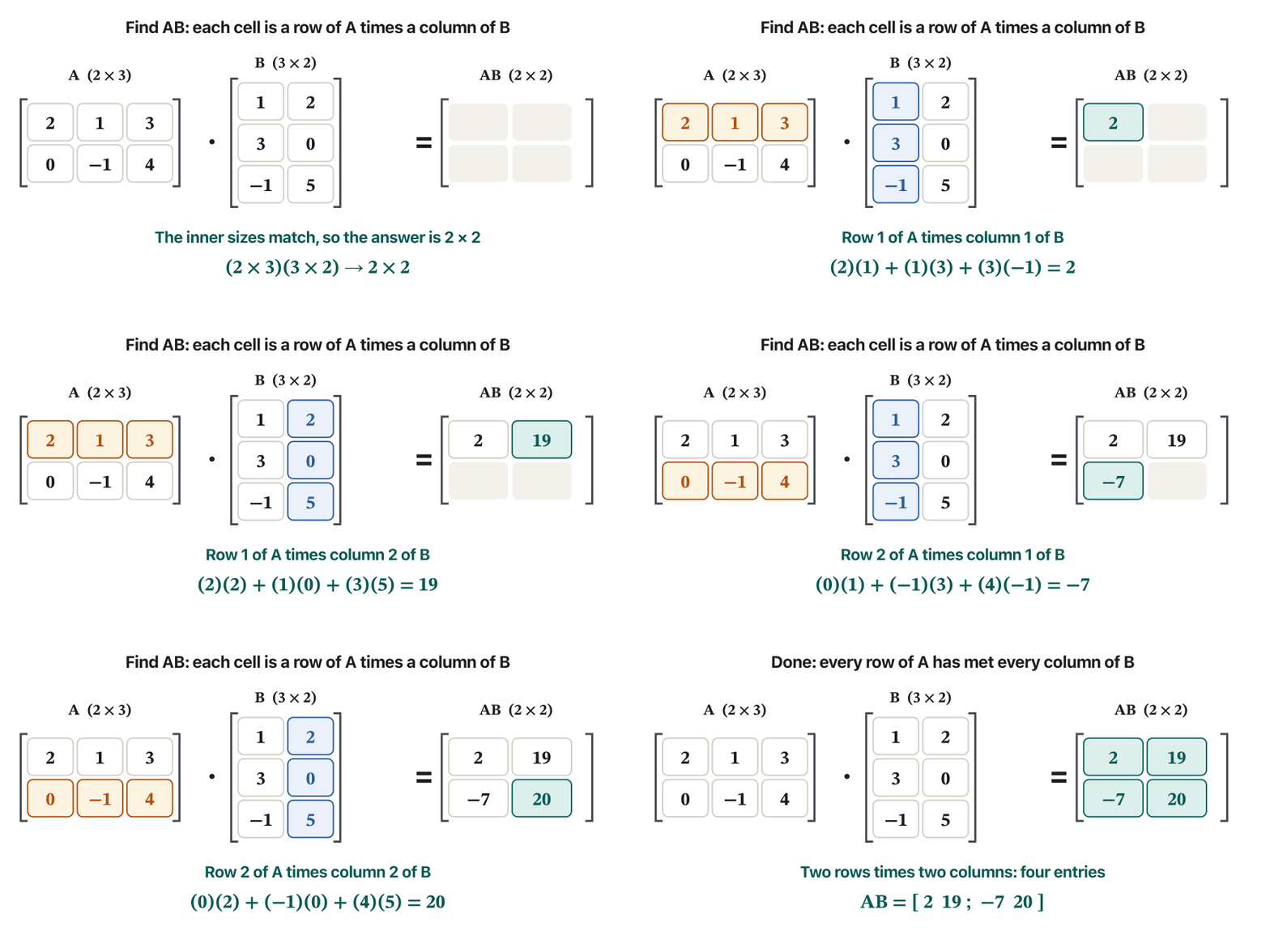
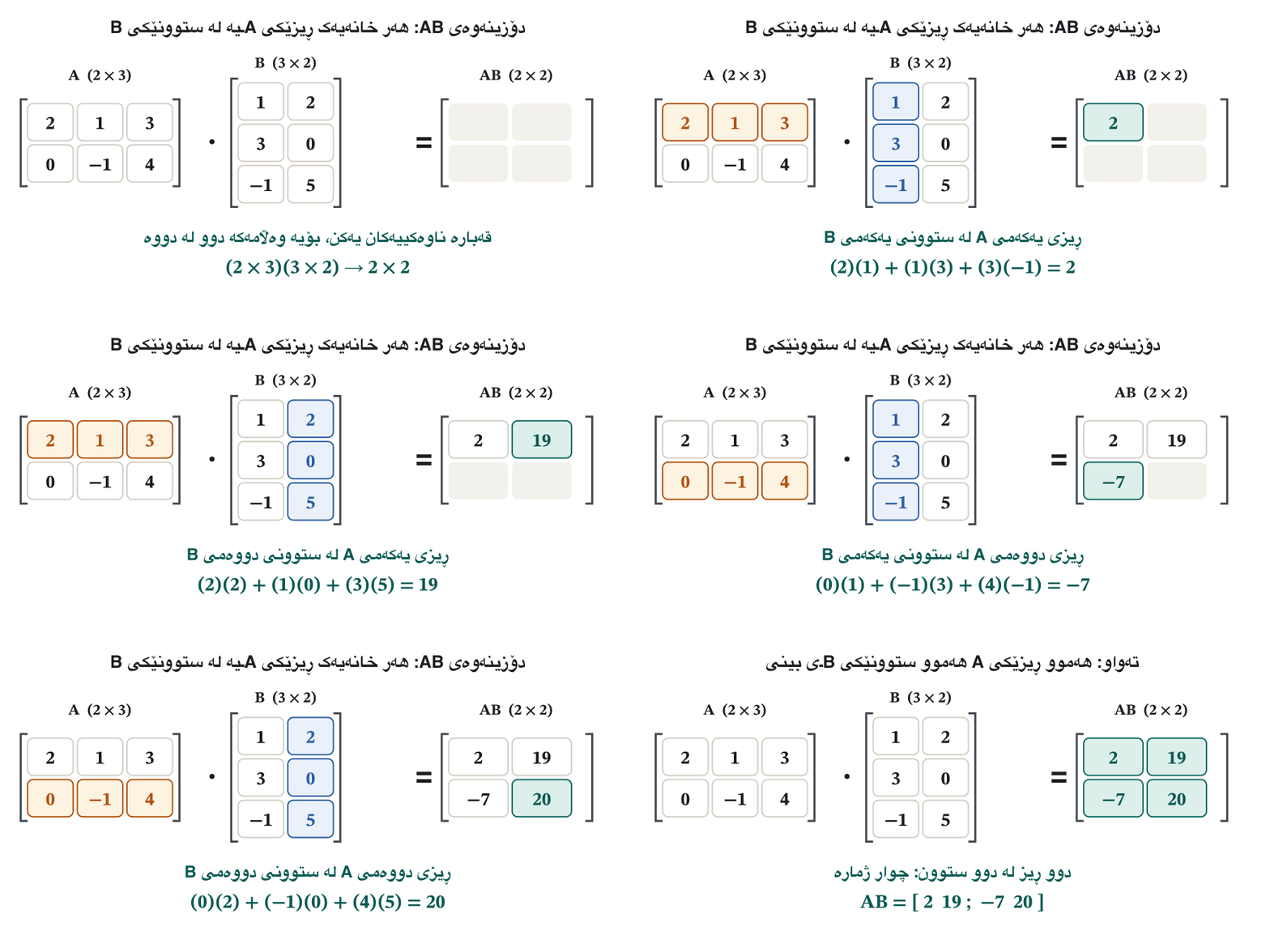
Take A=[2130−14]A = \begin{bmatrix} 2 & 1 & 3 \\ 0 & -1 & 4 \end{bmatrix} (2×32 \times 3) and B=[1230−15]B = \begin{bmatrix} 1 & 2 \\ 3 & 0 \\ -1 & 5 \end{bmatrix} (3×23 \times 2). The inner sizes are both 3, so ABAB exists and is 2×22 \times 2: four entries, each a row of AA times a column of BB.

A=[2130−14]A = \begin{bmatrix} 2 & 1 & 3 \\ 0 & -1 & 4 \end{bmatrix} (2×32 \times 3) و B=[1230−15]B = \begin{bmatrix} 1 & 2 \\ 3 & 0 \\ -1 & 5 \end{bmatrix} (3×23 \times 2) وەربگرە. قەبارە ناوەکییەکان هەردووکیان 3ـن، بۆیە ABAB هەیە و 2×22 \times 2ـە: چوار ژمارە، هەریەکەیان ڕیزێکی AAـە لە ستوونێکی BB.

A is 2 by 3 with rows 2, 1, 3 and 0, −1, 4; B is 3 by 2 with rows 1, 2 / 3, 0 / −1, 5; the answer AB is an empty 2 by 2 grid. Frame by frame one row of A and one column of B light up and their products are added into one cell: row 1 with column 1 gives 2 + 3 − 3 = 2, row 1 with column 2 gives 4 + 0 + 15 = 19, row 2 with column 1 gives 0 − 3 − 4 = −7, row 2 with column 2 gives 0 + 0 + 20 = 20. The last frame shows AB with rows 2, 19 and −7, 20.
Each cell of ABAB: one row of AA times one column of BB.هەر خانەیەکی ABAB: ڕیزێکی AA لە ستوونێکی BB.CêIT
(AB)11=(2)(1)+(1)(3)+(3)(−1)=2(AB)12=(2)(2)+(1)(0)+(3)(5)=19(AB)21=(0)(1)+(−1)(3)+(4)(−1)=−7(AB)22=(0)(2)+(−1)(0)+(4)(5)=20\begin{aligned} (AB)_{11} &= (2)(1) + (1)(3) + (3)(-1) = 2 & (AB)_{12} &= (2)(2) + (1)(0) + (3)(5) = 19 \\ (AB)_{21} &= (0)(1) + (-1)(3) + (4)(-1) = -7 & (AB)_{22} &= (0)(2) + (-1)(0) + (4)(5) = 20 \end{aligned}

So AB=[219−720]AB = \begin{bmatrix} 2 & 19 \\ -7 & 20 \end{bmatrix}.

کەواتە AB=[219−720]AB = \begin{bmatrix} 2 & 19 \\ -7 & 20 \end{bmatrix}.

Quick checkپشکنینی خێراWhich entry of ABAB comes from row 2 of AA and column 2 of BB?کام ژمارەی ABAB لە ڕیزی 2ی AA و ستوونی 2ی BBـەوە دێت؟

Now BABA: a different sizeئێستا BABA: قەبارەیەکی جیاواز

Swap the order. BB is 3×23 \times \mathbf{2} and AA is 2×3\mathbf{2} \times 3: the inner sizes are both 2, so BABA exists too — but it is 3×33 \times 3, nine entries, each a row of BB (2 numbers) times a column of AA (2 numbers):

ڕیزبەندییەکە بگۆڕە. BB 3×23 \times \mathbf{2}ـە و AA 2×3\mathbf{2} \times 3ـە: قەبارە ناوەکییەکان هەردووکیان 2ـن، بۆیە BABAـیش هەیە — بەڵام 3×33 \times 3ـە، نۆ ژمارە، هەریەکەیان ڕیزێکی BBـە (⁦2⁩ ژمارە) لە ستوونێکی AA (⁦2⁩ ژمارە):

BA=[(1)(2)+(2)(0)(1)(1)+(2)(−1)(1)(3)+(2)(4)(3)(2)+(0)(0)(3)(1)+(0)(−1)(3)(3)+(0)(4)(−1)(2)+(5)(0)(−1)(1)+(5)(−1)(−1)(3)+(5)(4)]=[2−111639−2−617]BA = \begin{bmatrix} (1)(2) + (2)(0) & (1)(1) + (2)(-1) & (1)(3) + (2)(4) \\ (3)(2) + (0)(0) & (3)(1) + (0)(-1) & (3)(3) + (0)(4) \\ (-1)(2) + (5)(0) & (-1)(1) + (5)(-1) & (-1)(3) + (5)(4) \end{bmatrix} = \begin{bmatrix} 2 & -1 & 11 \\ 6 & 3 & 9 \\ -2 & -6 & 17 \end{bmatrix}

ABAB is 2×22 \times 2 and BABA is 3×33 \times 3: they cannot even be compared. Non-square matrices show most clearly why the order of a product matters.

ABAB 2×22 \times 2ـە و BABA 3×33 \times 3ـە: تەنانەت بەراوردیش ناکرێن. ناچوارگۆشەییەکان بە ڕوونترین شێوە پیشان دەدەن بۆچی ڕیزبەندیی لێکدان گرنگە.

Quick checkپشکنینی خێراAA is 1×31 \times 3 and BB is 3×13 \times 1. What are the orders of ABAB and BABA?AA 1×31 \times 3ـە و BB 3×13 \times 1ـە. قەبارەی ABAB و BABA چەندن؟

When ABAB exists but BABA does notکاتێک ABAB هەیە بەڵام BABA نییە

Sometimes only one order works. The notes' example is a 3×23 \times 2 matrix AA times a 2×22 \times 2 matrix BB: ABAB is 3×23 \times 2, but BABA would need the 2 columns of BB to meet the 3 rows of AA, so it is not defined. A new example of the same shapes:

هەندێک جار تەنها یەک ڕیزبەندی کار دەکات. نموونەی تێبینییەکان 3×23 \times 2ی AAـە لە 2×22 \times 2ی BB: ABAB 3×23 \times 2ـە، بەڵام BABA پێویستی بەوەیە کە 2 ستوونی BB لەگەڵ 3 ڕیزی AA یەک بگرنەوە، بۆیە پێناسە نەکراوە. نموونەیەکی نوێ بە هەمان شێوە:

C=[142−103],D=[21−35],CD=[2−121+204+32−50−90+15]=[−10217−3−915]C = \begin{bmatrix} 1 & 4 \\ 2 & -1 \\ 0 & 3 \end{bmatrix}, \quad D = \begin{bmatrix} 2 & 1 \\ -3 & 5 \end{bmatrix}, \quad CD = \begin{bmatrix} 2 - 12 & 1 + 20 \\ 4 + 3 & 2 - 5 \\ 0 - 9 & 0 + 15 \end{bmatrix} = \begin{bmatrix} -10 & 21 \\ 7 & -3 \\ -9 & 15 \end{bmatrix}

DCDC: (2×2)(3×2)(2 \times \mathbf{2})(\mathbf{3} \times 2) — the inner sizes 2 and 3 differ, so DCDC is not defined.

DCDC: (2×2)(3×2)(2 \times \mathbf{2})(\mathbf{3} \times 2) — قەبارە ناوەکییەکان 2 و 3 جیاوازن، بۆیە DCDC پێناسە نەکراوە.

When both AA and BB are square of the same size nn, both ABAB and BABA exist and are n×nn \times n — and still, as the 2×22 \times 2 example showed, they are usually different.

کاتێک AA و BB هەردووکیان چوارگۆشەیی بن بە هەمان قەبارەی nn، ABAB و BABA هەردووکیان هەن و n×nn \times nـن — بەڵام هێشتا، وەک نموونە 2×22 \times 2ـەکە پیشانی دا، زۆرجار جیاوازن.

Quick checkپشکنینی خێراPP is 4×24 \times 2 and QQ is 2×22 \times 2. Which products are defined?PP 4×24 \times 2ـە و QQ 2×22 \times 2ـە. کام لێکدراو پێناسە کراوە؟

Vectors and matrices: a shopping bill in IQDئاڕاستەبڕەکان و ماتریکسەکان: پسوولەی کڕین بە دینار

A row or a column is a matrix too, so the same rule covers . Hana buys 2 kg of tomatoes, 1 kg of onions and 3 kg of potatoes at a bazaar in Erbil, where they cost 1,000, 750 and 500 IQD per kg. Write the amounts as a row qq and the prices as a column pp:

ڕیز یان ستوونیش ، بۆیە هەمان یاسا دەگرێتەوە. هانا لە بازاڕێکی هەولێر 2 کیلۆ تەماتە، 1 کیلۆ پیاز و 3 کیلۆ پەتاتە دەکڕێت کە کیلۆی بە ⁦1,000⁩، ⁦750⁩ و ⁦500⁩ دینارە. بڕەکان وەک ڕیزی qq و نرخەکان وەک ستوونی pp بنووسە:

q p=[213][1000750500]=[2(1000)+1(750)+3(500)]=[4250]q\,p = \begin{bmatrix} 2 & 1 & 3 \end{bmatrix}\begin{bmatrix} 1000 \\ 750 \\ 500 \end{bmatrix} = \begin{bmatrix} 2(1000) + 1(750) + 3(500) \end{bmatrix} = \begin{bmatrix} 4250 \end{bmatrix}

A 1×31 \times 3 row times a 3×13 \times 1 column is 1×11 \times 1: one number, the bill, 4,250 IQD.

ڕیزێکی 1×31 \times 3 لە ستوونێکی 3×13 \times 1 دەکاتە 1×11 \times 1: یەک ژمارە، پسوولەکە، ⁦4,250⁩ دینار.

Quick checkپشکنینی خێراAt another stall potatoes cost 600 IQD per kg; tomatoes and onions cost the same as before. What is Hana's bill for q=(2,1,3)q = (2, 1, 3) there?لە دوکانێکی تر کیلۆی پەتاتە ⁦600⁩ دینارە؛ تەماتە و پیاز وەک پێشوون. پسوولەی هانا بۆ q=(2,1,3)q = (2, 1, 3) لەوێ چەندە؟

Vectors and matrices: a shopping bill in IQDئاڕاستەبڕەکان و ماتریکسەکان: پسوولەی کڕین بە دینار

Several shops, several shoppersچەند دوکانێک، چەند کڕیارێک

Row vector × matrix. To compare two shops, put each shop's prices in its own column (the bazaar first, then a supermarket). The 1×31 \times 3 row times the 3×23 \times 2 matrix gives a 1×21 \times 2 row: one bill for each shop.

ڕیز × . بۆ بەراوردکردنی دوو دوکان، نرخەکانی هەر دوکانێک لە ستوونی خۆیدا دابنێ (سەرەتا بازاڕەکە، پاشان سوپەرمارکێتێک). ڕیزی 1×31 \times 3 لە 3×23 \times 2 ڕیزێکی 1×21 \times 2 دەدات: پسوولەیەک بۆ هەر دوکانێک.

q P=[213][10001250750750500600]=[42505050]q\,P = \begin{bmatrix} 2 & 1 & 3 \end{bmatrix}\begin{bmatrix} 1000 & 1250 \\ 750 & 750 \\ 500 & 600 \end{bmatrix} = \begin{bmatrix} 4250 & 5050 \end{bmatrix}

Matrix × column vector. If Hana and Shilan both shop at the bazaar, put their amounts in the rows of a 2×32 \times 3 matrix QQ. Then QpQp is a 2×12 \times 1 column: one bill for each person. The other order, pQpQ, is (3×1)(2×3)(3 \times 1)(2 \times 3) and not defined.

× ستوون. ئەگەر هانا و شیلان هەردووکیان لە بازاڕەکە بکڕن، بڕەکانیان لە ڕیزەکانی 2×32 \times 3ی QQدا دابنێ. ئەو کاتە QpQp ستوونێکی 2×12 \times 1ـە: پسوولەیەک بۆ هەر کەسێک. ڕیزبەندییەکەی تر، pQpQ، (3×1)(2×3)(3 \times 1)(2 \times 3)ـە و پێناسە نەکراوە.

Q p=[213120][1000750500]=[2(1000)+1(750)+3(500)1(1000)+2(750)+0(500)]=[42502500]Q\,p = \begin{bmatrix} 2 & 1 & 3 \\ 1 & 2 & 0 \end{bmatrix}\begin{bmatrix} 1000 \\ 750 \\ 500 \end{bmatrix} = \begin{bmatrix} 2(1000) + 1(750) + 3(500) \\ 1(1000) + 2(750) + 0(500) \end{bmatrix} = \begin{bmatrix} 4250 \\ 2500 \end{bmatrix}

The notes practise the same four cases with a row bb, a column aa and 3×33 \times 3 matrices: bXbX works, XbXb does not ((3×3)(1×3)(3 \times 3)(1 \times 3)), XaXa gives a column and aTXa^TX gives a row. Try them in the exercises.

تێبینییەکان هەمان چوار حاڵەت بە ڕیزی bb، ستوونی aa و 3×33 \times 3 ڕادەهێنن: bXbX کار دەکات، XbXb کار ناکات ((3×3)(1×3)(3 \times 3)(1 \times 3))، XaXa ستوونێک دەدات و aTXa^TX ڕیزێک. لە ڕاهێنانەکاندا تاقییان بکەرەوە.

Quick checkپشکنینی خێراShilan's row of QQ is (1,2,0)(1, 2, 0). What is her bill at the supermarket prices (1250,750,600)(1250, 750, 600)?ڕیزی شیلان لە QQدا (1,2,0)(1, 2, 0)ـە. پسوولەکەی بە نرخەکانی سوپەرمارکێت (1250,750,600)(1250, 750, 600) چەندە؟

The laws of matrix multiplicationیاساکانی لێکدانی ماتریکسەکان

Let AA, BB, CC have orders for which the products below are defined, and let rr be a number. Then:

با AA، BB، CC ئەو قەبارانەیان هەبێت کە لێکدراوەکانی خوارەوە پێناسە بکەن و rr ژمارەیەک بێت. ئەو کاتە:

Laws that hold — and the one that does notئەو یاسایانەی ڕاستن — و ئەوەی ڕاست نییە
LawیاساFormulaIn wordsبە وشە
A(BC)=(AB)CA(BC) = (AB)Cmultiply in any grouping, keep the orderبە هەر کۆمەڵکردنێک لێکی بدە، ڕیزبەندییەکە بپارێزە
(left) (چەپ)A(B+C)=AB+ACA(B + C) = AB + ACAA stays on the leftAA لە لای چەپ دەمێنێتەوە
(right) (ڕاست)(A+B)C=AC+BC(A + B)C = AC + BCCC stays on the rightCC لە لای ڕاست دەمێنێتەوە
Numbers move freelyژمارە بە ئازادی دەجووڵێتA(rB)=r(AB)=(rA)BA(rB) = r(AB) = (rA)Ba scalar can sit anywhere دەتوانێت لە هەر شوێنێک بێت
AI=IA=AAI = IA = AII acts like the number 1II وەک ژمارەی 1 ڕەفتار دەکات
Not commutativeئاڵوگۆڕ نییەAB≠BAAB \ne BAin general different: never swap the factorsبە گشتی جیاوازن: هەرگیز شوێنی لێکدراوەکان مەگۆڕە

A check with L1=[120−1]L_1 = \begin{bmatrix} 1 & 2 \\ 0 & -1 \end{bmatrix}, L2=[3012]L_2 = \begin{bmatrix} 3 & 0 \\ 1 & 2 \end{bmatrix}, L3=[−1120]L_3 = \begin{bmatrix} -1 & 1 \\ 2 & 0 \end{bmatrix}:

پشکنینێک بە L1=[120−1]L_1 = \begin{bmatrix} 1 & 2 \\ 0 & -1 \end{bmatrix}، L2=[3012]L_2 = \begin{bmatrix} 3 & 0 \\ 1 & 2 \end{bmatrix}، L3=[−1120]L_3 = \begin{bmatrix} -1 & 1 \\ 2 & 0 \end{bmatrix}:

(L1L2)L3=[54−1−2][−1120]=[35−3−1]L1(L2L3)=[120−1][−3331]=[35−3−1]L1(L2+L3)=[120−1][2132]=[85−3−2]=L1L2+L1L3\begin{aligned} (L_1L_2)L_3 &= \begin{bmatrix} 5 & 4 \\ -1 & -2 \end{bmatrix}\begin{bmatrix} -1 & 1 \\ 2 & 0 \end{bmatrix} = \begin{bmatrix} 3 & 5 \\ -3 & -1 \end{bmatrix} \\ L_1(L_2L_3) &= \begin{bmatrix} 1 & 2 \\ 0 & -1 \end{bmatrix}\begin{bmatrix} -3 & 3 \\ 3 & 1 \end{bmatrix} = \begin{bmatrix} 3 & 5 \\ -3 & -1 \end{bmatrix} \\ L_1(L_2 + L_3) &= \begin{bmatrix} 1 & 2 \\ 0 & -1 \end{bmatrix}\begin{bmatrix} 2 & 1 \\ 3 & 2 \end{bmatrix} = \begin{bmatrix} 8 & 5 \\ -3 & -2 \end{bmatrix} = L_1L_2 + L_1L_3 \end{aligned}

But L2L1=[3610]≠L1L2L_2L_1 = \begin{bmatrix} 3 & 6 \\ 1 & 0 \end{bmatrix} \ne L_1L_2.

بەڵام L2L1=[3610]≠L1L2L_2L_1 = \begin{bmatrix} 3 & 6 \\ 1 & 0 \end{bmatrix} \ne L_1L_2.

The must have the right size on each side. For the 2×32 \times 3 matrix AA of this lesson, I2A=AI_2A = A and AI3=AAI_3 = A: a different II on each side.

دەبێت لە هەر لایەک قەبارەی گونجاوی هەبێت. بۆ 2×32 \times 3ی AAی ئەم وانەیە، I2A=AI_2A = A و AI3=AAI_3 = A: لە هەر لایەک IIـێکی جیاواز.

Quick checkپشکنینی خێراWhich statement is always true (when the products are defined)?کام ڕستە هەمیشە ڕاستە (کاتێک لێکدراوەکان پێناسە کرابن)؟

Matrix Multiplication and Associated PropertiesProfessor Dave Explains · Englishئینگلیزی · 242K viewsبینین · 3.9K likesلایک · Partبەشی 2:31–6:21 (ofلە 6:21)

The laws of matrix multiplication: you may regroup a product (associative) and multiply out brackets (distributive), but you must keep the order.

یاساکانی لێکدانی : دەتوانیت لێکدراوێک بە شێوەیەکی تر گرووپ بکەیتەوە () و کەوانە بکەیتەوە ()، بەڵام دەبێت ڕیزبەندییەکە وەک خۆی بهێڵیتەوە.

Plays from 2:31: AB for a 2 × 3 times a 3 × 2 matrix, then BA (3 × 3, different), so multiplication is not commutative; 4:33 associative and 4:43 distributive laws (frames checked at 3:10, 4:10 and 5:05).

لە ⁦2:31⁩ـەوە پەخش دەبێت: ABAB بۆ 2×32 \times 3 لە 3×23 \times 2، پاشان BABA (3×33 \times 3، جیاواز)، کەواتە لێکدانی پەیڕەو ناکات؛ ⁦4:33⁩ و ⁦4:43⁩ (وێنەکانی ⁦3:10⁩، ⁦4:10⁩ و ⁦5:05⁩ پشکنراون).

Powers of a square matrixتوانی ماتریکسێکی چوارگۆشەیی

For a AA, AAAA is written A2A^2, AAA=A3AAA = A^3, and in general A⋯A=AnA \cdots A = A^n (nn factors). The matrix must be square: for a 2×32 \times 3 matrix, (2×3)(2×3)(2 \times 3)(2 \times 3) is not defined.

بۆ AA، AAAA بە A2A^2 دەنووسرێت، AAA=A3AAA = A^3 و بە گشتی A⋯A=AnA \cdots A = A^n (nn جار). دەبێت چوارگۆشەیی بێت: بۆ 2×32 \times 3، (2×3)(2×3)(2 \times 3)(2 \times 3) پێناسە نەکراوە.

P=[1230],P2=[1230][1230]=[7236],P3=P2P=[1314216]P = \begin{bmatrix} 1 & 2 \\ 3 & 0 \end{bmatrix}, \quad P^2 = \begin{bmatrix} 1 & 2 \\ 3 & 0 \end{bmatrix}\begin{bmatrix} 1 & 2 \\ 3 & 0 \end{bmatrix} = \begin{bmatrix} 7 & 2 \\ 3 & 6 \end{bmatrix}, \quad P^3 = P^2P = \begin{bmatrix} 13 & 14 \\ 21 & 6 \end{bmatrix}

Because multiplication is associative, the grouping of the factors does not matter: P3=P2P=PP2P^3 = P^2P = PP^2. Recall from Special matrices that an involutory matrix has A2=IA^2 = I.

لەبەر ئەوەی لێکدان پەیڕەو دەکات، چۆنیەتیی کۆمەڵکردنی لێکدراوەکان گرنگ نییە: P3=P2P=PP2P^3 = P^2P = PP^2. لە ماتریکسە تایبەتەکانەوە بیرت بێتەوە کە A2=IA^2 = Iـی هەیە.

Quick checkپشکنینی خێراWhat is [2101]2\begin{bmatrix} 2 & 1 \\ 0 & 1 \end{bmatrix}^2?[2101]2\begin{bmatrix} 2 & 1 \\ 0 & 1 \end{bmatrix}^2 چەندە؟

The transpose of sums and productsجێگۆڕکێی ماتریکسی کۆ و لێکدراو

Recall the Transpose: rows become columns, and (AT)T=A(A^T)^T = A. Three more rules connect it to this chapter's operations:

جێگۆڕکێی ماتریکست بیر بێتەوە: ڕیزەکان دەبنە ستوون و (AT)T=A(A^T)^T = A. سێ یاسای تر پەیوەندی بە کۆکردنەوە و لێکدانی ئەم بەشەوە دەکەن:

(kA)T=kAT(A+B)T=AT+BT(AB)T=BTAT(kA)^T = kA^T \qquad (A + B)^T = A^T + B^T \qquad (AB)^T = B^TA^T

A number comes out unchanged; a sum transposes term by term; a product reverses its order.

ژمارە وەک خۆی دێتە دەرەوە؛ کۆ پارچە بە پارچە دەکرێت؛ لێکدراو ڕیزبەندییەکەی پێچەوانە دەبێتەوە.

Quick checkپشکنینی خێراWhich rule for the transpose of a sum is correct?کام یاسای کۆ ڕاستە؟

The transpose of sums and productsجێگۆڕکێی ماتریکسی کۆ و لێکدراو

(AB)T=BTAT(AB)^T = B^TA^T: the order reverses(AB)T=BTAT(AB)^T = B^TA^T: ڕیزبەندییەکە پێچەوانە دەبێتەوە

Socks and shoesگۆرەوی و پێڵاو

In the morning you put on your socks, then your shoes. In the evening you undo it in the reverse order: shoes first, then socks. (AB)T=BTAT(AB)^T = B^TA^T follows the same pattern: the last factor comes first.

بەیانی سەرەتا گۆرەوییەکانت لە پێ دەکەیت، پاشان پێڵاوەکانت. ئێوارە بە ڕیزبەندیی پێچەوانە دایاندەکەنیت: سەرەتا پێڵاو، پاشان گۆرەوی. (AB)T=BTAT(AB)^T = B^TA^T هەمان شێوە پەیڕەو دەکات: دوایین لێکدراو یەکەم دێت.

Where the analogy stops workingسنووری ئەم نموونەیە

The analogy shows the order only; it does not explain why the rule holds. The reason is that row ii times column jj of ABAB is the same sum as row jj of BTB^T times column ii of ATA^T.

ئەم بەراوردکردنە تەنها ڕیزبەندییەکە پیشان دەدات؛ ڕوون ناکاتەوە بۆچی یاساکە ڕاستە. هۆکەی ئەوەیە کە ڕیزی ii لە ستوونی jjی ABAB هەمان کۆیە وەک ڕیزی jjی BTB^T لە ستوونی iiی ATA^T.

A=[20113−1],  B=[12014−1],  AB=[63−36](AB)T=[6−336],BTAT=[10421−1][21031−1]=[6−336]\begin{aligned} A &= \begin{bmatrix} 2 & 0 & 1 \\ 1 & 3 & -1 \end{bmatrix}, \; B = \begin{bmatrix} 1 & 2 \\ 0 & 1 \\ 4 & -1 \end{bmatrix}, \; AB = \begin{bmatrix} 6 & 3 \\ -3 & 6 \end{bmatrix} \\ (AB)^T &= \begin{bmatrix} 6 & -3 \\ 3 & 6 \end{bmatrix}, \quad B^TA^T = \begin{bmatrix} 1 & 0 & 4 \\ 2 & 1 & -1 \end{bmatrix}\begin{bmatrix} 2 & 1 \\ 0 & 3 \\ 1 & -1 \end{bmatrix} = \begin{bmatrix} 6 & -3 \\ 3 & 6 \end{bmatrix} \end{aligned}

In the wrong order, ATBTA^TB^T is (3×2)(2×3)→3×3(3 \times 2)(2 \times 3) \to 3 \times 3 — not even the right size.

بە ڕیزبەندیی هەڵە، ATBTA^TB^T دەبێتە (3×2)(2×3)→3×3(3 \times 2)(2 \times 3) \to 3 \times 3 — تەنانەت قەبارەکەشی هەڵەیە.

Quick checkپشکنینی خێراWhat is (ABC)T(ABC)^T?(ABC)T(ABC)^T چییە؟

Practice: solve it or explain why notڕاهێنان: شیکاری بکە یان ڕوونی بکەرەوە بۆچی ناکرێت

This set follows the notes' practice questions, with new matrices of the same shapes. First write each order, then decide.

ئەم کۆمەڵەیە پرسیارەکانی ڕاهێنانی تێبینییەکان پەیڕەو دەکات، بە نوێ کە هەمان شێوەیان هەیە. سەرەتا قەبارەی هەریەکەیان بنووسە، پاشان بڕیار بدە.

A=[20−1143]  B=[3−21]  C=[150−243]  D=[2−134]  E=[05−21]  F=[112−306]A = \begin{bmatrix} 2 & 0 & -1 \\ 1 & 4 & 3 \end{bmatrix}\; B = \begin{bmatrix} 3 \\ -2 \\ 1 \end{bmatrix}\; C = \begin{bmatrix} 1 & 5 \\ 0 & -2 \\ 4 & 3 \end{bmatrix}\; D = \begin{bmatrix} 2 & -1 \\ 3 & 4 \end{bmatrix}\; E = \begin{bmatrix} 0 & 5 \\ -2 & 1 \end{bmatrix}\; F = \begin{bmatrix} 1 & 1 & 2 \\ -3 & 0 & 6 \end{bmatrix}
Review questionsپرسیارەکانی پێداچوونەوە
Question 1: A+FA + Fپرسیاری 1: A+FA + F

Both 2×32 \times 3: [311−249]\begin{bmatrix} 3 & 1 & 1 \\ -2 & 4 & 9 \end{bmatrix}.

هەردووکیان 2×32 \times 3: [311−249]\begin{bmatrix} 3 & 1 & 1 \\ -2 & 4 & 9 \end{bmatrix}.

Question 2: E−DE - Dپرسیاری 2: E−DE - D

Both 2×22 \times 2: [−26−5−3]\begin{bmatrix} -2 & 6 \\ -5 & -3 \end{bmatrix}.

هەردووکیان 2×22 \times 2: [−26−5−3]\begin{bmatrix} -2 & 6 \\ -5 & -3 \end{bmatrix}.

Question 3: C+BC + Bپرسیاری 3: C+BC + B

Not possible: 3×23 \times 2 and 3×13 \times 1 are different orders.

ناکرێت: 3×23 \times 2 و 3×13 \times 1 قەبارەی جیاوازن.

Question 4: CDCDپرسیاری 4: CDCD

(3×2)(2×2)→3×2(3 \times 2)(2 \times 2) \to 3 \times 2: [1719−6−8178]\begin{bmatrix} 17 & 19 \\ -6 & -8 \\ 17 & 8 \end{bmatrix}.

(3×2)(2×2)→3×2(3 \times 2)(2 \times 2) \to 3 \times 2: [1719−6−8178]\begin{bmatrix} 17 & 19 \\ -6 & -8 \\ 17 & 8 \end{bmatrix}.

Question 5: AFAFپرسیاری 5: AFAF

Not possible: (2×3)(2×3)(2 \times 3)(2 \times 3), 3 columns but 2 rows.

ناکرێت: (2×3)(2×3)(2 \times 3)(2 \times 3)، 3 ستوون بەڵام 2 ڕیز.

Question 6: CTC^Tپرسیاری 6: CTC^T

[1045−23]\begin{bmatrix} 1 & 0 & 4 \\ 5 & -2 & 3 \end{bmatrix} (2×32 \times 3).

[1045−23]\begin{bmatrix} 1 & 0 & 4 \\ 5 & -2 & 3 \end{bmatrix} (2×32 \times 3).

Question 7: FTEF^TEپرسیاری 7: FTEF^TE

(3×2)(2×2)→3×2(3 \times 2)(2 \times 2) \to 3 \times 2: [6205−1216]\begin{bmatrix} 6 & 2 \\ 0 & 5 \\ -12 & 16 \end{bmatrix}.

(3×2)(2×2)→3×2(3 \times 2)(2 \times 2) \to 3 \times 2: [6205−1216]\begin{bmatrix} 6 & 2 \\ 0 & 5 \\ -12 & 16 \end{bmatrix}.

Question 8: ABAB and BABAپرسیاری 8: ABAB و BABA

ABAB: (2×3)(3×1)→2×1(2 \times 3)(3 \times 1) \to 2 \times 1, [5−2]\begin{bmatrix} 5 \\ -2 \end{bmatrix}. BABA: (3×1)(2×3)(3 \times 1)(2 \times 3), not possible.

ABAB: (2×3)(3×1)→2×1(2 \times 3)(3 \times 1) \to 2 \times 1، [5−2]\begin{bmatrix} 5 \\ -2 \end{bmatrix}. BABA: (3×1)(2×3)(3 \times 1)(2 \times 3)، ناکرێت.

In computing: three loops and moving picturesلە کۆمپیوتەردا: سێ خول و وێنەی جووڵاو

Common mistakesهەڵە باوەکان

MistakeهەڵەWhat is trueڕاستییەکە
Multiplying matrices entry by entry, like addition.لێکدانی ژمارە بە ژمارە، وەک کۆکردنەوە.Each entry is a row times a column, added up.هەر ژمارەیەک ڕیزێکە لە ستوونێک، کۆکراوە.
Checking the outer sizes: “2×32 \times 3 times 2×32 \times 3 is fine, both are 2×32 \times 3”.پشکنینی قەبارە دەرەکییەکان: «2×32 \times 3 لە 2×32 \times 3 باشە، هەردووکیان 2×32 \times 3ـن».The inner sizes must match (columns of the first = rows of the second).قەبارە ناوەکییەکان دەبێت یەک بن (ستوونی یەکەم = ڕیزی دووەم).
Assuming AB=BAAB = BA, or that BABA exists because ABAB does.وا دانان کە AB=BAAB = BA، یان BABA هەیە چونکە ABAB هەیە.Check each order separately; even when both exist they usually differ.هەر ڕیزبەندییەک جیا بپشکنە؛ تەنانەت کاتێک هەردووکیان هەن زۆرجار جیاوازن.
A2A^2 = each entry squared.A2A^2 = هەر ژمارەیەک بە دووجا.A2=AAA^2 = AA, and only for square AA.A2=AAA^2 = AA و تەنها بۆ AAـی چوارگۆشەیی.
(AB)T=ATBT(AB)^T = A^TB^T.(AB)T=ATBT(AB)^T = A^TB^T.The order reverses: (AB)T=BTAT(AB)^T = B^TA^T.ڕیزبەندییەکە پێچەوانە دەبێتەوە: (AB)T=BTAT(AB)^T = B^TA^T.
A(B+C)=BA+CAA(B + C) = BA + CA.A(B+C)=BA+CAA(B + C) = BA + CA.Keep AA on the left: AB+ACAB + AC.AA لە لای چەپ بهێڵەوە: AB+ACAB + AC.

Exercisesڕاهێنانەکان

ExerciseڕاهێنانExercise 1: a row and a matrixڕاهێنانی 1: ڕیزێک و ماتریکسێک

Let b=[314]b = \begin{bmatrix} 3 & 1 & 4 \end{bmatrix} and X=[354261462]X = \begin{bmatrix} 3 & 5 & 4 \\ 2 & 6 & 1 \\ 4 & 6 & 2 \end{bmatrix}. Find bXbX and XbXb if they exist.

با b=[314]b = \begin{bmatrix} 3 & 1 & 4 \end{bmatrix} و X=[354261462]X = \begin{bmatrix} 3 & 5 & 4 \\ 2 & 6 & 1 \\ 4 & 6 & 2 \end{bmatrix} بن. bXbX و XbXb بدۆزەرەوە ئەگەر هەبن.

Show answerوەڵامەکە پیشان بدە
bX=[9+2+1615+6+2412+1+8]=[274521]bX = \begin{bmatrix} 9 + 2 + 16 & 15 + 6 + 24 & 12 + 1 + 8 \end{bmatrix} = \begin{bmatrix} 27 & 45 & 21 \end{bmatrix}

XbXb is (3×3)(1×3)(3 \times 3)(1 \times 3): the inner sizes 3 and 1 differ, so it is not defined.

XbXb (3×3)(1×3)(3 \times 3)(1 \times 3)ـە: قەبارە ناوەکییەکان 3 و 1 جیاوازن، بۆیە پێناسە نەکراوە.

ExerciseڕاهێنانExercise 2: a matrix and a columnڕاهێنانی 2: ماتریکسێک و ستوونێک

Let Y=[453571212]Y = \begin{bmatrix} 4 & 5 & 3 \\ 5 & 7 & 1 \\ 2 & 1 & 2 \end{bmatrix} and a=[426]a = \begin{bmatrix} 4 \\ 2 \\ 6 \end{bmatrix}. Find YaYa and aTYa^TY.

با Y=[453571212]Y = \begin{bmatrix} 4 & 5 & 3 \\ 5 & 7 & 1 \\ 2 & 1 & 2 \end{bmatrix} و a=[426]a = \begin{bmatrix} 4 \\ 2 \\ 6 \end{bmatrix} بن. YaYa و aTYa^TY بدۆزەرەوە.

Hintئاماژە

aTa^T is the row (4,2,6)(4, 2, 6).

aTa^T ڕیزی (4,2,6)(4, 2, 6)ـە.

Show answerوەڵامەکە پیشان بدە
Ya=[16+10+1820+14+68+2+12]=[444022],aTY=[16+10+1220+14+612+2+12]=[384026]Ya = \begin{bmatrix} 16 + 10 + 18 \\ 20 + 14 + 6 \\ 8 + 2 + 12 \end{bmatrix} = \begin{bmatrix} 44 \\ 40 \\ 22 \end{bmatrix}, \qquad a^TY = \begin{bmatrix} 16 + 10 + 12 & 20 + 14 + 6 & 12 + 2 + 12 \end{bmatrix} = \begin{bmatrix} 38 & 40 & 26 \end{bmatrix}
ExerciseڕاهێنانExercise 3: both ordersڕاهێنانی 3: هەردوو ڕیزبەندی

With DD and EE from the practice set, find DEDE and EDED.

بە DD و EEی کۆمەڵەی ڕاهێنانەکە، DEDE و EDED بدۆزەرەوە.

Show answerوەڵامەکە پیشان بدە
DE=[2−134][05−21]=[29−819],ED=[05−21][2−134]=[1520−16]DE = \begin{bmatrix} 2 & -1 \\ 3 & 4 \end{bmatrix}\begin{bmatrix} 0 & 5 \\ -2 & 1 \end{bmatrix} = \begin{bmatrix} 2 & 9 \\ -8 & 19 \end{bmatrix}, \qquad ED = \begin{bmatrix} 0 & 5 \\ -2 & 1 \end{bmatrix}\begin{bmatrix} 2 & -1 \\ 3 & 4 \end{bmatrix} = \begin{bmatrix} 15 & 20 \\ -1 & 6 \end{bmatrix}

Both are 2×22 \times 2, yet DE≠EDDE \ne ED.

هەردووکیان 2×22 \times 2ـن، بەڵام DE≠EDDE \ne ED.

ExerciseڕاهێنانExercise 4: row times column, column times rowڕاهێنانی 4: ڕیز لە ستوون، ستوون لە ڕیز

Find [1−23][40−1]\begin{bmatrix} 1 & -2 & 3 \end{bmatrix}\begin{bmatrix} 4 \\ 0 \\ -1 \end{bmatrix} and [40−1][1−23]\begin{bmatrix} 4 \\ 0 \\ -1 \end{bmatrix}\begin{bmatrix} 1 & -2 & 3 \end{bmatrix}.

[1−23][40−1]\begin{bmatrix} 1 & -2 & 3 \end{bmatrix}\begin{bmatrix} 4 \\ 0 \\ -1 \end{bmatrix} و [40−1][1−23]\begin{bmatrix} 4 \\ 0 \\ -1 \end{bmatrix}\begin{bmatrix} 1 & -2 & 3 \end{bmatrix} بدۆزەرەوە.

Show answerوەڵامەکە پیشان بدە
[1−23][40−1]=[4+0−3]=[1],[40−1][1−23]=[4−812000−12−3]\begin{bmatrix} 1 & -2 & 3 \end{bmatrix}\begin{bmatrix} 4 \\ 0 \\ -1 \end{bmatrix} = \begin{bmatrix} 4 + 0 - 3 \end{bmatrix} = \begin{bmatrix} 1 \end{bmatrix}, \qquad \begin{bmatrix} 4 \\ 0 \\ -1 \end{bmatrix}\begin{bmatrix} 1 & -2 & 3 \end{bmatrix} = \begin{bmatrix} 4 & -8 & 12 \\ 0 & 0 & 0 \\ -1 & 2 & -3 \end{bmatrix}

1×11 \times 1 one way, 3×33 \times 3 the other.

بە لایەکدا 1×11 \times 1، بە لاکەی تردا 3×33 \times 3.

ExerciseڕاهێنانExercise 5: a surprising squareڕاهێنانی 5: دووجایەکی سەرسوڕهێنەر

Find N2N^2 for N=[0100]N = \begin{bmatrix} 0 & 1 \\ 0 & 0 \end{bmatrix}. What is surprising?

N2N^2 بدۆزەرەوە بۆ N=[0100]N = \begin{bmatrix} 0 & 1 \\ 0 & 0 \end{bmatrix}. چی سەرسوڕهێنەرە؟

Show answerوەڵامەکە پیشان بدە
N2=[0000]=ON^2 = \begin{bmatrix} 0 & 0 \\ 0 & 0 \end{bmatrix} = O

N≠ON \ne O but N2=ON^2 = O. With numbers, x2=0x^2 = 0 forces x=0x = 0; with matrices it does not.

N≠ON \ne O بەڵام N2=ON^2 = O. بۆ ژمارەکان x2=0x^2 = 0 مانای x=0x = 0ـە؛ بۆ وا نییە.

ExerciseڕاهێنانExercise 6: a pattern of powersڕاهێنانی 6: نەخشێکی توانەکان

Let K=[1101]K = \begin{bmatrix} 1 & 1 \\ 0 & 1 \end{bmatrix}. Find K2K^2 and K3K^3, then guess K10K^{10}.

با K=[1101]K = \begin{bmatrix} 1 & 1 \\ 0 & 1 \end{bmatrix} بێت. K2K^2 و K3K^3 بدۆزەرەوە، پاشان K10K^{10} پێشبینی بکە.

Show answerوەڵامەکە پیشان بدە
K2=[1201],K3=[1301],K10=[11001]K^2 = \begin{bmatrix} 1 & 2 \\ 0 & 1 \end{bmatrix}, \quad K^3 = \begin{bmatrix} 1 & 3 \\ 0 & 1 \end{bmatrix}, \quad K^{10} = \begin{bmatrix} 1 & 10 \\ 0 & 1 \end{bmatrix}

Each extra factor adds 1 to the top-right entry.

هەر لێکدراوێکی زیادە 1 دەخاتە سەر ژمارەی سەرەوەی ڕاست.

ExerciseڕاهێنانExercise 7: an unknown entryڕاهێنانی 7: ژمارەیەکی نەزانراو

Find xx so that [x123][12]=[58]\begin{bmatrix} x & 1 \\ 2 & 3 \end{bmatrix}\begin{bmatrix} 1 \\ 2 \end{bmatrix} = \begin{bmatrix} 5 \\ 8 \end{bmatrix}.

xx بدۆزەرەوە بە شێوەیەک کە [x123][12]=[58]\begin{bmatrix} x & 1 \\ 2 & 3 \end{bmatrix}\begin{bmatrix} 1 \\ 2 \end{bmatrix} = \begin{bmatrix} 5 \\ 8 \end{bmatrix}.

Show answerوەڵامەکە پیشان بدە
[x+22+6]=[58]  ⇒  x=3\begin{bmatrix} x + 2 \\ 2 + 6 \end{bmatrix} = \begin{bmatrix} 5 \\ 8 \end{bmatrix} \;\Rightarrow\; x = 3

Row 2 gives 8=88 = 8 for any xx, so only row 1 decides.

ڕیزی 2 بۆ هەر xxـێک 8=88 = 8 دەدات، بۆیە تەنها ڕیزی 1 بڕیار دەدات.

ExerciseڕاهێنانExercise 8: the notes' productsڕاهێنانی 8: لێکدانەکانی تێبینییەکان

Find ABAB and BABA for A=[12−1314]A = \begin{bmatrix} 1 & 2 & -1 \\ 3 & 1 & 4 \end{bmatrix} and B=[−254−321]B = \begin{bmatrix} -2 & 5 \\ 4 & -3 \\ 2 & 1 \end{bmatrix}. Then find CDCD and DCDC for C=[2534110]C = \begin{bmatrix} 2 & 5 \\ 3 & 4 \\ 1 & 10 \end{bmatrix} and D=[38104]D = \begin{bmatrix} 3 & 8 \\ 10 & 4 \end{bmatrix}, or explain why one does not exist.

ABAB و BABA بدۆزەرەوە بۆ A=[12−1314]A = \begin{bmatrix} 1 & 2 & -1 \\ 3 & 1 & 4 \end{bmatrix} و B=[−254−321]B = \begin{bmatrix} -2 & 5 \\ 4 & -3 \\ 2 & 1 \end{bmatrix}. پاشان CDCD و DCDC بدۆزەرەوە بۆ C=[2534110]C = \begin{bmatrix} 2 & 5 \\ 3 & 4 \\ 1 & 10 \end{bmatrix} و D=[38104]D = \begin{bmatrix} 3 & 8 \\ 10 & 4 \end{bmatrix}، یان ڕوونی بکەرەوە بۆچی یەکێکیان نییە.

Hintئاماژە

Write the orders first: (2×3)(3×2)(2 \times 3)(3 \times 2), (3×2)(2×3)(3 \times 2)(2 \times 3), (3×2)(2×2)(3 \times 2)(2 \times 2), (2×2)(3×2)(2 \times 2)(3 \times 2).

سەرەتا قەبارەکان بنووسە: (2×3)(3×2)(2 \times 3)(3 \times 2)، (3×2)(2×3)(3 \times 2)(2 \times 3)، (3×2)(2×2)(3 \times 2)(2 \times 2)، (2×2)(3×2)(2 \times 2)(3 \times 2).

Show answerوەڵامەکە پیشان بدە
AB=[4−2616]2×2,BA=[13122−55−16552]3×3AB = \begin{bmatrix} 4 & -2 \\ 6 & 16 \end{bmatrix}_{2 \times 2}, \qquad BA = \begin{bmatrix} 13 & 1 & 22 \\ -5 & 5 & -16 \\ 5 & 5 & 2 \end{bmatrix}_{3 \times 3}
CD=[5636494010348]3×2CD = \begin{bmatrix} 56 & 36 \\ 49 & 40 \\ 103 & 48 \end{bmatrix}_{3 \times 2}

DCDC is (2×2)(3×2)(2 \times 2)(3 \times 2): the inner sizes 2 and 3 differ, so it is not defined.

DCDC (2×2)(3×2)(2 \times 2)(3 \times 2)ـە: قەبارە ناوەکییەکان 2 و 3 جیاوازن، بۆیە پێناسە نەکراوە.

Summaryپوختە

  • (m×n)(n×p)→m×p(m \times n)(n \times p) \to m \times p: the inner sizes must match, the outer sizes give the answer.
  • (AB)ij=∑kaikbkj(AB)_{ij} = \sum_k a_{ik}b_{kj}: row ii of AA times column jj of BB.
  • ABAB and BABA may have different sizes, one may not exist, and even for square matrices AB≠BAAB \ne BA in general.
  • A row of amounts times a column of prices is a bill: (1×n)(n×1)→1×1(1 \times n)(n \times 1) \to 1 \times 1.
  • Associative and distributive laws hold, A(rB)=r(AB)A(rB) = r(AB), AI=IA=AAI = IA = A; commutativity does not.
  • AnA^n only for square AA, and A2=AAA^2 = AA, not the squared entries.
  • (kA)T=kAT(kA)^T = kA^T, (A+B)T=AT+BT(A + B)^T = A^T + B^T (the slide's “A+BA + B” is a typo), (AB)T=BTAT(AB)^T = B^TA^T.
  • (m×n)(n×p)→m×p(m \times n)(n \times p) \to m \times p: قەبارە ناوەکییەکان دەبێت یەک بن، دەرەکییەکان قەبارەی وەڵامەکە دەدەن.
  • (AB)ij=∑kaikbkj(AB)_{ij} = \sum_k a_{ik}b_{kj}: ڕیزی iiی AA لە ستوونی jjی BB.
  • ABAB و BABA دەشێت قەبارەی جیاوازیان هەبێت، یەکێکیان دەشێت نەبێت و تەنانەت بۆ بە گشتی AB≠BAAB \ne BA.
  • ڕیزێک لە بڕەکان لە ستوونێک لە نرخەکان دەکاتە پسوولەیەک: (1×n)(n×1)→1×1(1 \times n)(n \times 1) \to 1 \times 1.
  • و ڕاستن، A(rB)=r(AB)A(rB) = r(AB)، AI=IA=AAI = IA = A؛ ئاڵوگۆڕ ڕاست نییە.
  • AnA^n تەنها بۆ AAـی چوارگۆشەیی و A2=AAA^2 = AA، نەک ژمارە دووجاکراوەکان.
  • (kA)T=kAT(kA)^T = kA^T، (A+B)T=AT+BT(A + B)^T = A^T + B^T («A+BA + B»ی سلایدەکە هەڵەی چاپە)، (AB)T=BTAT(AB)^T = B^TA^T.
Review questionsپرسیارەکانی پێداچوونەوە
Can two 3×23 \times 2 matrices be multiplied?ئایا دوو ماتریکسی 3×23 \times 2 لێک دەدرێن؟

No: 2 columns meet 3 rows. They can be added, but not multiplied.

نەخێر: 2 ستوون لەگەڵ 3 ڕیز. کۆ دەکرێنەوە، بەڵام لێک نادرێن.

Why is A2A^2 not defined for a 2×32 \times 3 matrix?بۆچی A2A^2 بۆ ماتریکسێکی 2×32 \times 3 پێناسە نەکراوە؟

AAAA would be (2×3)(2×3)(2 \times 3)(2 \times 3): the inner sizes 3 and 2 differ.

AAAA دەبێتە (2×3)(2×3)(2 \times 3)(2 \times 3): قەبارە ناوەکییەکان 3 و 2 جیاوازن.

Videoڤیدیۆ

Watch a videoسەیری ڤیدیۆیەک بکە

A video that viewers liked a lot and praised in their comments, chosen for this lesson.ڤیدیۆیەک کە بینەران زۆریان پێ خۆش بووە و لە کۆمێنتەکانیاندا ستایشیان کردووە، بۆ ئەم وانەیە هەڵبژێردراوە.

How to organize, add and multiply matrices - Bill ShillitoTED-Ed · Englishئینگلیزی · 572K viewsبینین · 12K likesلایک

Why numbers are kept in a matrix, and how each product entry is a row of the first times a column of the second.

چین و چۆن لێکیان دەدەیت: ڕیزێکی یەکەم لە ستوونێکی دووەم، ژمارە بە ژمارە لێک دەدرێن، پاشان کۆ دەکرێنەوە.

Short animated overview: 0:48 what matrices are, 1:58 how to multiply (row times column), 3:49 an example.

ناساندنێکی کورت بە : ⁦0:48⁩ چین، ⁦1:58⁩ چۆن لێک دەدرێن (ڕیز لە ستوون)، ⁦3:49⁩ نموونەیەک.

Lesson complete!وانەکە تەواو بوو!

Well done. Review the key terms, then go on to the next lesson.دەستخۆش. سەیرێکی زاراوە سەرەکییەکان بکەرەوە، پاشان بڕۆ بۆ وانەی داهاتوو.

Key termsزاراوە سەرەکییەکان

Next lessonوانەی داهاتوو

Determinants, Minors and Cofactorsدیتەرمینانتەکان، ماینەرەکان و کۆفاکتەرەکان

References and further readingسەرچاوەکان و خوێندنەوەی زیاتر

This lecture is a first edition. The Kurdish text and terminology are waiting for review by Kurdish IT teachers.ئەم وانەیە چاپی یەکەمە. دەقە کوردییەکە و زاراوەکانی چاوەڕێی پێداچوونەوەی مامۆستایانی کوردی بواری IT ن.