Chapterبەش 6 · Lectureوانە 6.7

Finding the Inverse by Row Operations (Gauss–Jordan)دۆزینەوەی پێچەوانە بە کارە سەرەتاییەکانی ڕیز (لابردنی گاوس–جۆردان)

The three elementary row operations, the augmented matrix [A∣I][A \mid I] and why row operations turn it into [I∣A−1][I \mid A^{-1}]; worked 2×22 \times 2 and 3×33 \times 3 examples, how a singular matrix shows itself (a zero row), the notes' homework solved both ways, and which method to use when.

سێ ، [A∣I][A \mid I] و بۆچی دەیکەن بە [I∣A−1][I \mid A^{-1}]؛ نموونەی شیکراوەی 2×22 \times 2 و 3×33 \times 3، چۆن خۆی دەردەخات (ڕیزێکی سفر)، ئەرکی تێبینییەکان بە هەردوو ڕێگە و کام ڕێگە و کەی.

10 min read11 خولەک خوێندنەوە · 12 stepsهەنگاو

What you will learnچی فێر دەبیت

  • Name the three elementary row operations, write them in RiR_i notation and undo each one.
  • Find the inverse of a 2×22 \times 2 or 3×33 \times 3 matrix by reducing [A∣I][A \mid I] to [I∣A−1][I \mid A^{-1}].
  • Recognise a singular matrix during the elimination.
  • Choose between the shortcut, the adjugate and Gauss–Jordan.
  • ناوی سێ بهێنیت، بە نووسینی RiR_i بیاننووسیت و هەریەکەیان هەڵبوەشێنیتەوە.
  • پێچەوانەی 2×22 \times 2 یان 3×33 \times 3 بدۆزیتەوە بە گۆڕینی [A∣I][A \mid I] بۆ [I∣A−1][I \mid A^{-1}].
  • لە کاتی لابردندا بناسیتەوە.
  • لە نێوان ڕێگە کورتەکە، و هەڵبژێریت.

The three elementary row operationsسێ کاری سەرەتایی ڕیز

The notes use row operations without naming them. There are exactly three , and each one has a short notation (R2R_2 means “row 2”):

تێبینییەکان بەکاردەهێنن بێ ئەوەی ناویان بهێنن. ڕێک سێ هەیە و هەریەکەیان نووسینێکی کورتی هەیە (R2R_2 واتە «ڕیزی 2»):

OperationکارNotationنووسینHow to undo itچۆن هەڵدەوەشێتەوە
Swap two rowsگۆڕینەوەی شوێنی دوو ڕیزR1↔R2R_1 \leftrightarrow R_2Swap them againدیسان بیانگۆڕەوە
Multiply a row by a number k≠0k \ne 0لێکدانی ڕیزێک لە ژمارەیەکی k≠0k \ne 0R2→kR2R_2 \to kR_2Multiply by 1k\tfrac1kلە 1k\tfrac1k بیدە
Add a multiple of another rowزیادکردنی چەند هێندەی ڕیزێکی ترR2→R2+kR1R_2 \to R_2 + kR_1Subtract the same multiple: R2→R2−kR1R_2 \to R_2 - kR_1هەمان چەند هێندە دەربکە: R2→R2−kR1R_2 \to R_2 - kR_1

Every operation can be undone, so no information is lost — that is why k=0k = 0 is not allowed (multiplying a row by 0 wipes it out). Their effect on the determinant is in Properties of Determinants; here they build inverses.

هەموو کارێک دەکرێت هەڵبوەشێنرێتەوە، بۆیە هیچ زانیارییەک ون نابێت — هەر بۆیە k=0k = 0 ڕێگەپێدراو نییە (لێکدانی ڕیزێک لە 0 دەیسڕێتەوە). کاریگەرییان لەسەر لە تایبەتمەندییەکانی دیتەرمینانتدایە؛ لێرەدا پێچەوانە دروست دەکەن.

Quick checkپشکنینی خێراWhich of these is not an elementary row operation?کامیان نییە؟

Manipulating Matrices: Elementary Row Operations and Gauss-Jordan EliminationProfessor Dave Explains · Englishئینگلیزی · 352K viewsبینین · 6.7K likesلایک · Partبەشی 1:03–2:57 (ofلە 10:36)

The three elementary row operations: swap two rows, multiply a row by a non-zero number, and add a multiple of one row to another.

سێ : گۆڕینەوەی شوێنی دوو ڕیز، لێکدانی ڕیزێک لە ژمارەیەکی ناسفر و زیادکردنی چەند هێندەی ڕیزێک بۆ ڕیزێکی تر.

Plays 1:03-2:57 ('Elementary row operations'). The rest of the video uses them to solve a system of equations, not to find an inverse.

لە ⁦1:03⁩ تا ⁦2:57⁩ پەخش دەبێت (بەشی «Elementary row operations»). ئەوەی تری ڤیدیۆکە بەکاریان دەهێنێت بۆ چارەسەرکردنی کۆمەڵێک ، نەک بۆ دۆزینەوەی .

The idea: [A∣I][A \mid I] becomes [I∣A−1][I \mid A^{-1}]بیرۆکەکە: [A∣I][A \mid I] دەبێتە [I∣A−1][I \mid A^{-1}]

Write AA and the side by side, with a line between them. This long matrix is the [A∣I][A \mid I]. Then use row operations on the whole rows until the left half becomes II. The right half is then A−1A^{-1}. This is , Method 3 of the notes.

AA و لە تەنیشت یەکتر بنووسە و هێڵێک لە نێوانیاندا دابنێ. ئەم درێژە [A∣I][A \mid I]ـە. پاشان لەسەر هەموو ڕیزەکان بەکاربهێنە تا نیوەی چەپ دەبێتە II. ئەوکات نیوەی ڕاست A−1A^{-1}ـە. ئەمە ـە، ڕێگەی 3ی تێبینییەکان.

Top: an augmented matrix with a blue block A and a white block I, an arrow labelled row operations, and the result: a green block I and a purple block A⁻¹. Bottom: three boxes — swap two rows R1 ↔ R2; multiply a row by k ≠ 0, R2 → k R2; add a multiple of another row, R2 → R2 + k R1. Last line: whatever you do to the left half, you do to the right half.سەرەوە: ماتریکسێکی فراوانکراو بە بلۆکێکی شینی A و بلۆکێکی سپیی I، تیرێک بە ناوی کارە سەرەتاییەکانی ڕیز و ئەنجامەکە: بلۆکێکی سەوزی I و بلۆکێکی مۆری A⁻¹. خوارەوە: سێ چوارگۆشە — گۆڕینەوەی شوێنی دوو ڕیز R1 ↔ R2؛ لێکدانی ڕیزێک لە k ≠ 0، R2 → k R2؛ زیادکردنی چەند هێندەی ڕیزێکی تر، R2 → R2 + k R1. دێڕی کۆتایی: هەر کارێک بە نیوەی چەپ بکەیت، بە نیوەی ڕاستیش دەیکەیت.
Row operations turn [A∣I][A \mid I] into [I∣A−1][I \mid A^{-1}]. [A∣I][A \mid I] دەکەن بە [I∣A−1][I \mid A^{-1}].CêIT

Why it works. Each row operation is the same as multiplying on the left by a simple matrix. If the operations turn AA into II, their combined matrix EE satisfies EA=IEA = I, so E=A−1E = A^{-1}. The right half started as II and received the same operations, so it ends as EI=E=A−1EI = E = A^{-1}.

بۆچی کار دەکات. هەر هەمان لێکدانە لە لای چەپەوە لە سادە. ئەگەر کارەکان AA بکەن بە II، کۆکراوەکەیان EE EA=IEA = I دەکات، بۆیە E=A−1E = A^{-1}. نیوەی ڕاست بە II دەستی پێکرد و هەمان کارەکانی بەسەردا هات، بۆیە بە EI=E=A−1EI = E = A^{-1} کۆتایی دێت.

Quick checkپشکنینی خێراYou do R2→R2−3R1R_2 \to R_2 - 3R_1 on [A∣I][A \mid I]. Which part of row 2 changes?R2→R2−3R1R_2 \to R_2 - 3R_1 لەسەر [A∣I][A \mid I] دەکەیت. کام بەشی ڕیزی 2 دەگۆڕێت؟

A plan that always worksپلانێک کە هەمیشە کار دەکات

Work column by column, from left to right:

ستوون بە ستوون کار بکە، لە چەپەوە بۆ ڕاست:

  1. Get a 1 on the diagonal of this column: swap in a row whose entry here is not 0, or multiply the row by 1k\tfrac1k.
  2. Make every other entry of the column 0, above and below, with Ri→Ri−kRjR_i \to R_i - kR_j, where RjR_j is the row with the 1.
  3. Move to the next column. When the left half is II, read A−1A^{-1} on the right.
  1. 1 بخە سەر تیرەکە لەم ستوونەدا: ڕیزێک کە ژمارەکەی لێرە 0 نییە بهێنە ئێرە، یان ڕیزەکە لە 1k\tfrac1k بدە.
  2. هەموو ژمارەکانی تری ستوونەکە بکە بە 0، لە سەرەوە و خوارەوە، بە Ri→Ri−kRjR_i \to R_i - kR_j کە RjR_j ئەو ڕیزەیە کە 1ـەکەی تێدایە.
  3. بڕۆ بۆ ستوونی داهاتوو. کاتێک نیوەی چەپ بوو بە II، A−1A^{-1} لە لای ڕاست بخوێنەوە.

A 2×22 \times 2 exampleنموونەیەکی 2×22 \times 2

The notes' example: find A−1A^{-1} for A=[1234]A = \begin{bmatrix} 1 & 2 \\ 3 & 4 \end{bmatrix} by Gauss–Jordan.

نموونەکەی تێبینییەکان: A−1A^{-1} بدۆزەرەوە بۆ A=[1234]A = \begin{bmatrix} 1 & 2 \\ 3 & 4 \end{bmatrix} بە .

[12103401]→R2→R2−3R1  [12100−2−31]→R2→−12R2  [12100132−12]→R1→R1−2R2  [10−210132−12]=[ I∣A−1 ]\begin{aligned} &\left[\begin{array}{cc|cc} 1 & 2 & 1 & 0 \\ 3 & 4 & 0 & 1 \end{array}\right] \\ \xrightarrow{R_2 \to R_2 - 3R_1}\; &\left[\begin{array}{cc|cc} 1 & 2 & 1 & 0 \\ 0 & -2 & -3 & 1 \end{array}\right] \\ \xrightarrow{R_2 \to -\frac12 R_2}\; &\left[\begin{array}{cc|cc} 1 & 2 & 1 & 0 \\ 0 & 1 & \tfrac32 & -\tfrac12 \end{array}\right] \\ \xrightarrow{R_1 \to R_1 - 2R_2}\; &\left[\begin{array}{cc|cc} 1 & 0 & -2 & 1 \\ 0 & 1 & \tfrac32 & -\tfrac12 \end{array}\right] = [\,I \mid A^{-1}\,] \end{aligned}

The first step clears column 1, the second puts a 1 on the diagonal, the third clears column 2. So A−1=[−2132−12]A^{-1} = \begin{bmatrix} -2 & 1 \\ \frac32 & -\frac12 \end{bmatrix}.

هەنگاوی یەکەم ستوونی 1 پاک دەکاتەوە، دووەم 1 دەخاتە سەر تیرەکە، سێیەم ستوونی 2 پاک دەکاتەوە. کەواتە A−1=[−2132−12]A^{-1} = \begin{bmatrix} -2 & 1 \\ \frac32 & -\frac12 \end{bmatrix}.

Compare with the 2×22 \times 2 shortcut: det⁡A=4−6=−2\det A = 4 - 6 = -2 and 1−2[4−2−31]=[−2132−12]\frac{1}{-2}\begin{bmatrix} 4 & -2 \\ -3 & 1 \end{bmatrix} = \begin{bmatrix} -2 & 1 \\ \frac32 & -\frac12 \end{bmatrix} — the same matrix, as it must be: a matrix has only one inverse.

بەراوردی بکە لەگەڵ ڕێگە کورتەکەی 2×22 \times 2: det⁡A=4−6=−2\det A = 4 - 6 = -2 و 1−2[4−2−31]=[−2132−12]\frac{1}{-2}\begin{bmatrix} 4 & -2 \\ -3 & 1 \end{bmatrix} = \begin{bmatrix} -2 & 1 \\ \frac32 & -\frac12 \end{bmatrix} — هەمان ، وەک دەبێت وابێت: تەنها یەک پێچەوانەی هەیە.

Quick checkپشکنینی خێراFor [24101301]\left[\begin{array}{cc|cc} 2 & 4 & 1 & 0 \\ 1 & 3 & 0 & 1 \end{array}\right], which first step gives a 1 in the top-left corner without fractions?بۆ [24101301]\left[\begin{array}{cc|cc} 2 & 4 & 1 & 0 \\ 1 & 3 & 0 & 1 \end{array}\right]، کام یەکەم هەنگاو بێ 1 دەخاتە گۆشەی سەرەوەی چەپ؟

A 3×33 \times 3 example, row by rowنموونەیەکی 3×33 \times 3، ڕیز بە ڕیز

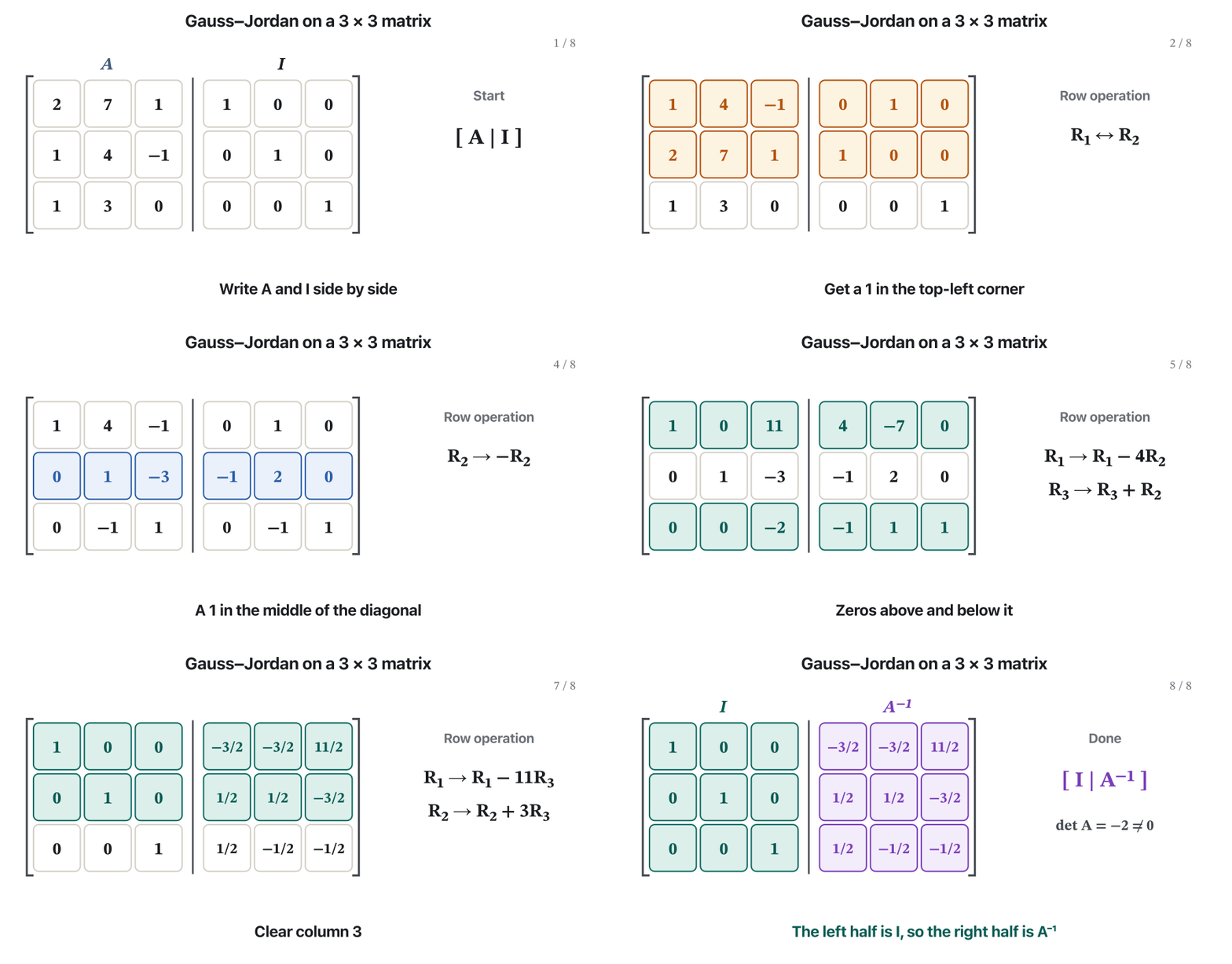
The notes' example: find A−1A^{-1} for A=[27114−1130]A = \begin{bmatrix} 2 & 7 & 1 \\ 1 & 4 & -1 \\ 1 & 3 & 0 \end{bmatrix}. Watch the left half turn into II while A−1A^{-1} appears on the right:

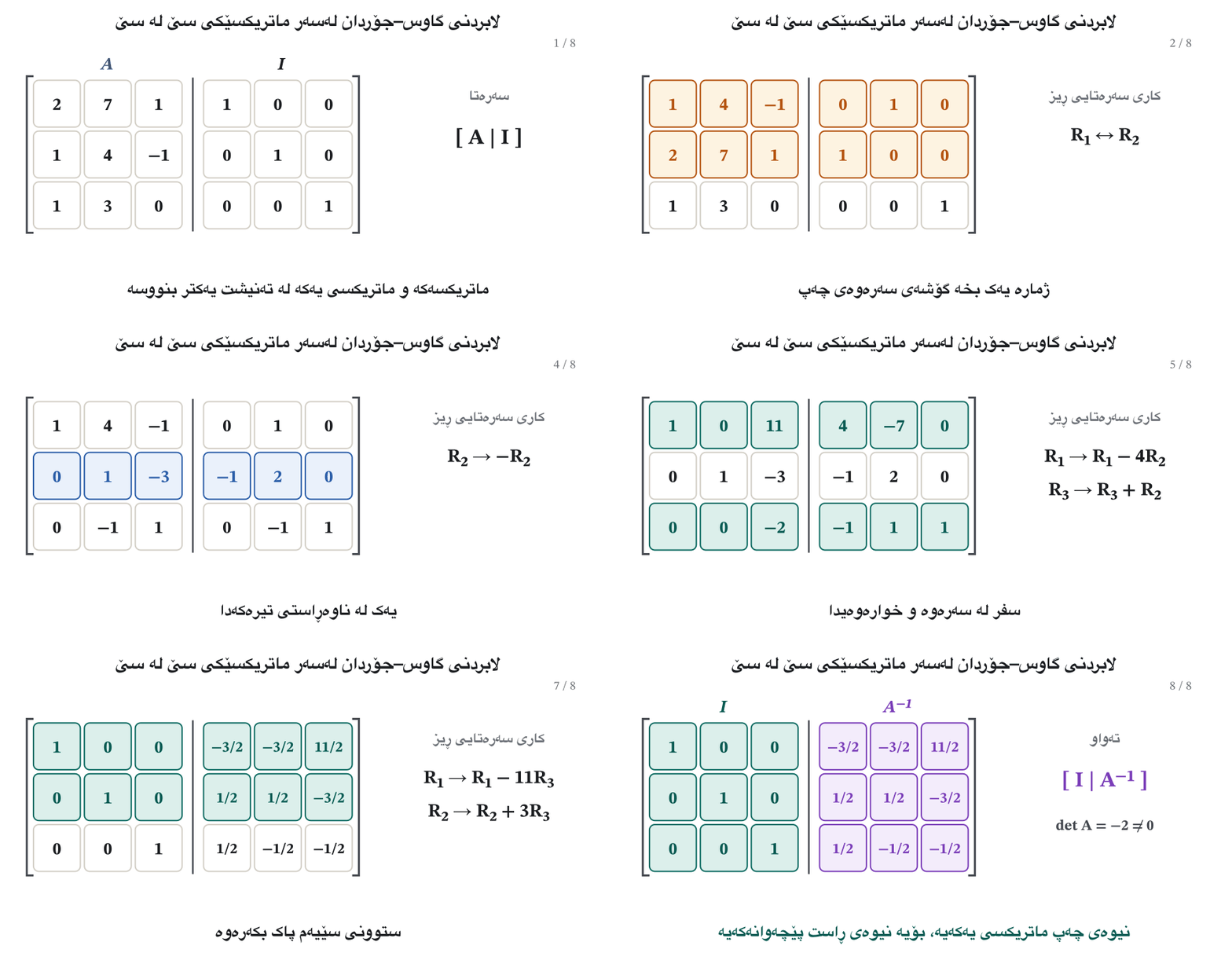
نموونەکەی تێبینییەکان: A−1A^{-1} بدۆزەرەوە بۆ A=[27114−1130]A = \begin{bmatrix} 2 & 7 & 1 \\ 1 & 4 & -1 \\ 1 & 3 & 0 \end{bmatrix}. سەیر بکە چۆن نیوەی چەپ دەبێتە II و A−1A^{-1} لە لای ڕاست دەردەکەوێت:

Eight frames of the augmented matrix [A | I] with A = rows (2, 7, 1), (1, 4, −1), (1, 3, 0). Each frame names the row operation and highlights the rows it changed: swap R1 and R2; R2 → R2 − 2R1 and R3 → R3 − R1; R2 → −R2; R1 → R1 − 4R2 and R3 → R3 + R2; R3 → −½R3; R1 → R1 − 11R3 and R2 → R2 + 3R3. In the last frame the left half is the identity matrix (green) and the right half (purple) is A⁻¹ with rows (−3/2, −3/2, 11/2), (1/2, 1/2, −3/2), (1/2, −1/2, −1/2).
Gauss–Jordan on [A∣I][A \mid I], one step per frame. لەسەر [A∣I][A \mid I]، هەر وێنەیەک یەک هەنگاو.CêIT
  1. Column 1ستوونی 1

    R1↔R2R_1 \leftrightarrow R_2 brings a 1 to the top; then R2→R2−2R1R_2 \to R_2 - 2R_1, R3→R3−R1R_3 \to R_3 - R_1.

    R1↔R2R_1 \leftrightarrow R_2 1 دەهێنێتە سەرەوە؛ پاشان R2→R2−2R1R_2 \to R_2 - 2R_1، R3→R3−R1R_3 \to R_3 - R_1.

    [14−10100−131−200−110−11]\left[\begin{array}{ccc|ccc} 1 & 4 & -1 & 0 & 1 & 0 \\ 0 & -1 & 3 & 1 & -2 & 0 \\ 0 & -1 & 1 & 0 & -1 & 1 \end{array}\right]
  2. Column 2ستوونی 2

    R2→−R2R_2 \to -R_2; then R1→R1−4R2R_1 \to R_1 - 4R_2, R3→R3+R2R_3 \to R_3 + R_2.

    R2→−R2R_2 \to -R_2؛ پاشان R1→R1−4R2R_1 \to R_1 - 4R_2، R3→R3+R2R_3 \to R_3 + R_2.

    [10114−7001−3−12000−2−111]\left[\begin{array}{ccc|ccc} 1 & 0 & 11 & 4 & -7 & 0 \\ 0 & 1 & -3 & -1 & 2 & 0 \\ 0 & 0 & -2 & -1 & 1 & 1 \end{array}\right]
  3. Column 3ستوونی 3

    R3→−12R3R_3 \to -\tfrac12 R_3; then R1→R1−11R3R_1 \to R_1 - 11R_3, R2→R2+3R3R_2 \to R_2 + 3R_3.

    R3→−12R3R_3 \to -\tfrac12 R_3؛ پاشان R1→R1−11R3R_1 \to R_1 - 11R_3، R2→R2+3R3R_2 \to R_2 + 3R_3.

    [100−32−321120101212−3200112−12−12]\left[\begin{array}{ccc|ccc} 1 & 0 & 0 & -\tfrac32 & -\tfrac32 & \tfrac{11}2 \\ 0 & 1 & 0 & \tfrac12 & \tfrac12 & -\tfrac32 \\ 0 & 0 & 1 & \tfrac12 & -\tfrac12 & -\tfrac12 \end{array}\right]
  4. Read the inverseپێچەوانەکە بخوێنەوە

    A−1=[−32−321121212−3212−12−12]=12[−3−31111−31−1−1]A^{-1} = \begin{bmatrix} -\frac32 & -\frac32 & \frac{11}2 \\ \frac12 & \frac12 & -\frac32 \\ \frac12 & -\frac12 & -\frac12 \end{bmatrix} = \frac12\begin{bmatrix} -3 & -3 & 11 \\ 1 & 1 & -3 \\ 1 & -1 & -1 \end{bmatrix}. Checked with sympy; det⁡A=−2\det A = -2.

    A−1=[−32−321121212−3212−12−12]=12[−3−31111−31−1−1]A^{-1} = \begin{bmatrix} -\frac32 & -\frac32 & \frac{11}2 \\ \frac12 & \frac12 & -\frac32 \\ \frac12 & -\frac12 & -\frac12 \end{bmatrix} = \frac12\begin{bmatrix} -3 & -3 & 11 \\ 1 & 1 & -3 \\ 1 & -1 & -1 \end{bmatrix}. بە sympy پشکنراوە؛ det⁡A=−2\det A = -2.

Quick checkپشکنینی خێراIn the first step, why swap R1R_1 and R2R_2?لە یەکەم هەنگاودا، بۆچی شوێنی R1R_1 و R2R_2 دەگۆڕینەوە؟

When there is no inverseکاتێک پێچەوانە نییە

If AA is singular, Gauss–Jordan tells you by itself: at some point a row of zeros appears in the left half. Then the left half can never become II, so there is no inverse. Example: S=[123253376]S = \begin{bmatrix} 1 & 2 & 3 \\ 2 & 5 & 3 \\ 3 & 7 & 6 \end{bmatrix} (R3=R1+R2R_3 = R_1 + R_2).

ئەگەر AA بێپێچەوانە بێت، خۆی پێت دەڵێت: لە شوێنێکدا ڕیزێکی سفر لە نیوەی چەپدا دەردەکەوێت. ئەوکات نیوەی چەپ هەرگیز نابێتە II، بۆیە پێچەوانە نییە. نموونە: S=[123253376]S = \begin{bmatrix} 1 & 2 & 3 \\ 2 & 5 & 3 \\ 3 & 7 & 6 \end{bmatrix} (R3=R1+R2R_3 = R_1 + R_2).

→R2−2R1,  R3−3R1[12310001−3−21001−3−301]→R3−R2[12310001−3−210000−1−11]\xrightarrow{R_2 - 2R_1,\; R_3 - 3R_1}\left[\begin{array}{ccc|ccc} 1 & 2 & 3 & 1 & 0 & 0 \\ 0 & 1 & -3 & -2 & 1 & 0 \\ 0 & 1 & -3 & -3 & 0 & 1 \end{array}\right]\xrightarrow{R_3 - R_2}\left[\begin{array}{ccc|ccc} 1 & 2 & 3 & 1 & 0 & 0 \\ 0 & 1 & -3 & -2 & 1 & 0 \\ 0 & 0 & 0 & -1 & -1 & 1 \end{array}\right]

Row 3 of the left half is (0,0,0)(0, 0, 0): stop — SS has no inverse. This agrees with the determinant test: det⁡S=0\det S = 0.

ڕیزی 3ی نیوەی چەپ (0,0,0)(0, 0, 0)ـە: بوەستە — SS پێچەوانەی نییە. ئەمە لەگەڵ تاقیکردنەوەی یەک دەگرێتەوە: det⁡S=0\det S = 0.

Quick checkپشکنینی خێراDuring Gauss–Jordan the left half shows the row (0,0,0)(0, 0, 0). What do you conclude?لە کاتی نیوەی چەپ ڕیزی (0,0,0)(0, 0, 0) پیشان دەدات. چ دەرئەنجامێک وەردەگریت؟

One matrix, two methodsیەک ماتریکس، دوو ڕێگە

The notes' homework uses the matrix of the inverse lesson's homework again, now by Gauss–Jordan. Do it, then compare with the adjugate answer.

ئەرکی تێبینییەکان هەمان ئەرکی وانەی پێچەوانە بەکاردەهێنێتەوە، ئەمجارە بە . بیکە و پاشان لەگەڵ وەڵامی بەراوردی بکە.

ExerciseڕاهێنانExercise: B−1B^{-1} by Gauss–Jordanڕاهێنان: B−1B^{-1} بە لابردنی گاوس–جۆردان

Find B−1B^{-1} for B=[123045106]B = \begin{bmatrix} 1 & 2 & 3 \\ 0 & 4 & 5 \\ 1 & 0 & 6 \end{bmatrix} by Gauss–Jordan.

B−1B^{-1} بدۆزەرەوە بۆ B=[123045106]B = \begin{bmatrix} 1 & 2 & 3 \\ 0 & 4 & 5 \\ 1 & 0 & 6 \end{bmatrix} بە .

Hintئاماژە

Start with R3→R3−R1R_3 \to R_3 - R_1: column 1 already has 1 and 0 above.

بە R3→R3−R1R_3 \to R_3 - R_1 دەست پێبکە: ستوونی 1 لە سەرەوە 1 و 0ـی هەیە.

Show answerوەڵامەکە پیشان بدە
→R3→R3−R1  [1231000450100−23−101]→R2→14R2  [123100015401400−23−101]→R1−2R2,  R3+2R2  [10121−1200154014000112−1121]→R3→211R3  [10121−12001540140001−211111211]→R1−12R3,  R2−54R3  [1001211−611−111010522322−522001−211111211]\begin{aligned} \xrightarrow{R_3 \to R_3 - R_1}\; &\left[\begin{array}{ccc|ccc} 1 & 2 & 3 & 1 & 0 & 0 \\ 0 & 4 & 5 & 0 & 1 & 0 \\ 0 & -2 & 3 & -1 & 0 & 1 \end{array}\right] \\ \xrightarrow{R_2 \to \frac14 R_2}\; &\left[\begin{array}{ccc|ccc} 1 & 2 & 3 & 1 & 0 & 0 \\ 0 & 1 & \tfrac54 & 0 & \tfrac14 & 0 \\ 0 & -2 & 3 & -1 & 0 & 1 \end{array}\right] \\ \xrightarrow{R_1 - 2R_2,\; R_3 + 2R_2}\; &\left[\begin{array}{ccc|ccc} 1 & 0 & \tfrac12 & 1 & -\tfrac12 & 0 \\ 0 & 1 & \tfrac54 & 0 & \tfrac14 & 0 \\ 0 & 0 & \tfrac{11}2 & -1 & \tfrac12 & 1 \end{array}\right] \\ \xrightarrow{R_3 \to \frac{2}{11} R_3}\; &\left[\begin{array}{ccc|ccc} 1 & 0 & \tfrac12 & 1 & -\tfrac12 & 0 \\ 0 & 1 & \tfrac54 & 0 & \tfrac14 & 0 \\ 0 & 0 & 1 & -\tfrac{2}{11} & \tfrac{1}{11} & \tfrac{2}{11} \end{array}\right] \\ \xrightarrow{R_1 - \frac12 R_3,\; R_2 - \frac54 R_3}\; &\left[\begin{array}{ccc|ccc} 1 & 0 & 0 & \tfrac{12}{11} & -\tfrac{6}{11} & -\tfrac{1}{11} \\ 0 & 1 & 0 & \tfrac{5}{22} & \tfrac{3}{22} & -\tfrac{5}{22} \\ 0 & 0 & 1 & -\tfrac{2}{11} & \tfrac{1}{11} & \tfrac{2}{11} \end{array}\right] \end{aligned}

So B−1=122[24−12−253−5−424]B^{-1} = \frac{1}{22}\begin{bmatrix} 24 & -12 & -2 \\ 5 & 3 & -5 \\ -4 & 2 & 4 \end{bmatrix} — exactly the adjugate answer. The adjugate needed one 3×33 \times 3 and nine 2×22 \times 2 determinants; Gauss–Jordan needed seven row operations.

کەواتە B−1=122[24−12−253−5−424]B^{-1} = \frac{1}{22}\begin{bmatrix} 24 & -12 & -2 \\ 5 & 3 & -5 \\ -4 & 2 & 4 \end{bmatrix} — ڕێک وەڵامی . پێویستی بە یەک 3×33 \times 3 و نۆ 2×22 \times 2 بوو؛ پێویستی بە حەوت بوو.

Which method when?کام ڕێگە و کەی؟

MethodڕێگەBest forباشترین بۆWorkکار
Shortcutڕێگە کورتەکە2×22 \times 2 onlyتەنها 2×22 \times 2One determinant, swap, change two signsیەک ، گۆڕینەوە، گۆڕینی دوو هێما
Adjugateڕێگەی ئەدجوگەیتSmall 3×33 \times 3 by hand; a formula for every entry3×33 \times 3ـی بچووک بە دەست؛ بۆ هەر ژمارەیەکFor n×nn \times n: n2n^2 cofactors, each a determinant of size n−1n - 1 — grows very fastبۆ n×nn \times n: n2n^2 ، هەریەکەیان بە قەبارەی n−1n - 1 — زۆر خێرا گەورە دەبێت
Gauss–Jordan3×33 \times 3 and bigger; also shows at once when there is no inverse3×33 \times 3 و گەورەتر؛ یەکسەریش پیشان دەدات کاتێک پێچەوانە نییەAbout n3n^3 steps: what computers useنزیکەی n3n^3 هەنگاو: ئەوەی بەکاری دەهێنێت
Quick checkپشکنینی خێراYou must invert a 5×55 \times 5 matrix by hand. Which method is the least work?دەبێت پێچەوانەی 5×55 \times 5 بە دەست بدۆزیتەوە. کام ڕێگە کەمترین کاری هەیە؟

In computing: rref and invلە کۆمپیوتەردا: rref و inv

Common mistakesهەڵە باوەکان

MistakeهەڵەWhat is trueڕاستییەکە
Changing only the left half of a rowگۆڕینی تەنها نیوەی چەپی ڕیزێکEvery operation acts on the whole row, both halves.هەموو کارێک لەسەر هەموو ڕیزەکە کار دەکات، هەردوو نیوە.
Multiplying a row by 0لێکدانی ڕیزێک لە 0Not allowed: it cannot be undone. Use k≠0k \ne 0.ڕێگەپێدراو نییە: ناگەڕێتەوە. k≠0k \ne 0 بەکاربهێنە.
R2→3R2−R1R_2 \to 3R_2 - R_1 in one stepR2→3R2−R1R_2 \to 3R_2 - R_1 لە یەک هەنگاوداAllowed for the inverse (it is two operations), but keep track; for determinants it multiplies by 3.بۆ پێچەوانە ڕێگەپێدراوە (دوو کارە)، بەڵام ئاگات لێ بێت؛ بۆ لە 3 دەدات.
Using an old row after it changedبەکارهێنانی ڕیزێکی کۆن دوای گۆڕانیAlways use the current rows; write the matrix again after each step.هەمیشە ڕیزە ئێستاییەکان بەکاربهێنە؛ دوای هەر هەنگاوێک دووبارە بنووسەوە.
Reading A−1A^{-1} before the left half is exactly IIخوێندنەوەی A−1A^{-1} پێش ئەوەی نیوەی چەپ ڕێک II بێتFinish every column, above and below the diagonal.هەموو ستوونێک تەواو بکە، لە سەرەوە و خوارەوەی تیرەکە.
Ignoring a zero row on the leftپشتگوێخستنی ڕیزێکی سفر لە لای چەپIt means the matrix is singular: there is no inverse.واتە : پێچەوانە نییە.

Exercisesڕاهێنانەکان

ExerciseڕاهێنانExercise 1 (notes' homework): both waysڕاهێنانی 1 (ئەرکی تێبینییەکان): بە هەردوو ڕێگە

Find A−1A^{-1} for A=[4332]A = \begin{bmatrix} 4 & 3 \\ 3 & 2 \end{bmatrix} (1) by Gauss–Jordan and (2) by the shortcut.

A−1A^{-1} بدۆزەرەوە بۆ A=[4332]A = \begin{bmatrix} 4 & 3 \\ 3 & 2 \end{bmatrix} ⁦(1)⁩ بە و ⁦(2)⁩ بە ڕێگە کورتەکە.

Show answerوەڵامەکە پیشان بدە
(1)  [43103201]→R1−R2[111−13201]→R2−3R1[111−10−1−34](1)  →−R2[111−1013−4]→R1−R2[10−23013−4](2)  det⁡A=8−9=−1,A−1=1−1[2−3−34]=[−233−4]\begin{aligned} &(1)\; \left[\begin{array}{cc|cc} 4 & 3 & 1 & 0 \\ 3 & 2 & 0 & 1 \end{array}\right]\xrightarrow{R_1 - R_2}\left[\begin{array}{cc|cc} 1 & 1 & 1 & -1 \\ 3 & 2 & 0 & 1 \end{array}\right]\xrightarrow{R_2 - 3R_1}\left[\begin{array}{cc|cc} 1 & 1 & 1 & -1 \\ 0 & -1 & -3 & 4 \end{array}\right] \\ &\phantom{(1)\;}\xrightarrow{-R_2}\left[\begin{array}{cc|cc} 1 & 1 & 1 & -1 \\ 0 & 1 & 3 & -4 \end{array}\right]\xrightarrow{R_1 - R_2}\left[\begin{array}{cc|cc} 1 & 0 & -2 & 3 \\ 0 & 1 & 3 & -4 \end{array}\right] \\ &(2)\; \det A = 8 - 9 = -1,\quad A^{-1} = \frac{1}{-1}\begin{bmatrix} 2 & -3 \\ -3 & 4 \end{bmatrix} = \begin{bmatrix} -2 & 3 \\ 3 & -4 \end{bmatrix} \end{aligned}
ExerciseڕاهێنانExercise 2: a new 3×33 \times 3ڕاهێنانی 2: ماتریکسێکی 3×33 \times 3ی نوێ

Find the inverse of N=[102213011]N = \begin{bmatrix} 1 & 0 & 2 \\ 2 & 1 & 3 \\ 0 & 1 & 1 \end{bmatrix} by Gauss–Jordan.

پێچەوانەی N=[102213011]N = \begin{bmatrix} 1 & 0 & 2 \\ 2 & 1 & 3 \\ 0 & 1 & 1 \end{bmatrix} بە بدۆزەرەوە.

Show answerوەڵامەکە پیشان بدە
→R2−2R1  [10210001−1−210011001]→R3−R2  [10210001−1−2100022−11]→12R3  [10210001−1−2100011−1212]→R1−2R3,  R2+R3  [100−11−1010−112120011−1212]\begin{aligned} \xrightarrow{R_2 - 2R_1}\; &\left[\begin{array}{ccc|ccc} 1 & 0 & 2 & 1 & 0 & 0 \\ 0 & 1 & -1 & -2 & 1 & 0 \\ 0 & 1 & 1 & 0 & 0 & 1 \end{array}\right] \\ \xrightarrow{R_3 - R_2}\; &\left[\begin{array}{ccc|ccc} 1 & 0 & 2 & 1 & 0 & 0 \\ 0 & 1 & -1 & -2 & 1 & 0 \\ 0 & 0 & 2 & 2 & -1 & 1 \end{array}\right] \\ \xrightarrow{\frac12 R_3}\; &\left[\begin{array}{ccc|ccc} 1 & 0 & 2 & 1 & 0 & 0 \\ 0 & 1 & -1 & -2 & 1 & 0 \\ 0 & 0 & 1 & 1 & -\tfrac12 & \tfrac12 \end{array}\right] \\ \xrightarrow{R_1 - 2R_3,\; R_2 + R_3}\; &\left[\begin{array}{ccc|ccc} 1 & 0 & 0 & -1 & 1 & -1 \\ 0 & 1 & 0 & -1 & \tfrac12 & \tfrac12 \\ 0 & 0 & 1 & 1 & -\tfrac12 & \tfrac12 \end{array}\right] \end{aligned}

det⁡N=2\det N = 2, and the right half is N−1N^{-1} (checked with sympy).

det⁡N=2\det N = 2 و نیوەی ڕاست N−1N^{-1}ـە (بە sympy پشکنراوە).

ExerciseڕاهێنانExercise 3: inverse or not?ڕاهێنانی 3: پێچەوانەی هەیە یان نا؟

Use Gauss–Jordan on Q=[12−1241360]Q = \begin{bmatrix} 1 & 2 & -1 \\ 2 & 4 & 1 \\ 3 & 6 & 0 \end{bmatrix}. What happens?

لەسەر Q=[12−1241360]Q = \begin{bmatrix} 1 & 2 & -1 \\ 2 & 4 & 1 \\ 3 & 6 & 0 \end{bmatrix} بەکاربهێنە. چی ڕوودەدات؟

Show answerوەڵامەکە پیشان بدە

After R2→R2−2R1R_2 \to R_2 - 2R_1 and R3→R3−3R1R_3 \to R_3 - 3R_1 the left half is [12−1003003]\begin{bmatrix} 1 & 2 & -1 \\ 0 & 0 & 3 \\ 0 & 0 & 3 \end{bmatrix}: column 2 has no non-zero entry below row 1, and R3→R3−R2R_3 \to R_3 - R_2 gives a zero row. QQ is singular (det⁡Q=0\det Q = 0: column 2 is twice column 1).

دوای R2→R2−2R1R_2 \to R_2 - 2R_1 و R3→R3−3R1R_3 \to R_3 - 3R_1 نیوەی چەپ [12−1003003]\begin{bmatrix} 1 & 2 & -1 \\ 0 & 0 & 3 \\ 0 & 0 & 3 \end{bmatrix}ـە: ستوونی 2 لە ژێر ڕیزی 1دا هیچ ژمارەیەکی ناسفری نییە و R3→R3−R2R_3 \to R_3 - R_2 ڕیزێکی سفر دەدات. QQ (det⁡Q=0\det Q = 0: ستوونی 2 دوو هێندەی ستوونی 1ە).

ExerciseڕاهێنانExercise 4: spot the mistakeڕاهێنانی 4: هەڵەکە بدۆزەرەوە

Soran started with [12103401]\left[\begin{array}{cc|cc} 1 & 2 & 1 & 0 \\ 3 & 4 & 0 & 1 \end{array}\right] and wrote, after R2→R2−3R1R_2 \to R_2 - 3R_1, the row (0,−2∣0,1)(0, -2 \mid 0, 1). What went wrong?

سۆران بە [12103401]\left[\begin{array}{cc|cc} 1 & 2 & 1 & 0 \\ 3 & 4 & 0 & 1 \end{array}\right] دەستی پێکرد و دوای R2→R2−3R1R_2 \to R_2 - 3R_1 ڕیزی (0,−2∣0,1)(0, -2 \mid 0, 1)ـی نووسی. چی هەڵە بوو؟

Show answerوەڵامەکە پیشان بدە

He changed only the left half. The right half also changes: (0,1)−3(1,0)=(−3,1)(0, 1) - 3(1, 0) = (-3, 1), so the row is (0,−2∣−3,1)(0, -2 \mid -3, 1).

تەنها نیوەی چەپی گۆڕی. نیوەی ڕاستیش دەگۆڕێت: (0,1)−3(1,0)=(−3,1)(0, 1) - 3(1, 0) = (-3, 1)، بۆیە ڕیزەکە (0,−2∣−3,1)(0, -2 \mid -3, 1)ـە.

Summaryپوختە

  • Three elementary row operations: swap Ri↔RjR_i \leftrightarrow R_j, scale Ri→kRiR_i \to kR_i (k≠0k \ne 0), replace Ri→Ri+kRjR_i \to R_i + kR_j. Each can be undone.
  • Gauss–Jordan: [A∣I]→[I∣A−1][A \mid I] \to [I \mid A^{-1}] — whatever happens on the left happens on the right.
  • Column by column: a 1 on the diagonal, then zeros above and below.
  • A zero row on the left means the matrix is singular.
  • Shortcut for 2×22 \times 2, adjugate for small 3×33 \times 3, Gauss–Jordan for bigger matrices and for computers.
  • سێ : گۆڕینەوە Ri↔RjR_i \leftrightarrow R_j، لێکدان Ri→kRiR_i \to kR_i (k≠0k \ne 0)، گۆڕین Ri→Ri+kRjR_i \to R_i + kR_j. هەریەکەیان دەگەڕێتەوە.
  • : [A∣I]→[I∣A−1][A \mid I] \to [I \mid A^{-1}] — هەرچی لە چەپ ڕووبدات لە ڕاستیش ڕوودەدات.
  • ستوون بە ستوون: 1 لەسەر تیرە، پاشان سفر لە سەرەوە و خوارەوە.
  • ڕیزێکی سفر لە لای چەپ واتە .
  • ڕێگە کورتەکە بۆ 2×22 \times 2، بۆ 3×33 \times 3ـی بچووک، بۆ گەورەتر و بۆ .
Review questionsپرسیارەکانی پێداچوونەوە
Why does doing the same operations to II give A−1A^{-1}?بۆچی هەمان کارەکان لەسەر II A−1A^{-1} دەدەن؟

The operations together act like one matrix EE with EA=IEA = I, so E=A−1E = A^{-1}; applied to II they give EI=A−1EI = A^{-1}.

کارەکان پێکەوە وەک یەک EE کار دەکەن کە EA=IEA = I، بۆیە E=A−1E = A^{-1}؛ لەسەر II EI=A−1EI = A^{-1} دەدەن.

Do different choices of steps give different inverses?ئایا هەڵبژاردنی هەنگاوی جیاواز پێچەوانەی جیاواز دەدات؟

No. The path can differ, but a matrix has only one inverse, so every correct path ends at the same A−1A^{-1}.

نەخێر. ڕێگەکە دەشێت جیاواز بێت، بەڵام تەنها یەک پێچەوانەی هەیە، بۆیە هەموو ڕێگەیەکی ڕاست بە هەمان A−1A^{-1} کۆتایی دێت.

Next: Partitioned (Block) Matrices — the chapter's advanced lesson, with Method 4 of the notes.

دواتر: ماتریکسە بلۆکییەکان — وانەی پێشکەوتووی ئەم بەشە، لەگەڵ ڕێگەی 4ی تێبینییەکان.

Lesson complete!وانەکە تەواو بوو!

Well done. Review the key terms, then go on to the next lesson.دەستخۆش. سەیرێکی زاراوە سەرەکییەکان بکەرەوە، پاشان بڕۆ بۆ وانەی داهاتوو.

Key termsزاراوە سەرەکییەکان

Next lessonوانەی داهاتوو

Partitioned (Block) Matricesماتریکسە بلۆکییەکان

References and further readingسەرچاوەکان و خوێندنەوەی زیاتر

This lecture is a first edition. The Kurdish text and terminology are waiting for review by Kurdish IT teachers.ئەم وانەیە چاپی یەکەمە. دەقە کوردییەکە و زاراوەکانی چاوەڕێی پێداچوونەوەی مامۆستایانی کوردی بواری IT ن.