Chapterبەش 5 · Lectureوانە 5.3

Adding, Subtracting, Multiplying and Dividing Functionsکۆکردنەوە، لێدەرکردن، لێکدان و دابەشکردنی نەخشەکان

Building f+gf+g, f−gf-g, f⋅gf\cdot g and f/gf/g from two functions, finding their domains (the intersection of the domains, minus the zeros of the denominator), the worked example of the notes and both homework sets with answers.

دروستکردنی f+gf+g، f−gf-g، f⋅gf\cdot g و f/gf/g لە دوو ، دۆزینەوەی ( ، جگە لە سفرەکانی )، نموونە چارەسەرکراوەکەی تێبینییەکان و هەردوو ئەرکی ماڵەوە لەگەڵ وەڵامەکانیان.

6 min read7 خولەک خوێندنەوە · 11 stepsهەنگاو

What you will learnچی فێر دەبیت

  • Build f+gf+g, f−gf-g, f⋅gf\cdot g and fg\frac fg from two functions and evaluate them.
  • Find their domains: Df∩DgD_f\cap D_g, and for a quotient also remove the zeros of the denominator.
  • Avoid reading a domain from a simplified formula.
  • f+gf+g، f−gf-g، f⋅gf\cdot g و fg\frac fg لە دوو دروست بکە و بەهاکانیان بدۆزەرەوە.
  • بدۆزەرەوە: Df∩DgD_f\cap D_g. بۆ دابەشکردن هەروەها سفرەکانی لاببە.
  • لە خوێندنەوەی لە فۆرمولەیەکی سادەکراوەوە خۆت بپارێزە.

New functions from old onesنەخشەیەکی نوێ لە دوو نەخشەی کۆنەوە

Two functions that work on the same numbers can be combined into a new one. You simply do the arithmetic on their outputs. A tea house is a good example. If it sells x glasses of tea a day, its income and its costs (in dinars) are

دوو کە لەسەر هەمان ژمارەکان کار دەکەن دەتوانرێن تێکەڵ بکرێن و نوێ دروست بکەن. تەنها ژمێرکاری لەسەر دەکەیت. چایخانەیەک نموونەیەکی باشە. ئەگەر ڕۆژانە x پەرداخ چا بفرۆشێت، داهات و تێچووەکەی (بە دینار) ئەمانەن

I(x)=500x,C(x)=20 000+150xI(x)=500x,\qquad C(x)=20\,000+150x

The profit is a new function, the difference of the two:

قازانج نوێیە، جیاوازیی ئەو دووانە:

P(x)=(I−C)(x)=I(x)−C(x)=500x−(20 000+150x)=350x−20 000P(x)=(I-C)(x)=I(x)-C(x)=500x-(20\,000+150x)=350x-20\,000

At 100 glasses the profit is 350⋅100−20 000=15 000350\cdot100-20\,000=15\,000 dinars. The tea house needs at least 58 glasses to make a profit, because 350x>20 000350x>20\,000 means x>57.1x>57.1.

بە ⁦100⁩ پەرداخ قازانجەکە 350⋅100−20 000=15 000350\cdot100-20\,000=15\,000 دینارە. چایخانەکە لانیکەم ⁦58⁩ پەرداخی پێویستە بۆ ئەوەی قازانج بکات، چونکە 350x>20 000350x>20\,000 واتە x>57.1x>57.1.

Two price listsدوو لیستی نرخ

Think of f and g as two price lists in the bazaar that both list the same items. (f+g)(x)(f+g)(x) is "look up x in both lists and add the two prices". You can only do that for an item that appears in both lists.

f و g وەک دوو لیستی نرخی بازاڕ وێنا بکە کە هەردووکیان هەمان کاڵا دەژمێرن. (f+g)(x)(f+g)(x) واتە «x لە هەردوو لیستەکەدا بدۆزەرەوە و دوو نرخەکە کۆ بکەرەوە». تەنها بۆ کاڵایەک دەتوانیت ئەمە بکەیت کە لە هەردوو لیستەکەدا هەبێت.

Where the analogy stops workingسنووری ئەم نموونەیە

For a quotient there is one more condition: you cannot divide by a price of 0.

بۆ دابەشکردن مەرجێکی تر هەیە: ناتوانیت لەسەر نرخی 0 دابەش بکەیت.

Quick checkپشکنینی خێراFor the tea house, what is P(200)P(200)?بۆ چایخانەکە P(200)P(200) چەندە؟

The four operationsکۆکردنەوە، لێدەرکردن، لێکدان و دابەشکردن

The notes define the four operations for two functions f and g:

تێبینییەکان کۆکردنەوە، لێدەرکردن، لێکدان و دابەشکردن بۆ دوو f و g پێناسە دەکەن:

(f+g)(x)=f(x)+g(x)(f−g)(x)=f(x)−g(x)(f⋅g)(x)=f(x)⋅g(x)(fg)(x)=f(x)g(x),g(x)≠0\begin{aligned}(f+g)(x)&=f(x)+g(x)\\(f-g)(x)&=f(x)-g(x)\\(f\cdot g)(x)&=f(x)\cdot g(x)\\\left(\frac fg\right)(x)&=\frac{f(x)}{g(x)},\quad g(x)\ne0\end{aligned}

Example: f(x)=x2f(x)=x^2 and g(x)=x+1g(x)=x+1. At x=2x=2 we have f(2)=4f(2)=4 and g(2)=3g(2)=3, so:

نموونە: f(x)=x2f(x)=x^2 و g(x)=x+1g(x)=x+1. لە x=2x=2ـدا f(2)=4f(2)=4 و g(2)=3g(2)=3، بۆیە:

New function نوێFormulaفۆرمولەAt x=2x=2لە x=2x=2ـدا
f+gf+gx2+x+1x^2+x+14+3=74+3=7
f−gf-gx2−x−1x^2-x-14−3=14-3=1
f⋅gf\cdot gx3+x2x^3+x^24⋅3=124\cdot3=12
fg\frac fgx2x+1, x≠−1\frac{x^2}{x+1},\ x\ne-143\frac43
Quick checkپشکنینی خێراWith f(x)=x2f(x)=x^2 and g(x)=x+1g(x)=x+1, what is (f⋅g)(−2)(f\cdot g)(-2)?بە f(x)=x2f(x)=x^2 و g(x)=x+1g(x)=x+1، (f⋅g)(−2)(f\cdot g)(-2) چەندە؟

The four operationsکۆکردنەوە، لێدەرکردن، لێکدان و دابەشکردن

A sum, point by pointکۆ، خاڵ بە خاڵ

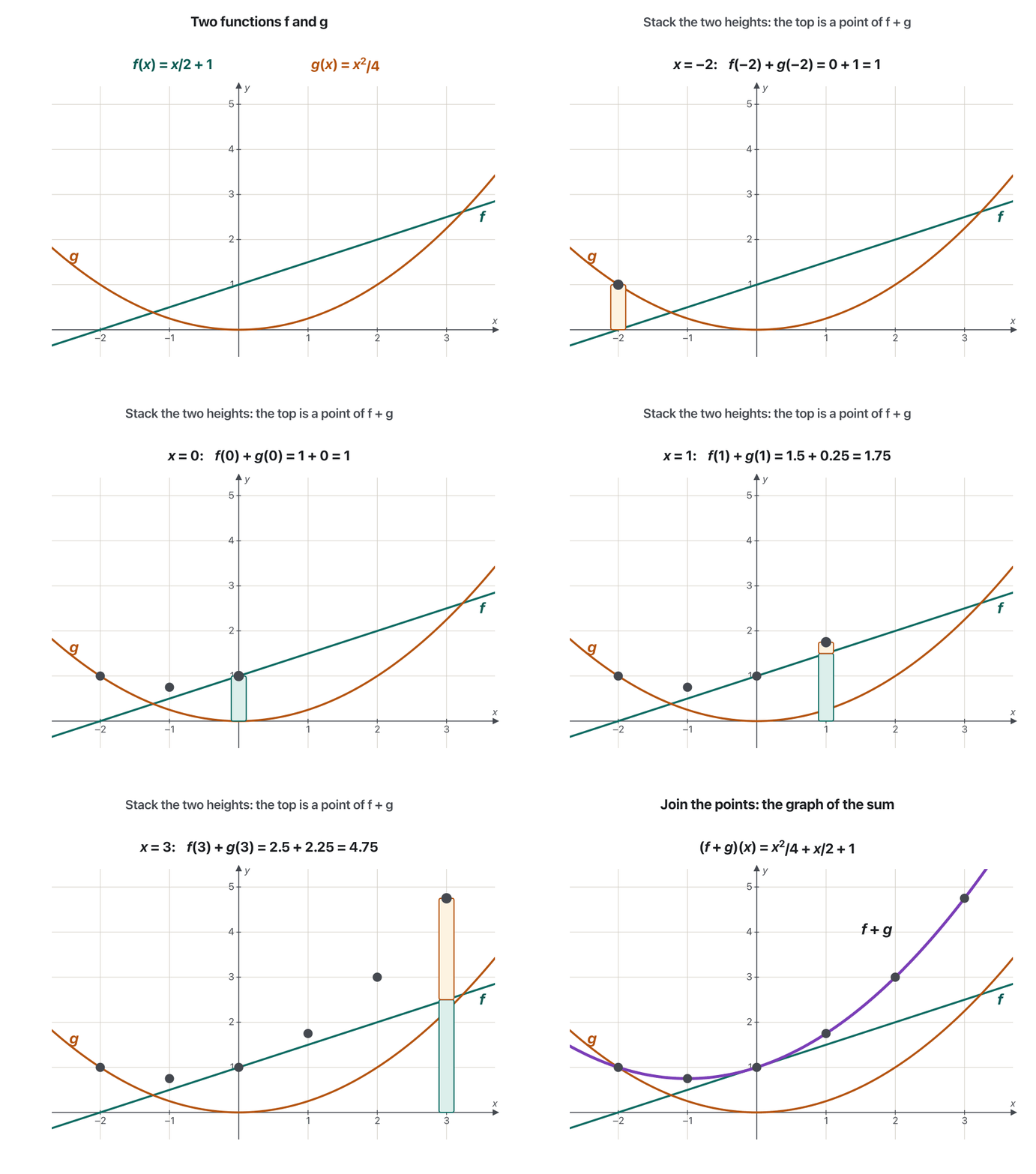
The graph of f+gf+g is built by adding heights. At every x, put the height g(x)g(x) on top of the height f(x)f(x); the top is a point of f+gf+g:

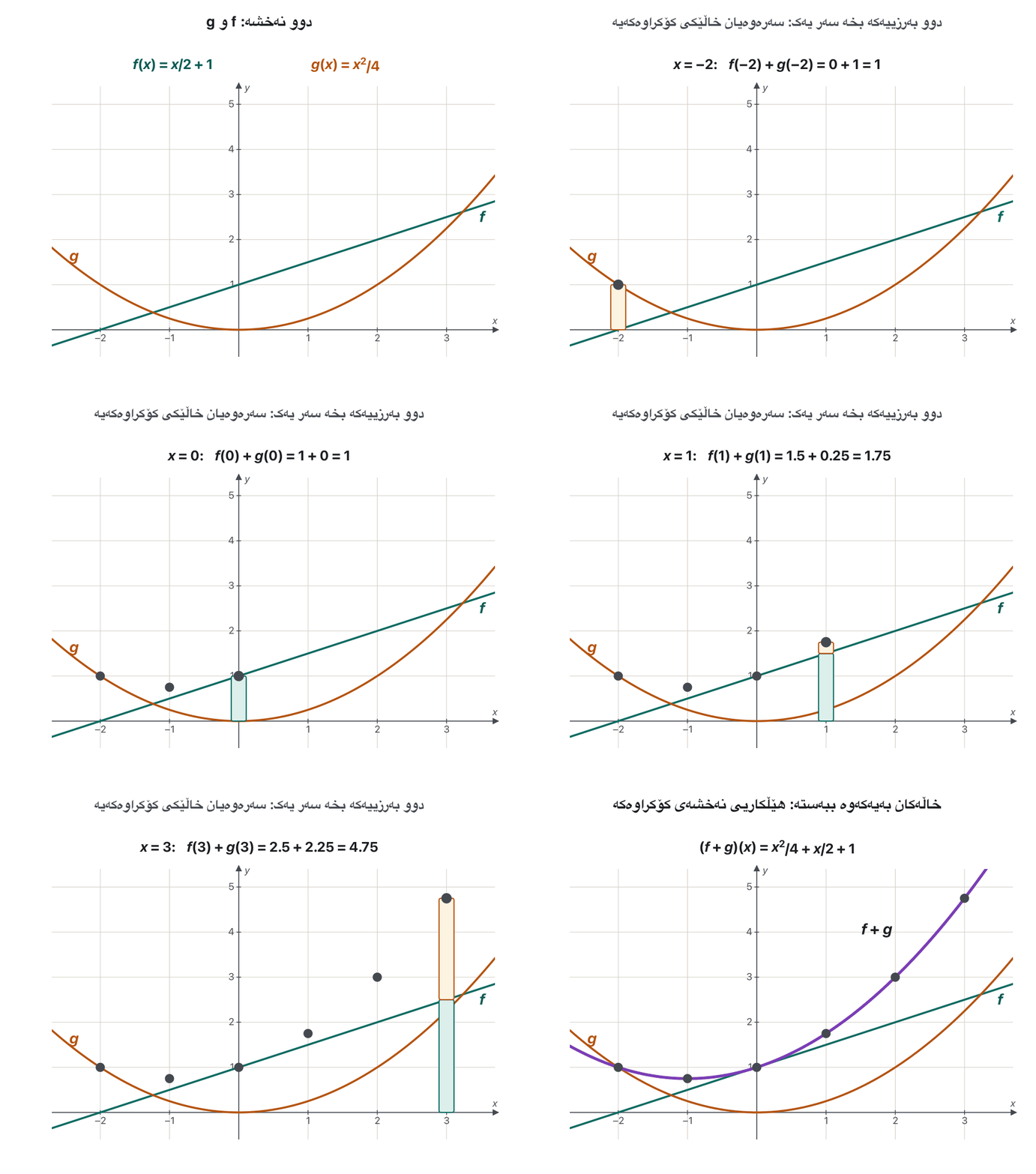
f+gf+g بە کۆکردنەوەی بەرزییەکان دروست دەبێت. لە هەر xێکدا بەرزیی g(x)g(x) بخە سەر بەرزیی f(x)f(x)؛ سەرەوەیان خاڵێکی f+gf+gـە:

Animation: the line f(x) = x/2 + 1 and the parabola g(x) = x squared over 4 are drawn. For x = −2, −1, 0, 1, 2 and 3 in turn, a green bar of height f(x) and an orange bar of height g(x) are stacked, and the top of the stack is marked: 1, 0.75, 1, 1.75, 3 and 4.75. Finally the marked points are joined into the purple curve f + g, which is x squared over 4 plus x over 2 plus 1.
Stacking f(x)f(x) and g(x)g(x) gives the points of f+gf+g.خستنە سەر یەکی f(x)f(x) و g(x)g(x) خاڵەکانی f+gf+g دەدات.CêIT
Quick checkپشکنینی خێراAt x=2x=2 the GIF stacks f(2)=2f(2)=2 and g(2)=1g(2)=1. Which point of f+gf+g does it mark?لە x=2x=2ـدا GIFـەکە f(2)=2f(2)=2 و g(2)=1g(2)=1 دەخاتە سەر یەک. کام خاڵی f+gf+g نیشان دەکات؟

Domains of f+gf+g, f−gf-g, f⋅gf\cdot g and f/gf/gبواری f+gf+g، f−gf-g، f⋅gf\cdot g و f/gf/g

To compute f(x)+g(x)f(x)+g(x) you need both values, so x must lie in both domains. For a quotient, the denominator g(x)g(x) must also not be 0. The notes write this as:

بۆ ژماردنی f(x)+g(x)f(x)+g(x) پێویستت بە هەردوو بەهاکەیە، بۆیە x دەبێت لە هەردوو بێت. بۆ دابەشکردن، g(x)g(x)ـیش نابێت 0 بێت. تێبینییەکان ئەمە وا دەنووسن:

D(f+g)=D(f−g)=D(f⋅g)=Df∩Dg,D ⁣(fg)=Df∩Dg−{x∣g(x)=0}D(f+g)=D(f-g)=D(f\cdot g)=D_f\cap D_g,\qquad D\!\left(\frac fg\right)=D_f\cap D_g-\{x\mid g(x)=0\}

∩\cap is the intersection of the two domains: the numbers that are in both.

∩\cap یەکتربڕینی دوو : ئەو ژمارانەی لە هەردووکیاندان.

Small example: f(x)=xf(x)=\sqrt x with Df=[0,∞)D_f=[0,\infty) and g(x)=x−3g(x)=x-3 with Dg=RD_g=\mathbb{R}. Then D(f+g)=[0,∞)D(f+g)=[0,\infty). For fg\frac fg we also remove x=3x=3, where g(3)=0g(3)=0: D ⁣(fg)=[0,3)∪(3,∞)D\!\left(\frac fg\right)=[0,3)\cup(3,\infty).

نموونەیەکی بچووک: f(x)=xf(x)=\sqrt x بە Df=[0,∞)D_f=[0,\infty) و g(x)=x−3g(x)=x-3 بە Dg=RD_g=\mathbb{R}. ئەو کاتە D(f+g)=[0,∞)D(f+g)=[0,\infty). بۆ fg\frac fg هەروەها x=3x=3 لادەبەین، کە لەوێدا g(3)=0g(3)=0: D ⁣(fg)=[0,3)∪(3,∞)D\!\left(\frac fg\right)=[0,3)\cup(3,\infty).

Quick checkپشکنینی خێراDf=[−1,∞)D_f=[-1,\infty) and Dg=(−∞,3]D_g=(-\infty,3]. What is D(f−g)D(f-g)?Df=[−1,∞)D_f=[-1,\infty) و Dg=(−∞,3]D_g=(-\infty,3]. D(f−g)D(f-g) چییە؟

Worked example: f(x)=x3f(x)=x^3, g(x)=x2−4g(x)=\sqrt{x^2-4}نموونەی چارەسەرکراو: f(x)=x3f(x)=x^3، g(x)=x2−4g(x)=\sqrt{x^2-4}

The example in the notes: let f(x)=x3f(x)=x^3 and g(x)=x2−4g(x)=\sqrt{x^2-4}. Find (f+g)(x)(f+g)(x), (f−g)(x)(f-g)(x), (f⋅g)(x)(f\cdot g)(x), (f/g)(x)(f/g)(x), ((4f)+(10g))(x)((4f)+(10g))(x) and ((2g)−f)(x)((2g)-f)(x). The notes give no answers; here they are with their domains.

نموونەکەی تێبینییەکان: با f(x)=x3f(x)=x^3 و g(x)=x2−4g(x)=\sqrt{x^2-4}. (f+g)(x)(f+g)(x)، (f−g)(x)(f-g)(x)، (f⋅g)(x)(f\cdot g)(x)، (f/g)(x)(f/g)(x)، ((4f)+(10g))(x)((4f)+(10g))(x) و ((2g)−f)(x)((2g)-f)(x) بدۆزەرەوە. تێبینییەکان وەڵام نادەن؛ ئەمانە وەڵامەکانن لەگەڵ .

Six combinations of f and gشەش تێکەڵەی f و g
  1. Domain of each functionبواری هەر نەخشەیەک

    x3x^3 works for every x: Df=RD_f=\mathbb{R}. The square root needs x2−4≥0x^2-4\ge0, a quadratic inequality: (x−2)(x+2)≥0(x-2)(x+2)\ge0.

    x3x^3 بۆ هەموو xێک کار دەکات: Df=RD_f=\mathbb{R}. پێویستی بە x2−4≥0x^2-4\ge0 هەیە، لاسەنگەیەکی پلەدوو: (x−2)(x+2)≥0(x-2)(x+2)\ge0.

    Dg=(−∞,−2]∪[2,∞)D_g=(-\infty,-2]\cup[2,\infty)
  2. Sum, difference, productکۆ، جیاوازی، لێکدان

    The formulas come straight from the definitions, and the domain is Df∩Dg=DgD_f\cap D_g=D_g:

    فۆرمولەکان ڕاستەوخۆ لە پێناسەکانەوە دێن و Df∩Dg=DgD_f\cap D_g=D_gـە:

    (f+g)(x)=x3+x2−4(f−g)(x)=x3−x2−4(f⋅g)(x)=x3x2−4D=(−∞,−2]∪[2,∞)\begin{aligned}(f+g)(x)&=x^3+\sqrt{x^2-4}\\(f-g)(x)&=x^3-\sqrt{x^2-4}\\(f\cdot g)(x)&=x^3\sqrt{x^2-4}\end{aligned}\qquad D=(-\infty,-2]\cup[2,\infty)
  3. Quotientدابەشکردن

    g(x)=0g(x)=0 when x2−4=0x^2-4=0, that is at x=±2x=\pm2. Remove both from the domain:

    g(x)=0g(x)=0 کاتێک x2−4=0x^2-4=0، واتە لە x=±2x=\pm2. هەردووکیان لە لاببە:

    (fg)(x)=x3x2−4,D=(−∞,−2)∪(2,∞)\left(\frac fg\right)(x)=\frac{x^3}{\sqrt{x^2-4}},\qquad D=(-\infty,-2)\cup(2,\infty)
  4. Constant multiplesلێکدان لە نەگۆڕێک

    Multiply first, then add or subtract. The domain stays DgD_g:

    یەکەم لێکیان بدە، پاشان کۆ یان لێدەرکردن بکە. هەر DgD_g دەمێنێتەوە:

    ((4f)+(10g))(x)=4x3+10x2−4((2g)−f)(x)=2x2−4−x3\begin{aligned}((4f)+(10g))(x)&=4x^3+10\sqrt{x^2-4}\\((2g)-f)(x)&=2\sqrt{x^2-4}-x^3\end{aligned}

Check two values: (f+g)(−3)=−27+5≈−24.76(f+g)(-3)=-27+\sqrt5\approx-24.76 and (fg)(3)=275≈12.07\left(\frac fg\right)(3)=\frac{27}{\sqrt5}\approx12.07. At x=1x=1 none of them exists, because 1−4=−3\sqrt{1-4}=\sqrt{-3} is not real.

دوو بەها بپشکنە: (f+g)(−3)=−27+5≈−24.76(f+g)(-3)=-27+\sqrt5\approx-24.76 و (fg)(3)=275≈12.07\left(\frac fg\right)(3)=\frac{27}{\sqrt5}\approx12.07. لە x=1x=1ـدا هیچیان بوونیان نییە، چونکە 1−4=−3\sqrt{1-4}=\sqrt{-3} نییە.

Quick checkپشکنینی خێراWhy is x=2x=2 in the domain of f⋅gf\cdot g but not in the domain of fg\frac fg?بۆچی x=2x=2 لە f⋅gf\cdot gـدایە بەڵام لە fg\frac fgـدا نییە؟

Homework 1: f(x)=x+1f(x)=\sqrt{x+1}, g(x)=x2−4g(x)=\sqrt{x^2-4}ئەرکی ماڵەوە 1: f(x)=x+1f(x)=\sqrt{x+1}، g(x)=x2−4g(x)=\sqrt{x^2-4}

First find each domain on its own, then intersect. DfD_f: x+1≥0x+1\ge0, so [−1,∞)[-1,\infty). Dg=(−∞,−2]∪[2,∞)D_g=(-\infty,-2]\cup[2,\infty) as before. The number lines show the overlap:

یەکەم هەر یەکێکیان بە تەنها بدۆزەرەوە، پاشان بدۆزەرەوە. DfD_f: x+1≥0x+1\ge0، بۆیە [−1,∞)[-1,\infty). Dg=(−∞,−2]∪[2,∞)D_g=(-\infty,-2]\cup[2,\infty) وەک پێشوو. لەسەر ببینە:

Four number lines from −4 to 5. Line 1: D_f, x + 1 ≥ 0, shaded from −1 (filled dot) to the right: [−1, ∞). Line 2: D_g, x squared − 4 ≥ 0, shaded to the left of −2 and to the right of 2 with filled dots: (−∞, −2] ∪ [2, ∞). Line 3: D(f + g) = D(f · g) = D_f ∩ D_g, shaded from 2 (filled dot) to the right: [2, ∞). Line 4: D(f / g), the same but with an open circle at 2 because g(2) = 0: (2, ∞).چوار هێڵی ژمارەکان لە −4 تا 5. هێڵی 1: D_f، x + 1 ≥ 0، لە −1 (خاڵی پڕکراو) بەرەو ڕاست ڕەنگکراوە: [−1, ∞). هێڵی 2: D_g، x دووجا − 4 ≥ 0، لە چەپی −2 و لە ڕاستی 2 بە خاڵی پڕکراو ڕەنگکراوە: (−∞, −2] ∪ [2, ∞). هێڵی 3: D(f + g) = D(f · g) = D_f ∩ D_g، لە 2 (خاڵی پڕکراو) بەرەو ڕاست: [2, ∞). هێڵی 4: D(f / g)، هەمان شت بەڵام بازنەیەکی کراوە لە 2 چونکە g(2) = 0: (2, ∞).
Intersect the domains; for f/gf/g also remove the zero of g at x=2x=2. بدۆزەرەوە؛ بۆ f/gf/g هەروەها سفری g لە x=2x=2 لاببە.CêIT
ExerciseڕاهێنانD(f+g)D(f+g)D(f+g)D(f+g)

Find D(f+g)D(f+g).

D(f+g)D(f+g) بدۆزەرەوە.

Show answerوەڵامەکە پیشان بدە

Df∩Dg=[−1,∞)∩((−∞,−2]∪[2,∞))=[2,∞)D_f\cap D_g=[-1,\infty)\cap\left((-\infty,-2]\cup[2,\infty)\right)=[2,\infty). The left piece (−∞,−2](-\infty,-2] lies outside DfD_f.

Df∩Dg=[−1,∞)∩((−∞,−2]∪[2,∞))=[2,∞)D_f\cap D_g=[-1,\infty)\cap\left((-\infty,-2]\cup[2,\infty)\right)=[2,\infty). بەشی چەپی (−∞,−2](-\infty,-2] لە دەرەوەی DfD_fـە.

ExerciseڕاهێنانD(g/f)D(g/f)D(g/f)D(g/f)

Find D(g/f)D(g/f).

D(g/f)D(g/f) بدۆزەرەوە.

Show answerوەڵامەکە پیشان بدە

Now f is the denominator. f(x)=0f(x)=0 only at x=−1x=-1, which is not in [2,∞)[2,\infty) anyway. So D(g/f)=[2,∞)D(g/f)=[2,\infty).

ئێستا f . f(x)=0f(x)=0 تەنها لە x=−1x=-1، کە هەر لە [2,∞)[2,\infty)ـدا نییە. بۆیە D(g/f)=[2,∞)D(g/f)=[2,\infty).

ExerciseڕاهێنانD(f⋅g)D(f\cdot g)D(f⋅g)D(f\cdot g)

Find D(f⋅g)D(f\cdot g).

D(f⋅g)D(f\cdot g) بدۆزەرەوە.

Show answerوەڵامەکە پیشان بدە

Same as the sum: D(f⋅g)=[2,∞)D(f\cdot g)=[2,\infty).

وەک کۆکردنەوەکە: D(f⋅g)=[2,∞)D(f\cdot g)=[2,\infty).

ExerciseڕاهێنانD(f/g)D(f/g)D(f/g)D(f/g)

Find D(f/g)D(f/g).

D(f/g)D(f/g) بدۆزەرەوە.

Show answerوەڵامەکە پیشان بدە

Now g is the denominator and g(x)=0g(x)=0 at x=±2x=\pm2. Only 2 is in [2,∞)[2,\infty), so remove it: D(f/g)=(2,∞)D(f/g)=(2,\infty).

ئێستا g و g(x)=0g(x)=0 لە x=±2x=\pm2. تەنها 2 لە [2,∞)[2,\infty)ـدایە، بۆیە لایببە: D(f/g)=(2,∞)D(f/g)=(2,\infty).

Homework 2: f(x)=xf(x)=\sqrt x, g(x)=1−xg(x)=\sqrt{1-x}ئەرکی ماڵەوە 2: f(x)=xf(x)=\sqrt x، g(x)=1−xg(x)=\sqrt{1-x}

Df=[0,∞)D_f=[0,\infty) (we need x≥0x\ge0) and Dg=(−∞,1]D_g=(-\infty,1] (we need 1−x≥01-x\ge0, that is x≤1x\le1). Their intersection is the closed interval [0,1][0,1].

Df=[0,∞)D_f=[0,\infty) (پێویستمان بە x≥0x\ge0ـە) و Dg=(−∞,1]D_g=(-\infty,1] (پێویستمان بە 1−x≥01-x\ge0ـە، واتە x≤1x\le1). [0,1][0,1]ـە.

ExerciseڕاهێنانD(f+g)D(f+g)D(f+g)D(f+g)

Find D(f+g)D(f+g).

D(f+g)D(f+g) بدۆزەرەوە.

Show answerوەڵامەکە پیشان بدە

[0,∞)∩(−∞,1]=[0,1][0,\infty)\cap(-\infty,1]=[0,1].

[0,∞)∩(−∞,1]=[0,1][0,\infty)\cap(-\infty,1]=[0,1].

ExerciseڕاهێنانD(f−g)D(f-g)D(f−g)D(f-g)

Find D(f−g)D(f-g).

D(f−g)D(f-g) بدۆزەرەوە.

Show answerوەڵامەکە پیشان بدە

The same intersection: D(f−g)=[0,1]D(f-g)=[0,1].

هەمان : D(f−g)=[0,1]D(f-g)=[0,1].

ExerciseڕاهێنانD(f⋅g)D(f\cdot g)D(f⋅g)D(f\cdot g)

Find D(f⋅g)D(f\cdot g).

D(f⋅g)D(f\cdot g) بدۆزەرەوە.

Show answerوەڵامەکە پیشان بدە

Again D(f⋅g)=[0,1]D(f\cdot g)=[0,1]. Note that (f⋅g)(x)=x(1−x)(f\cdot g)(x)=\sqrt{x(1-x)}.

دیسان D(f⋅g)=[0,1]D(f\cdot g)=[0,1]. تێبینی بکە کە (f⋅g)(x)=x(1−x)(f\cdot g)(x)=\sqrt{x(1-x)}.

ExerciseڕاهێنانGoing further: the two quotientsزیاتر: دوو دابەشکردنەکە

Find D(f/g)D(f/g) and D(g/f)D(g/f).

D(f/g)D(f/g) و D(g/f)D(g/f) بدۆزەرەوە.

Show answerوەڵامەکە پیشان بدە

g(1)=0g(1)=0, so D(f/g)=[0,1)D(f/g)=[0,1). f(0)=0f(0)=0, so D(g/f)=(0,1]D(g/f)=(0,1]. Swapping numerator and denominator removes a different end.

g(1)=0g(1)=0، بۆیە D(f/g)=[0,1)D(f/g)=[0,1). f(0)=0f(0)=0، بۆیە D(g/f)=(0,1]D(g/f)=(0,1]. گۆڕینەوەی و سەرێکی تر لادەبات.

Do not read the domain from a simplified formulaبوار لە فۆرمولەی سادەکراوەوە مەخوێنەرەوە

Find the domain before you simplify. Take f(x)=x2−1f(x)=x^2-1 and g(x)=x−1g(x)=x-1:

پێش سادەکردن بدۆزەرەوە. f(x)=x2−1f(x)=x^2-1 و g(x)=x−1g(x)=x-1 وەربگرە:

(fg)(x)=x2−1x−1=(x−1)(x+1)x−1=x+1(x≠1)\left(\frac fg\right)(x)=\frac{x^2-1}{x-1}=\frac{(x-1)(x+1)}{x-1}=x+1\qquad(x\ne1)

The simplified answer x+1x+1 holds only for x≠1x\ne1. It looks defined everywhere, yet fg\frac fg has no value at x=1x=1 (00\frac00). Its graph is the line y=x+1y=x+1 with a hole at (1,2)(1,2).

وەڵامی سادەکراوی x+1x+1 تەنها بۆ x≠1x\ne1 دروستە. وا دەردەکەوێت لە هەموو شوێنێک پێناسەکراو بێت، بەڵام fg\frac fg لە x=1x=1ـدا بەهای نییە (00\frac00). هێڵکارییەکەی هێڵی y=x+1y=x+1ـە بە کونێک لە (1,2)(1,2).

The same trap appears with roots: x⋅x=x\sqrt x\cdot\sqrt x=x only for x≥0x\ge0. You will meet it again in composition.

هەمان تەڵە لە ڕەگەکانیشدا هەیە: x⋅x=x\sqrt x\cdot\sqrt x=x تەنها بۆ x≥0x\ge0. لە ئاوێتەکردنی نەخشەکانـدا دووبارە دەیبینیتەوە.

Quick checkپشکنینی خێراWhat is the domain of h(x)=x2−9x−3h(x)=\frac{x^2-9}{x-3}? h(x)=x2−9x−3h(x)=\frac{x^2-9}{x-3} چییە؟

Common mistakesهەڵە باوەکان

MistakeهەڵەCorrectڕاست
Taking the union Df∪DgD_f\cup D_gوەرگرتنی Df∪DgD_f\cup D_gBoth values are needed: Df∩DgD_f\cap D_g.هەردوو بەها پێویستن: Df∩DgD_f\cap D_g.
Forgetting the zeros of g in fg\frac fgلەبیرکردنی سفرەکانی g لە fg\frac fgـداRemove every x with g(x)=0g(x)=0.هەموو xێک کە g(x)=0g(x)=0 لاببە.
Removing the zeros of f from fg\frac fgلابردنی سفرەکانی f لە fg\frac fgA zero in the numerator is fine: 05=0\frac05=0.سفر لە کێشە نییە: 05=0\frac05=0.
Reading the domain from the simplified formulaخوێندنەوەی لە فۆرمولە سادەکراوەکەوەFind the domain first, then simplify.یەکەم بدۆزەرەوە، پاشان سادەی بکەرەوە.
Thinking D(f/g)=D(g/f)D(f/g)=D(g/f)وا بزانیت D(f/g)=D(g/f)D(f/g)=D(g/f)Different denominators remove different points (homework 2: [0,1)[0,1) and (0,1](0,1]). جیاواز خاڵی جیاواز لادەبەن (ئەرکی 2: [0,1)[0,1) و (0,1](0,1]).

Summaryکورتە

  • (f±g)(x)=f(x)±g(x)(f\pm g)(x)=f(x)\pm g(x), (f⋅g)(x)=f(x)g(x)(f\cdot g)(x)=f(x)g(x), (fg)(x)=f(x)g(x)\left(\frac fg\right)(x)=\frac{f(x)}{g(x)} with g(x)≠0g(x)\ne0.
  • D(f±g)=D(f⋅g)=Df∩DgD(f\pm g)=D(f\cdot g)=D_f\cap D_g; D ⁣(fg)=Df∩Dg−{x∣g(x)=0}D\!\left(\frac fg\right)=D_f\cap D_g-\{x\mid g(x)=0\}.
  • Multiplying by a constant does not change a domain.
  • Graphically, f+gf+g stacks the heights f(x)f(x) and g(x)g(x) at every x.
  • Find the domain before simplifying: x2−1x−1=x+1\frac{x^2-1}{x-1}=x+1 only for x≠1x\ne1.
  • (f±g)(x)=f(x)±g(x)(f\pm g)(x)=f(x)\pm g(x)، (f⋅g)(x)=f(x)g(x)(f\cdot g)(x)=f(x)g(x)، (fg)(x)=f(x)g(x)\left(\frac fg\right)(x)=\frac{f(x)}{g(x)} بە g(x)≠0g(x)\ne0.
  • D(f±g)=D(f⋅g)=Df∩DgD(f\pm g)=D(f\cdot g)=D_f\cap D_g؛ D ⁣(fg)=Df∩Dg−{x∣g(x)=0}D\!\left(\frac fg\right)=D_f\cap D_g-\{x\mid g(x)=0\}.
  • لێکدان لە ناگۆڕێت.
  • بە هێڵکاری، f+gf+g بەرزییەکانی f(x)f(x) و g(x)g(x) لە هەر xێکدا دەخاتە سەر یەک.
  • پێش سادەکردن بدۆزەرەوە: x2−1x−1=x+1\frac{x^2-1}{x-1}=x+1 تەنها بۆ x≠1x\ne1.
Review questionsپرسیارەکانی پێداچوونەوە
Is 0 in the domain of xx\frac{\sqrt x}{x}?ئایا 0 لە بواری xx\frac{\sqrt x}{x}ـدایە؟

No. 0\sqrt0 exists, but the denominator is 0 there. The domain is (0,∞)(0,\infty).

نەخێر. 0\sqrt0 بوونی هەیە، بەڵام لەوێدا 0ـە. (0,∞)(0,\infty)ـە.

What is D(f+g)D(f+g) if Df=[0,5]D_f=[0,5] and Dg=[3,8]D_g=[3,8]?ئەگەر Df=[0,5]D_f=[0,5] و Dg=[3,8]D_g=[3,8]، D(f+g)D(f+g) چییە؟

[3,5][3,5], the overlap.

[3,5][3,5]، بەشە هاوبەشەکە.

Videoڤیدیۆ

Watch a videoسەیری ڤیدیۆیەک بکە

A video that viewers liked a lot and praised in their comments, chosen for this lesson.ڤیدیۆیەک کە بینەران زۆریان پێ خۆش بووە و لە کۆمێنتەکانیاندا ستایشیان کردووە، بۆ ئەم وانەیە هەڵبژێردراوە.

بیرکاری پۆلی١١ی زانستی بەشی پێنجەم وانەی سێیەمIbrahim Ismahil · Kurdish (Sorani)کوردی (سۆرانی) · 28K viewsبینین · 889 likesلایک · Partبەشی 0:00–13:55 (ofلە 35:00)

In Kurdish: adding, subtracting, multiplying and dividing two functions, with worked examples from the Grade 11 book (lesson 5-3).

بە کوردی: کۆکردنەوە، لێدەرکردن، لێکدان و دابەشکردنی دوو ، بە نموونەی چارەسەرکراو لە کتێبی پۆلی ⁦11⁩ (وانەی ⁦5-3⁩).

Sorani, Grade 11 lesson 5-3, page 293. Watch 0:00–13:55: (f + g)(x), (f − g)(x), (f·g)(x) and (f/g)(x) with worked examples.

بە سۆرانی، پۆلی ⁦11⁩، وانەی ⁦5-3⁩، لاپەڕە ⁦293⁩. لە ⁦0:00⁩ تا ⁦13:55⁩ سەیر بکە: (f+g)(x)(f + g)(x)، (f−g)(x)(f - g)(x)، (f⋅g)(x)(f \cdot g)(x) و (f/g)(x)(f/g)(x) بە نموونەی چارەسەرکراو.

Lesson complete!وانەکە تەواو بوو!

Well done. Review the key terms, then go on to the next lesson.دەستخۆش. سەیرێکی زاراوە سەرەکییەکان بکەرەوە، پاشان بڕۆ بۆ وانەی داهاتوو.

Key termsزاراوە سەرەکییەکان

Next lessonوانەی داهاتوو

Composition of Functionsئاوێتەکردنی نەخشەکان

References and further readingسەرچاوەکان و خوێندنەوەی زیاتر

This lecture is a first edition. The Kurdish text and terminology are waiting for review by Kurdish IT teachers.ئەم وانەیە چاپی یەکەمە. دەقە کوردییەکە و زاراوەکانی چاوەڕێی پێداچوونەوەی مامۆستایانی کوردی بواری IT ن.