Chapterبەش 6 · Lectureوانە 6.6

The Inverse of a Matrixپێچەوانەی ماتریکس

Why there is no matrix division and what A−1A^{-1} does instead; the definition AA−1=A−1A=IAA^{-1} = A^{-1}A = I; invertible and singular matrices and the determinant test; the 2×22 \times 2 shortcut; the rules of inverses with the reversed order (AB)−1=B−1A−1(AB)^{-1} = B^{-1}A^{-1}; the adjugate method; and solving AX=BAX = B as X=A−1BX = A^{-1}B.

بۆچی دابەشکردنی نییە و A−1A^{-1} لە جیاتی ئەوە چی دەکات؛ پێناسەی AA−1=A−1A=IAA^{-1} = A^{-1}A = I؛ و و تاقیکردنەوەی ؛ ڕێگە کورتەکەی 2×22 \times 2؛ یاساکانی پێچەوانە لەگەڵ ڕیزبەندیی پێچەوانەی (AB)−1=B−1A−1(AB)^{-1} = B^{-1}A^{-1}؛ ڕێگەی ؛ و شیکارکردنی AX=BAX = B وەک X=A−1BX = A^{-1}B.

15 min read17 خولەک خوێندنەوە · 16 stepsهەنگاو

What you will learnچی فێر دەبیت

  • Explain why matrices are not divided and check that a matrix is the inverse of another.
  • Decide with the determinant whether a matrix is invertible or singular.
  • Invert a 2×22 \times 2 matrix with the shortcut and a 3×33 \times 3 matrix with the adjugate.
  • Use the rules of inverses and solve AX=BAX = B as X=A−1BX = A^{-1}B.
  • ڕوون بکەیتەوە بۆچی دابەش ناکرێن و بپشکنیت کە پێچەوانەی یەکێکی ترە.
  • بە بڕیار بدەیت ئایا یان .
  • پێچەوانەی 2×22 \times 2 بە ڕێگە کورتەکە و 3×33 \times 3 بە بدۆزیتەوە.
  • یاساکانی پێچەوانە بەکاربهێنیت و AX=BAX = B وەک X=A−1BX = A^{-1}B شیکار بکەیت.

Why inverses? There is no matrix divisionبۆچی پێچەوانە؟ دابەشکردنی ماتریکس نییە

With numbers, 5x=155x = 15 is solved by dividing by 5 — or, the same thing, by multiplying both sides by 15\tfrac15, the Reciprocal of 5: 15⋅5x=x\tfrac15 \cdot 5x = x. For matrices there is no division: BA\frac{B}{A} has no meaning. What we have instead is a matrix A−1A^{-1} that undoes AA, the way 15\tfrac15 undoes 5.

بە ژمارە، 5x=155x = 15 بە دابەشکردن بەسەر 5دا شیکار دەکرێت — یان، کە هەمان شتە، بە لێکدانی هەردوو لا لە 15\tfrac15، هەڵگەڕاوەی 5: 15⋅5x=x\tfrac15 \cdot 5x = x. بۆ دابەشکردن نییە: BA\frac{B}{A} هیچ واتایەکی نییە. لە جیاتی ئەوە هەیە، A−1A^{-1}، کە کاری AA هەڵدەوەشێنێتەوە، وەک چۆن 15\tfrac15 کاری 5 هەڵدەوەشێنێتەوە.

A column X = (3, 4) goes into a green machine A = [2 1; 1 1] and comes out as AX = (10, 7). That column goes into a purple machine A⁻¹ = [1 −1; −1 2] and comes out as (3, 4) again. Below: A⁻¹(AX) = (A⁻¹A)X = IX = X, back where you started.ستوونی X = (3، 4) دەچێتە ناو ئامێرێکی سەوز A = [2 1؛ 1 1] و وەک AX = (10، 7) دێتە دەرەوە. ئەو ستوونە دەچێتە ناو ئامێرێکی مۆر A⁻¹ = [1 −1؛ −1 2] و دیسان وەک (3، 4) دێتە دەرەوە. لە خوارەوە: A⁻¹(AX) = (A⁻¹A)X = IX = X، گەڕایتەوە شوێنی دەستپێکردن.
Multiplying by A−1A^{-1} undoes multiplying by AA.لێکدان لە A−1A^{-1} لێکدان لە AA هەڵدەوەشێنێتەوە.CêIT

It is the same “undo” idea as an inverse function, now for matrices. And it is the reason inverses matter: they solve matrix equations AX=BAX = B (later in this lesson).

هەمان بیرۆکەی «هەڵوەشاندنەوە»یە وەک پێچەوانەی نەخشە، ئێستا بۆ . هۆی گرنگیی پێچەوانەکانیش ئەمەیە: وەک AX=BAX = B شیکار دەکەن (دواتر لەم وانەیەدا).

A secret codeکۆدێکی نهێنی

Karwan sends Dilan the numbers 3 and 4 hidden: he multiplies them by AA and sends 10 and 7. Dilan knows A−1A^{-1}; multiplying by it brings back 3 and 4. A stranger who sees 10 and 7 cannot read them without the key.

کاروان ژمارەکانی 3 و 4 بە شاراوەیی بۆ دیلان دەنێرێت: لە AAیان دەدات و ⁦10⁩ و 7 دەنێرێت. دیلان A−1A^{-1} دەزانێت؛ لێکدانی ⁦10⁩ و 7 لە A−1A^{-1} ژمارەکانی 3 و 4 دەگەڕێنێتەوە. کەسێکی نامۆ کە ⁦10⁩ و 7 دەبینێت بێ ناتوانێت بیانخوێنێتەوە.

Where the analogy stops workingسنووری ئەم نموونەیە

This is the idea of the old Hill cipher. It is far too easy to break for real security today; modern encryption works differently.

ئەمە بیرۆکەی کۆنی هیلە. بۆ ڕاستەقینەی ئەمڕۆ زۆر ئاسان دەشکێنرێت؛ نوێ بە شێوەیەکی تر کار دەکات.

Quick checkپشکنینی خێراWhich statement is true?کام ڕستە ڕاستە؟

Definition: AA−1=A−1A=IAA^{-1} = A^{-1}A = Iپێناسە: AA−1=A−1A=IAA^{-1} = A^{-1}A = I

Let AA be a of order n×nn \times n. An n×nn \times n matrix BB is the of AA when multiplying in both orders gives the :

با AA بە قەبارەی n×nn \times n بێت. n×nn \times nی BB AAـیە کاتێک لێکدان بە هەردوو ڕیزبەندی بدات:

AB=BA=In⟹B=A−1AB = BA = I_n \quad\Longrightarrow\quad B = A^{-1}

When both products give InI_n, we write B=A−1B = A^{-1}, read “A inverse”. The −1-1 is not a power of the entries; it is a name.

کاتێک هەردوو لێکدراوەکە InI_n بدەن، دەنووسین B=A−1B = A^{-1} و دەخوێنرێتەوە «پێچەوانەی A». −1-1 ژمارەکان نییە؛ ناوێکە.

Only square matrices can have an inverse: ABAB and BABA must both be n×nn \times n. The notes' example: show that BB is the inverse of AA.

تەنها دەتوانن پێچەوانەیان هەبێت: ABAB و BABA دەبێت هەردووکیان n×nn \times n بن. نموونەکەی تێبینییەکان: پیشانی بدە کە BB پێچەوانەی AAـیە.

A=[2322],B=[−1321−1]AB=[−2+33−3−2+23−2]=[1001]BA=[−2+3−3+32−23−2]=[1001]\begin{aligned} A &= \begin{bmatrix} 2 & 3 \\ 2 & 2 \end{bmatrix}, \quad B = \begin{bmatrix} -1 & \tfrac32 \\ 1 & -1 \end{bmatrix} \\ AB &= \begin{bmatrix} -2 + 3 & 3 - 3 \\ -2 + 2 & 3 - 2 \end{bmatrix} = \begin{bmatrix} 1 & 0 \\ 0 & 1 \end{bmatrix} \\ BA &= \begin{bmatrix} -2 + 3 & -3 + 3 \\ 2 - 2 & 3 - 2 \end{bmatrix} = \begin{bmatrix} 1 & 0 \\ 0 & 1 \end{bmatrix} \end{aligned}

Both orders give I2I_2, so B=A−1B = A^{-1}.

هەردوو ڕیزبەندی I2I_2 دەدەن، بۆیە B=A−1B = A^{-1}.

Quick checkپشکنینی خێراWhich matrix is the inverse of [5221]\begin{bmatrix} 5 & 2 \\ 2 & 1 \end{bmatrix}?کام پێچەوانەی [5221]\begin{bmatrix} 5 & 2 \\ 2 & 1 \end{bmatrix}ـە؟

Invertible or singular: the determinant decidesپێچەوانەدار یان بێپێچەوانە: دیتەرمینانت بڕیار دەدات

A matrix that has an inverse is called (or non-singular). A with no inverse is called . Theorem 4 of the notes gives the test:

کە پێچەوانەی هەبێت پێی دەگوترێت (بە ئینگلیزی ⁦non-singular⁩). کە پێچەوانەی نەبێت پێی دەگوترێت . 4ی تێبینییەکان تاقیکردنەوەکە دەدات:

  • (has an inverse)   ⟺  det⁡A≠0\iff \det A \ne 0
  • (no inverse)   ⟺  det⁡A=0\iff \det A = 0
  • (پێچەوانەی هەیە)   ⟺  det⁡A≠0\iff \det A \ne 0
  • (پێچەوانەی نییە)   ⟺  det⁡A=0\iff \det A = 0

Why: if A−1A^{-1} exists, the product rule gives det⁡A⋅det⁡A−1=det⁡I=1\det A \cdot \det A^{-1} = \det I = 1, so det⁡A\det A cannot be 0. In pictures, a determinant of 0 squashes the plane flat, and a flattened picture cannot be un-flattened.

بۆچی: ئەگەر A−1A^{-1} هەبێت، یاسای لێکدان دەدات det⁡A⋅det⁡A−1=det⁡I=1\det A \cdot \det A^{-1} = \det I = 1، بۆیە det⁡A\det A ناتوانێت 0 بێت. بە وێنە، 0 ڕووتەختەکە دەپلیشێنێتەوە و وێنەیەکی پلیشاو ناگەڕێتەوە دۆخی پێشووی.

Try to invert the singular S=[6342]S = \begin{bmatrix} 6 & 3 \\ 4 & 2 \end{bmatrix} (det⁡S=12−12=0\det S = 12 - 12 = 0). If [pqrs]\begin{bmatrix} p & q \\ r & s \end{bmatrix} were its inverse, the first column of SS−1=ISS^{-1} = I would need 6p+3r=16p + 3r = 1 and 4p+2r=04p + 2r = 0, that is 3(2p+r)=13(2p + r) = 1 and 2(2p+r)=02(2p + r) = 0. No numbers do both.

هەوڵ بدە پێچەوانەی S=[6342]S = \begin{bmatrix} 6 & 3 \\ 4 & 2 \end{bmatrix}ی بدۆزیتەوە (det⁡S=12−12=0\det S = 12 - 12 = 0). ئەگەر [pqrs]\begin{bmatrix} p & q \\ r & s \end{bmatrix} پێچەوانەکەی بوایە، ستوونی یەکەمی SS−1=ISS^{-1} = I پێویستی بە 6p+3r=16p + 3r = 1 و 4p+2r=04p + 2r = 0 دەبوو، واتە 3(2p+r)=13(2p + r) = 1 و 2(2p+r)=02(2p + r) = 0. هیچ ژمارەیەک هەردووکیان ناکات.

Quick checkپشکنینی خێراWhich matrix is singular?کام ؟

Inverse matrices, column space and null space | Chapter 7, Essence of linear algebra3Blue1Brown · Englishئینگلیزی · 3.9M viewsبینین · 80K likesلایک · Partبەشی 3:51–7:26 (ofلە 12:08)

The inverse as the matrix that undoes A, and why a matrix with determinant 0 squashes space flat, so nothing can undo it.

وەک ئەو کاری A هەڵدەوەشێنێتەوە، هەروەها بۆچی بە 0 بۆشایی پان دەکاتەوە، بۆیە هیچ شتێک ناتوانێت بیگەڕێنێتەوە.

Plays 3:51-7:26: 'Inverse matrices' (A⁻¹A does nothing, like the identity) and 'Zero determinant cases' (no inverse). Stops before rank and column space.

لە ⁦3:51⁩ تا ⁦7:26⁩ پەخش دەبێت: «Inverse matrices» (A−1AA^{-1}A هیچ ناگۆڕێت، وەک ) و «Zero determinant cases» (هیچ پێچەوانەیەکی نییە). پێش و column space ڕادەوەستێت.

Method 1: the 2×22 \times 2 shortcutڕێگەی 1: ڕێگە کورتەکەی 2×22 \times 2

For a 2×22 \times 2 matrix there is a formula. Swap the two numbers on the , change the signs of the other two, and divide everything by the determinant:

بۆ 2×22 \times 2 هەیە. شوێنی دوو ژمارەکەی بگۆڕەوە، هێمای دووەکەی تر بگۆڕە و هەمووی دابەش بکە بەسەر :

A=[abcd]⟹A−1=1ad−bc[d−b−ca](ad−bc≠0)A = \begin{bmatrix} a & b \\ c & d \end{bmatrix} \quad\Longrightarrow\quad A^{-1} = \frac{1}{ad - bc}\begin{bmatrix} d & -b \\ -c & a \end{bmatrix} \qquad (ad - bc \ne 0)

If ad−bc=0ad - bc = 0 the formula would divide by 0: the matrix is singular.

ئەگەر ad−bc=0ad - bc = 0 بێت، داوای دابەشکردن بەسەر سفردا دەکات: .
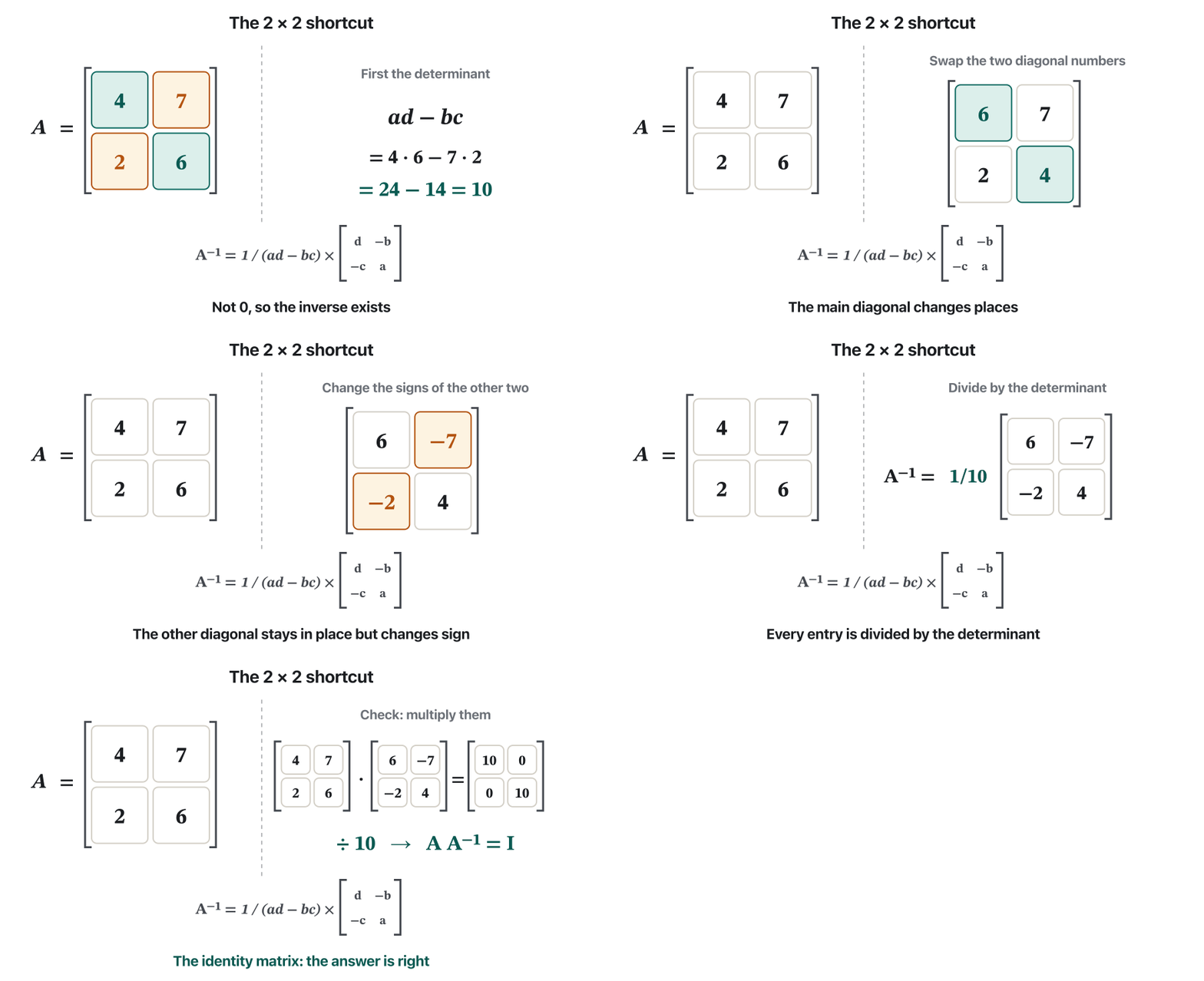
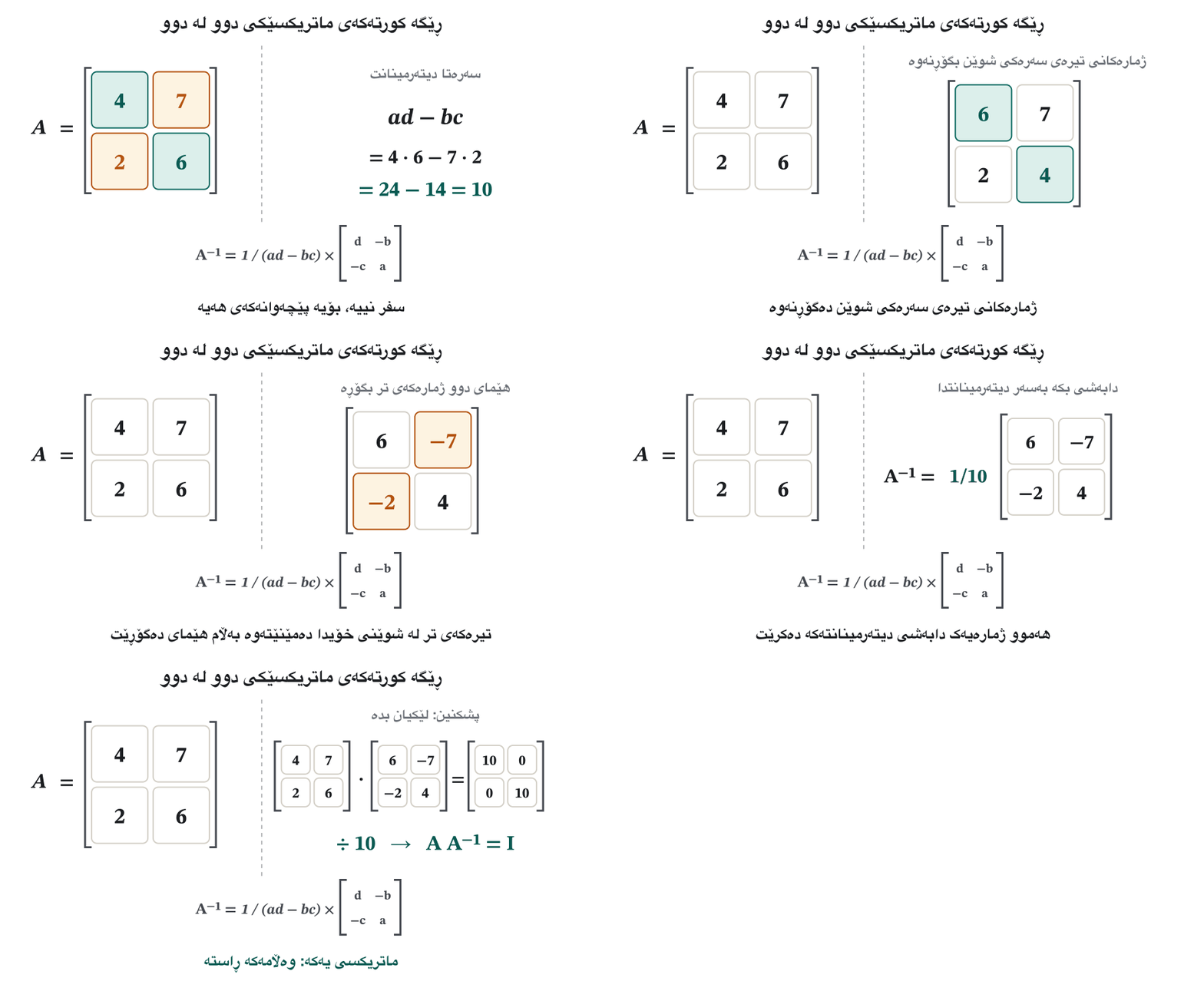
Five frames on A = [4 7; 2 6]. Frame 1: det = 4·6 − 7·2 = 24 − 14 = 10, not 0. Frame 2: the diagonal numbers 4 and 6 swap places, giving [6 7; 2 4]. Frame 3: 7 and 2 change sign, giving [6 −7; −2 4]. Frame 4: A⁻¹ = 1/10 times [6 −7; −2 4]. Frame 5: check — A times [6 −7; −2 4] is [10 0; 0 10]; dividing by 10 gives the identity matrix.
The shortcut on A=[4726]A = \begin{bmatrix} 4 & 7 \\ 2 & 6 \end{bmatrix}: A−1=110[6−7−24]A^{-1} = \frac{1}{10}\begin{bmatrix} 6 & -7 \\ -2 & 4 \end{bmatrix}.ڕێگە کورتەکە لەسەر A=[4726]A = \begin{bmatrix} 4 & 7 \\ 2 & 6 \end{bmatrix}: A−1=110[6−7−24]A^{-1} = \frac{1}{10}\begin{bmatrix} 6 & -7 \\ -2 & 4 \end{bmatrix}.CêIT
  1. The notes' exampleنموونەکەی تێبینییەکان

    A=[3−21−1]A = \begin{bmatrix} 3 & -2 \\ 1 & -1 \end{bmatrix}: det⁡A=(3)(−1)−(−2)(1)=−3+2=−1\det A = (3)(-1) - (-2)(1) = -3 + 2 = -1.

    A=[3−21−1]A = \begin{bmatrix} 3 & -2 \\ 1 & -1 \end{bmatrix}: det⁡A=(3)(−1)−(−2)(1)=−3+2=−1\det A = (3)(-1) - (-2)(1) = -3 + 2 = -1.

  2. Swap, change signs, divideبیگۆڕەوە، هێما بگۆڕە، دابەشی بکە

    A−1=1−1[−12−13]=[1−21−3]A^{-1} = \frac{1}{-1}\begin{bmatrix} -1 & 2 \\ -1 & 3 \end{bmatrix} = \begin{bmatrix} 1 & -2 \\ 1 & -3 \end{bmatrix}.

    A−1=1−1[−12−13]=[1−21−3]A^{-1} = \frac{1}{-1}\begin{bmatrix} -1 & 2 \\ -1 & 3 \end{bmatrix} = \begin{bmatrix} 1 & -2 \\ 1 & -3 \end{bmatrix}.

  3. Checkپشکنین

    [3−21−1][1−21−3]=[3−2−6+61−1−2+3]=I\begin{bmatrix} 3 & -2 \\ 1 & -1 \end{bmatrix}\begin{bmatrix} 1 & -2 \\ 1 & -3 \end{bmatrix} = \begin{bmatrix} 3 - 2 & -6 + 6 \\ 1 - 1 & -2 + 3 \end{bmatrix} = I. Always check: it takes a minute and catches sign slips.

    [3−21−1][1−21−3]=[3−2−6+61−1−2+3]=I\begin{bmatrix} 3 & -2 \\ 1 & -1 \end{bmatrix}\begin{bmatrix} 1 & -2 \\ 1 & -3 \end{bmatrix} = \begin{bmatrix} 3 - 2 & -6 + 6 \\ 1 - 1 & -2 + 3 \end{bmatrix} = I. هەمیشە بیپشکنە: یەک خولەک دەخایەنێت و هەڵەی هێما دەگرێت.

Quick checkپشکنینی خێراWhat is the inverse of [3211]\begin{bmatrix} 3 & 2 \\ 1 & 1 \end{bmatrix}?پێچەوانەی [3211]\begin{bmatrix} 3 & 2 \\ 1 & 1 \end{bmatrix} چییە؟

The determinant of the inverseدیتەرمینانتی پێچەوانەکە

If AA is invertible, det⁡A−1\det A^{-1} is the of det⁡A\det A. It comes straight from the product rule: det⁡A⋅det⁡A−1=det⁡I=1\det A \cdot \det A^{-1} = \det I = 1.

ئەگەر AA بێت، det⁡A−1\det A^{-1} det⁡A\det Aـە. ڕاستەوخۆ لە یاسای لێکدانەوە دێت: det⁡A⋅det⁡A−1=det⁡I=1\det A \cdot \det A^{-1} = \det I = 1.

det⁡A−1=1det⁡A\det A^{-1} = \frac{1}{\det A}
A=[1231],  det⁡A=1−6=−5A−1=1−5[1−2−31]=[−152535−15],  det⁡A−1=125−625=−15A = \begin{bmatrix} 1 & 2 \\ 3 & 1 \end{bmatrix},\; \det A = 1 - 6 = -5 \qquad A^{-1} = \frac{1}{-5}\begin{bmatrix} 1 & -2 \\ -3 & 1 \end{bmatrix} = \begin{bmatrix} -\tfrac15 & \tfrac25 \\ \tfrac35 & -\tfrac15 \end{bmatrix},\; \det A^{-1} = \tfrac{1}{25} - \tfrac{6}{25} = -\tfrac15

The notes' example: −15-\tfrac15 is indeed 1−5\frac{1}{-5}.

نموونەکەی تێبینییەکان: −15-\tfrac15 بەڕاستی 1−5\frac{1}{-5}ـە.

Quick checkپشکنینی خێراdet⁡A=4\det A = 4. What is det⁡A−1\det A^{-1}?det⁡A=4\det A = 4. det⁡A−1\det A^{-1} چەندە؟

The rules of inversesیاساکانی پێچەوانە

Let AA and BB be invertible n×nn \times n matrices and k≠0k \ne 0 a number. The notes' theorems, with two more rules:

با AA و BB بن بە قەبارەی n×nn \times n و k≠0k \ne 0 ژمارەیەک بێت. تێبینییەکان، لەگەڵ دوو یاسای تر:

RuleیاساIn wordsبە وشە
A−1A^{-1} is uniqueتەنها یەک A−1A^{-1} هەیەA matrix has at most one inverse. زۆرترین یەک پێچەوانەی هەیە.
(A−1)−1=A(A^{-1})^{-1} = AUndoing the undo gives back AA (theorem 1).هەڵوەشاندنەوەی هەڵوەشاندنەوە AA دەگەڕێنێتەوە ( ⁦1⁩).
(AB)−1=B−1A−1(AB)^{-1} = B^{-1}A^{-1}The order reverses (theorem 2).ڕیزبەندییەکە پێچەوانە دەبێتەوە ( ⁦2⁩).
(AT)−1=(A−1)T(A^T)^{-1} = (A^{-1})^TTranspose and inverse can be done in either order (theorem 3). و پێچەوانە بە هەر ڕیزبەندییەک دەکرێن ( ⁦3⁩).
(kA)−1=1kA−1(kA)^{-1} = \tfrac1k A^{-1}A number comes out as its reciprocal.ژمارەیەک وەک دێتە دەرەوە.
det⁡A−1=1det⁡A\det A^{-1} = \tfrac{1}{\det A}From the previous screen.لە شاشەی پێشووەوە.

Why only one inverse? If BB and CC were both inverses of AA, then B=BI=B(AC)=(BA)C=IC=CB = BI = B(AC) = (BA)C = IC = C. Why does the order reverse? Check it: (AB)(B−1A−1)=A(BB−1)A−1=AA−1=I(AB)(B^{-1}A^{-1}) = A(BB^{-1})A^{-1} = AA^{-1} = I. It is the same “socks and shoes” rule as (AB)T=BTAT(AB)^T = B^TA^T: what you put on last, you take off first.

بۆچی تەنها یەک پێچەوانە؟ ئەگەر BB و CC هەردووکیان پێچەوانەی AA بوونایە، ئەوا B=BI=B(AC)=(BA)C=IC=CB = BI = B(AC) = (BA)C = IC = C. بۆچی ڕیزبەندییەکە پێچەوانە دەبێتەوە؟ بیپشکنە: (AB)(B−1A−1)=A(BB−1)A−1=AA−1=I(AB)(B^{-1}A^{-1}) = A(BB^{-1})A^{-1} = AA^{-1} = I. هەمان یاسای «گۆرەوی و پێڵاو»ـە وەک (AB)T=BTAT(AB)^T = B^TA^T: ئەوەی دوایین جار لەبەرت دەکەیت، یەکەم جار دای دەکەنیت.

A=[2111],  B=[1201],  AB=[2513](AB)−1=[3−5−12]=B−1A−1=[1−201][1−1−12]A−1B−1=[1−3−14]≠(AB)−1\begin{aligned} A &= \begin{bmatrix} 2 & 1 \\ 1 & 1 \end{bmatrix},\; B = \begin{bmatrix} 1 & 2 \\ 0 & 1 \end{bmatrix},\; AB = \begin{bmatrix} 2 & 5 \\ 1 & 3 \end{bmatrix} \\ (AB)^{-1} &= \begin{bmatrix} 3 & -5 \\ -1 & 2 \end{bmatrix} = B^{-1}A^{-1} = \begin{bmatrix} 1 & -2 \\ 0 & 1 \end{bmatrix}\begin{bmatrix} 1 & -1 \\ -1 & 2 \end{bmatrix} \\ A^{-1}B^{-1} &= \begin{bmatrix} 1 & -3 \\ -1 & 4 \end{bmatrix} \ne (AB)^{-1} \end{aligned}

A numeric check: the reversed order works, the same order does not. Also (BT)−1=[10−21]=(B−1)T(B^T)^{-1} = \begin{bmatrix} 1 & 0 \\ -2 & 1 \end{bmatrix} = (B^{-1})^T and (2A)−1=12A−1(2A)^{-1} = \tfrac12 A^{-1}.

پشکنینێکی ژمارەیی: ڕیزبەندیی پێچەوانە کار دەکات، هەمان ڕیزبەندی کار ناکات. هەروەها (BT)−1=[10−21]=(B−1)T(B^T)^{-1} = \begin{bmatrix} 1 & 0 \\ -2 & 1 \end{bmatrix} = (B^{-1})^T و (2A)−1=12A−1(2A)^{-1} = \tfrac12 A^{-1}.

Quick checkپشکنینی خێراWhat is (ABC)−1(ABC)^{-1}?(ABC)−1(ABC)^{-1} چییە؟

Matrices with easy inversesئەو ماتریکسانەی پێچەوانەیان ئاسانە

Some special matrices from Special Matrices invert with almost no work:

هەندێک تایبەت لە ماتریکسە تایبەتەکانەوە بە کەمترین کار پێچەوانە دەکرێنەوە:

MatrixInverseپێچەوانەWhyبۆچی
Identity II III−1=II^{-1} = III=III = III=III = I
Diagonal, no zero on the diagonalتیرەیی، بێ سفر لەسەر تیرەکە[2005]−1=[120015]\begin{bmatrix} 2 & 0 \\ 0 & 5 \end{bmatrix}^{-1} = \begin{bmatrix} \frac12 & 0 \\ 0 & \frac15 \end{bmatrix}Each diagonal number is undone by its reciprocal.هەر ژمارەیەکی تیرە بە هەڵدەوەشێتەوە.
Involutory: A2=IA^2 = Iماتریکسی خۆپێچەوانە، واتە A2=IA^2 = IA−1=AA^{-1} = AAA=IAA = I says AA is its own inverse.AA=IAA = I دەڵێت AA پێچەوانەی خۆیەتی.
Orthogonal: AAT=IAA^T = Iماتریکسی ئۆرتۆگۆناڵ، واتە AAT=IAA^T = IA−1=ATA^{-1} = A^TThe definition says ATA^T works as the inverse. A rotation by θ\theta is undone by a rotation by −θ-\theta, which is its transpose.پێناسەکە دەڵێت ATA^T وەک پێچەوانە کار دەکات. بە θ\theta بە بە −θ-\theta هەڵدەوەشێتەوە کە .
Quick checkپشکنینی خێراQQ is orthogonal. What is the quickest way to find Q−1Q^{-1}?QQ . خێراترین ڕێگە بۆ دۆزینەوەی Q−1Q^{-1} چییە؟

Method 2: the adjugateڕێگەی 2: ئەدجوگەیت

For bigger matrices the notes use the (written adj⁡A\operatorname{adj} A). It is built from the Cofactors in three steps:

بۆ گەورەترەکان تێبینییەکان بەکاردەهێنن (بە adj⁡A\operatorname{adj} A دەنووسرێت). لە کۆفاکتەرەکان بە سێ هەنگاو دروست دەکرێت:

Three boxes joined by arrows. Box 1, cofactor matrix: C = [C11 C12 …], each entry becomes its cofactor. Box 2, transpose it: adj A = C transposed, the adjugate. Box 3, divide by det A: A⁻¹ = adj A ÷ det A, only if det A is not 0. Below: older books call the adjugate the adjoint.سێ چوارگۆشە کە بە تیر بەستراون. چوارگۆشەی 1، ماتریکسی کۆفاکتەرەکان: C = [C11 C12 …]، هەر ژمارەیەک دەبێتە کۆفاکتەرەکەی. چوارگۆشەی 2، ڕیزەکان بکە بە ستوون: adj A = Cᵀ، ئەدجوگەیت. چوارگۆشەی 3، دابەش بەسەر دیتەرمینانتدا: A⁻¹ = adj A ÷ det A، تەنها ئەگەر det A سفر نەبێت. لە خوارەوە: کتێبە کۆنەکان بە ئەدجوگەیت دەڵێن ئەدجۆینت.
cofactors → transpose → divide by det⁡A\det A ← ← دابەشکردن بەسەر det⁡A\det AداCêIT
A−1=1det⁡Aadj⁡A,adj⁡A=[cof⁡A]TA^{-1} = \frac{1}{\det A}\operatorname{adj} A, \qquad \operatorname{adj} A = [\operatorname{cof} A]^T
Quick checkپشکنینی خێراWhat is the second step of the adjugate method?هەنگاوی دووەمی ڕێگەی چییە؟

How to find the inverse of a 3 by 3 matrix (the fast way)bprp math basics · Englishئینگلیزی · 117K viewsبینین · 3K likesلایک

A 3×3 inverse in three steps: the determinant, the matrix of cofactors, then transpose it (the adjugate) and divide by the determinant.

3×33 \times 3 بە سێ هەنگاو: ، ، پاشان () و دابەشکردنی بەسەر .

Chapters: 0:22 finding the determinant, 1:37 finding the inverse (cofactors, transpose at about 4:40, divide by det).

بەشەکان: ⁦0:22⁩ دۆزینەوەی ، ⁦1:37⁩ دۆزینەوەی (، لە نزیکەی ⁦4:40⁩، دابەشکردن بەسەر ).

Method 2: the adjugateڕێگەی 2: ئەدجوگەیت

Why the adjugate worksبۆچی ئەدجوگەیت کار دەکات

Multiply AA by adj⁡A\operatorname{adj} A. On the diagonal, row ii meets its own cofactors: that is the expansion along row ii, so you get det⁡A\det A. Off the diagonal, row ii meets the cofactors of another row: that is the expansion of a matrix with two equal rows, so you get 0. Together: Aadj⁡A=(det⁡A) IA \operatorname{adj} A = (\det A)\,I.

AA لە adj⁡A\operatorname{adj} A بدە. لەسەر تیرەکە، ڕیزی ii بە خۆی دەگات: ئەمە کردنەوەیە بە درێژایی ڕیزی ii، بۆیە det⁡A\det A دەردەچێت. لە دەرەوەی تیرەکە، ڕیزی ii بە ڕیزێکی تر دەگات: ئەمە کردنەوەی دوو ڕیزی یەکسانە، بۆیە 0 دەردەچێت. پێکەوە: Aadj⁡A=(det⁡A) IA \operatorname{adj} A = (\det A)\,I.

For a 2×22 \times 2 matrix the cofactors of [abcd]\begin{bmatrix} a & b \\ c & d \end{bmatrix} are [d−c−ba]\begin{bmatrix} d & -c \\ -b & a \end{bmatrix}; transposed, [d−b−ca]\begin{bmatrix} d & -b \\ -c & a \end{bmatrix}. So the shortcut of Method 1 is the adjugate method — the notes call this matrix adj⁡(A)\operatorname{adj}(A) there too.

بۆ 2×22 \times 2، [abcd]\begin{bmatrix} a & b \\ c & d \end{bmatrix} [d−c−ba]\begin{bmatrix} d & -c \\ -b & a \end{bmatrix}ـن؛ دوای کردنی ڕیز بە ستوون، [d−b−ca]\begin{bmatrix} d & -b \\ -c & a \end{bmatrix}. کەواتە ڕێگە کورتەکەی ڕێگەی 1 هەمان ڕێگەی — تێبینییەکان لەوێشدا بەم دەڵێن adj⁡(A)\operatorname{adj}(A).

Quick checkپشکنینی خێراWhat is the adjugate of [abcd]\begin{bmatrix} a & b \\ c & d \end{bmatrix}? [abcd]\begin{bmatrix} a & b \\ c & d \end{bmatrix} چییە؟

A 3×33 \times 3 inverse with the adjugateپێچەوانەی ماتریکسێکی 3×33 \times 3 بە ئەدجوگەیت

The notes' example: find A−1A^{-1} for

نموونەکەی تێبینییەکان: A−1A^{-1} بدۆزەرەوە بۆ

A=[1−22211101]A = \begin{bmatrix} 1 & -2 & 2 \\ 2 & 1 & 1 \\ 1 & 0 & 1 \end{bmatrix}
  1. The determinantدیتەرمینانت

    Row 3 has a zero, so expand along it: det⁡A=1⋅∣−2211∣+0+1⋅∣1−221∣=(−4)+5=1\det A = 1\cdot\begin{vmatrix} -2 & 2 \\ 1 & 1 \end{vmatrix} + 0 + 1\cdot\begin{vmatrix} 1 & -2 \\ 2 & 1 \end{vmatrix} = (-4) + 5 = 1. Not 0, so the inverse exists.

    ڕیزی 3 سفرێکی تێدایە، بۆیە بە درێژاییدا بیکەرەوە: det⁡A=1⋅∣−2211∣+0+1⋅∣1−221∣=(−4)+5=1\det A = 1\cdot\begin{vmatrix} -2 & 2 \\ 1 & 1 \end{vmatrix} + 0 + 1\cdot\begin{vmatrix} 1 & -2 \\ 2 & 1 \end{vmatrix} = (-4) + 5 = 1. سفر نییە، بۆیە پێچەوانەکەی هەیە.

  2. Minors, then cofactorsماینەرەکان، پاشان کۆفاکتەرەکان

    For example M12=∣2111∣=1M_{12} = \begin{vmatrix} 2 & 1 \\ 1 & 1 \end{vmatrix} = 1, so C12=−1C_{12} = -1. All nine:

    بۆ نموونە M12=∣2111∣=1M_{12} = \begin{vmatrix} 2 & 1 \\ 1 & 1 \end{vmatrix} = 1، بۆیە C12=−1C_{12} = -1. هەر نۆکەیان:

    M=[11−1−2−12−4−35]C=[1−1−12−1−2−435]M = \begin{bmatrix} 1 & 1 & -1 \\ -2 & -1 & 2 \\ -4 & -3 & 5 \end{bmatrix} \qquad C = \begin{bmatrix} 1 & -1 & -1 \\ 2 & -1 & -2 \\ -4 & 3 & 5 \end{bmatrix}
  3. Transpose: the adjugateکردنی ڕیز بە ستوون: ئەدجوگەیت

    Row 1 of CC becomes column 1, and so on.

    ڕیزی 1ی CC دەبێتە ستوونی 1 و بەم شێوەیە.

    adj⁡A=CT=[12−4−1−13−1−25]\operatorname{adj} A = C^T = \begin{bmatrix} 1 & 2 & -4 \\ -1 & -1 & 3 \\ -1 & -2 & 5 \end{bmatrix}
  4. Divide by the determinantدابەشکردن بەسەر دیتەرمینانتدا

    det⁡A=1\det A = 1, so A−1=adj⁡A=[12−4−1−13−1−25]A^{-1} = \operatorname{adj} A = \begin{bmatrix} 1 & 2 & -4 \\ -1 & -1 & 3 \\ -1 & -2 & 5 \end{bmatrix}.

    det⁡A=1\det A = 1، بۆیە A−1=adj⁡A=[12−4−1−13−1−25]A^{-1} = \operatorname{adj} A = \begin{bmatrix} 1 & 2 & -4 \\ -1 & -1 & 3 \\ -1 & -2 & 5 \end{bmatrix}.

  5. Check two entriesدوو ژمارە بپشکنە

    Row 1 of AA times column 1 of A−1A^{-1}: 1+2−2=11 + 2 - 2 = 1. Row 1 times column 2: 2+2−4=02 + 2 - 4 = 0. The full product is I3I_3 (checked with sympy).

    ڕیزی 1ی AA جاران ستوونی 1ی A−1A^{-1}: 1+2−2=11 + 2 - 2 = 1. ڕیزی 1 جاران ستوونی 2: 2+2−4=02 + 2 - 4 = 0. لێکدراوە تەواوەکە I3I_3ـە (بە sympy پشکنراوە).

Quick checkپشکنینی خێراIn this example, why was row 3 the best row for the determinant?لەم نموونەیەدا، بۆچی ڕیزی 3 باشترین ڕیز بوو بۆ ؟

Finding inverse of Matrix in a short time in Kurdish languageAvin Omer Karim · Kurdish (Sorani)کوردی (سۆرانی) · 2.6K viewsبینین · 83 likesلایک

In Kurdish: the inverse of a 3×3 matrix with A⁻¹ = adj(A) / det(A), using quick patterns for the determinant and the cofactors.

بە کوردی: 3×33 \times 3 بە A−1=adj⁡(A)det⁡(A)A^{-1} = \frac{\operatorname{adj}(A)}{\det(A)}، بە ڕێگای خێرا بۆ و .

Kurdish worked example on A = [1 2 3; 2 −1 3; 1 0 1]: det A = 4 by the diagonal (Sarrus) pattern, cofactors by a crossing shortcut, then A⁻¹ = adj(A)/det A.

نموونەیەکی چارەسەرکراو بە کوردی لەسەر A=[1232−13101]A = \begin{bmatrix}1&2&3\\2&-1&3\\1&0&1\end{bmatrix}: det⁡A=4\det A = 4 بە شێوازی تیرەکان (ساروس)، بە کورتەڕێیەکی خاچی، پاشان A−1=adj⁡(A)/det⁡AA^{-1} = \operatorname{adj}(A)/\det A.

Using the inverse: solving AX=BAX = Bبەکارهێنانی پێچەوانە: شیکارکردنی AX=BAX = B

Shilan buys 2 boxes of kulicha and 3 bags of samoon at a bakery in Duhok and pays 13,000 IQD. Rezan buys 1 box and 4 bags and pays 9,000 IQD. What does one box (kk) and one bag (ss) cost? The two receipts are one matrix equation:

شیلان لە نانەواخانەیەک لە دهۆک 2 قوتوو کولێچە و 3 کیسە سەموون دەکڕێت و ⁦13,000⁩ دینار دەدات. ڕێزان 1 قوتوو و 4 کیسە دەکڕێت و ⁦9,000⁩ دینار دەدات. یەک قوتوو (kk) و یەک کیسە (ss) بە چەندە؟ دوو پسوولەکە :

[2314]⏟A[ks]⏟X=[130009000]⏟B\underbrace{\begin{bmatrix} 2 & 3 \\ 1 & 4 \end{bmatrix}}_{A}\underbrace{\begin{bmatrix} k \\ s \end{bmatrix}}_{X} = \underbrace{\begin{bmatrix} 13000 \\ 9000 \end{bmatrix}}_{B}

Multiply both sides on the left by A−1A^{-1}: A−1AX=A−1BA^{-1}AX = A^{-1}B, so X=A−1BX = A^{-1}B. Here det⁡A=8−3=5\det A = 8 - 3 = 5:

هەردوو لا لە لای چەپەوە لە A−1A^{-1} بدە: A−1AX=A−1BA^{-1}AX = A^{-1}B، بۆیە X=A−1BX = A^{-1}B. لێرەدا det⁡A=8−3=5\det A = 8 - 3 = 5:

X=A−1B=15[4−3−12][130009000]=15[52000−27000−13000+18000]=[50001000]X = A^{-1}B = \frac15\begin{bmatrix} 4 & -3 \\ -1 & 2 \end{bmatrix}\begin{bmatrix} 13000 \\ 9000 \end{bmatrix} = \frac15\begin{bmatrix} 52000 - 27000 \\ -13000 + 18000 \end{bmatrix} = \begin{bmatrix} 5000 \\ 1000 \end{bmatrix}

A box of kulicha costs 5,000 IQD and a bag of samoon 1,000 IQD. Check: 2(5000)+3(1000)=130002(5000) + 3(1000) = 13000 and 5000+4(1000)=90005000 + 4(1000) = 9000.

قوتوویەک کولێچە ⁦5,000⁩ دینارە و کیسەیەک سەموون ⁦1,000⁩ دینار. پشکنین: 2(5000)+3(1000)=130002(5000) + 3(1000) = 13000 و 5000+4(1000)=90005000 + 4(1000) = 9000.

Quick checkپشکنینی خێراSolve [3211]X=[125]\begin{bmatrix} 3 & 2 \\ 1 & 1 \end{bmatrix}X = \begin{bmatrix} 12 \\ 5 \end{bmatrix} using [3211]−1=[1−2−13]\begin{bmatrix} 3 & 2 \\ 1 & 1 \end{bmatrix}^{-1} = \begin{bmatrix} 1 & -2 \\ -1 & 3 \end{bmatrix}.[3211]X=[125]\begin{bmatrix} 3 & 2 \\ 1 & 1 \end{bmatrix}X = \begin{bmatrix} 12 \\ 5 \end{bmatrix} شیکار بکە بە بەکارهێنانی [3211]−1=[1−2−13]\begin{bmatrix} 3 & 2 \\ 1 & 1 \end{bmatrix}^{-1} = \begin{bmatrix} 1 & -2 \\ -1 & 3 \end{bmatrix}.

A system of three equationsسیستەمێکی سێ هاوکێشە

The inverse found with the adjugate solves any system with the same left side. Solve

ئەو پێچەوانەیەی بە دۆزرایەوە هەر سیستەمێک شیکار دەکات کە هەمان لای چەپی هەبێت. شیکار بکە

x−2y+2z=−22x+y+z=8x+z=3⟺[1−22211101][xyz]=[−283]\begin{aligned} x - 2y + 2z &= -2 \\ 2x + y + z &= 8 \\ x + z &= 3 \end{aligned} \qquad\Longleftrightarrow\qquad \begin{bmatrix} 1 & -2 & 2 \\ 2 & 1 & 1 \\ 1 & 0 & 1 \end{bmatrix}\begin{bmatrix} x \\ y \\ z \end{bmatrix} = \begin{bmatrix} -2 \\ 8 \\ 3 \end{bmatrix}

The coefficient matrix is the AA of the adjugate example (a missing yy is a 0).

هەمان AAی نموونەی (yyی ون 0ـە).

X=A−1B=[12−4−1−13−1−25][−283]=[−2+16−122−8+92−16+15]=[231]X = A^{-1}B = \begin{bmatrix} 1 & 2 & -4 \\ -1 & -1 & 3 \\ -1 & -2 & 5 \end{bmatrix}\begin{bmatrix} -2 \\ 8 \\ 3 \end{bmatrix} = \begin{bmatrix} -2 + 16 - 12 \\ 2 - 8 + 9 \\ 2 - 16 + 15 \end{bmatrix} = \begin{bmatrix} 2 \\ 3 \\ 1 \end{bmatrix}

So x=2x = 2, y=3y = 3, z=1z = 1. Check the second equation: 2(2)+3+1=82(2) + 3 + 1 = 8.

کەواتە x=2x = 2، y=3y = 3، z=1z = 1. دووەم بپشکنە: 2(2)+3+1=82(2) + 3 + 1 = 8.

Quick checkپشکنینی خێراWith the same AA, the right side changes to B=(1,0,0)B = (1, 0, 0). What is XX?بە هەمان AA، لای ڕاست دەگۆڕێت بۆ B=(1,0,0)B = (1, 0, 0). XX چییە؟

In computing: inv(A) or Ab?لە کۆمپیوتەردا: ⁦inv(A)⁩ یان Ab؟

Common mistakesهەڵە باوەکان

MistakeهەڵەWhat is trueڕاستییەکە
A−1A^{-1} = the reciprocals of the entriesA−1A^{-1} = ژمارەکانA−1A^{-1} is the matrix with AA−1=IAA^{-1} = I; find it with a method.A−1A^{-1} ئەو کە AA−1=IAA^{-1} = I؛ بە ڕێگەیەک بیدۆزەرەوە.
(AB)−1=A−1B−1(AB)^{-1} = A^{-1}B^{-1}(AB)−1=A−1B−1(AB)^{-1} = A^{-1}B^{-1}The order reverses: (AB)−1=B−1A−1(AB)^{-1} = B^{-1}A^{-1}.ڕیزبەندییەکە پێچەوانە دەبێتەوە: (AB)−1=B−1A−1(AB)^{-1} = B^{-1}A^{-1}.
From AX=BAX = B writing X=BA−1X = BA^{-1} or X=BAX = \frac{B}{A}لە AX=BAX = Bـەوە نووسینی X=BA−1X = BA^{-1} یان X=BAX = \frac{B}{A}Multiply on the left: X=A−1BX = A^{-1}B.لە لای چەپەوە لێی بدە: X=A−1BX = A^{-1}B.
In the shortcut, swapping bb and cc instead of aa and ddلە ڕێگە کورتەکەدا، گۆڕینەوەی bb و cc لە جیاتی aa و ddSwap the main diagonal; only change the signs of the other two. بگۆڕەوە؛ تەنها هێمای دووەکەی تر بگۆڕە.
Using the cofactor matrix as the adjugateبەکارهێنانی وەک Transpose it first: adj⁡A=CT\operatorname{adj} A = C^T.سەرەتا ڕیزەکانی بکە بە ستوون: adj⁡A=CT\operatorname{adj} A = C^T.
Looking for the inverse of a 2×32 \times 3 matrix, or of one with det⁡A=0\det A = 0گەڕان بەدوای پێچەوانەی 2×32 \times 3 یان یەکێک بە det⁡A=0\det A = 0Only square matrices with det⁡A≠0\det A \ne 0 have one.تەنها بە det⁡A≠0\det A \ne 0 پێچەوانەیان هەیە.

Exercisesڕاهێنانەکان

ExerciseڕاهێنانExercise 1 (notes' homework)ڕاهێنانی 1 (ئەرکی تێبینییەکان)

Find the inverse of A=[1357]A = \begin{bmatrix} 1 & 3 \\ 5 & 7 \end{bmatrix}.

پێچەوانەی A=[1357]A = \begin{bmatrix} 1 & 3 \\ 5 & 7 \end{bmatrix} بدۆزەرەوە.

Show answerوەڵامەکە پیشان بدە
det⁡A=7−15=−8,A−1=1−8[7−3−51]=[−783858−18]\det A = 7 - 15 = -8, \qquad A^{-1} = \frac{1}{-8}\begin{bmatrix} 7 & -3 \\ -5 & 1 \end{bmatrix} = \begin{bmatrix} -\tfrac78 & \tfrac38 \\ \tfrac58 & -\tfrac18 \end{bmatrix}
ExerciseڕاهێنانExercise 2 (notes' homework): two proofsڕاهێنانی 2 (ئەرکی تێبینییەکان): دوو سەلماندن

For A=[abcd]A = \begin{bmatrix} a & b \\ c & d \end{bmatrix} with Δ=ad−bc≠0\Delta = ad - bc \ne 0, prove (a) (A−1)−1=A(A^{-1})^{-1} = A and (b) (AT)−1=(A−1)T(A^T)^{-1} = (A^{-1})^T.

بۆ A=[abcd]A = \begin{bmatrix} a & b \\ c & d \end{bmatrix} کە Δ=ad−bc≠0\Delta = ad - bc \ne 0، بیسەلمێنە (أ) (A−1)−1=A(A^{-1})^{-1} = A و (ب) (AT)−1=(A−1)T(A^T)^{-1} = (A^{-1})^T.

Show answerوەڵامەکە پیشان بدە
(a) A−1=1Δ[d−b−ca], det⁡A−1=1Δ2(da−bc)=1Δ(A−1)−1=11/Δ⋅1Δ[abcd]=A(b) AT=[acbd], det⁡AT=Δ, (AT)−1=1Δ[d−c−ba]=(1Δ[d−b−ca])T=(A−1)T\begin{aligned} &\text{(a) } A^{-1} = \tfrac1\Delta\begin{bmatrix} d & -b \\ -c & a \end{bmatrix},\ \det A^{-1} = \tfrac{1}{\Delta^2}(da - bc) = \tfrac1\Delta \\ &\quad (A^{-1})^{-1} = \frac{1}{1/\Delta}\cdot\tfrac1\Delta\begin{bmatrix} a & b \\ c & d \end{bmatrix} = A \\ &\text{(b) } A^T = \begin{bmatrix} a & c \\ b & d \end{bmatrix},\ \det A^T = \Delta,\ (A^T)^{-1} = \tfrac1\Delta\begin{bmatrix} d & -c \\ -b & a \end{bmatrix} = \Big(\tfrac1\Delta\begin{bmatrix} d & -b \\ -c & a \end{bmatrix}\Big)^T = (A^{-1})^T \end{aligned}

In (a) the shortcut is used twice: swapping and changing signs twice gives back a,b,c,da, b, c, d. Both were also checked symbolically with sympy.

لە (أ)دا ڕێگە کورتەکە دوو جار بەکارهاتووە: دوو جار گۆڕینەوە و گۆڕینی هێما a,b,c,da, b, c, d دەگەڕێنێتەوە. هەردووکیان بە sympy بە هێما پشکنران.

ExerciseڕاهێنانExercise 3 (notes' homework)ڕاهێنانی 3 (ئەرکی تێبینییەکان)

Find B−1B^{-1} for B=[123045106]B = \begin{bmatrix} 1 & 2 & 3 \\ 0 & 4 & 5 \\ 1 & 0 & 6 \end{bmatrix} with the adjugate.

B−1B^{-1} بدۆزەرەوە بۆ B=[123045106]B = \begin{bmatrix} 1 & 2 & 3 \\ 0 & 4 & 5 \\ 1 & 0 & 6 \end{bmatrix} بە .

Hintئاماژە

Expand the determinant along column 1 (it has a 0).

بە درێژایی ستوونی 1 بکەرەوە (سفرێکی تێدایە).

Show answerوەڵامەکە پیشان بدە
det⁡B=1(24−0)−0+1(10−12)=22,B−1=122[24−12−253−5−424]\det B = 1(24 - 0) - 0 + 1(10 - 12) = 22, \qquad B^{-1} = \frac{1}{22}\begin{bmatrix} 24 & -12 & -2 \\ 5 & 3 & -5 \\ -4 & 2 & 4 \end{bmatrix}

The next lesson finds the same inverse by row operations.

وانەی داهاتوو هەمان پێچەوانە بە دەدۆزێتەوە.

ExerciseڕاهێنانExercise 4 (notes' homework)ڕاهێنانی 4 (ئەرکی تێبینییەکان)

Find C−1C^{-1} for C=[63−10528−69]C = \begin{bmatrix} 6 & 3 & -1 \\ 0 & 5 & 2 \\ 8 & -6 & 9 \end{bmatrix}.

C−1C^{-1} بدۆزەرەوە بۆ C=[63−10528−69]C = \begin{bmatrix} 6 & 3 & -1 \\ 0 & 5 & 2 \\ 8 & -6 & 9 \end{bmatrix}.

Show answerوەڵامەکە پیشان بدە
det⁡C=6(45+12)−3(0−16)−1(0−40)=342+48+40=430,C−1=1430[57−21111662−12−406030]\det C = 6(45 + 12) - 3(0 - 16) - 1(0 - 40) = 342 + 48 + 40 = 430, \qquad C^{-1} = \frac{1}{430}\begin{bmatrix} 57 & -21 & 11 \\ 16 & 62 & -12 \\ -40 & 60 & 30 \end{bmatrix}
ExerciseڕاهێنانExercise 5: solve with the inverseڕاهێنانی 5: بە پێچەوانە شیکار بکە

Lana's café sells tea and cake. Two teas and three cakes cost 11 thousand IQD; one tea and two cakes cost 7 thousand. Find both prices (in thousands).

کافێکەی لانا چا و کێک دەفرۆشێت. دوو چا و سێ کێک بە ⁦11⁩ هەزار دینارن؛ یەک چا و دوو کێک بە 7 هەزار دینار. هەردوو نرخەکە بدۆزەرەوە (بە هەزار).

Show answerوەڵامەکە پیشان بدە
[2312][tc]=[117],det⁡=1,  A−1=[2−3−12],X=[22−21−11+14]=[13]\begin{bmatrix} 2 & 3 \\ 1 & 2 \end{bmatrix}\begin{bmatrix} t \\ c \end{bmatrix} = \begin{bmatrix} 11 \\ 7 \end{bmatrix}, \quad \det = 1,\; A^{-1} = \begin{bmatrix} 2 & -3 \\ -1 & 2 \end{bmatrix}, \quad X = \begin{bmatrix} 22 - 21 \\ -11 + 14 \end{bmatrix} = \begin{bmatrix} 1 \\ 3 \end{bmatrix}

A tea costs 1,000 IQD and a cake 3,000 IQD. Check: 2(1)+3(3)=112(1) + 3(3) = 11 and 1+2(3)=71 + 2(3) = 7.

چایەک ⁦1,000⁩ دینارە و کێکێک ⁦3,000⁩ دینار. پشکنین: 2(1)+3(3)=112(1) + 3(3) = 11 و 1+2(3)=71 + 2(3) = 7.

ExerciseڕاهێنانExercise 6: when is there no inverse?ڕاهێنانی 6: کەی پێچەوانە نییە؟

For which kk is [k346]\begin{bmatrix} k & 3 \\ 4 & 6 \end{bmatrix} singular?

بۆ کام kk [k346]\begin{bmatrix} k & 3 \\ 4 & 6 \end{bmatrix} ؟

Show answerوەڵامەکە پیشان بدە

6k−12=06k - 12 = 0, so k=2k = 2. Then row 2 is twice row 1.

6k−12=06k - 12 = 0، بۆیە k=2k = 2. ئەوکات ڕیزی 2 دوو هێندەی ڕیزی 1ە.

ExerciseڕاهێنانExercise 7: another adjugateڕاهێنانی 7: ئەدجوگەیتێکی تر

Find the inverse of H=[201110011]H = \begin{bmatrix} 2 & 0 & 1 \\ 1 & 1 & 0 \\ 0 & 1 & 1 \end{bmatrix}.

پێچەوانەی H=[201110011]H = \begin{bmatrix} 2 & 0 & 1 \\ 1 & 1 & 0 \\ 0 & 1 & 1 \end{bmatrix} بدۆزەرەوە.

Show answerوەڵامەکە پیشان بدە
det⁡H=2(1)−0+1(1)=3,C=[1−1112−2−112],H−1=13[11−1−1211−22]\det H = 2(1) - 0 + 1(1) = 3, \quad C = \begin{bmatrix} 1 & -1 & 1 \\ 1 & 2 & -2 \\ -1 & 1 & 2 \end{bmatrix}, \quad H^{-1} = \frac13\begin{bmatrix} 1 & 1 & -1 \\ -1 & 2 & 1 \\ 1 & -2 & 2 \end{bmatrix}
ExerciseڕاهێنانExercise 8: spot the mistakeڕاهێنانی 8: هەڵەکە بدۆزەرەوە

Hana wrote (PQ)−1=P−1Q−1(PQ)^{-1} = P^{-1}Q^{-1} for P=[1112]P = \begin{bmatrix} 1 & 1 \\ 1 & 2 \end{bmatrix} and Q=[2111]Q = \begin{bmatrix} 2 & 1 \\ 1 & 1 \end{bmatrix}. Show that it is wrong and correct it.

هانا نووسی (PQ)−1=P−1Q−1(PQ)^{-1} = P^{-1}Q^{-1} بۆ P=[1112]P = \begin{bmatrix} 1 & 1 \\ 1 & 2 \end{bmatrix} و Q=[2111]Q = \begin{bmatrix} 2 & 1 \\ 1 & 1 \end{bmatrix}. پیشانی بدە کە هەڵەیە و ڕاستی بکەرەوە.

Show answerوەڵامەکە پیشان بدە
(PQ)−1=[3−2−43],P−1Q−1=[3−4−23],Q−1P−1=[3−2−43](PQ)^{-1} = \begin{bmatrix} 3 & -2 \\ -4 & 3 \end{bmatrix}, \quad P^{-1}Q^{-1} = \begin{bmatrix} 3 & -4 \\ -2 & 3 \end{bmatrix}, \quad Q^{-1}P^{-1} = \begin{bmatrix} 3 & -2 \\ -4 & 3 \end{bmatrix}

The correct rule reverses the order: (PQ)−1=Q−1P−1(PQ)^{-1} = Q^{-1}P^{-1}.

یاسا ڕاستەکە ڕیزبەندییەکە پێچەوانە دەکاتەوە: (PQ)−1=Q−1P−1(PQ)^{-1} = Q^{-1}P^{-1}.

Summaryپوختە

  • No matrix division: A−1A^{-1} undoes AA, with AA−1=A−1A=IAA^{-1} = A^{-1}A = I (square matrices only).
  • Invertible ⇔ det⁡A≠0\det A \ne 0; singular ⇔ det⁡A=0\det A = 0. det⁡A−1=1/det⁡A\det A^{-1} = 1/\det A.
  • 2×22 \times 2: A−1=1ad−bc[d−b−ca]A^{-1} = \frac{1}{ad - bc}\begin{bmatrix} d & -b \\ -c & a \end{bmatrix}.
  • Adjugate (older books: adjoint): A−1=1det⁡ACTA^{-1} = \frac{1}{\det A}C^T.
  • (A−1)−1=A(A^{-1})^{-1} = A, (AB)−1=B−1A−1(AB)^{-1} = B^{-1}A^{-1}, (AT)−1=(A−1)T(A^T)^{-1} = (A^{-1})^T, (kA)−1=1kA−1(kA)^{-1} = \frac1k A^{-1}.
  • AX=B⇒X=A−1BAX = B \Rightarrow X = A^{-1}B (multiply on the left).
  • دابەشکردنی نییە: A−1A^{-1} کاری AA هەڵدەوەشێنێتەوە، بە AA−1=A−1A=IAA^{-1} = A^{-1}A = I (تەنها ).
  • ⇔ det⁡A≠0\det A \ne 0؛ ⇔ det⁡A=0\det A = 0. det⁡A−1=1/det⁡A\det A^{-1} = 1/\det A.
  • 2×22 \times 2: A−1=1ad−bc[d−b−ca]A^{-1} = \frac{1}{ad - bc}\begin{bmatrix} d & -b \\ -c & a \end{bmatrix}.
  • (کتێبە کۆنەکان: ئەدجۆینت): A−1=1det⁡ACTA^{-1} = \frac{1}{\det A}C^T.
  • (A−1)−1=A(A^{-1})^{-1} = A، (AB)−1=B−1A−1(AB)^{-1} = B^{-1}A^{-1}، (AT)−1=(A−1)T(A^T)^{-1} = (A^{-1})^T، (kA)−1=1kA−1(kA)^{-1} = \frac1k A^{-1}.
  • AX=B⇒X=A−1BAX = B \Rightarrow X = A^{-1}B (لە لای چەپەوە لێی بدە).
Review questionsپرسیارەکانی پێداچوونەوە
Why must both AA−1AA^{-1} and A−1AA^{-1}A be II?بۆچی دەبێت هەردوو AA−1AA^{-1} و A−1AA^{-1}A II بن؟

Because matrix products depend on the order. For square matrices one order is enough in fact, but the definition asks for both.

چونکە لێکدراوی بە ڕیزبەندییەوە پەیوەستە. بۆ لە ڕاستیدا یەک ڕیزبەندی بەسە، بەڵام پێناسەکە هەردووکیان داوا دەکات.

Which method should I use?کام ڕێگە بەکاربهێنم؟

2×22 \times 2: the shortcut. Small 3×33 \times 3: the adjugate or row operations. Bigger: row operations (next lesson).

2×22 \times 2: ڕێگە کورتەکە. 3×33 \times 3ـی بچووک: یان . گەورەتر: (وانەی داهاتوو).

Next: Finding the Inverse by Row Operations — Method 3 of the notes.

دواتر: دۆزینەوەی پێچەوانە بە کارە سەرەتاییەکانی ڕیز — ڕێگەی 3ی تێبینییەکان.

Lesson complete!وانەکە تەواو بوو!

Well done. Review the key terms, then go on to the next lesson.دەستخۆش. سەیرێکی زاراوە سەرەکییەکان بکەرەوە، پاشان بڕۆ بۆ وانەی داهاتوو.

Key termsزاراوە سەرەکییەکان

Next lessonوانەی داهاتوو

Finding the Inverse by Row Operations (Gauss–Jordan)دۆزینەوەی پێچەوانە بە کارە سەرەتاییەکانی ڕیز (لابردنی گاوس–جۆردان)

References and further readingسەرچاوەکان و خوێندنەوەی زیاتر

This lecture is a first edition. The Kurdish text and terminology are waiting for review by Kurdish IT teachers.ئەم وانەیە چاپی یەکەمە. دەقە کوردییەکە و زاراوەکانی چاوەڕێی پێداچوونەوەی مامۆستایانی کوردی بواری IT ن.