MATLABMATLAB · Chapterبەش 5 · Lectureوانە 5.5
while Loops, break and continueخولەکانی while، break و continue
Repeat code until something happens: the while loop and its three parts (start value, condition, change), the lab's endless loops and how Ctrl+C stops them, a sum too big to be exact, stopping at a negative input, loops with an unknown number of turns, break (with the lab's average-after-break bug and the ask-again pattern), continue, and when to choose for or while.
کۆد دووبارە بکەرەوە تا شتێک ڕوو دەدات: و سێ بەشەکەی ( سەرەتا، ، گۆڕان)، تاقیگە و چۆن Ctrl+C دەیانوەستێنێت، کۆیەک گەورەتر لەوەی ورد بێت، وەستان لەسەر سالب، کە ژمارەی جارەکانیان نەزانراوە، break ( دوای break و شێوازی دووبارە پرسین)، continue و کەی for یان while هەڵبژێریت.
What you will learnچی فێر دەبیت
- Write a while loop with a start value, a condition and a change, and predict how many times its body runs.
- Find the missing change in an infinite loop with a trace table, and stop a running program with Ctrl+C.
- End an input loop with a sentinel value and validate input with while true … break.
- Use break and continue correctly, including the count after break and the innermost-loop rule.
- Choose between for and while, and explain why huge factorials are rounded.
- بە سەرەتا، و گۆڕانێک بنووسیت و پێشبینی بکەیت جەستەکەی چەند جار جێبەجێ دەبێت.
- گۆڕانی ونبوو لە بە بدۆزیتەوە و کە کار دەکات بە Ctrl+C بوەستێنیت.
- بە کۆتایی پێ بهێنیت و بە while true … break بپشکنیت.
- break و continue بە دروستی بەکار بهێنیت، ژماردن دوای break و یاسای ناوەکیترین .
- لە نێوان for و whileـدا هەڵبژێریت و ڕوونی بکەیتەوە بۆچی نزیک دەکرێنەوە.
Repeating until something happensدووبارەکردنەوە تا شتێک ڕوو دەدات
A for loop is the right tool when you know the number of turns: ten marks, five terms of a series. Very often you do not know it in advance. Keep asking until the user types a negative number. Keep doubling until the amount passes 1000. Keep halving until the answer is accurate enough. For jobs like these MATLAB has the : it repeats a block of code as long as a is true and stops the first time the condition is false.
خولی for ئامرازی گونجاوە کاتێک ژمارەی جارەکان دەزانیت: دە نمرە، پێنج بڕگەی زنجیرەیەک. بەڵام زۆر جار ئەو ژمارەیە پێشوەختە نازانیت. بپرسە تا دەنووسێت. دوو هێندە بکە تا بڕەکە لە 1000 تێدەپەڕێت. نیوە بکە تا وەڵامەکە بەس وردە. بۆ کاری لەم جۆرە MATLAB هەیە: بلۆکێک کۆد دووبارە دەکاتەوە مادام ڕاست بێت و یەکەم جار کە هەڵە بوو، دەوەستێت.
A shared taxi from Erbil to Sulaymaniyah waits at the garage while a seat is empty. Each new passenger fills one seat. The moment no seat is empty, the driver leaves. The waiting is the loop, a seat is empty is the condition, and each passenger is the change that brings the end closer.
تاکسییەکی هاوبەشی هەولێر بۆ سلێمانی لە گەراج چاوەڕێ دەکات مادام کورسییەکی بەتاڵ هەبێت. هەر سەرنشینێکی نوێ کورسییەک پڕ دەکاتەوە. هەر کە هیچ کورسییەکی بەتاڵ نەما، شۆفێرەکە دەڕوات. چاوەڕوانییەکە ، کورسییەکی بەتاڵ هەیە و هەر سەرنشینێک ئەو گۆڕانەیە کە کۆتایی نزیک دەکاتەوە.
Where the analogy stops workingسنووری ئەم نموونەیە
The driver looks at the seats all the time. MATLAB tests the condition only at the top of each turn, so the whole body runs even if the condition becomes false halfway through it.
شۆفێرەکە هەموو کاتێک سەیری کورسییەکان دەکات. MATLAB تەنها لە سەرەتای هەر جارێکدا تاقی دەکاتەوە، بۆیە هەموو جێبەجێ دەبێت تەنانەت ئەگەر لە نیوەیدا هەڵە بێت.
Repeating until something happensدووبارەکردنەوە تا شتێک ڕوو دەدات
A first while loopیەکەم خولی while
Repetition is the same idea in every language (see the building blocks of algorithms); this lesson teaches MATLAB's form, break and continue. Every program here also runs in GNU Octave (free) and in the free version of MATLAB Online. A first example with new numbers: a lab sample starts with 3 cells and the number doubles every hour. After how many hours are there more than 1000 cells?
دووبارەکردنەوە لە هەموو زمانێکدا هەمان بیرۆکەیە (بڕوانە بەردە بناغەکانی ئەلگۆریزمەکان)؛ ئەم وانەیە شێوەی MATLAB و break و continue فێر دەکات. هەموو ئەم وانەیە لە GNU Octave (بەخۆڕایی) و وەشانی بەخۆڕایی MATLAB Onlineـیش کار دەکەن. یەکەم نموونە بە ژمارەی نوێ: نموونەیەکی تاقیگە بە 3 خانە دەست پێدەکات و ژمارەکەی هەموو کاتژمێرێک دوو هێندە دەبێت. دوای چەند کاتژمێر زیاتر لە 1000 خانە هەیە؟
amount = 3;            % start value
hours = 0;
while amount <= 1000   % the condition
    amount = 2*amount; % the change
    hours = hours + 1;
end
fprintf('After %d hours: %d cells\n', hours, amount)After 9 hours: 1536 cells
Explain the codeڕوونکردنەوەی کۆدەکە
- Lineدێڕی 1-2
The start values: 3 cells, 0 hours so far.
سەرەتا: 3 خانە، تا ئێستا 0 کاتژمێر.
- Lineدێڕی 3
MATLAB tests
amount <= 1000before every turn.MATLAB پێش هەموو جارێک
amount <= 1000تاقی دەکاتەوە.- Lineدێڕی 4-5
The body: double the amount and count one more hour.
: بڕەکە دوو هێندە بکە و کاتژمێرێکی تر بژمێرە.
- Lineدێڕی 7
After
endthe loop is over: 3 → 6 → … → 768 → 1536, nine doublings.دوای
endتەواو دەبێت: 3 ← 6 ← … ← 768 ← 1536، نۆ جار دوو هێندەکردن.
How a while loop runsخولی while چۆن جێبەجێ دەبێت
The form is short: the keyword while, a condition, the statements to repeat, and end.
شێوەکەی کورتە: while، ، ناو کە دووبارە دەبنەوە و end.
statements before the loop
while condition
    statements inside the loop
end
statements after the loop- Testتاقیکردنەوە
MATLAB works out the condition.
MATLAB هەژمار دەکات.
- True: run the bodyڕاست: جەستەکە جێبەجێ بکە
If it is true, every statement of the body runs once, then MATLAB goes back to the test.
ئەگەر ڕاست بێت، هەموو یەک جار جێبەجێ دەبن، پاشان MATLAB دەگەڕێتەوە بۆ تاقیکردنەوەکە.
- False: leaveهەڵە: دەرچوون
If it is false, MATLAB jumps to the first statement after
end.ئەگەر هەڵە بێت، MATLAB باز دەدات بۆ یەکەم دوای
end.
break is an emergency exit وەک : دەبێت تیری گۆڕان هەبێت و break دەرگای فریاکەوتنەCêITTwo consequences. First, if the condition is false the very first time, the body runs zero times — with amount = 2000; in the example above, hours stays 0. Second, the condition follows the same truth rule as if: it is true only when it is not empty and every element is nonzero. A vector condition such as while v > 0 therefore means while all elements are positive; write all(…) or any(…) to say what you mean (see when the condition is an array). Join conditions with && and || (logical operators).
دوو ئەنجام. یەکەم، ئەگەر لە یەکەم جاردا هەڵە بێت، جەستەکە سفر جار جێبەجێ دەبێت — بە amount = 2000; لە نموونەکەی سەرەوەدا، hours بە 0 دەمێنێتەوە. دووەم، پەیڕەوی هەمان یاسای ڕاستیی if دەکات: تەنها کاتێک ڕاستە کە بەتاڵ نەبێت و هەموو ناسفر بن. بۆیە وەک while v > 0 واتە مادام هەموو موجەبن؛ all(…) یان any(…) بنووسە بۆ ئەوەی مەبەستەکەت ڕوون بێت (بڕوانە کاتێک مەرج ڕیزەکێکە). بە && و || پێکەوە ببەستە (کارپێکەرە لۆجیکییەکان).
A MATLAB beginner course by Phil Parisi: the Command Window, variables, vectors and matrices, indexing, scripts, sections and naming rules, each in short parts.
کۆرسێکی سەرەتایی MATLAB لەلایەن Phil Parisi: Command Window، ، و ، ، ، بەشەکان و یاساکانی ناونان، هەر یەکەیان بە بەشێکی کورت.
Chapter 'While Loop' (1:45:54-1:50:16): the condition is tested before each turn; once it is false the loop stops.
بەشی While Loop (لە 1:45:54 تا 1:50:16): پێش هەر دەپشکنرێت؛ هەر کە بوو بە false، دەوەستێت.
The three parts every while loop needsئەو سێ بەشەی هەموو خولێکی while پێویستی پێیانە
A while loop that works always has three parts. Two of them are easy to see; the third is the one people forget.
کە بە دروستی کار دەکات هەمیشە سێ بەشی هەیە. دووانیان بە ئاسانی دەبینرێن؛ سێیەمیان ئەوەیە کە خەڵک لە بیری دەکەن.
| Partبەش | Whereلە کوێ | In the doubling exampleلە نموونەی دوو هێندەکردندا |
|---|---|---|
| Start value — the variables the condition uses get a value سەرەتا — بەکاریان دەهێنێت وەردەگرن | before whileپێش while | amount = 3; |
| Condition — the question asked before every turn — ئەو پرسیارەی پێش هەموو جارێک دەکرێت | after the word whileدوای وشەی while | amount <= 1000 |
| Change — something in the body moves the condition towards falseگۆڕان — شتێک لە جەستەکەدا بەرەو هەڵە دەبات | inside the bodyلەناو جەستەکەدا | amount = 2*amount; |
The change must also go in the right direction. amount = amount/2; changes the amount, but it moves it away from 1000, so the condition stays true for ever. When you write a while loop, point at the line that will one day make the condition false. If you cannot find that line, the loop has a bug.
گۆڕانەکە دەبێت بە ئاڕاستەی دروستیش بڕوات. amount = amount/2; بڕەکە دەگۆڕێت، بەڵام لە 1000 دووری دەخاتەوە، بۆیە بۆ هەمیشە ڕاست دەمێنێتەوە. کاتێک دەنووسیت، ئاماژە بەو دێڕە بکە کە ڕۆژێک هەڵە دەکات. ئەگەر نەتتوانی ئەو دێڕە بدۆزیتەوە، تێدایە.
Spot the mistake: a loop that never endsهەڵەکە بدۆزەرەوە: خولێک کە هەرگیز کۆتایی نایەت
This program comes from the course's lab sheet (re-typed; the bug is kept on purpose). It should add ten terms of a series with alternating signs: J flips between 1 and −1, and pow takes the odd powers 1, 3, 5, … Read it and look for the three parts of the loop.
ئەم لە پەڕەی تاقیگەی کۆرسەکەوە هاتووە (دووبارە نووسراوەتەوە؛ بە مەبەست هێڵراوەتەوە). دەبێت دە بڕگەی زنجیرەیەک بە هێمای گۆڕاو کۆ بکاتەوە: J لە نێوان 1 و دا دەگۆڕێت و pow توانە تاکەکانی 1، 3، 5، … وەردەگرێت. بیخوێنەرەوە و بەدوای سێ بەشەکەی بگەڕێ.
x = input('x = ');
J = 1;
pow = 1;
y = 0;
counter = 1;
while counter <= 10
    y = y + J*(sin(x)^pow/pi^pow);
    J = -J;
    pow = pow + 2;
end
disp(y)x = 1 (nothing more appears: the prompt >> does not come back)
MATLAB shows Busy at the bottom of the desktop. Press Ctrl+C to stop it.
MATLAB لە Busy پیشان دەدات. بۆ وەستاندنی Ctrl+C دابگرە.
Explain the codeڕوونکردنەوەی کۆدەکە
- Lineدێڕی 5
Start value of the counter: 1.
سەرەتای : 1.
- Lineدێڕی 6
Condition:
counter <= 10.:
counter <= 10.- Lineدێڕی 7-9
The body changes
y,Jandpow— but nevercounter.جەستەکە
y،Jوpowدەگۆڕێت — بەڵام هەرگیزcounterناگۆڕێت.
counter starts at 1 and nothing inside the loop changes it, so counter <= 10 is true at every test. The loop is an : MATLAB keeps working, never reaches disp(y), and the >> prompt does not come back. The value of y even settles near 0.2499 after a few turns, which makes the bug sneaky — the number is right, but the program never stops to show it.
counter بە 1 دەست پێدەکات و هیچ شتێک لەناو نایگۆڕێت، بۆیە counter <= 10 لە هەموو تاقیکردنەوەیەکدا ڕاستە. : MATLAB بەردەوام کار دەکات، هەرگیز ناگاتە disp(y) و >> ناگەڕێتەوە. y تەنانەت دوای چەند جارێک لە نزیک 0.2499 جێگیر دەبێت، ئەمەش فێڵاوی دەکات — ژمارەکە دروستە، بەڵام هەرگیز ناوەستێت بۆ ئەوەی پیشانی بدات.
Spot the mistake: a loop that never endsهەڵەکە بدۆزەرەوە: خولێک کە هەرگیز کۆتایی نایەت
Stopping a running program: Ctrl+Cوەستاندنی بەرنامەیەک کە کار دەکات: Ctrl+C
When a program seems stuck, click in the Command Window and press Ctrl+C (hold Ctrl, press C). MathWorks' page on while gives exactly this advice for a loop that never ends on its own. MATLAB stops the program, prints a short message about the interruption, and the >> prompt returns. The same works in Octave and in MATLAB Online. On a Mac it is also Ctrl+C, not Cmd+C.
کاتێک وا دیارە گیری خواردووە، لە Command Window کلیک بکە و Ctrl+C دابگرە (Ctrl ڕابگرە و C دابگرە). پەڕەی MathWorks دەربارەی while ڕێک ئەم ئامۆژگارییە بۆ دەدات کە خۆی هەرگیز کۆتایی نایەت. MATLAB دەوەستێنێت، پەیامێکی کورت دەربارەی پچڕاندنەکە چاپ دەکات و >> دەگەڕێتەوە. هەمان لە Octave و MATLAB Onlineـیشدا کار دەکات. لەسەر Macـیش Ctrl+Cـە، نەک Cmd+C.
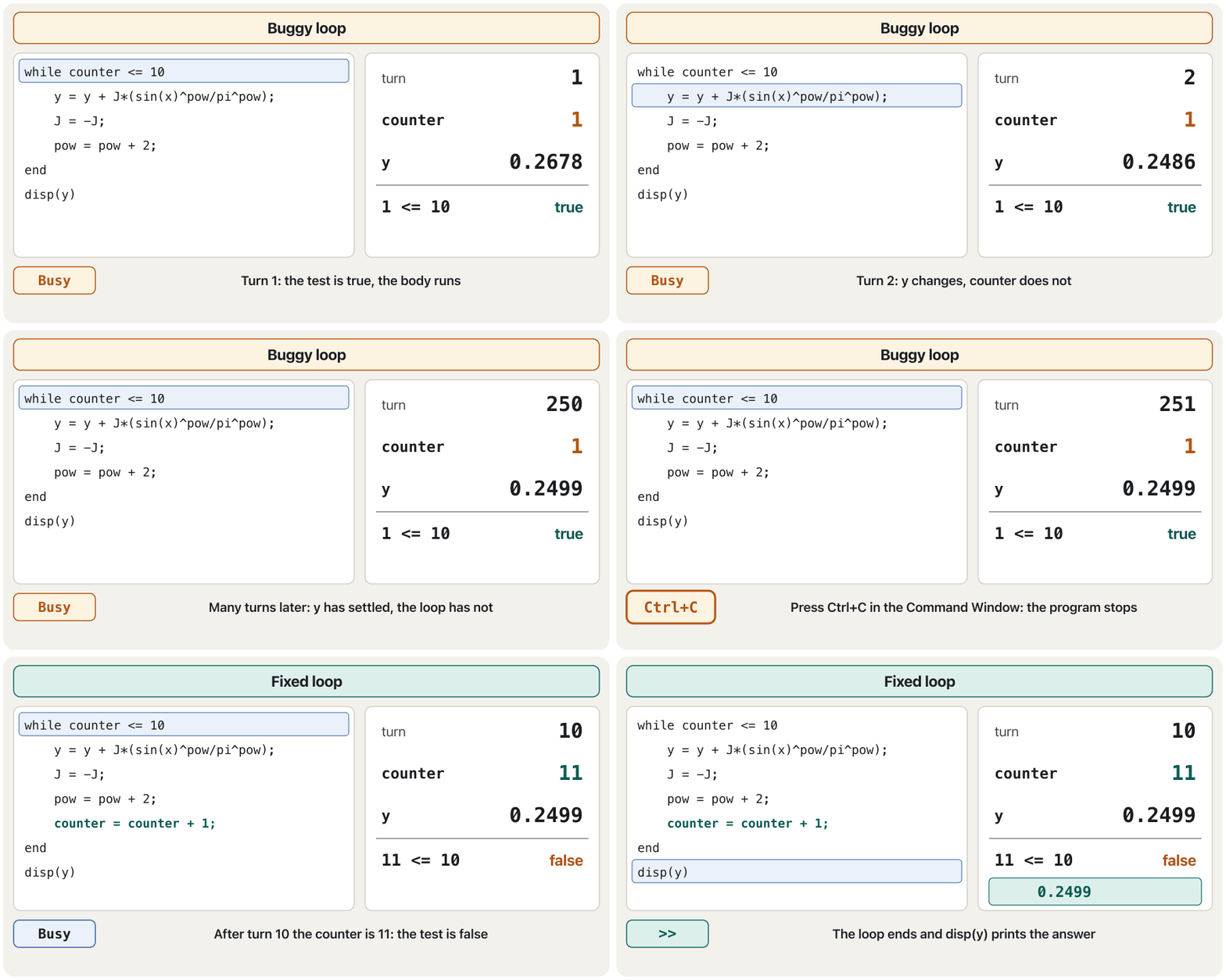
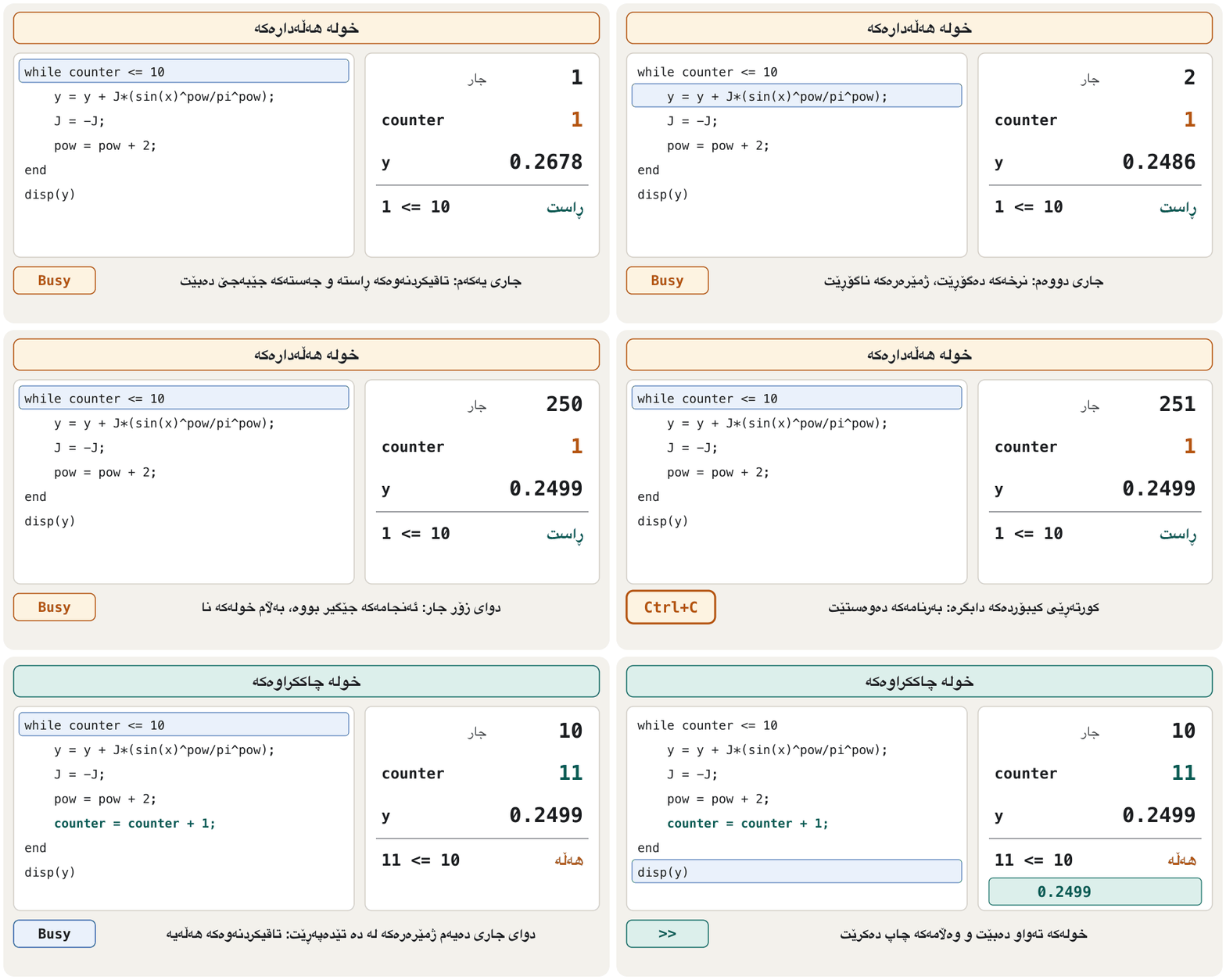
Spot the mistake: a loop that never endsهەڵەکە بدۆزەرەوە: خولێک کە هەرگیز کۆتایی نایەت
The fix, and what the program computesچاککردنەکە و ئەوەی بەرنامەکە هەژماری دەکات
x = input('x = ');
J = 1;
pow = 1;
y = 0;
counter = 1;
while counter <= 10
    y = y + J*(sin(x)^pow/pi^pow);
    J = -J;
    pow = pow + 2;
    counter = counter + 1;   % the missing change
end
disp(y)x = 1
0.2499Explain the codeڕوونکردنەوەی کۆدەکە
- Lineدێڕی 10
Now
countergrows 1, 2, …, 10, 11; at 11 the test fails and the loop ends.ئێستا
counterگەورە دەبێت 1، 2، …، 10، 11؛ لە 11دا تاقیکردنەوەکە سەرناکەوێت و تەواو دەبێت.
With the change in place the loop runs exactly ten times and adds
بە بوونی گۆڕانەکە ڕێک دە جار جێبەجێ دەبێت و ئەمە کۆ دەکاتەوە
For the ratio is and the sum is 0.2499 (checked with Python). J supplies the sign and pow the power .
بۆ ڕێژەکە ـە و کۆکە 0.2499ـە (بە Python پشکنراوە). J هێمای دەدات و pow .
Notice that this loop has a fixed number of turns (ten), so a for loop is the more natural choice: for k = 0:9 changes k by itself and cannot forget its change. While loops are for the cases where the number of turns is unknown — the next screens show them.
سەرنج بدە کە ئەم ژمارەیەکی جێگیری جاری هەیە (دە)، بۆیە هەڵبژاردنێکی سروشتیترە: for k = 0:9 خۆی k دەگۆڕێت و ناتوانێت گۆڕانەکەی لە بیر بکات. بۆ ئەو حاڵەتانەن کە ژمارەی جارەکان نەزانراوە — شاشەکانی داهاتوو پیشانیان دەدەن.
Program 4: a sum too big to be exactبەرنامە 4: کۆیەک گەورەتر لەوەی ورد بێت
Lab program 4 has the same missing counter = counter + 1;. With the fix it adds ten factorials with alternating signs, 1!, 5!, 9!, …, 37! (seq grows by 4 each turn):
4ـی تاقیگە هەمان counter = counter + 1;ـی ونبووی هەیە. بە چاککردنەکە دە بە هێمای گۆڕاو کۆ دەکاتەوە، 1!، 5!، 9!، …، 37! (seq هەموو جارێک 4 زیاد دەکات):
y = 0;
J = 1;
seq = 1;
counter = 1;
while counter <= 10
    y = y + J*factorial(seq);
    J = -J;
    seq = seq + 4;
    counter = counter + 1;   % added
end
disp(y)-1.3764e+43
The last term, , is so large that it decides the result.
دوایین بڕگە، ، ئەوەندە گەورەیە کە ئەنجامەکە دیاری دەکات.
The exact answer is a whole number with 44 digits: . MATLAB cannot hold it. A double stores every whole number exactly only up to ; MathWorks' page on factorial says the result is exact for and above that is right only in its first 15 digits. So MATLAB's −1.3764e+43 is a rounded answer: correct in its leading digits, wrong in the last ones. Read more in round-off, factorial and what computers cannot do exactly.
وەڵامە وردەکە بە 44 : . MATLAB ناتوانێت هەڵیبگرێت. double هەموو تەنها تا بە وردی هەڵدەگرێت؛ پەڕەی MathWorks دەربارەی factorial دەڵێت ئەنجامەکە بۆ وردە و لەوە زیاتر تەنها لە 15 یەکەمیدا دروستە. بۆیە −1.3764e+43ـی MATLAB وەڵامێکی نزیککراوەیە: لە دروستە، لە کۆتاییەکانیدا هەڵەیە. زیاتر بخوێنەرەوە لە هەڵەی نزیککردنەوە، فاکتۆریێل و ئەوەی کۆمپیوتەر ناتوانێت بە وردی بیکات.
Stopping at a special inputوەستان لەسەر نێوخستەیەکی تایبەت
Lab program 3 reads a number, prints its factorial, and reads again — until the user types a negative number. The negative number is not data; it is a signal that means stop. Programmers call such a value a . Nobody knows in advance how many numbers will come, so this is a job for while.
3ـی تاقیگە ژمارەیەک دەخوێنێتەوە، چاپ دەکات و دووبارە دەخوێنێتەوە — تا ژمارەیەکی سالب دەنووسێت. نییە؛ نیشانەیەکە بە واتای بوەستە. بەرنامەنووسان بەم جۆرە دەڵێن . کەس پێشوەختە نازانێت چەند ژمارە دێت، بۆیە ئەمە کاری whileـە.
x = input('x = ');
while x >= 0
    y = factorial(x)
    x = input('x = ')
endx = 4
y =
24
x = 0
x =
0
y =
1
x = 6
x =
6
y =
720
x = -1
x =
-1Explain the codeڕوونکردنەوەی کۆدەکە
- Lineدێڕی 1
Start value: the first number is read before the loop.
سەرەتا: یەکەم ژمارە پێش دەخوێندرێتەوە.
- Lineدێڕی 3-4
No semicolons, so MATLAB echoes
y = …andx = …after each input.نییە، بۆیە MATLAB دوای هەر
y = …وx = …پیشان دەداتەوە.- Lineدێڕی 4
The change: a new
xfrom the user. A negative one makesx >= 0false.گۆڕانەکە:
xـێکی نوێ لە .xـی سالبx >= 0هەڵە دەکات.
The program works, but its output is noisy, and the original sheet also wrote while(x>=0); with a semicolon after the condition — MATLAB accepts that empty statement, but it only confuses the reader. A tidier version prints one clear line per number with fprintf (printing with fprintf):
کار دەکات، بەڵام قەرەباڵغە و پەڕە ڕەسەنەکە while(x>=0);ـیشی نووسیوە بە دوای — MATLAB ئەو وەردەگرێت، بەڵام تەنها خوێنەر سەرگەردان دەکات. وەشانێکی ڕێکتر بۆ هەر ژمارەیەک یەک دێڕی ڕوون بە fprintf چاپ دەکات (چاپکردن بە fprintf):
x = input('Whole number (negative to stop): ');
while x >= 0
    fprintf('%d! = %d\n', x, factorial(x))
    x = input('Whole number (negative to stop): ');
end
disp('Goodbye')Whole number (negative to stop): 4 4! = 24 Whole number (negative to stop): 0 0! = 1 Whole number (negative to stop): 6 6! = 720 Whole number (negative to stop): -1 Goodbye
Explain the codeڕوونکردنەوەی کۆدەکە
- Lineدێڕی 4
The semicolon matters here: it stops MATLAB from echoing
x.لێرەدا گرنگە: ڕێگری دەکات لەوەی MATLAB
xپیشان بداتەوە.
When nobody knows the number of turnsکاتێک کەس ژمارەی جارەکان نازانێت
The strength of while is a question whose answer is how many times? Hana's new page has 10,000 followers and grows by 25 % a month. Soran's page has 60,000 and gains 5,000 a month. After how many months does Hana catch up? Count the turns, and print the situation before and after the loop so you can check it:
هێزی while لە پرسیارێکدایە کە وەڵامەکەی چەند جار؟ـە. پەڕە نوێیەکەی هانا 10,000 شوێنکەوتووی هەیە و مانگانە 25 % گەورە دەبێت. پەڕەکەی سۆران 60,000ـی هەیە و مانگانە 5,000 زیاد دەکات. دوای چەند مانگ هانا دەگاتە سۆران؟ جارەکان بژمێرە و دۆخەکە پێش و دوای چاپ بکە بۆ ئەوەی بتوانیت بیپشکنیت:
hana = 10000;
soran = 60000;
months = 0;
fprintf('Before the loop: Hana %d, Soran %d\n', hana, soran)
while hana < soran
    hana = 1.25*hana;
    soran = soran + 5000;
    months = months + 1;
end
fprintf('After %d months: Hana %.0f, Soran %d\n', months, hana, soran)Before the loop: Hana 10000, Soran 60000 After 11 months: Hana 116415, Soran 115000
Explain the codeڕوونکردنەوەی کۆدەکە
- Lineدێڕی 3
monthsis a : it starts at 0 and the body adds 1.months: بە 0 دەست پێدەکات و جەستەکە 1ی بۆ زیاد دەکات.- Lineدێڕی 5
Both values change inside the loop; the condition compares them.
هەردوو لەناو دەگۆڕێن؛ بەراوردیان دەکات.
- Lineدێڕی 10
%.0fprints Hana's 116415.32 without decimals.%.0f116415.32ـی هانا بێ چاپ دەکات.
Two more loops of the same kind (the guide shows the factorial one with 100; here with new numbers). The first finds the smallest n whose factorial is above 5000 — prod(1:n) multiplies . The second prints a running total until it passes 20:
دوو تر لە هەمان جۆر (ڕێبەرەکە نموونەی بە 100 پیشان دەدات؛ لێرە بە ژمارەی نوێ). یەکەمیان بچووکترین n دەدۆزێتەوە کە لە 5000 زیاترە — prod(1:n) لێک دەدات. دووەمیان کۆیەکی ڕۆیشتوو چاپ دەکات تا لە 20 تێدەپەڕێت:
n = 1;
while prod(1:n) <= 5000
    n = n + 1;
end
nn =
7Explain the codeڕوونکردنەوەی کۆدەکە
- Lineدێڕی 2
is still too small; is the first above 5000.
هێشتا بچووکە؛ یەکەمە کە لە 5000 زیاترە.
total = 0;
k = 0;
while total <= 20
k = k + 1;
total = total + k;
fprintf('k = %d, total = %d\n', k, total)
endk = 1, total = 1 k = 2, total = 3 k = 3, total = 6 k = 4, total = 10 k = 5, total = 15 k = 6, total = 21
Explain the codeڕوونکردنەوەی کۆدەکە
- Lineدێڕی 5
totalis an ; the line that grows it is also the change.total؛ ئەو دێڕەی گەورەی دەکات گۆڕانەکەشە.
When nobody knows the number of turnsکاتێک کەس ژمارەی جارەکان نازانێت
Walking along a vector with an indexڕۆیشتن بە درێژایی ئاڕاستەبڕێک بە ئیندێکسێک
The guide also walks an index i along a vector with while and stops in time. Here is the idea with new data: find the first element above 50.
ڕێبەرەکە بە while i بە درێژایی دەجوڵێنێت و لە کاتی خۆیدا دەوەستێت. ئەمە بیرۆکەکەیە بە نوێ: یەکەم بدۆزەرەوە کە لە 50 زیاترە.
v = [12 47 33 58 91 20];
i = 1;
while i <= length(v) && v(i) <= 50
i = i + 1;
end
fprintf('Element %d is %d\n', i, v(i))Element 4 is 58
Explain the codeڕوونکردنەوەی کۆدەکە
- Lineدێڕی 3
&&testsi <= length(v)first. If i has passed the end, it never looks atv(i), so there is no index error.&&یەکەم جارi <= length(v)تاقی دەکاتەوە. ئەگەر i لە کۆتایی تێپەڕیبێت، هەرگیز سەیریv(i)ناکات، بۆیە ڕوو نادات.
This is the of && at work. With v = [12 47 33] the loop stops with i = 4, which is past the end — so check i <= length(v) before you use v(i) after the loop. The one-line MATLAB way is find(v > 50, 1) (comparing a whole vector).
ئەمە &&ـە لە کاردا. بە v = [12 47 33] بە i = 4 دەوەستێت کە لە کۆتایی تێپەڕیوە — بۆیە پێش ئەوەی دوای v(i) بەکار بهێنیت، i <= length(v) بپشکنە. ڕێگای یەک دێڕیی MATLAB find(v > 50, 1)ـە (بەراوردکردنی ئاڕاستەبڕێکی تەواو).
When nobody knows the number of turnsکاتێک کەس ژمارەی جارەکان نازانێت
Filling a vector step by stepپڕکردنەوەی ئاڕاستەبڕێک هەنگاو بە هەنگاو
The guide's first example on its second while page uses the same index walk to fill a vector. It makes x values from 0 to 2 in steps of h, a vector y of zeros with the same size (y = 0*x), sets y(1) = 1, and then computes every new element from the one before it, y(i+1) = y(i) + h*(…), until i reaches the last position, max(size(x)) — the same number as length(x). At the end it draws plot(x, y, 'go'). Here is the pattern with a short new rule: each new value lies halfway between the old value and x(i).
یەکەم نموونەی پەڕەی دووەمی whileـی ڕێبەرەکە هەمان ڕۆیشتنی بەکار دەهێنێت بۆ پڕکردنەوەی . x لە 0 تا 2 بە هەنگاوی h دروست دەکات، y لە سفر بە هەمان قەبارە (y = 0*x)، y(1) = 1 دادەنێت و پاشان هەر نوێ لە پێشوویەوە هەژمار دەکات، y(i+1) = y(i) + h*(…)، تا i دەگاتە دوایین شوێن، max(size(x)) — هەمان ژمارەی length(x). لە کۆتاییدا plot(x, y, 'go') دەکێشێت. ئەمە هەمان شێوازە بە یاسایەکی نوێی کورت: هەر نوێ لە نیوەڕێی نێوان و x(i)ـدایە.
h = 0.5;
x = 0:h:2; % 0 0.5 1 1.5 2
y = zeros(size(x)); % room for every value (the guide writes 0*x)
y(1) = 1; % the start value
i = 1;
while i < length(x) % the guide writes max(size(x))
y(i+1) = y(i) + h*(x(i) - y(i));
i = i + 1;
end
yy =
1.0000 0.5000 0.5000 0.7500 1.1250Explain the codeڕوونکردنەوەی کۆدەکە
- Lineدێڕی 3
Make room for all the values before the loop, so MATLAB does not have to grow
yat every turn.پێش شوێن بۆ هەموو دابنێ ()، بۆ ئەوەی MATLAB ناچار نەبێت لە هەموو جارێکدا
yگەورە بکات.- Lineدێڕی 6
<and not<=: the body writesy(i+1), soimust stop one before the last position.<نەک<=: جەستەکەy(i+1)دەنووسێت، بۆیە دەبێتiیەک شوێن پێش کۆتایی بوەستێت.- Lineدێڕی 7
With h = 0.5 this is the average of
y(i)andx(i): 1, 0.5, 0.5, 0.75, 1.125.بە h = 0.5 ئەمە ناوەندی
y(i)وx(i)ـە: 1، 0.5، 0.5، 0.75، 1.125.
A rule that builds each value from the previous one is how computers follow anything that changes step by step — a balance month by month, or (in a numerical-analysis course) the solution of an equation of change. The loop is a while here because the guide wrote it so; since the number of turns is known (length(x) - 1), for i = 1:length(x)-1 does the same job.
یاسایەک کە هەر لە پێشوویەوە دروست دەکات، ڕێگای کۆمپیوتەرە بۆ بەدواداچوونی هەر شتێک کە هەنگاو بە هەنگاو دەگۆڕێت — بڕی پارەی هەژمارێکی بانک مانگ بە مانگ، یان (لە کۆرسێکی شیکاریی ژمارەییدا) چارەسەری گۆڕان. لێرەدا whileـە چونکە ڕێبەرەکە وای نووسیوە؛ بەڵام ژمارەی جارەکان زانراوە (length(x) - 1)، بۆیە for i = 1:length(x)-1 هەمان کار دەکات.
break: leaving a loop at oncebreak: یەکسەر جێهێشتنی خولێک
Sometimes the reason to stop appears in the middle of the body. The ends the loop immediately: the rest of the body is skipped, no more turns happen, and MATLAB continues with the first statement after the loop's end. break works in for and while loops alike — MathWorks' page puts it simply: the statements after break in the loop do not run.
هەندێک جار هۆکاری وەستان لە ناوەڕاستی جەستەکەدا دەردەکەوێت. یەکسەر کۆتایی پێ دەهێنێت: باقیی جەستەکە باز دەدرێت، هیچ جارێکی تر ڕوو نادات و MATLAB بە یەکەم دوای endـی بەردەوام دەبێت. break لە for و whileـدا وەک یەک کار دەکات — پەڕەی MathWorks بە سادەیی دەڵێت: دوای break لە جێبەجێ نابن.
break: leaving a loop at oncebreak: یەکسەر جێهێشتنی خولێک
Spot the mistakes: the average after breakهەڵەکان بدۆزەرەوە: ناوەند دوای break
A lab program reads the marks of four subjects and stops at the first mark below 50. Then it prints the average. Here it is as it was typed in the lab (re-typed from a photo):
تاقیگە نمرەی چوار وانە دەخوێنێتەوە و لە یەکەم نمرەی خوار 50دا دەوەستێت. پاشان چاپ دەکات. ئەمە وەک ئەوەیە کە لە تاقیگەدا نووسراوە (لە وێنەیەکەوە دووبارە نووسراوەتەوە):
sum = 0;
for i = 1:4
n = input('inter the subject mark ');
if n >= 50
sum = sum + n;
else
break
end
end
avg = sum/4inter the subject mark 70 inter the subject mark 85 inter the subject mark 40 avg = 38.7500
Marks 70 and 85 were added, then 40 triggered break. The program still divides by 4, so it reports 38.75 for a student whose two counted marks average 77.5. The three mistakes:
نمرەکانی 70 و 85 کۆ کرانەوە، پاشان 40 breakـی چالاک کرد. هێشتا دابەشی 4 دەکات، بۆیە 38.75 ڕادەگەیەنێت بۆ قوتابییەک کە دوو نمرە ژمێردراوەکەی 77.5ـە. سێ هەڵەکە:
- Dividing by the planned count. After a
break, fewer than four marks were added. Count the marks you really add and divide by that count. - A variable called
sum. It hides MATLAB's ownsumfunction for the rest of the session (the rule is explained in the accumulator). Call ittotal. - The prompt says inter. It should say Enter, and a colon and a space make the prompt easier to read.
- دابەشکردن بە ژمارەی پلاندانراو. دوای
breakکەمتر لە چوار نمرە کۆ کرانەوە. ئەو نمرانە بژمێرە کە بەڕاستی کۆیان دەکەیتەوە و بەو ژمارەیە دابەشی بکە. - بە ناوی
sum. بۆ باقیی کارەکەتsumـی خودی MATLAB دەشارێتەوە (یاساکە لە گۆڕاوی کۆکردنەوە ڕوون کراوەتەوە). ناوی بنێtotal. - دەڵێت inter. دەبێت بڵێت Enter؛ دوو خاڵ و خوێندنەوەی ئاسانتر دەکەن.
total = 0;
count = 0;
for i = 1:4
mark = input('Enter the subject mark: ');
if mark < 50
break % leave the loop at once
end
total = total + mark;
count = count + 1;
end
if count > 0
avg = total/count
else
disp('No marks were added.')
endEnter the subject mark: 70 Enter the subject mark: 85 Enter the subject mark: 40 avg = 77.5000
Explain the codeڕوونکردنەوەی کۆدەکە
- Lineدێڕی 2
A second counter for the marks actually added.
دووەم بۆ ئەو نمرانەی بەڕاستی کۆ کراونەتەوە.
- Lineدێڕی 11-15
If the very first mark is below 50,
countis 0: say so instead of dividing by zero.ئەگەر یەکەم نمرە لە خوار 50 بێت،
count0ـە: ئەوە بڵێ لە جیاتی دابەشکردن بە سفر.
| Marks typedنمرە نووسراوەکان | Lab program تاقیگە | Corrected program |
|---|---|---|
| 70, 85, 40 | avg = 38.7500 | avg = 77.5000 |
| 66, 74, 58, 90 | avg = 72 | avg = 72 |
| 30 | avg = 0 | No marks were added. |
break: leaving a loop at oncebreak: یەکسەر جێهێشتنی خولێک
while true … break: ask until the answer is validwhile true … break: بپرسە تا وەڵامەکە دروست دەبێت
MATLAB has no , which runs its body first and tests afterwards. MathWorks' page on while shows the usual replacement: a loop whose condition is always true, with an if … break at the point where you can decide. It is ideal for checking input ():
MATLAB نییە کە یەکەم جار جەستەکەی جێبەجێ دەکات و پاشان تاقی دەکاتەوە. پەڕەی MathWorks دەربارەی while جێگرەوە باوەکە پیشان دەدات: کە هەمیشە trueـە و if … breakـێک لەو شوێنەی دەتوانیت بڕیار بدەیت. بۆ پشکنینی () زۆر گونجاوە:
while true
mark = input('Mark (0-100): ');
if mark >= 0 && mark <= 100
break
end
disp('Please type a number from 0 to 100.')
end
fprintf('Saved mark: %d\n', mark)Mark (0-100): 120 Please type a number from 0 to 100. Mark (0-100): -5 Please type a number from 0 to 100. Mark (0-100): 85 Saved mark: 85
Explain the codeڕوونکردنەوەی کۆدەکە
- Lineدێڕی 1
truenever becomes false, so the only way out isbreak.trueهەرگیز هەڵە نابێت، بۆیە تاکە ڕێگای دەرچوونbreakـە.- Lineدێڕی 3-5
The test sits after the input: a valid mark leaves the loop.
تاقیکردنەوەکە دوای دێت: نمرەیەکی دروست جێدەهێڵێت.
break: leaving a loop at oncebreak: یەکسەر جێهێشتنی خولێک
break leaves only the innermost loopbreak تەنها ناوەکیترین خول جێدەهێڵێت
In a , break ends only the loop it is written in. The outer loop carries on with its next turn:
لە break تەنها ئەو کۆتایی پێ دەهێنێت کە تێیدا نووسراوە. بە جاری داهاتووی بەردەوام دەبێت:
for i = 1:3
for j = 1:3
if j == 2
break % ends the j loop only
end
fprintf('i = %d, j = %d\n', i, j)
end
endi = 1, j = 1 i = 2, j = 1 i = 3, j = 1
break belongs inside a loop. Written outside any loop it is an error in a MATLAB file. To leave a function early you use return instead (leaving early with return).
break شوێنی لەناو . ئەگەر لە دەرەوەی هەموو بنووسرێت، لە MATLABـدا . بۆ زوو جێهێشتنی لە جیاتی ئەوە return بەکار دەهێنیت (زوو دەرچوون بە return).
continue: skipping the rest of one turncontinue: بازدان بە سەر باقیی یەک جاردا
The is the gentle cousin of break: it skips the rest of the current turn and goes straight to the next one; the loop itself goes on. Here −1 marks an absent student, and the absent ones are skipped:
ئامۆزای نەرمی breakـە: باقیی جاری ئێستا باز دەدات و ڕاستەوخۆ دەچێت بۆ جاری داهاتوو؛ خودی بەردەوام دەبێت. لێرەدا نیشانەی قوتابیی ئامادەنەبووە و ئامادەنەبووەکان باز دەدرێن:
marks = [72 -1 88 95 -1 60]; % -1 = absent
total = 0;
count = 0;
for m = marks
if m < 0
continue % skip this turn
end
total = total + m;
count = count + 1;
end
fprintf('%d marks, mean %.2f\n', count, total/count)4 marks, mean 78.75
Explain the codeڕوونکردنەوەی کۆدەکە
- Lineدێڕی 6
For −1, lines 8 and 9 are skipped and the loop takes the next mark.
بۆ ، دێڕەکانی 8 و 9 باز دەدرێن و نمرەی داهاتوو وەردەگرێت.
MATLAB can also do this job without a loop: mean(marks(marks >= 0)) keeps only the marks that pass the test (comparing a whole vector). Use continue when the body is long and you want to drop the unwanted cases early.
MATLAB دەتوانێت ئەم کارە بەبێ بکات: mean(marks(marks >= 0)) تەنها ئەو نمرانە دەهێڵێتەوە کە لە تاقیکردنەوەکە دەردەچن (بەراوردکردنی ئاڕاستەبڕێکی تەواو). continue بەکار بهێنە کاتێک جەستەکە درێژە و دەتەوێت حاڵەتە نەویستراوەکان زوو لاببەیت.
for or while?for یان while؟
| The jobکارەکە | Loop | Whyبۆچی |
|---|---|---|
| Add the 10 marks of a classکۆکردنەوەی 10 نمرەی پۆلێک | for | the number of turns is knownژمارەی جارەکان زانراوە |
| Do something with every element of a vectorکارێک لەگەڵ هەموو | for | for x = v takes each element in turnfor x = v هەر بە نۆبە وەردەگرێت |
| Read numbers until a negative oneخوێندنەوەی ژمارە تا | while | nobody knows how many will comeکەس نازانێت چەندیان دێت |
| Double until the amount passes 1000دوو هێندەکردن تا بڕەکە لە 1000 تێدەپەڕێت | while | the answer is the number of turnsوەڵامەکە خودی ژمارەی جارەکانە |
| Halve an interval until it is small enoughنیوەکردنی تا بەس بچووک دەبێت | while | stops when an accuracy is reached (finding roots)کاتێک وردییەک بەدەست هات دەوەستێت (دۆزینەوەی ڕەگ) |
A useful rule: if you can write the number of turns before the loop starts, use for — it changes its variable by itself, so it cannot become infinite by accident. If the loop must stop when something happens, use while and check its three parts.
یاسایەکی بەسوود: ئەگەر دەتوانیت ژمارەی جارەکان پێش دەستپێکردنی بنووسیت، for بەکار بهێنە — خۆی دەگۆڕێت، بۆیە بە هەڵە نابێتە . ئەگەر دەبێت کاتێک شتێک ڕوو دەدات بوەستێت، while بەکار بهێنە و سێ بەشەکەی بپشکنە.
Common mistakesهەڵە باوەکان
| Mistakeهەڵە | What happensچی ڕوو دەدات | Fixچاککردن |
|---|---|---|
| No change inside the loop (lab programs 2 and 4)هیچ گۆڕانێک لەناو نییە ( 2 و 4ـی تاقیگە) | an infinite loop; Busy for ever؛ Busy بۆ هەمیشە | add the change, e.g. counter = counter + 1;; stop with Ctrl+Cگۆڕانەکە زیاد بکە، بۆ نموونە counter = counter + 1;؛ بە Ctrl+C بیوەستێنە |
A change in the wrong direction (amount = amount/2 while waiting to pass 1000)گۆڕان بە ئاڕاستەی هەڵە (amount = amount/2 کاتێک چاوەڕێی تێپەڕینی 1000 دەکەیت) | an infinite loop | make the change move towards a false conditionگۆڕانەکە بەرەو هەڵە ببە |
| A condition that is false at the start کە لە سەرەتادا هەڵەیە | the body runs zero times, silentlyجەستەکە سفر جار جێبەجێ دەبێت، بە بێدەنگی | check the start values سەرەتا بپشکنە |
Testing a decimal for exact equality: x = 0; while x ~= 1, x = x + 0.1; endتاقیکردنەوەی ژمارەی دەیی بۆ یەکسانیی ڕێک: x = 0; while x ~= 1, x = x + 0.1; end | ten steps of 0.1 give 0.9999999999999999, never exactly 1: infiniteدە هەنگاوی 0.1 دەبێتە 0.9999999999999999، هەرگیز ڕێک 1 نا: بێکۆتا | use < or a tolerance: while x < 1 - 1e-9 (round-off)< یان پەراوێزێک بەکار بهێنە: while x < 1 - 1e-9 (هەڵەی نزیککردنەوە) |
Dividing by the planned count after breakدابەشکردن بە ژمارەی پلاندانراو دوای break | a wrong average (38.75 instead of 77.5) هەڵە (38.75 لە جیاتی 77.5) | count what was really addedئەوە بژمێرە کە بەڕاستی کۆ کراوەتەوە |
continue before the change in a while loopcontinue پێش گۆڕان لە whileـدا | the change is skipped: infiniteگۆڕانەکە باز دەدرێت: بێکۆتا | change first, then continueیەکەم گۆڕان، پاشان continue |
break outside a loopbreak لە دەرەوەی | an error | use return to leave a functionبۆ جێهێشتنی return بەکار بهێنە |
Practiceڕاهێنان
Write a while loop that counts the digits of a positive whole number n. Test it with 70321. Hint: fix(n/10) drops the last digit.
بنووسە کە موجەبی n بژمێرێت. بە 70321 تاقیی بکەرەوە. ڕێنمایی: fix(n/10) دوایین لادەبات.
Hintئاماژە
Start value ndigits = 0; condition n > 0; change n = fix(n/10).
سەرەتا ndigits = 0؛ n > 0؛ گۆڕان n = fix(n/10).
Show answerوەڵامەکە پیشان بدە
n = 70321;
ndigits = 0;
while n > 0
n = fix(n/10);
ndigits = ndigits + 1;
end
ndigitsndigits =
5Explain the codeڕوونکردنەوەی کۆدەکە
- Lineدێڕی 4
The change: 70321 → 7032 → 703 → 70 → 7 → 0.
گۆڕانەکە: 70321 ← 7032 ← 703 ← 70 ← 7 ← 0.
Karwan puts 250,000 IQD in a savings account that adds 5 % every year. After how many years is the balance at least 400,000 IQD, and what is it then? Print both with fprintf.
کاروان 250,000 دینار لە هەژمارێکی پاشەکەوتدا دادەنێت کە ساڵانە 5 % زیاد دەکات. دوای چەند ساڵ بڕی هەژمارەکە لانیکەم 400,000 دینار دەبێت و ئەو کاتە چەندە؟ هەردووکیان بە fprintf چاپ بکە.
Show answerوەڵامەکە پیشان بدە
balance = 250000;
years = 0;
while balance < 400000
    balance = 1.05*balance;
    years = years + 1;
end
fprintf('%d years, %.2f IQD\n', years, balance)10 years, 407223.66 IQD
Start with p = 1 and multiply by 3 while the next power is still below 1000. What is p at the end?
بە p = 1 دەست پێبکە و مادام توانی داهاتوو هێشتا لە خوار 1000دایە، لێکی بدە لە 3. p لە کۆتاییدا چەندە؟
Show answerوەڵامەکە پیشان بدە
p = 1;
while 3*p < 1000
    p = 3*p;
end
pp = 729
; the next power, , is above 1000.
؛ توانی داهاتوو، ، لە 1000 زیاترە.
Fill a trace table for the first three turns of the buggy lab program 2 with x = 1: the values of counter, J, pow and y at the end of each turn. What tells you the loop will never end?
بۆ سێ جاری یەکەمی 2ـی هەڵەداری تاقیگە بە x = 1 پڕ بکەرەوە: counter، J، pow و y لە کۆتایی هەر جارێکدا. چی پێت دەڵێت هەرگیز کۆتایی نایەت؟
Show answerوەڵامەکە پیشان بدە
| Turnجار | counter | J | pow | y |
|---|---|---|---|---|
| 1 | 1 | −1 | 3 | 0.2678 |
| 2 | 1 | 1 | 5 | 0.2486 |
| 3 | 1 | −1 | 7 | 0.2500 |
The counter column never changes, so counter <= 10 can never become false.
ستوونی counter هەرگیز ناگۆڕێت، بۆیە counter <= 10 هەرگیز ناتوانێت هەڵە بێت.
Start with n = 6. While n is not 1: if n is even, halve it; otherwise replace it with . Count the steps and print the numbers you visit. (Nobody has proved that this loop ends for every start — a famous open question.)
بە n = 6 دەست پێبکە. مادام n یەکسان نییە بە 1: ئەگەر n جووت بوو، نیوەی بکە؛ ئەگینا بیکە بە . هەنگاوەکان بژمێرە و ئەو ژمارانەی پێیاندا تێدەپەڕیت چاپ بکە. (کەس نەیسەلماندووە کە ئەم بۆ هەموو سەرەتایەک کۆتایی دێت — پرسیارێکی کراوەی بەناوبانگە.)
Show answerوەڵامەکە پیشان بدە
n = 6;
steps = 0;
fprintf('%d ', n)
while n ~= 1
    if mod(n, 2) == 0
        n = n/2;
    else
        n = 3*n + 1;
    end
    steps = steps + 1;
    fprintf('%d ', n)
end
fprintf('\n%d steps\n', steps)6 3 10 5 16 8 4 2 1 8 steps
Improve the tidy version of lab program 3: if the number is not whole (for example 2.5), print Whole numbers only and ask again instead of stopping with an error.
وەشانە ڕێکخراوەکەی 3ـی تاقیگە باشتر بکە: ئەگەر ژمارەکە تەواو نەبوو (بۆ نموونە 2.5)، Whole numbers only چاپ بکە و دووبارە بپرسە لە جیاتی ئەوەی بە بوەستێت.
Show answerوەڵامەکە پیشان بدە
x = input('Whole number (negative to stop): ');
while x >= 0
    if x == fix(x)
        fprintf('%d! = %d\n', x, factorial(x))
    else
        disp('Whole numbers only')
    end
    x = input('Whole number (negative to stop): ');
end
disp('Goodbye')Whole number (negative to stop): 5 5! = 120 Whole number (negative to stop): 2.5 Whole numbers only Whole number (negative to stop): -1 Goodbye
Summaryپوختە
while condition … endrepeats while the condition is true; it is tested before every turn, so the body may run zero times.- Every while loop needs a start value, a condition and a change that moves the condition towards false.
- No change (lab programs 2 and 4) means an : press Ctrl+C in the Command Window.
- A such as a negative number ends input loops;
while true … if … break … endasks again until the input is valid. breakends the innermost loop at once — afterwards, divide by what was really counted.continueskips only the rest of the current turn.- Known number of turns →
for; until something happens →while. Huge factorials are stored as rounded doubles.
while condition … endمادام ڕاست بێت دووبارە دەکاتەوە؛ پێش هەموو جارێک تاقی دەکرێتەوە، بۆیە لەوانەیە جەستەکە سفر جار جێبەجێ ببێت.- هەموو پێویستی بە سەرەتا، و گۆڕانێک هەیە کە بەرەو هەڵە ببات.
- نەبوونی گۆڕان ( 2 و 4ـی تاقیگە) واتە : لە Command Window Ctrl+C دابگرە.
- وەک کۆتایی پێ دەهێنێت؛
while true … if … break … endدووبارە دەپرسێت تا دروست دەبێت. breakیەکسەر ناوەکیترین کۆتایی پێ دەهێنێت — دوای ئەوە بەوە دابەش بکە کە بەڕاستی ژمێردراوە.continueتەنها باقیی جاری ئێستا باز دەدات.- ژمارەی زانراوی جار ←
for؛ تا شتێک ڕوو دەدات ←while. وەکdoubleـی نزیککراوە هەڵدەگیرێن.
If you know Python: its while loop works the same way, including endless loops stopped with Ctrl+C and break/continue — see infinite loops in Python and break.
ئەگەر Python دەزانیت: لەوێدا بە هەمان شێوە کار دەکات، بە کە بە Ctrl+C دەوەستێنرێن و break/continue — بڕوانە خولە بێکۆتاکان لە Pythonـدا و break.
A while loop prints nothing and MATLAB says Busy. What is the most likely cause?خولێکی while هیچ چاپ ناکات و MATLAB دەڵێت Busy. ئەگەری زۆری هۆکار چییە؟
Nothing in the body changes the variables of the condition, so it stays true. Press Ctrl+C, then add or fix the change.
هیچ شتێک لە جەستەکەدا ناگۆڕێت، بۆیە ڕاست دەمێنێتەوە. Ctrl+C دابگرە، پاشان گۆڕانەکە زیاد بکە یان چاکی بکە.
Why is while true not always a bug?بۆچی while true هەمیشە باگ نییە؟
Because a break inside the loop can end it at the right moment — the usual way to ask again until the input is valid.
چونکە breakـێک لەناو دەتوانێت لە کاتی گونجاودا کۆتایی پێ بهێنێت — ڕێگای باوی دووبارە پرسین تا دروست دەبێت.
What does break do inside two nested loops?break لەناو خولێکی ناوەکیدا چی دەکات؟
It ends only the inner loop; the outer loop continues with its next turn.
تەنها کۆتایی پێ دەهێنێت؛ بە جاری داهاتووی بەردەوام دەبێت.
Lesson complete!وانەکە تەواو بوو!
Well done. Review the key terms, then go on to the next lesson.دەستخۆش. سەیرێکی زاراوە سەرەکییەکان بکەرەوە، پاشان بڕۆ بۆ وانەی داهاتوو.
Key termsزاراوە سەرەکییەکان
Function Files and Anonymous Functionsفایلەکانی کردار و کردارە بێناوەکان
Related lecturesوانە پەیوەندیدارەکان
- Algorithms, Pseudocode and Flowchartsئەلگۆریزمەکان، نیمچەکۆد و هێڵکارییەکانی ڕەوت
- Function Files and Anonymous Functionsفایلەکانی کردار و کردارە بێناوەکان
- Project: Finding Roots Numericallyپڕۆژە: دۆزینەوەی ڕەگ بە ڕێگە ژمارەییەکان
- MATLAB as a Calculator: Operators, Variables and FormatsMATLAB وەک حاسیبە: کارپێکەرەکان، گۆڕاوەکان و شێوەکانی پیشاندان
- The while Loopخولی while
- Controlling Loops: break and continueکۆنترۆڵکردنی خولەکان:
breakوcontinue - What Computers Do Well and Where They Fall Shortکۆمپیوتەرەکان لە چیدا باشن و لە کوێدا کەم دەهێنن
References and further readingسەرچاوەکان و خوێندنەوەی زیاتر
This lecture is a first edition. The Kurdish text and terminology are waiting for review by Kurdish IT teachers.ئەم وانەیە چاپی یەکەمە. دەقە کوردییەکە و زاراوەکانی چاوەڕێی پێداچوونەوەی مامۆستایانی کوردی بواری IT ن.