Chapterبەش 4 · Lectureوانە 4.2

Trigonometric Identitiesهاوئەنجامە سێگۆشەییەکان

The eight basic identities of the notes and where they come from: Pythagoras on the unit circle, the sum and difference formulas, and the double-angle forms — with both worked examples of the notes, including the homework proof.

هەشت بنەڕەتییەکەی تێبینییەکان و ئەوەی لە کوێوە دێن: فیساغۆرس لەسەر ، یاساکانی کۆ و جیاوازی و شێوەکانی دوو هێندەی گۆشە — لەگەڵ هەردوو نموونە چارەسەرکراوەکەی تێبینییەکان، ئەرکی ماڵەوەش.

10 min read11 خولەک خوێندنەوە · 15 stepsهەنگاو

What you will learnچی فێر دەبیت

  • Tell an identity from an equation.
  • Derive identities 2, 3, 7 and 8 from identity 1 and the sum formulas.
  • Use the sum and difference formulas to find exact values such as sin⁡75∘\sin75^\circ.
  • Prove simple identities step by step and explain where an absolute value comes from.
  • لە جیا بکەیتەوە.
  • 2، 3، 7 و 8 لە 1 و یاساکانی کۆوە دەربهێنیت.
  • یاساکانی کۆ و جیاوازی بەکار بهێنیت بۆ دۆزینەوەی نرخی ورد، وەک sin⁡75∘\sin75^\circ.
  • سادەکان هەنگاو بە هەنگاو بسەلمێنیت و ڕوونی بکەیتەوە لە کوێوە دێت.

Equation or identity?هاوکێشە یان هاوئەنجام؟

The equation sin⁡θ=12\sin\theta=\frac12 is true only for some angles (π6\frac{\pi}{6}, 5π6\frac{5\pi}{6} and the angles a full turn away from them). The equation cos⁡2θ+sin⁡2θ=1\cos^2\theta+\sin^2\theta=1 is different: it is true for every angle. An equation that is true for every value where both sides are defined is called an identity.

sin⁡θ=12\sin\theta=\frac12 تەنها بۆ هەندێک گۆشە ڕاستە (π6\frac{\pi}{6}، 5π6\frac{5\pi}{6} و ئەو گۆشانەی سووڕانەوەیەکی تەواو لێیانەوە دوورن). cos⁡2θ+sin⁡2θ=1\cos^2\theta+\sin^2\theta=1 جیاوازە: بۆ هەموو گۆشەیەک ڕاستە. کە بۆ هەموو ئەو نرخانەی هەردوو لاکەی تێیدا پێناسە کراون ڕاست بێت، پێی دەوترێت .

Definitionپێناسە

An between trigonometric functions that holds for every angle where both sides are defined.

لە نێوان کە بۆ هەموو گۆشەیەک ڕاستە کە هەردوو لاکەی تێیدا پێناسە کرابن.

Everyday analogyنموونەیەک لە ژیانی ڕۆژانەوە

From the bazaar to the citadel there are two roads: a short steep one and a longer flat one. Both always end at the same place. An identity is like that: two expressions that look different but always give the same value, so you may take whichever road is easier for the job in front of you.

لە بازاڕەوە بۆ قەڵا دوو ڕێگا هەیە: یەکێکی کورت و هەوراز و یەکێکی درێژتر و تەخت. هەردووکیان هەمیشە دەگەنە هەمان شوێن. وایە: دوو کە جیاواز دەردەکەون بەڵام هەمیشە هەمان نرخ دەدەن، بۆیە دەتوانیت ئەو ڕێگایە بگریت کە بۆ کارەکەی بەردەستت ئاسانترە.

Where the analogy stops workingسنووری ئەم نموونەیە

Some roads close at certain points: an identity with tan⁡\tan or sec⁡\sec says nothing where cos⁡θ=0\cos\theta=0, because one side is undefined there.

هەندێک ڕێگا لە هەندێک شوێندا دادەخرێن: کە tan⁡\tan یان sec⁡\secـی تێدا بێت لەو شوێنانەی cos⁡θ=0\cos\theta=0ـە هیچ ناڵێت، چونکە لایەکی پێناسە نەکراوە.

Quick checkپشکنینی خێراWhich one is an identity?کامیان ؟

The eight basic identitiesهەشت هاوئەنجامە بنەڕەتییەکە

The notes list eight basic identities. You do not have to learn them as eight separate facts: they grow from two roots — the unit circle (identity 1) and the sum formulas (identities 4 and 5).

تێبینییەکان هەشت بنەڕەتی دەنووسن. پێویست ناکات وەک هەشت ڕاستیی جیاواز لەبەریان بکەیت: لە دوو ڕەگەوە دێن — ( ⁦1⁩) و یاساکانی کۆ ( 4 و ⁦5⁩).

The basic identities of the notes and their roots بنەڕەتییەکانی تێبینییەکان و ڕەگەکانیان
No.ژ.IdentityWhere it comes fromلە کوێوە دێت
1cos⁡2θ+sin⁡2θ=1\cos^2\theta+\sin^2\theta=1The unit circle: x2+y2=1x^2+y^2=1: x2+y2=1x^2+y^2=1
2sec⁡2θ=1+tan⁡2θ\sec^2\theta=1+\tan^2\thetaIdentity 1 divided by cos⁡2θ\cos^2\theta 1 دابەشی cos⁡2θ\cos^2\theta بکە
3csc⁡2θ=1+cot⁡2θ\csc^2\theta=1+\cot^2\thetaIdentity 1 divided by sin⁡2θ\sin^2\theta 1 دابەشی sin⁡2θ\sin^2\theta بکە
4cos⁡(x±y)=cos⁡xcos⁡y∓sin⁡xsin⁡y\cos(x\pm y)=\cos x\cos y\mp\sin x\sin ySum and difference formulaیاسای کۆ و جیاوازی
5sin⁡(x±y)=sin⁡xcos⁡y±cos⁡xsin⁡y\sin(x\pm y)=\sin x\cos y\pm\cos x\sin ySum and difference formulaیاسای کۆ و جیاوازی
6tan⁡(x±y)=tan⁡x±tan⁡y1∓tan⁡xtan⁡y\tan(x\pm y)=\frac{\tan x\pm\tan y}{1\mp\tan x\tan y}Identity 5 divided by identity 4 5 دابەشی 4 بکە
7cos⁡2θ=12(1+cos⁡2θ)\cos^2\theta=\frac12(1+\cos2\theta)Identity 4 with x=y=θx=y=\theta, then identity 1 4 بە x=y=θx=y=\theta، پاشان 1
8sin⁡2θ=12(1−cos⁡2θ)\sin^2\theta=\frac12(1-\cos2\theta)Identity 4 with x=y=θx=y=\theta, then identity 1 4 بە x=y=θx=y=\theta، پاشان 1

You can test any of them yourself: put in an angle such as θ=π3\theta=\frac{\pi}{3} and compare the two sides. The next screens show where each one comes from.

دەتوانیت خۆت هەریەکەیان تاقی بکەیتەوە: گۆشەیەک وەک θ=π3\theta=\frac{\pi}{3} دابنێ و هەردوو لاکە بەراورد بکە. شاشەکانی داهاتوو پیشان دەدەن هەریەکەیان لە کوێوە دێت.

Quick checkپشکنینی خێراWhich identity is the root of identities 2 and 3?کام ڕەگی 2 و 3ـە؟

Identity 1: the Pythagorean identityهاوئەنجامی 1: هاوئەنجامی فیساغۆرس

Draw the right triangle under the point P=(cos⁡θ,sin⁡θ)P=(\cos\theta,\sin\theta) of the unit circle. Its legs are cos⁡θ\cos\theta and sin⁡θ\sin\theta and its hypotenuse is the radius, 1. Pythagoras' theorem gives identity 1 at once. (You met it in the trigonometric functions lesson.)

سێگۆشە گۆشەوەستاوەکەی ژێر خاڵی P=(cos⁡θ,sin⁡θ)P=(\cos\theta,\sin\theta)ـی بکێشە. دوو لاکەی cos⁡θ\cos\theta و sin⁡θ\sin\thetaـن و ژێکەی نیوەتیرەکەیە، واتە 1. فیساغۆرس یەکسەر 1 دەدات. (پێشتر لە وانەی نەخشە سێگۆشەییەکاندا ناسیوتە.)

A quarter of the unit circle with the point P on it. The right triangle under P has a horizontal leg cos θ (blue), a vertical leg sin θ (orange) and a hypotenuse of length 1. A side box shows Pythagoras' theorem a² + b² = c², then (cos θ)² + (sin θ)² = 1², then cos²θ + sin²θ = 1.چارەکێکی بازنەی یەکە لەگەڵ خاڵی P لەسەری. سێگۆشە گۆشەوەستاوەکەی ژێر P لایەکی ئاسۆیی cos θ (شین)، لایەکی ستوونی sin θ (پرتەقاڵی) و ژێیەک بە درێژیی 1ی هەیە. چوارگۆشەیەکی تەنیشت سەلمێنراوی فیساغۆرس a² + b² = c² پیشان دەدات، پاشان (cos θ)² + (sin θ)² = 1² و پاشان cos²θ + sin²θ = 1.
Identity 1 is Pythagoras' theorem in the unit circle. 1 هەمان فیساغۆرسە لە ناو .CêIT
cos⁡2θ+sin⁡2θ=1\cos^2\theta+\sin^2\theta=1
Quick checkپشکنینی خێراIf sin⁡θ=1213\sin\theta=\frac{12}{13}, what is cos⁡2θ\cos^2\theta?ئەگەر sin⁡θ=1213\sin\theta=\frac{12}{13} بێت، cos⁡2θ\cos^2\theta چەندە؟

Basic Trigonometric Identities: Pythagorean Identities and Cofunction IdentitiesProfessor Dave Explains · Englishئینگلیزی · 192K viewsبینین · 3.7K likesلایک · Partبەشی 1:13–3:06 (ofلە 5:25)

Why sin²θ + cos²θ = 1 follows from a right triangle, and how dividing it gives the identities with tan, sec, cot and csc.

بۆچی sin⁡2θ+cos⁡2θ=1\sin^2\theta + \cos^2\theta = 1 لە سێگۆشەیەکی ڕاستگۆشەوە دێت، هەروەها چۆن دابەشکردنی ئەم یاسایە ، ، و دەدات.

Watch 1:13–3:06: sin²θ + cos²θ = 1 from a right triangle (to about 2:30), then a short look at dividing it (identities 2 and 3, the next screen).

لە ⁦1:13⁩ تا ⁦3:06⁩ سەیر بکە: sin⁡2θ+cos⁡2θ=1\sin^2\theta + \cos^2\theta = 1 لە سێگۆشەیەکی ڕاستگۆشەوە (تا نزیکەی ⁦2:30⁩)، پاشان سەیرێکی کورتی دابەشکردنی ( 2 و 3، شاشەی داهاتوو).

Identity 1: the Pythagorean identityهاوئەنجامی 1: هاوئەنجامی فیساغۆرس

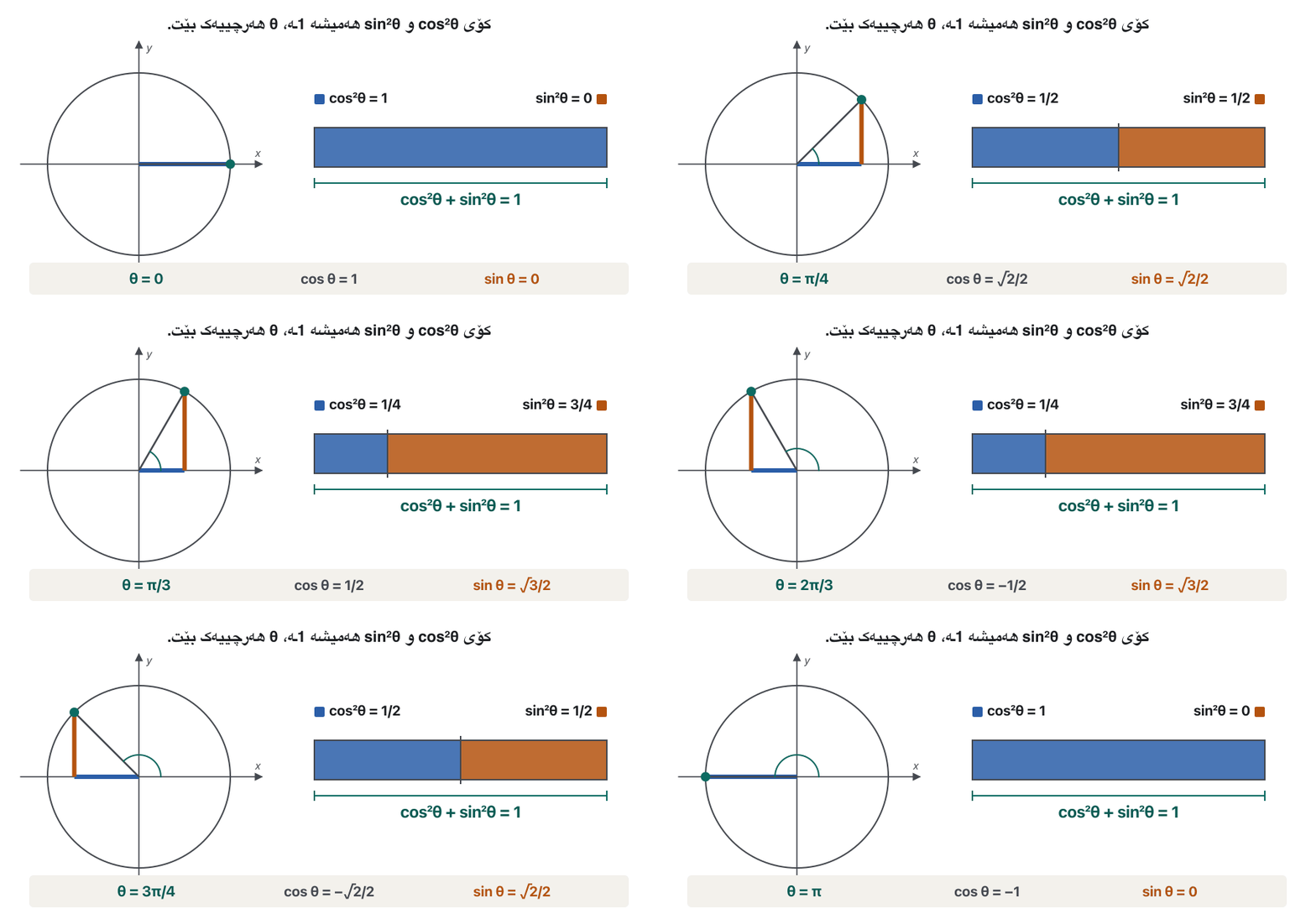
Always 1, whatever the angleهەمیشە 1، گۆشەکە هەرچییەک بێت

Watch the two squares while the angle turns from 00 to π\pi. One grows while the other shrinks, but together they always fill the same bar of length 1. Notice that after π2\frac{\pi}{2} the cosine becomes negative, and its square is still positive.

سەیری دوو دووجاکە بکە لە کاتێکدا گۆشەکە لە 00ـەوە تا π\pi دەسووڕێت. یەکێکیان گەورە دەبێت و ئەوی تر بچووک، بەڵام پێکەوە هەمیشە هەمان ستوون بە درێژیی 1 پڕ دەکەنەوە. سەرنج بدە کە دوای π2\frac{\pi}{2} سالب دەبێت، بەڵام دووجاکەی هەر موجەبە.
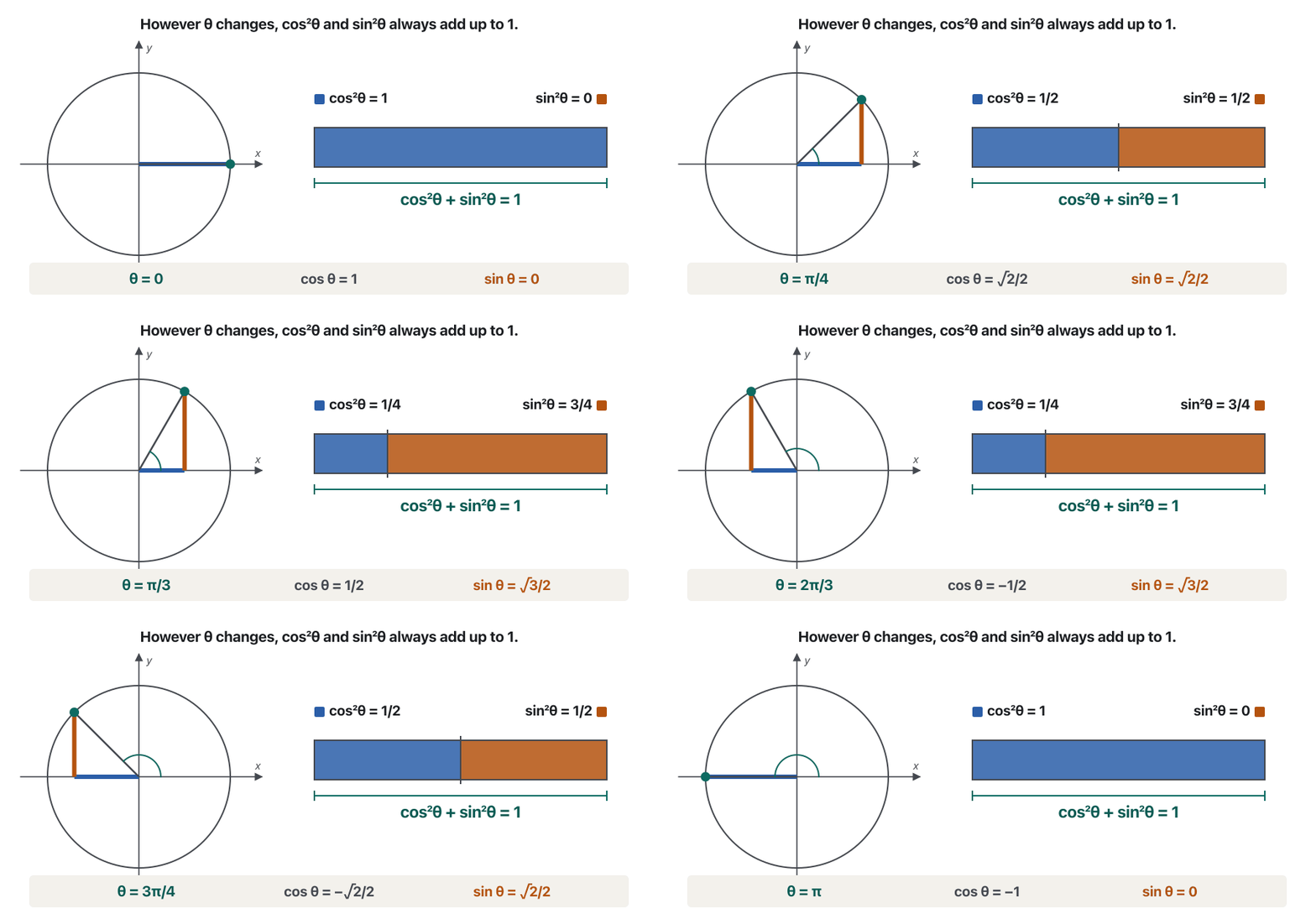
Animation in nine steps. On the left the point P moves around the upper half of the unit circle from θ = 0 to θ = π in steps of π/6 and π/4; its legs cos θ (blue) and sin θ (orange) are drawn. On the right a bar of length 1 is split into a blue part cos²θ and an orange part sin²θ: 1 and 0, 3/4 and 1/4, 1/2 and 1/2, 1/4 and 3/4, 0 and 1, then back again. Under the bar a bracket always reads cos²θ + sin²θ = 1. A line at the bottom shows θ, cos θ and sin θ; after π/2 cos θ is negative, for example −1/2 at 2π/3.
The two squares change, their sum stays 1.دوو دووجاکە دەگۆڕێن، کۆکەیان هەر 1 دەمێنێتەوە.CêIT
Quick checkپشکنینی خێراAt θ=2π3\theta=\frac{2\pi}{3}, cos⁡θ=−12\cos\theta=-\frac12. What is cos⁡2θ\cos^2\theta?لە θ=2π3\theta=\frac{2\pi}{3}، cos⁡θ=−12\cos\theta=-\frac12ـە. cos⁡2θ\cos^2\theta چەندە؟

Identity 1: the Pythagorean identityهاوئەنجامی 1: هاوئەنجامی فیساغۆرس

Identities 2 and 3 by divisionهاوئەنجامەکانی 2 و 3 بە دابەشکردن

Divide both sides of identity 1 by cos⁡2θ\cos^2\theta (allowed only where cos⁡θ≠0\cos\theta\ne0). Use sin⁡θcos⁡θ=tan⁡θ\frac{\sin\theta}{\cos\theta}=\tan\theta and 1cos⁡θ=sec⁡θ\frac{1}{\cos\theta}=\sec\theta:

هەردوو لای 1 دابەشی cos⁡2θ\cos^2\theta بکە (تەنها لەو شوێنانە ڕێگەپێدراوە کە cos⁡θ≠0\cos\theta\ne0). sin⁡θcos⁡θ=tan⁡θ\frac{\sin\theta}{\cos\theta}=\tan\theta و 1cos⁡θ=sec⁡θ\frac{1}{\cos\theta}=\sec\theta بەکار بهێنە:

cos⁡2θcos⁡2θ+sin⁡2θcos⁡2θ=1cos⁡2θ⟹1+tan⁡2θ=sec⁡2θ\frac{\cos^2\theta}{\cos^2\theta}+\frac{\sin^2\theta}{\cos^2\theta}=\frac{1}{\cos^2\theta}\quad\Longrightarrow\quad 1+\tan^2\theta=\sec^2\theta

This is identity 2. It is true wherever tan⁡θ\tan\theta and sec⁡θ\sec\theta are defined.

ئەمە 2ـە. لە هەر شوێنێک tan⁡θ\tan\theta و sec⁡θ\sec\theta پێناسە کرابن ڕاستە.

In the same way, divide identity 1 by sin⁡2θ\sin^2\theta (where sin⁡θ≠0\sin\theta\ne0), using cos⁡θsin⁡θ=cot⁡θ\frac{\cos\theta}{\sin\theta}=\cot\theta and 1sin⁡θ=csc⁡θ\frac{1}{\sin\theta}=\csc\theta:

بە هەمان شێوە، 1 دابەشی sin⁡2θ\sin^2\theta بکە (لەو شوێنانەی sin⁡θ≠0\sin\theta\ne0)، بە بەکارهێنانی cos⁡θsin⁡θ=cot⁡θ\frac{\cos\theta}{\sin\theta}=\cot\theta و 1sin⁡θ=csc⁡θ\frac{1}{\sin\theta}=\csc\theta:

cos⁡2θsin⁡2θ+sin⁡2θsin⁡2θ=1sin⁡2θ⟹cot⁡2θ+1=csc⁡2θ\frac{\cos^2\theta}{\sin^2\theta}+\frac{\sin^2\theta}{\sin^2\theta}=\frac{1}{\sin^2\theta}\quad\Longrightarrow\quad \cot^2\theta+1=\csc^2\theta

This is identity 3.

ئەمە 3ـە.

Quick checkپشکنینی خێراWhere is identity 2, sec⁡2θ=1+tan⁡2θ\sec^2\theta=1+\tan^2\theta, not meaningful? 2، واتە sec⁡2θ=1+tan⁡2θ\sec^2\theta=1+\tan^2\theta، لە کوێ بێ واتایە؟

Identities 4–6: sum and difference formulasهاوئەنجامەکانی ⁦4–6⁩: یاساکانی کۆ و جیاوازی

These formulas give the sine, cosine and tangent of a sum x+yx+y or a difference x−yx-y from the values of xx and yy. Read the signs carefully: in ±\pm and ∓\mp take the top signs together or the bottom signs together.

ئەم یاسایانە ، و کۆی x+yx+y یان جیاوازیی x−yx-y لە نرخەکانی xx و yyـەوە دەدەن. هێماکان بە وردی بخوێنەوە: لە ±\pm و ∓\mpدا یان هێماکانی سەرەوە پێکەوە وەربگرە یان هێماکانی خوارەوە پێکەوە.

cos⁡(x±y)=cos⁡xcos⁡y∓sin⁡xsin⁡ysin⁡(x±y)=sin⁡xcos⁡y±cos⁡xsin⁡ytan⁡(x±y)=tan⁡x±tan⁡y1∓tan⁡xtan⁡y\begin{aligned}\cos(x\pm y)&=\cos x\cos y\mp\sin x\sin y\\ \sin(x\pm y)&=\sin x\cos y\pm\cos x\sin y\\ \tan(x\pm y)&=\frac{\tan x\pm\tan y}{1\mp\tan x\tan y}\end{aligned}

Identities 4, 5 and 6 of the notes.

4، 5 و 6ی تێبینییەکان.

cos⁡(x+y)=cos⁡xcos⁡y−sin⁡xsin⁡ycos⁡(x−y)=cos⁡xcos⁡y+sin⁡xsin⁡ysin⁡(x+y)=sin⁡xcos⁡y+cos⁡xsin⁡ysin⁡(x−y)=sin⁡xcos⁡y−cos⁡xsin⁡y\begin{aligned}\cos(x+y)&=\cos x\cos y-\sin x\sin y & \cos(x-y)&=\cos x\cos y+\sin x\sin y\\ \sin(x+y)&=\sin x\cos y+\cos x\sin y & \sin(x-y)&=\sin x\cos y-\cos x\sin y\end{aligned}

The same four formulas written out one by one. Cosine swaps the sign; sine keeps it.

هەمان چوار یاسا یەک یەک نووسراون. هێماکە پێچەوانە دەکاتەوە؛ هێماکە دەهێڵێتەوە.

Quick checkپشکنینی خێراWhich formula is correct for cos⁡(x−y)\cos(x-y)?کام یاسا بۆ cos⁡(x−y)\cos(x-y) ڕاستە؟

Proving the angle sum identity for sine and cosineblackpenredpen · Englishئینگلیزی · 85K viewsبینین · 3.8K likesلایک

A picture proof of the formulas for sin(A+B) and cos(A+B), built from two right triangles step by step.

بە وێنە بۆ یاساکانی sin⁡(A+B)\sin(A+B) و cos⁡(A+B)\cos(A+B)، کە هەنگاو بە هەنگاو لە دوو سێگۆشەی ڕاستگۆشە دروست دەکرێت.

Where identities 4 and 5 come from; the difference formulas follow by putting −B for B.

4 و 5 لە کوێوە دێن؛ یاساکانی جیاوازی بە دانانی −B-B لە جیاتی BB دەردەچن.

Identities 4–6: sum and difference formulasهاوئەنجامەکانی ⁦4–6⁩: یاساکانی کۆ و جیاوازی

Exact values with the sum formulasنرخی ورد بە یاساکانی کۆ

The table of common angles gives exact values only at 30°, 45°, 60°, … With the sum formulas you can reach new angles such as 75∘=45∘+30∘75^\circ=45^\circ+30^\circ and 15∘=45∘−30∘15^\circ=45^\circ-30^\circ.

خشتەی گۆشە باوەکان تەنها لە ⁦30°⁩، ⁦45°⁩، ⁦60°⁩ و … نرخی ورد دەدات. بە یاساکانی کۆ دەتوانیت بگەیتە گۆشەی نوێ، وەک 75∘=45∘+30∘75^\circ=45^\circ+30^\circ و 15∘=45∘−30∘15^\circ=45^\circ-30^\circ.

  1. sin⁡75∘\sin75^\circsin⁡75∘\sin75^\circ

    Identity 5 with the top sign:

    5 بە هێمای سەرەوە:

    sin⁡75∘=sin⁡(45∘+30∘)=22⋅32+22⋅12=6+24≈0.966\sin75^\circ=\sin(45^\circ+30^\circ)=\frac{\sqrt2}{2}\cdot\frac{\sqrt3}{2}+\frac{\sqrt2}{2}\cdot\frac12=\frac{\sqrt6+\sqrt2}{4}\approx0.966
  2. cos⁡15∘\cos15^\circcos⁡15∘\cos15^\circ

    Identity 4 with the bottom sign (the cosine of a difference uses ++):

    4 بە هێمای خوارەوە ( جیاوازی ++ بەکار دەهێنێت):

    cos⁡15∘=cos⁡(45∘−30∘)=22⋅32+22⋅12=6+24\cos15^\circ=\cos(45^\circ-30^\circ)=\frac{\sqrt2}{2}\cdot\frac{\sqrt3}{2}+\frac{\sqrt2}{2}\cdot\frac12=\frac{\sqrt6+\sqrt2}{4}
  3. tan⁡15∘\tan15^\circtan⁡15∘\tan15^\circ

    Identity 6 with the bottom signs, using tan⁡45∘=1\tan45^\circ=1 and tan⁡30∘=33\tan30^\circ=\frac{\sqrt3}{3}:

    6 بە هێماکانی خوارەوە، بە بەکارهێنانی tan⁡45∘=1\tan45^\circ=1 و tan⁡30∘=33\tan30^\circ=\frac{\sqrt3}{3}:

    tan⁡15∘=1−331+33=3−33+3=2−3≈0.268\tan15^\circ=\frac{1-\frac{\sqrt3}{3}}{1+\frac{\sqrt3}{3}}=\frac{3-\sqrt3}{3+\sqrt3}=2-\sqrt3\approx0.268

Notice that sin⁡75∘=cos⁡15∘\sin75^\circ=\cos15^\circ. That is no accident: 75° and 15° add up to 90°, and sin⁡(90∘−x)=cos⁡x\sin(90^\circ-x)=\cos x (exercise 2 below).

سەرنج بدە کە sin⁡75∘=cos⁡15∘\sin75^\circ=\cos15^\circ. ئەمە ڕێکەوت نییە: کۆی ⁦75°⁩ و ⁦15°⁩ دەکاتە ⁦90°⁩ و sin⁡(90∘−x)=cos⁡x\sin(90^\circ-x)=\cos x (ڕاهێنانی 2ی خوارەوە).

Quick checkپشکنینی خێراWhich split of 105° lets you use the sum formula with known values?کام دابەشکردنی ⁦105°⁩ ڕێگە دەدات یاسای کۆ بە نرخی ناسراو بەکار بهێنیت؟

Identities 7 and 8: from a square to a double angleهاوئەنجامەکانی 7 و 8: لە دووجاوە بۆ دوو هێندەی گۆشە

Put x=y=θx=y=\theta into identity 4 (top signs). The cosine of a double angle appears:

x=y=θx=y=\theta بخە ناو 4 (هێماکانی سەرەوە). دوو هێندەی گۆشە دەردەکەوێت:

cos⁡2θ=cos⁡(θ+θ)=cos⁡2θ−sin⁡2θ\cos2\theta=\cos(\theta+\theta)=\cos^2\theta-\sin^2\theta
  1. Replace sin⁡2θ\sin^2\theta by 1−cos⁡2θ1-\cos^2\theta (identity 1): cos⁡2θ=2cos⁡2θ−1\cos2\theta=2\cos^2\theta-1. Solve for cos⁡2θ\cos^2\theta:

    لە جیاتی sin⁡2θ\sin^2\theta بنووسە 1−cos⁡2θ1-\cos^2\theta ( ⁦1⁩): cos⁡2θ=2cos⁡2θ−1\cos2\theta=2\cos^2\theta-1. cos⁡2θ\cos^2\theta بدۆزەرەوە:

    cos⁡2θ=12(1+cos⁡2θ)\cos^2\theta=\tfrac12\left(1+\cos2\theta\right)

    This is identity 7.

    ئەمە 7ـە.

  2. Replace cos⁡2θ\cos^2\theta by 1−sin⁡2θ1-\sin^2\theta instead: cos⁡2θ=1−2sin⁡2θ\cos2\theta=1-2\sin^2\theta. Solve for sin⁡2θ\sin^2\theta:

    ئەم جارە لە جیاتی cos⁡2θ\cos^2\theta بنووسە 1−sin⁡2θ1-\sin^2\theta: cos⁡2θ=1−2sin⁡2θ\cos2\theta=1-2\sin^2\theta. sin⁡2θ\sin^2\theta بدۆزەرەوە:

    sin⁡2θ=12(1−cos⁡2θ)\sin^2\theta=\tfrac12\left(1-\cos2\theta\right)

    This is identity 8.

    ئەمە 8ـە.

Identities 7 and 8 trade a square for a double angle. That is exactly the move you need in example a below. The same trick with identity 5 gives the double-angle formula for sine: sin⁡2θ=2sin⁡θcos⁡θ\sin2\theta=2\sin\theta\cos\theta.

7 و 8 دووجا بە دوو هێندەی گۆشە دەگۆڕنەوە. ئەمە ڕێک ئەو هەنگاوەیە کە لە نموونەی aی خوارەوەدا پێویستە. هەمان ڕێگا لەگەڵ 5 یاسای دوو هێندەی گۆشە بۆ دەدات: sin⁡2θ=2sin⁡θcos⁡θ\sin2\theta=2\sin\theta\cos\theta.

cos⁡2π8=12(1+cos⁡π4)=12(1+22)=2+24\cos^2\frac{\pi}{8}=\frac12\left(1+\cos\frac{\pi}{4}\right)=\frac12\left(1+\frac{\sqrt2}{2}\right)=\frac{2+\sqrt2}{4}

Example: an exact value for an angle that is not in the table.

نموونە: نرخێکی ورد بۆ گۆشەیەک کە لە خشتەکەدا نییە.

Identity 7 also tells you what the graph of cos⁡2θ=12+12cos⁡2θ\cos^2\theta=\frac12+\frac12\cos2\theta looks like: the cosine wave compressed horizontally by 2 (period π\pi), squashed vertically to half its height and moved up by 12\frac12. So it stays between 0 and 1, as a square of a cosine must.

7 هەروەها پیشان دەدات هێڵکاریی cos⁡2θ=12+12cos⁡2θ\cos^2\theta=\frac12+\frac12\cos2\theta چۆنە: شەپۆلی کە بە ئاسۆیی بە 2 پەستێنراوە ( π\pi)، بە ستوونی بۆ نیوەی بەرزییەکەی پەستێنراوە و 12\frac12 بەرەو سەرەوە کشاوە. بۆیە لە نێوان 0 و 1دا دەمێنێتەوە، وەک چۆن دووجای دەبێت وابێت.

Quick checkپشکنینی خێراWhich expression equals sin⁡2θ\sin^2\theta?کام یەکسانە بە sin⁡2θ\sin^2\theta؟

Example b: sin⁡(x+π)=−sin⁡x\sin(x+\pi)=-\sin xنموونەی b: sin⁡(x+π)=−sin⁡x\sin(x+\pi)=-\sin x

The notes prove this in one line with identity 5. Here is the line with the middle step shown:

تێبینییەکان ئەمە بە یەک دێڕ و بە 5 دەسەلمێنن. ئەمە هەمان دێڕە لەگەڵ هەنگاوی ناوەڕاست:

sin⁡(x+π)=sin⁡xcos⁡π+cos⁡xsin⁡π=sin⁡x⋅(−1)+cos⁡x⋅0=−sin⁡x\sin(x+\pi)=\sin x\cos\pi+\cos x\sin\pi=\sin x\cdot(-1)+\cos x\cdot0=-\sin x

We used cos⁡π=−1\cos\pi=-1 and sin⁡π=0\sin\pi=0.

cos⁡π=−1\cos\pi=-1 و sin⁡π=0\sin\pi=0مان بەکار هێنا.

The unit circle with the point P(cos x, sin x) at angle x and, half a turn further along an arrow marked +π, the opposite point Q(−cos x, −sin x) at the other end of a diameter. A side box lists sin(x + π) = −sin x, cos(x + π) = −cos x and tan(x + π) = tan x: both signs change, the ratio stays.بازنەی یەکە لەگەڵ خاڵی P(cos x, sin x) لە گۆشەی x و، نیو سووڕانەوە دواتر بە درێژایی تیرێکی +π، خاڵی بەرامبەری Q(−cos x, −sin x) لە سەری تری تیرەکە. چوارگۆشەیەکی تەنیشت دەنووسێت sin(x + π) = −sin x، cos(x + π) = −cos x و tan(x + π) = tan x: هەردوو هێما دەگۆڕێن، ڕێژەکە دەمێنێت.
Adding π\pi sends PP to the opposite point of the circle.زیادکردنی π\pi خاڵی PP دەباتە خاڵی بەرامبەری بازنەکە.CêIT

The picture explains the result without any formula: half a turn takes PP to the opposite point, so both coordinates change sign. The y-coordinate is the sine, so sin⁡(x+π)=−sin⁡x\sin(x+\pi)=-\sin x. On the graph, adding π\pi inside moves the sine wave π\pi to the left, and the result is the same wave flipped in the x-axis.

وێنەکە بەبێ هیچ یاسایەک ئەنجامەکە ڕوون دەکاتەوە: نیو سووڕانەوە PP دەباتە خاڵی بەرامبەر، بۆیە هێمای هەردوو دەگۆڕێت. y هەمان ، بۆیە sin⁡(x+π)=−sin⁡x\sin(x+\pi)=-\sin x. لەسەر هێڵکاری، زیادکردنی π\pi لە ناوەوە شەپۆلی ساین π\pi بەرەو چەپ دەکشێنێت و ئەنجامەکە هەمان شەپۆلە کە بەرامبەر تەوەرەی x هەڵگەڕاوەتەوە.

Quick checkپشکنینی خێراWhat is cos⁡(x+π)\cos(x+\pi)?cos⁡(x+π)\cos(x+\pi) چەندە؟

Example a (homework): a square root and an absolute valueنموونەی a (ئەرکی ماڵەوە): ڕەگێکی دووجا و نرخێکی ڕووت

The notes leave this proof as homework. Try it yourself before you open the answer. The key facts are identity 1, identity 7 with θ=x2\theta=\frac x2, and u2=∣u∣\sqrt{u^2}=|u| from absolute value.

تێبینییەکان ئەم وەک ئەرکی ماڵەوە جێدەهێڵن. پێش کردنەوەی وەڵامەکە خۆت هەوڵ بدە. ڕاستییە سەرەکییەکان: 1، 7 بە θ=x2\theta=\frac x2 و u2=∣u∣\sqrt{u^2}=|u| لە وانەی نرخی ڕووت.

ExerciseڕاهێنانProve the identityهاوئەنجامەکە بسەلمێنە

Prove that (1+cos⁡x)2+sin⁡2x=2∣cos⁡x2∣\sqrt{(1+\cos x)^2+\sin^2x}=2\left|\cos\frac{x}{2}\right| for every real xx.

بیسەلمێنە کە (1+cos⁡x)2+sin⁡2x=2∣cos⁡x2∣\sqrt{(1+\cos x)^2+\sin^2x}=2\left|\cos\frac{x}{2}\right| بۆ هەموو xxێکی ڕاستی.

Hintئاماژە

Expand (1+cos⁡x)2(1+\cos x)^2, use cos⁡2x+sin⁡2x=1\cos^2x+\sin^2x=1, then identity 7 with θ=x2\theta=\frac{x}{2}.

(1+cos⁡x)2(1+\cos x)^2 بکەرەوە، cos⁡2x+sin⁡2x=1\cos^2x+\sin^2x=1 بەکار بهێنە، پاشان 7 بە θ=x2\theta=\frac{x}{2}.

Show answerوەڵامەکە پیشان بدە
  1. Expand the square and group cos⁡2x+sin⁡2x\cos^2x+\sin^2x, which is 1 (identity 1):

    دووجاکە بکەرەوە و cos⁡2x+sin⁡2x\cos^2x+\sin^2x کۆ بکەرەوە، کە 1ـە ( ⁦1⁩):

    (1+cos⁡x)2+sin⁡2x=1+2cos⁡x+cos⁡2x+sin⁡2x=2+2cos⁡x=2(1+cos⁡x)(1+\cos x)^2+\sin^2x=1+2\cos x+\cos^2x+\sin^2x=2+2\cos x=2(1+\cos x)
  2. Identity 7 with θ=x2\theta=\frac x2 says 1+cos⁡x=2cos⁡2x21+\cos x=2\cos^2\frac x2. So:

    7 بە θ=x2\theta=\frac x2 دەڵێت 1+cos⁡x=2cos⁡2x21+\cos x=2\cos^2\frac x2. کەواتە:

    2(1+cos⁡x)=4cos⁡2x22(1+\cos x)=4\cos^2\frac x2
  3. Take the square root. Because u2=∣u∣\sqrt{u^2}=|u|, the absolute value appears:

    وەربگرە. لەبەر ئەوەی u2=∣u∣\sqrt{u^2}=|u|، دەردەکەوێت:

    (1+cos⁡x)2+sin⁡2x=4cos⁡2x2=(2cos⁡x2)2=2∣cos⁡x2∣■\sqrt{(1+\cos x)^2+\sin^2x}=\sqrt{4\cos^2\frac x2}=\sqrt{\left(2\cos\frac x2\right)^2}=2\left|\cos\frac x2\right|\qquad\blacksquare
Quick checkپشکنینی خێراIn the last step, why does 4cos⁡2x2\sqrt{4\cos^2\frac x2} become 2∣cos⁡x2∣2\left|\cos\frac x2\right| and not 2cos⁡x22\cos\frac x2?لە دوایین هەنگاودا بۆچی 4cos⁡2x2\sqrt{4\cos^2\frac x2} دەبێتە 2∣cos⁡x2∣2\left|\cos\frac x2\right| نەک 2cos⁡x22\cos\frac x2؟

How to prove an identityچۆن هاوئەنجامێک دەسەلمێنرێت

A strategy that worksڕێگایەک کە کار دەکات
  1. Start from the more complicated side and work towards the other side. Do not treat the identity as already true by doing the same thing to both sides.

    لە لایە ئاڵۆزترەکەوە دەست پێبکە و بەرەو لاکەی تر بڕۆ. وەک شتێکی پێشتر سەلمێنراو مەبینە بە کردنی هەمان کار لەسەر هەردوو لا.

  2. If you are stuck, rewrite everything with sin⁡\sin and cos⁡\cos (tan⁡=sin⁡cos⁡\tan=\frac{\sin}{\cos}, sec⁡=1cos⁡\sec=\frac{1}{\cos}, …).

    ئەگەر گیرت خوارد، هەموو شتێک بە sin⁡\sin و cos⁡\cos بنووسەرەوە (tan⁡=sin⁡cos⁡\tan=\frac{\sin}{\cos}، sec⁡=1cos⁡\sec=\frac{1}{\cos}، …).

  3. Look for cos⁡2θ+sin⁡2θ\cos^2\theta+\sin^2\theta hiding inside an expression and replace it by 1. Look for a square next to a double angle (identities 7 and 8).

    بەدوای cos⁡2θ+sin⁡2θ\cos^2\theta+\sin^2\theta بگەڕێ کە لە ناو شاراوەتەوە و لە جیاتی بنووسە 1. بەدوای دووجایەک بگەڕێ لە تەنیشت دوو هێندەی گۆشەیەک ( 7 و ⁦8⁩).

  4. Expand brackets, put fractions over one denominator, and factor.

    کەوانەکان بکەرەوە، بخە سەر یەک و بەکار بهێنە.

  5. Check your result with one or two angles (for example θ=π3\theta=\frac{\pi}{3}). One check does not prove an identity, but one failed check proves it is false.

    ئەنجامەکەت بە یەک یان دوو گۆشە بپشکنە (بۆ نموونە θ=π3\theta=\frac{\pi}{3}). یەک پشکنین ناسەلمێنێت، بەڵام یەک پشکنینی شکستخواردوو دەیسەلمێنێت کە هەڵەیە.

Quick checkپشکنینی خێراYou test sin⁡2θ=2sin⁡θ\sin2\theta=2\sin\theta with θ=π6\theta=\frac{\pi}{6}: the left side is 32\frac{\sqrt3}{2}, the right side is 1. What does this show?sin⁡2θ=2sin⁡θ\sin2\theta=2\sin\theta بە θ=π6\theta=\frac{\pi}{6} تاقی دەکەیتەوە: لای چەپ 32\frac{\sqrt3}{2}ـە و لای ڕاست 1. ئەمە چی پیشان دەدات؟

How to Prove Trigonometric Identities (and how not to)Eddie Woo · Englishئینگلیزی · 204K viewsبینین · 3.6K likesلایک

How to prove an identity: start from one side and work to the other, and why treating it as an equation is wrong.

چۆن دەسەلمێنیت: لە لایەکەوە دەست پێ بکە و بگەرە لاکەی تر، هەروەها بۆچی مامەڵەکردن لەگەڵی وەک هەڵەیە.

Classroom lesson: the same strategy as this screen, with a wrong proof shown as a warning.

وانەیەکی ناو پۆل: هەمان ڕێگای ئەم شاشەیە، لەگەڵ هەڵە کە وەک ئاگادارکردنەوە پیشان دەدرێت.

Common mistakesهەڵە باوەکان

MistakeهەڵەCounterexampleنموونەی پێچەوانەCorrectڕاست
sin⁡(x+y)=sin⁡x+sin⁡y\sin(x+y)=\sin x+\sin ysin⁡(x+y)=sin⁡x+sin⁡y\sin(x+y)=\sin x+\sin yx=y=π2x=y=\frac{\pi}{2}: sin⁡π=0\sin\pi=0 but 1+1=21+1=2x=y=π2x=y=\frac{\pi}{2}: sin⁡π=0\sin\pi=0 بەڵام 1+1=21+1=2Identity 5 5
sin⁡2θ=2sin⁡θ\sin2\theta=2\sin\thetasin⁡2θ=2sin⁡θ\sin2\theta=2\sin\thetaθ=π6\theta=\frac{\pi}{6}: 32≠1\frac{\sqrt3}{2}\ne1θ=π6\theta=\frac{\pi}{6}: 32≠1\frac{\sqrt3}{2}\ne1sin⁡2θ=2sin⁡θcos⁡θ\sin2\theta=2\sin\theta\cos\thetasin⁡2θ=2sin⁡θcos⁡θ\sin2\theta=2\sin\theta\cos\theta
cos⁡(x+y)=cos⁡xcos⁡y+sin⁡xsin⁡y\cos(x+y)=\cos x\cos y+\sin x\sin ycos⁡(x+y)=cos⁡xcos⁡y+sin⁡xsin⁡y\cos(x+y)=\cos x\cos y+\sin x\sin yx=y=π2x=y=\frac{\pi}{2}: cos⁡π=−1\cos\pi=-1 but the right side is 1x=y=π2x=y=\frac{\pi}{2}: cos⁡π=−1\cos\pi=-1 بەڵام لای ڕاست 1ـەCosine of a sum has a minus کۆ نیشانەی کەمکردنەوەی هەیە
u2=u\sqrt{u^2}=uu2=u\sqrt{u^2}=uu=−3u=-3: 9=3≠−3\sqrt9=3\ne-3u=−3u=-3: 9=3≠−3\sqrt9=3\ne-3u2=∣u∣\sqrt{u^2}=|u|u2=∣u∣\sqrt{u^2}=|u|
cos⁡2θ=cos⁡(θ2)\cos^2\theta=\cos(\theta^2)cos⁡2θ=cos⁡(θ2)\cos^2\theta=\cos(\theta^2)The square belongs to the value of cos⁡θ\cos\thetaدووجاکە هی نرخی cos⁡θ\cos\thetaـەcos⁡2θ=(cos⁡θ)2\cos^2\theta=(\cos\theta)^2cos⁡2θ=(cos⁡θ)2\cos^2\theta=(\cos\theta)^2
Using identity 2 at θ=π2\theta=\frac{\pi}{2}بەکارهێنانی 2 لە θ=π2\theta=\frac{\pi}{2}We divided by cos⁡2θ\cos^2\theta, which is 0 thereدابەشمان کرد بەسەر cos⁡2θ\cos^2\theta کە لەوێ 0ـەIdentities 2 and 6 hold only where every term is defined 2 و 6 تەنها لەو شوێنانە ڕاستن کە هەموو بڕەکان پێناسە کرابن

Exercisesڕاهێنانەکان

Exerciseڕاهێنان1. Half a turn for cosine1. نیو سووڕانەوە بۆ کۆساین

Prove that cos⁡(x+π)=−cos⁡x\cos(x+\pi)=-\cos x.

بیسەلمێنە کە cos⁡(x+π)=−cos⁡x\cos(x+\pi)=-\cos x.

Show answerوەڵامەکە پیشان بدە
cos⁡(x+π)=cos⁡xcos⁡π−sin⁡xsin⁡π=cos⁡x⋅(−1)−sin⁡x⋅0=−cos⁡x\cos(x+\pi)=\cos x\cos\pi-\sin x\sin\pi=\cos x\cdot(-1)-\sin x\cdot0=-\cos x
Exerciseڕاهێنان2. Angles that add up to π2\frac{\pi}{2}2. دوو گۆشە کە کۆیان π2\frac{\pi}{2}ـە

Prove that sin⁡(π2−x)=cos⁡x\sin\left(\frac{\pi}{2}-x\right)=\cos x.

بیسەلمێنە کە sin⁡(π2−x)=cos⁡x\sin\left(\frac{\pi}{2}-x\right)=\cos x.

Hintئاماژە

Identity 5 with the bottom sign.

5 بە هێمای خوارەوە.

Show answerوەڵامەکە پیشان بدە
sin⁡(π2−x)=sin⁡π2cos⁡x−cos⁡π2sin⁡x=1⋅cos⁡x−0⋅sin⁡x=cos⁡x\sin\left(\tfrac{\pi}{2}-x\right)=\sin\tfrac{\pi}{2}\cos x-\cos\tfrac{\pi}{2}\sin x=1\cdot\cos x-0\cdot\sin x=\cos x
Exerciseڕاهێنان3. A square that hides a double angle3. دووجایەک کە دوو هێندەی گۆشەی تێدا شاراوەتەوە

Prove that (sin⁡x+cos⁡x)2=1+sin⁡2x(\sin x+\cos x)^2=1+\sin2x.

بیسەلمێنە کە (sin⁡x+cos⁡x)2=1+sin⁡2x(\sin x+\cos x)^2=1+\sin2x.

Show answerوەڵامەکە پیشان بدە
(sin⁡x+cos⁡x)2=sin⁡2x+2sin⁡xcos⁡x+cos⁡2x=1+2sin⁡xcos⁡x=1+sin⁡2x(\sin x+\cos x)^2=\sin^2x+2\sin x\cos x+\cos^2x=1+2\sin x\cos x=1+\sin2x
Exerciseڕاهێنان4. Difference of fourth powers4. جیاوازیی توانی چوار

Prove that cos⁡4x−sin⁡4x=cos⁡2x\cos^4x-\sin^4x=\cos2x.

بیسەلمێنە کە cos⁡4x−sin⁡4x=cos⁡2x\cos^4x-\sin^4x=\cos2x.

Hintئاماژە

Factor: a4−b4=(a2−b2)(a2+b2)a^4-b^4=(a^2-b^2)(a^2+b^2).

بەکار بهێنە: a4−b4=(a2−b2)(a2+b2)a^4-b^4=(a^2-b^2)(a^2+b^2).

Show answerوەڵامەکە پیشان بدە
cos⁡4x−sin⁡4x=(cos⁡2x−sin⁡2x)(cos⁡2x+sin⁡2x)=(cos⁡2x−sin⁡2x)⋅1=cos⁡2x\cos^4x-\sin^4x=(\cos^2x-\sin^2x)(\cos^2x+\sin^2x)=(\cos^2x-\sin^2x)\cdot1=\cos2x
Exerciseڕاهێنان5. Everything in sin⁡\sin and cos⁡\cos5. هەموو شتێک بە sin⁡\sin و cos⁡\cos

Prove that tan⁡x+cot⁡x=sec⁡xcsc⁡x\tan x+\cot x=\sec x\csc x (where all are defined).

بیسەلمێنە کە tan⁡x+cot⁡x=sec⁡xcsc⁡x\tan x+\cot x=\sec x\csc x (لەو شوێنانەی هەموویان پێناسە کراون).

Show answerوەڵامەکە پیشان بدە
tan⁡x+cot⁡x=sin⁡xcos⁡x+cos⁡xsin⁡x=sin⁡2x+cos⁡2xsin⁡xcos⁡x=1sin⁡xcos⁡x=sec⁡x⋅csc⁡x\tan x+\cot x=\frac{\sin x}{\cos x}+\frac{\cos x}{\sin x}=\frac{\sin^2x+\cos^2x}{\sin x\cos x}=\frac{1}{\sin x\cos x}=\sec x\cdot\csc x
Exerciseڕاهێنان6. Exact values6. نرخی ورد

Find cos⁡75∘\cos75^\circ exactly with a sum formula, and sin⁡2π12\sin^2\frac{\pi}{12} with identity 8.

cos⁡75∘\cos75^\circ بە یاسای کۆ و sin⁡2π12\sin^2\frac{\pi}{12} بە 8 بە وردی بدۆزەرەوە.

Show answerوەڵامەکە پیشان بدە
cos⁡75∘=cos⁡45∘cos⁡30∘−sin⁡45∘sin⁡30∘=64−24=6−24≈0.259sin⁡2π12=12(1−cos⁡π6)=12(1−32)=2−34\begin{aligned}\cos75^\circ&=\cos45^\circ\cos30^\circ-\sin45^\circ\sin30^\circ=\frac{\sqrt6}{4}-\frac{\sqrt2}{4}=\frac{\sqrt6-\sqrt2}{4}\approx0.259\\ \sin^2\frac{\pi}{12}&=\frac12\left(1-\cos\frac{\pi}{6}\right)=\frac12\left(1-\frac{\sqrt3}{2}\right)=\frac{2-\sqrt3}{4}\end{aligned}
Exerciseڕاهێنان7. Spot the mistake7. هەڵەکە بدۆزەرەوە

Dilan writes the homework answer as (1+cos⁡x)2+sin⁡2x=2cos⁡x2\sqrt{(1+\cos x)^2+\sin^2x}=2\cos\frac{x}{2}. Find one value of xx that shows the answer is wrong, and fix it.

دیلان وەڵامی ئەرکی ماڵەوەکە بەم شێوەیە دەنووسێت: (1+cos⁡x)2+sin⁡2x=2cos⁡x2\sqrt{(1+\cos x)^2+\sin^2x}=2\cos\frac{x}{2}. نرخێکی xx بدۆزەرەوە کە پیشان بدات وەڵامەکە هەڵەیە و ڕاستی بکەرەوە.

Show answerوەڵامەکە پیشان بدە

Take x=2πx=2\pi: the left side is (1+1)2+0=2\sqrt{(1+1)^2+0}=2, but 2cos⁡π=−22\cos\pi=-2. The square root of 4cos⁡2x24\cos^2\frac x2 is 2∣cos⁡x2∣2\left|\cos\frac x2\right|, not 2cos⁡x22\cos\frac x2.

x=2πx=2\pi وەربگرە: لای چەپ (1+1)2+0=2\sqrt{(1+1)^2+0}=2ـە، بەڵام 2cos⁡π=−22\cos\pi=-2. 4cos⁡2x24\cos^2\frac x2 دەکاتە 2∣cos⁡x2∣2\left|\cos\frac x2\right|، نەک 2cos⁡x22\cos\frac x2.

Summaryپوختە

  • An identity is true for every value where both sides are defined; an equation may be true only for some values.
  • Identity 1 is Pythagoras on the unit circle; dividing it by cos⁡2θ\cos^2\theta or sin⁡2θ\sin^2\theta gives identities 2 and 3.
  • Identities 4–6 give sin⁡\sin, cos⁡\cos and tan⁡\tan of x±yx\pm y; read the top signs together and the bottom signs together.
  • Identities 7 and 8 come from cos⁡2θ=cos⁡2θ−sin⁡2θ\cos2\theta=\cos^2\theta-\sin^2\theta and identity 1; they turn a square into a double angle.
  • u2=∣u∣\sqrt{u^2}=|u|: that is why example a ends with 2∣cos⁡x2∣2\left|\cos\frac{x}{2}\right|.
  • بۆ هەموو ئەو نرخانە ڕاستە کە هەردوو لا تێیاندا پێناسە کراون؛ لەوانەیە تەنها بۆ هەندێک نرخ ڕاست بێت.
  • 1 هەمان فیساغۆرسە لەسەر ؛ دابەشکردنی بەسەر cos⁡2θ\cos^2\theta یان sin⁡2θ\sin^2\theta 2 و 3 دەدات.
  • ⁦4–6⁩ sin⁡\sin، cos⁡\cos و tan⁡\tanـی x±yx\pm y دەدەن؛ هێماکانی سەرەوە پێکەوە و هێماکانی خوارەوە پێکەوە بخوێنەوە.
  • 7 و 8 لە cos⁡2θ=cos⁡2θ−sin⁡2θ\cos2\theta=\cos^2\theta-\sin^2\theta و 1ـەوە دێن؛ دووجا دەکەنە دوو هێندەی گۆشە.
  • u2=∣u∣\sqrt{u^2}=|u|: بۆیە نموونەی a بە 2∣cos⁡x2∣2\left|\cos\frac{x}{2}\right| کۆتایی دێت.
Review questionsپرسیارەکانی پێداچوونەوە
How do you get identity 3 from identity 1?چۆن هاوئەنجامی 3 لە هاوئەنجامی 1ـەوە دەردەهێنیت؟

Divide cos⁡2θ+sin⁡2θ=1\cos^2\theta+\sin^2\theta=1 by sin⁡2θ\sin^2\theta (where sin⁡θ≠0\sin\theta\ne0): cot⁡2θ+1=csc⁡2θ\cot^2\theta+1=\csc^2\theta.

cos⁡2θ+sin⁡2θ=1\cos^2\theta+\sin^2\theta=1 دابەشی sin⁡2θ\sin^2\theta بکە (لەو شوێنانەی sin⁡θ≠0\sin\theta\ne0): cot⁡2θ+1=csc⁡2θ\cot^2\theta+1=\csc^2\theta.

What is sin⁡(x+π)\sin(x+\pi)?sin⁡(x+π)\sin(x+\pi) چەندە؟

−sin⁡x-\sin x: half a turn sends the point to the opposite side of the circle.

−sin⁡x-\sin x: نیو سووڕانەوە خاڵەکە دەباتە لای بەرامبەری بازنەکە.

Is sin⁡(x+y)=sin⁡x+sin⁡y\sin(x+y)=\sin x+\sin y an identity?ئایا sin⁡(x+y)=sin⁡x+sin⁡y\sin(x+y)=\sin x+\sin y هاوئەنجامە؟

No. x=y=π2x=y=\frac{\pi}{2} gives 0 on the left and 2 on the right.

نەخێر. x=y=π2x=y=\frac{\pi}{2} لە لای چەپ 0 و لە لای ڕاست 2 دەدات.

Videoڤیدیۆ

Watch a videoسەیری ڤیدیۆیەک بکە

A video that viewers liked a lot and praised in their comments, chosen for this lesson.ڤیدیۆیەک کە بینەران زۆریان پێ خۆش بووە و لە کۆمێنتەکانیاندا ستایشیان کردووە، بۆ ئەم وانەیە هەڵبژێردراوە.

هاوئەنجامە سێگۆشەییەکانBryar Ali · Kurdish (Sorani)کوردی (سۆرانی) · 16K viewsبینین · 879 likesلایک

In Kurdish: tan = sin/cos, sin²x + cos²x = 1, the double-angle formulas and sin²x, cos²x written with cos 2x.

بە کوردی: tan⁡x=sin⁡xcos⁡x\tan x = \frac{\sin x}{\cos x}، sin⁡2x+cos⁡2x=1\sin^2 x + \cos^2 x = 1، شێوەکانی دوو هێندەی گۆشە، هەروەها نووسینی sin⁡2x\sin^2 x و cos⁡2x\cos^2 x بە cos⁡2x\cos 2x.

Sorani school lesson on trigonometric identities (هاوئەنجامە سێگۆشەییەکان), about 9 minutes.

وانەیەکی قوتابخانە بە سۆرانی دەربارەی ، نزیکەی 9 خولەک.

Lesson complete!وانەکە تەواو بوو!

Well done. Review the key terms, then go on to the next lesson.دەستخۆش. سەیرێکی زاراوە سەرەکییەکان بکەرەوە، پاشان بڕۆ بۆ وانەی داهاتوو.

Key termsزاراوە سەرەکییەکان

Next lessonوانەی داهاتوو

Inverse Functions and Inverse Trigonometric Functionsپێچەوانەکانی نەخشە و نەخشە سێگۆشەییە پێچەوانەکان

References and further readingسەرچاوەکان و خوێندنەوەی زیاتر

This lecture is a first edition. The Kurdish text and terminology are waiting for review by Kurdish IT teachers.ئەم وانەیە چاپی یەکەمە. دەقە کوردییەکە و زاراوەکانی چاوەڕێی پێداچوونەوەی مامۆستایانی کوردی بواری IT ن.